Emerging Communication Protocols and
Technologies for the Internet of Things Domain
Jiri Hosek, Ph.D.
Youth School-Seminar, DCCN 2016
RUDN University, Moscow, November 24, 2016
*These slides are intended for educational purposes and include material
published by WISLAB group as well as available openly on the Internet.
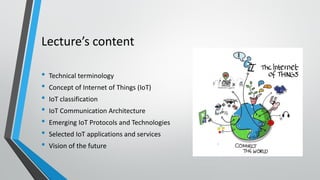
Lecture’s content
• Technical terminology
• Concept of Internet of Things (IoT)
• IoT classification
• IoT Communication Architecture
• Emerging IoT Protocols and Technologies
• Selected IoT applications and services
• Vision of the future
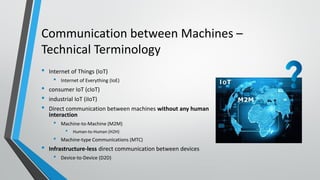
Communication between Machines –
Technical Terminology
• Internet of Things (IoT)
• Internet of Everything (IoE)
• consumer IoT (cIoT)
• industrial IoT (iIoT)
• Direct communication between machines without any human
interaction
• Machine-to-Machine (M2M)
• Human-to-Human (H2H)
• Machine-type Communications (MTC)
• Infrastructure-less direct communication between devices
• Device-to-Device (D2D)
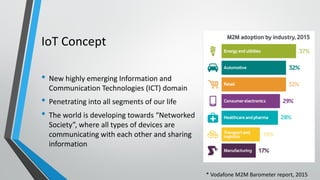
IoT Concept
• New highly emerging Information and
Communication Technologies (ICT) domain
• Penetrating into all segments of our life
• The world is developing towards “Networked
Society”, where all types of devices are
communicating with each other and sharing
information
* Vodafone M2M Barometer report, 2015
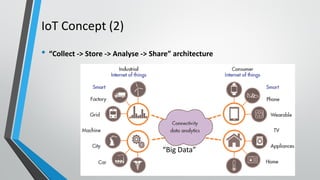
IoT Concept (2)
“Big Data”
• “Collect -> Store -> Analyse -> Share” architecture
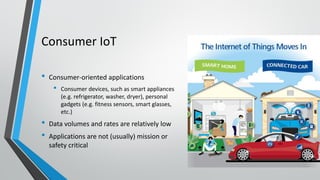
Consumer IoT
• Consumer-oriented applications
• Consumer devices, such as smart appliances
(e.g. refrigerator, washer, dryer), personal
gadgets (e.g. fitness sensors, smart glasses,
etc.)
• Data volumes and rates are relatively low
• Applications are not (usually) mission or
safety critical
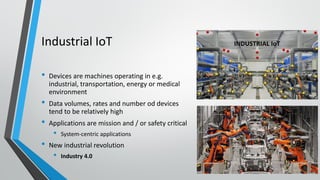
Industrial IoT
• Devices are machines operating in e.g.
industrial, transportation, energy or medical
environment
• Data volumes, rates and number od devices
tend to be relatively high
• Applications are mission and / or safety critical
• System-centric applications
• New industrial revolution
• Industry 4.0
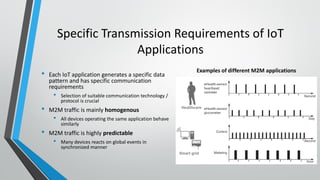
Specific Transmission Requirements of IoT
Applications
• Each IoT application generates a specific data
pattern and has specific communication
requirements
• Selection of suitable communication technology /
protocol is crucial
• M2M traffic is mainly homogenous
• All devices operating the same application behave
similarly
• M2M traffic is highly predictable
• Many devices reacts on global events in
synchronized manner
Examples of different M2M applications
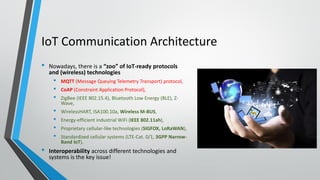
IoT Communication Architecture
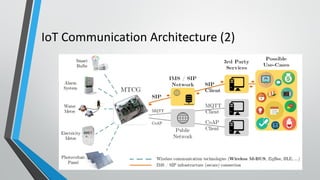
• Nowadays, there is a “zoo” of IoT-ready protocols
and (wireless) technologies
• MQTT (Message Queuing Telemetry Transport) protocol,
• CoAP (Constraint Application Protocol),
• ZigBee (IEEE 802.15.4), Bluetooth Low Energy (BLE), Z-
Wave,
• WirelessHART, ISA100.10a, Wireless M-BUS,
• Energy-efficient industrial WiFi (IEEE 802.11ah),
• Proprietary cellular-like technologies (SIGFOX, LoRaWAN),
• Standardized cellular systems (LTE-Cat. 0/1, 3GPP Narrow-
Band IoT).
• Interoperability across different technologies and
systems is the key issue!
IoT Communication Architecture (2)
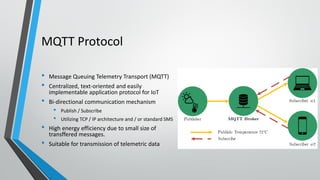
MQTT Protocol
• Message Queuing Telemetry Transport (MQTT)
• Centralized, text-oriented and easily
implementable application protocol for IoT
• Bi-directional communication mechanism
• Publish / Subscribe
• Utilizing TCP / IP architecture and / or standard SMS
• High energy efficiency due to small size of
transffered messages.
• Suitable for transmission of telemetric data
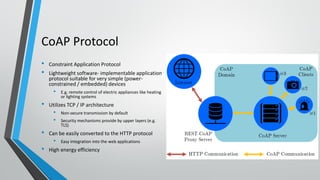
CoAP Protocol
• Constraint Application Protocol
• Lightweight software- implementable application
protocol suitable for very simple (power-
constrained / embedded) devices
• E.g. remote control of electric appliances like heating
or lighting systems
• Utilizes TCP / IP architecture
• Non-secure transmission by default
• Security mechanisms provide by upper layers (e.g.
TLS)
• Can be easily converted to the HTTP protocol
• Easy integration into the web applications
• High energy efficiency
Wireless M-BUS Technology
• Wireless alternative of two-wire bus technology
(M-BUS)
• Data transmission and control in the area of
measurements and regulation of heating systems,
gas / water pipes, electricity grid, etc.
• Unlicensed band 169 / 433 / 868 MHz
• Application in smart metering systems
(Smart Grid)
• Including standardized format of
communication between all devices in
utilities sector (DLMS / COSEM)
• Modelling of transmission reliability
for specific environment
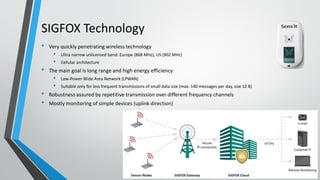
SIGFOX Technology
• Very quickly penetrating wireless technology
• Ultra narrow unlicensed band: Europe (868 MHz), US (902 MHz)
• Cellular architecture
• The main goal is long range and high energy efficiency
• Low-Power Wide Area Network (LPWAN)
• Suitable only for less frequent transmissions of small data size (max. 140 messages per day, size 12 B)
• Robustness assured by repetitive transmission over different frequency channels
• Mostly monitoring of simple devices (uplink direction)
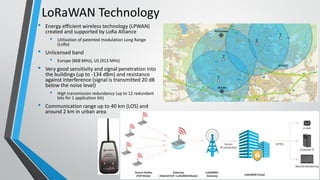
LoRaWAN Technology
• Energy efficient wireless technology (LPWAN)
created and supported by LoRa Alliance
• Utilization of patented modulation Long Range
(LoRa)
• Unlicensed band
• Europe (868 MHz), US (913 MHz)
• Very good sensitivity and signal penetration into
the buildings (up to -134 dBm) and resistance
against interference (signal is transmitted 20 dB
below the noise level)
• High transmission redundancy (up to 12 redundant
bits for 1 application bit)
• Communication range up to 40 km (LOS) and
around 2 km in urban area
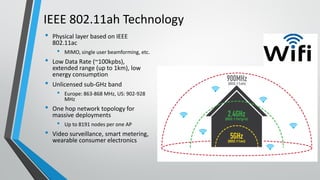
IEEE 802.11ah Technology
• Physical layer based on IEEE
802.11ac
• MIMO, single user beamforming, etc.
• Low Data Rate (~100kpbs),
extended range (up to 1km), low
energy consumption
• Unlicensed sub-GHz band
• Europe: 863-868 MHz, US: 902-928
MHz
• One hop network topology for
massive deployments
• Up to 8191 nodes per one AP
• Video surveillance, smart metering,
wearable consumer electronics
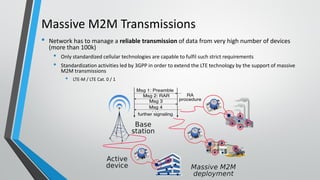
Massive M2M Transmissions
• Network has to manage a reliable transmission of data from very high number of devices
(more than 100k)
• Only standardized cellular technologies are capable to fulfil such strict requirements
• Standardization activities led by 3GPP in order to extend the LTE technology by the support of massive
M2M transmissions
• LTE-M / LTE Cat. 0 / 1
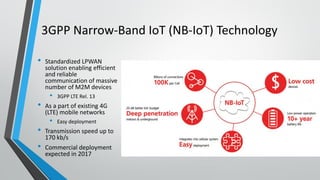
3GPP Narrow-Band IoT (NB-IoT) Technology
• Standardized LPWAN
solution enabling efficient
and reliable
communication of massive
number of M2M devices
• 3GPP LTE Rel. 13
• As a part of existing 4G
(LTE) mobile networks
• Easy deployment
• Transmission speed up to
170 kb/s
• Commercial deployment
expected in 2017
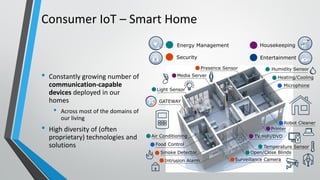
Consumer IoT – Smart Home
• Constantly growing number of
communication-capable
devices deployed in our
homes
• Across most of the domains of
our living
• High diversity of (often
proprietary) technologies and
solutions
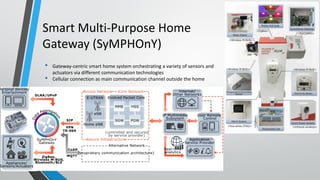
Smart Multi-Purpose Home
Gateway (SyMPHOnY)
• Gateway-centric smart home system orchestrating a variety of sensors and
actuators via different communication technologies
• Cellular connection as main communication channel outside the home
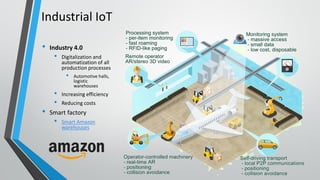
Industrial IoT
• Industry 4.0
• Digitalization and
automatization of all
production processes
• Automotive halls,
logistic
warehouses
• Increasing efficiency
• Reducing costs
• Smart factory
• Smart Amazon
warehouses
Wearables
• Emerging IoT segment enabling applications in
cIoT and iIoT as well
• Electronic appliances (gadgets) worn directly on
human body or in its vicinity
• Specific transmission requirements
• Up to Gb/s transmission speed, ultra-low delay,
high energy efficiency, good user experience
• Variety of short range technologies
• mmWave technologies
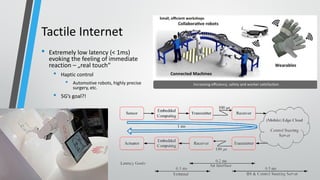
Tactile Internet
• Extremely low latency (< 1ms)
evoking the feeling of immediate
reaction – „real touch“
• Haptic control
• Automotive robots, highly precise
surgery, etc.
• 5G’s goal?!
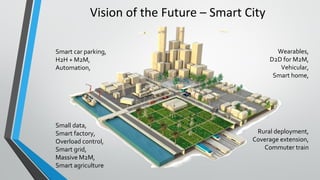
Vision of the Future – Smart City
Small data,
Smart factory,
Overload control,
Smart grid,
Massive M2M,
Smart agriculture
Wearables,
D2D for M2M,
Vehicular,
Smart home,
Rural deployment,
Coverage extension,
Commuter train
Smart car parking,
H2H + M2M,
Automation,
Vision of the Future in Numbers
Summary
• IoT is enabling new possibilities and services for end users and industry as well
• Carefully selection of suitable communication technology according to the specific
requirements of IoT application is necessary
• Standardized mobile communication systems are expected to become a dominant long-range IoT
technology (cellular IoT)
• Integrated 5G-IoT ecosystem
• Complete deployment of IoT vision will bring novel communication technologies and will
offer revolutionary applications and services across whole society
• Until then, many open issues need to be solved
• Security and privacy issues
• Energy efficiency is still not sufficient
• Wireless energy harvesting
• Unified data format
• Revolutionary technologies satisfying critical requirements of novel applications
• Wireless transmissions in ultra-high frequency bands (~60 GHz)
• User experience
Thank you for your attention!
Questions?

DCCN 2016 - Protocols and technologies for IoT

  • 1.
    Emerging Communication Protocolsand Technologies for the Internet of Things Domain Jiri Hosek, Ph.D. Youth School-Seminar, DCCN 2016 RUDN University, Moscow, November 24, 2016 *These slides are intended for educational purposes and include material published by WISLAB group as well as available openly on the Internet.
  • 2.
    Lecture’s content • Technicalterminology • Concept of Internet of Things (IoT) • IoT classification • IoT Communication Architecture • Emerging IoT Protocols and Technologies • Selected IoT applications and services • Vision of the future
  • 3.
    Communication between Machines– Technical Terminology • Internet of Things (IoT) • Internet of Everything (IoE) • consumer IoT (cIoT) • industrial IoT (iIoT) • Direct communication between machines without any human interaction • Machine-to-Machine (M2M) • Human-to-Human (H2H) • Machine-type Communications (MTC) • Infrastructure-less direct communication between devices • Device-to-Device (D2D)
  • 4.
    IoT Concept • Newhighly emerging Information and Communication Technologies (ICT) domain • Penetrating into all segments of our life • The world is developing towards “Networked Society”, where all types of devices are communicating with each other and sharing information * Vodafone M2M Barometer report, 2015
  • 5.
    IoT Concept (2) “BigData” • “Collect -> Store -> Analyse -> Share” architecture
  • 6.
    Consumer IoT • Consumer-orientedapplications • Consumer devices, such as smart appliances (e.g. refrigerator, washer, dryer), personal gadgets (e.g. fitness sensors, smart glasses, etc.) • Data volumes and rates are relatively low • Applications are not (usually) mission or safety critical
  • 7.
    Industrial IoT • Devicesare machines operating in e.g. industrial, transportation, energy or medical environment • Data volumes, rates and number od devices tend to be relatively high • Applications are mission and / or safety critical • System-centric applications • New industrial revolution • Industry 4.0
  • 8.
    Specific Transmission Requirementsof IoT Applications • Each IoT application generates a specific data pattern and has specific communication requirements • Selection of suitable communication technology / protocol is crucial • M2M traffic is mainly homogenous • All devices operating the same application behave similarly • M2M traffic is highly predictable • Many devices reacts on global events in synchronized manner Examples of different M2M applications
  • 9.
    IoT Communication Architecture •Nowadays, there is a “zoo” of IoT-ready protocols and (wireless) technologies • MQTT (Message Queuing Telemetry Transport) protocol, • CoAP (Constraint Application Protocol), • ZigBee (IEEE 802.15.4), Bluetooth Low Energy (BLE), Z- Wave, • WirelessHART, ISA100.10a, Wireless M-BUS, • Energy-efficient industrial WiFi (IEEE 802.11ah), • Proprietary cellular-like technologies (SIGFOX, LoRaWAN), • Standardized cellular systems (LTE-Cat. 0/1, 3GPP Narrow- Band IoT). • Interoperability across different technologies and systems is the key issue!
  • 10.
  • 11.
    MQTT Protocol • MessageQueuing Telemetry Transport (MQTT) • Centralized, text-oriented and easily implementable application protocol for IoT • Bi-directional communication mechanism • Publish / Subscribe • Utilizing TCP / IP architecture and / or standard SMS • High energy efficiency due to small size of transffered messages. • Suitable for transmission of telemetric data
  • 12.
    CoAP Protocol • ConstraintApplication Protocol • Lightweight software- implementable application protocol suitable for very simple (power- constrained / embedded) devices • E.g. remote control of electric appliances like heating or lighting systems • Utilizes TCP / IP architecture • Non-secure transmission by default • Security mechanisms provide by upper layers (e.g. TLS) • Can be easily converted to the HTTP protocol • Easy integration into the web applications • High energy efficiency
  • 13.
    Wireless M-BUS Technology •Wireless alternative of two-wire bus technology (M-BUS) • Data transmission and control in the area of measurements and regulation of heating systems, gas / water pipes, electricity grid, etc. • Unlicensed band 169 / 433 / 868 MHz • Application in smart metering systems (Smart Grid) • Including standardized format of communication between all devices in utilities sector (DLMS / COSEM) • Modelling of transmission reliability for specific environment
  • 14.
    SIGFOX Technology • Veryquickly penetrating wireless technology • Ultra narrow unlicensed band: Europe (868 MHz), US (902 MHz) • Cellular architecture • The main goal is long range and high energy efficiency • Low-Power Wide Area Network (LPWAN) • Suitable only for less frequent transmissions of small data size (max. 140 messages per day, size 12 B) • Robustness assured by repetitive transmission over different frequency channels • Mostly monitoring of simple devices (uplink direction)
  • 15.
    LoRaWAN Technology • Energyefficient wireless technology (LPWAN) created and supported by LoRa Alliance • Utilization of patented modulation Long Range (LoRa) • Unlicensed band • Europe (868 MHz), US (913 MHz) • Very good sensitivity and signal penetration into the buildings (up to -134 dBm) and resistance against interference (signal is transmitted 20 dB below the noise level) • High transmission redundancy (up to 12 redundant bits for 1 application bit) • Communication range up to 40 km (LOS) and around 2 km in urban area
  • 16.
    IEEE 802.11ah Technology •Physical layer based on IEEE 802.11ac • MIMO, single user beamforming, etc. • Low Data Rate (~100kpbs), extended range (up to 1km), low energy consumption • Unlicensed sub-GHz band • Europe: 863-868 MHz, US: 902-928 MHz • One hop network topology for massive deployments • Up to 8191 nodes per one AP • Video surveillance, smart metering, wearable consumer electronics
  • 17.
    Massive M2M Transmissions •Network has to manage a reliable transmission of data from very high number of devices (more than 100k) • Only standardized cellular technologies are capable to fulfil such strict requirements • Standardization activities led by 3GPP in order to extend the LTE technology by the support of massive M2M transmissions • LTE-M / LTE Cat. 0 / 1
  • 18.
    3GPP Narrow-Band IoT(NB-IoT) Technology • Standardized LPWAN solution enabling efficient and reliable communication of massive number of M2M devices • 3GPP LTE Rel. 13 • As a part of existing 4G (LTE) mobile networks • Easy deployment • Transmission speed up to 170 kb/s • Commercial deployment expected in 2017
  • 19.
    Consumer IoT –Smart Home • Constantly growing number of communication-capable devices deployed in our homes • Across most of the domains of our living • High diversity of (often proprietary) technologies and solutions
  • 20.
    Smart Multi-Purpose Home Gateway(SyMPHOnY) • Gateway-centric smart home system orchestrating a variety of sensors and actuators via different communication technologies • Cellular connection as main communication channel outside the home
  • 21.
    Industrial IoT • Industry4.0 • Digitalization and automatization of all production processes • Automotive halls, logistic warehouses • Increasing efficiency • Reducing costs • Smart factory • Smart Amazon warehouses
  • 22.
    Wearables • Emerging IoTsegment enabling applications in cIoT and iIoT as well • Electronic appliances (gadgets) worn directly on human body or in its vicinity • Specific transmission requirements • Up to Gb/s transmission speed, ultra-low delay, high energy efficiency, good user experience • Variety of short range technologies • mmWave technologies
  • 23.
    Tactile Internet • Extremelylow latency (< 1ms) evoking the feeling of immediate reaction – „real touch“ • Haptic control • Automotive robots, highly precise surgery, etc. • 5G’s goal?!
  • 24.
    Vision of theFuture – Smart City Small data, Smart factory, Overload control, Smart grid, Massive M2M, Smart agriculture Wearables, D2D for M2M, Vehicular, Smart home, Rural deployment, Coverage extension, Commuter train Smart car parking, H2H + M2M, Automation,
  • 25.
    Vision of theFuture in Numbers
  • 26.
    Summary • IoT isenabling new possibilities and services for end users and industry as well • Carefully selection of suitable communication technology according to the specific requirements of IoT application is necessary • Standardized mobile communication systems are expected to become a dominant long-range IoT technology (cellular IoT) • Integrated 5G-IoT ecosystem • Complete deployment of IoT vision will bring novel communication technologies and will offer revolutionary applications and services across whole society • Until then, many open issues need to be solved • Security and privacy issues • Energy efficiency is still not sufficient • Wireless energy harvesting • Unified data format • Revolutionary technologies satisfying critical requirements of novel applications • Wireless transmissions in ultra-high frequency bands (~60 GHz) • User experience
  • 27.
    Thank you foryour attention! Questions?