1 | P a g e
COMP1160
T411- Wireless Networking
RF/Wireless Techniques
“NARROW BAND INTERNET OF THINGS (NB-IoT)”
Submitted by:
NAIK HETVI 101212340
Submitted to:
Prof. Hisham Alasady
2 | P a g e
Introduction
Narrowband internet of things (NB-IoT) is wireless communication standards to enable a
wide range of cellular devices, IoT devices and services. It is low power wide area network
radio technology developed by 3GPP. It is also termed as “Cellular based IoT”. It is deployed
in GSM and LTE Spectrum.
It was to be launched in early 2017 and it was completed with release of 13 of 3GPP
published on 22 June 2016. It is also suitable for the reframing of GSM spectrum. It focuses
specifically on indoor coverage, low cost, long battery life and enabling many connected
devices. Initial cost of the NB-IoT modules is expected to be comparable to GSM/GPRS.
The underlying technology is however much simpler than today’s GSM/GPRS and its cost is
expected to decrease rapidly as demand increases.
NB-IoT can co-exist with 2G, 3G, and 4G mobile networks. It also benefits from all the
security and privacy features of mobile networks, such as support for user identity
confidentiality, entity authentication, confidentiality, data integrity, and mobile equipment
identification. The first NB-IoT commercial launches have been completed and global roll
out is expected for 2017/18.
NB-IoT is, among others, also referred to as LTE Cat-NB. Other terms such as LTE Cat-NB1
and Cat N1 apply to the NB-IoT specification released in 2016. Today, there are also Cat N2
or Cat NB2 devices that use the enhanced NB-IoT specifications that came later and are
currently on the road towards commercialization. That’s the name used for many types of
wireless IoT communication standards in the IoT stack that enable to use devices with
batteries for transmission over a wide area (wide area network or WAN, in this case WWAN
or wireless WAN) with relatively low power (hence the ‘LP’) for infrequent, mainly small
3 | P a g e
data volume, transmissions. NB-IoT uses a subset of the LTE standard but limits the
bandwidth to a single narrow-band of 200kHz. It uses OFDM modulation for downlink
communication and SC-FDMA for uplink communications.
NB-IoT evolution: -
Phase1: NB-M2M
Huawei developed the prototype and submitted proposals to the GRAN standard
organization, featuring FDMA on the air interface and Gb interface between the base
station and the core network.
NB
M2M
NB
CIOT
NB-IOT
WORK
NB-
IOT
3GPP R13
May 2014 May 2015 September 2015
4 | P a g e
Phase2: NB-CIoT
In order to improve the possibility of the standard adoption, Huawei worked with
Qualcomm to submit a narrowband Cellular Internet of Things (NB-IoT) solution to
RAN standard organization with a successful study item (SI) wrap-up. In addition, the
NB LTE SI solution of Ericsson remained to be completed.
Phase3: NB-IoT
NB-IoT WI project initiation requires a combination of the Huawei, Qualcomm and
Ericsson solution.
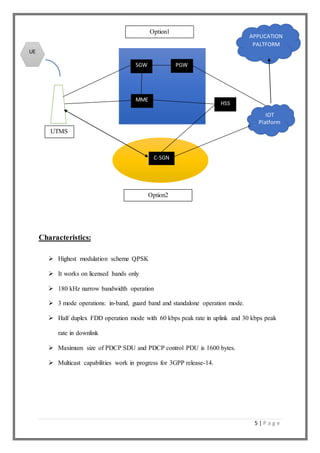
System Architecture:
Option1: SW upgrading based Legacy EPC.
It is based on Evolved Packet Core (EPC) used by LTE. Cellular IoT user equipment (CIOT
UE) is the mobile terminal. Evolved UMTS terrestrial Radio Access Network (E-UTRAN)
handles the radio communications between the UE and the EPC; and consists of the evolved
base stations called eNodeB or Enb.
Option2: Dedicated C-SGN for IOT services
The C-SGN (CIOT Serving Gateway Node) is a combined node EPC implementation option
that minimizes the number of physical entities by collocating EPC entities in the control and
user planes paths, which may be preferred in CIOT deployments.
5 | P a g e
Characteristics:
 Highest modulation scheme QPSK
 It works on licensed bands only
 180 kHz narrow bandwidth operation
 3 mode operations: in-band, guard band and standalone operation mode.
 Half duplex FDD operation mode with 60 kbps peak rate in uplink and 30 kbps peak
rate in downlink
 Maximum size of PDCP SDU and PDCP control PDU is 1600 bytes.
 Multicast capabilities work in progress for 3GPP release-14.
SGW
MME
PGW
HSS
C-SGN
Option1
Option2
UTMS
IOT
Platform
APPLICATION
PALTFORM
UE
6 | P a g e
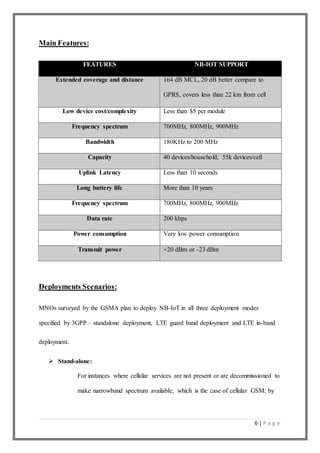
Main Features:
FEATURES NB-IOT SUPPORT
Extended coverage and distance 164 dB MCL, 20 dB better compare to
GPRS, covers less than 22 km from cell
Low device cost/complexity Less than $5 per module
Frequency spectrum 700MHz, 800MHz, 900MHz
Bandwidth 180KHz to 200 MHz
Capacity 40 devices/household, 55k devices/cell
Uplink Latency Less than 10 seconds
Long battery life More than 10 years
Frequency spectrum 700MHz, 800MHz, 900MHz
Data rate 200 kbps
Power consumption Very low power consumption
Transmit power +20 dBm or -23 dBm
Deployments Scenarios:
MNOs surveyed by the GSMA plan to deploy NB-IoT in all three deployment modes
specified by 3GPP – standalone deployment, LTE guard band deployment and LTE in-band
deployment.
 Stand-alone:
For instances where cellular services are not present or are decommissioned to
make narrowband spectrum available, which is the case of cellular GSM; by
7 | P a g e
reframing one or more GSM carriers to carry NB-IoT traffic, operators can
ensure a smooth transition to LTE for massive machine type communication.
 Guard band:
For instances where cellular services are present and NB-IoT is positioned in
the guard band of LTE carriers, without allocating LTE resources and
avoiding possible interference.
 In-band:
For instances where cellular services are present and NB-IoT is positioned in
the LTE carrier sharing LTE resources; this mode of operation is perhaps the
more cost-effective and seamless for mobile operators since it does not require
any hardware changes of the radio access network, and efficiently uses
spectrum resources for LTE or NB-IoT services based on demand from mobile
users or devices.
8 | P a g e
MAJOR MARKET FOR NB-IOT SERVICES:
 Agriculture
 Health care/ E-health
 Safety and security
 Automotive and logistics
 Manufacturing
 Smart city
 Energy and utilities
 Retail
 Smart home
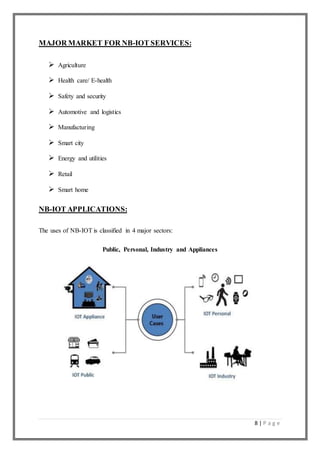
NB-IOT APPLICATIONS:
The uses of NB-IOT is classified in 4 major sectors:
Public, Personal, Industry and Appliances
9 | P a g e
PUBLIC:
 Smart metering
 Alarms and event detectors
 Smart garbage bins
PRIVATE:
 Wearables
 Smart bicycle
 Kids monitoring
 Pet tracking
INDUSTRY:
 Logistics tracking
 Asset tracking
 Smart applications
APPLICANCE:
 Zigbee
 Smart fridge
 Smart parking
10 | P a g e
SUMMARY:
NB-IoT has emerged as a key technology enabler to support wirelessly connectivity in
licensed spectrum to devices (static or mobile) that will increase network demand to properly
serve existing mobile users and devices.
Connected devices will reshape wireless network capacity and coverage demand due to their
diversity of applications, ranging from static sensors with sporadic communication to mobile
sensors with latency constraints; in addition, Strategy Analytics estimates that over 3 billion
connected devices will be deployed by 2020.
REFERENCES:-
 https://www.i-scoop.eu/internet-of-things-guide/lpwan/nb-iot-narrowband-iot/
 https://www.slideshare.net/dashupat30/lora-and-nbiot
 https://www.slideshare.net/Manji620/nb-iot-presentation
 https://en.wikipedia.org/wiki/Narrowband_IoT#Deployments
 https://datatracker.ietf.org/meeting/97/materials/slides-97-lpwan-30-nb-iot-presentation-
00
 https://www.viavisolutions.com/en-us/literature/narrowband-internet-things-nb-iot-
celladvisor-jd700b-series-application-notes-en.pdf

Nb iot (naik hetvi)

  • 1.
    1 | Pa g e COMP1160 T411- Wireless Networking RF/Wireless Techniques “NARROW BAND INTERNET OF THINGS (NB-IoT)” Submitted by: NAIK HETVI 101212340 Submitted to: Prof. Hisham Alasady
  • 2.
    2 | Pa g e Introduction Narrowband internet of things (NB-IoT) is wireless communication standards to enable a wide range of cellular devices, IoT devices and services. It is low power wide area network radio technology developed by 3GPP. It is also termed as “Cellular based IoT”. It is deployed in GSM and LTE Spectrum. It was to be launched in early 2017 and it was completed with release of 13 of 3GPP published on 22 June 2016. It is also suitable for the reframing of GSM spectrum. It focuses specifically on indoor coverage, low cost, long battery life and enabling many connected devices. Initial cost of the NB-IoT modules is expected to be comparable to GSM/GPRS. The underlying technology is however much simpler than today’s GSM/GPRS and its cost is expected to decrease rapidly as demand increases. NB-IoT can co-exist with 2G, 3G, and 4G mobile networks. It also benefits from all the security and privacy features of mobile networks, such as support for user identity confidentiality, entity authentication, confidentiality, data integrity, and mobile equipment identification. The first NB-IoT commercial launches have been completed and global roll out is expected for 2017/18. NB-IoT is, among others, also referred to as LTE Cat-NB. Other terms such as LTE Cat-NB1 and Cat N1 apply to the NB-IoT specification released in 2016. Today, there are also Cat N2 or Cat NB2 devices that use the enhanced NB-IoT specifications that came later and are currently on the road towards commercialization. That’s the name used for many types of wireless IoT communication standards in the IoT stack that enable to use devices with batteries for transmission over a wide area (wide area network or WAN, in this case WWAN or wireless WAN) with relatively low power (hence the ‘LP’) for infrequent, mainly small
  • 3.
    3 | Pa g e data volume, transmissions. NB-IoT uses a subset of the LTE standard but limits the bandwidth to a single narrow-band of 200kHz. It uses OFDM modulation for downlink communication and SC-FDMA for uplink communications. NB-IoT evolution: - Phase1: NB-M2M Huawei developed the prototype and submitted proposals to the GRAN standard organization, featuring FDMA on the air interface and Gb interface between the base station and the core network. NB M2M NB CIOT NB-IOT WORK NB- IOT 3GPP R13 May 2014 May 2015 September 2015
  • 4.
    4 | Pa g e Phase2: NB-CIoT In order to improve the possibility of the standard adoption, Huawei worked with Qualcomm to submit a narrowband Cellular Internet of Things (NB-IoT) solution to RAN standard organization with a successful study item (SI) wrap-up. In addition, the NB LTE SI solution of Ericsson remained to be completed. Phase3: NB-IoT NB-IoT WI project initiation requires a combination of the Huawei, Qualcomm and Ericsson solution. System Architecture: Option1: SW upgrading based Legacy EPC. It is based on Evolved Packet Core (EPC) used by LTE. Cellular IoT user equipment (CIOT UE) is the mobile terminal. Evolved UMTS terrestrial Radio Access Network (E-UTRAN) handles the radio communications between the UE and the EPC; and consists of the evolved base stations called eNodeB or Enb. Option2: Dedicated C-SGN for IOT services The C-SGN (CIOT Serving Gateway Node) is a combined node EPC implementation option that minimizes the number of physical entities by collocating EPC entities in the control and user planes paths, which may be preferred in CIOT deployments.
  • 5.
    5 | Pa g e Characteristics:  Highest modulation scheme QPSK  It works on licensed bands only  180 kHz narrow bandwidth operation  3 mode operations: in-band, guard band and standalone operation mode.  Half duplex FDD operation mode with 60 kbps peak rate in uplink and 30 kbps peak rate in downlink  Maximum size of PDCP SDU and PDCP control PDU is 1600 bytes.  Multicast capabilities work in progress for 3GPP release-14. SGW MME PGW HSS C-SGN Option1 Option2 UTMS IOT Platform APPLICATION PALTFORM UE
  • 6.
    6 | Pa g e Main Features: FEATURES NB-IOT SUPPORT Extended coverage and distance 164 dB MCL, 20 dB better compare to GPRS, covers less than 22 km from cell Low device cost/complexity Less than $5 per module Frequency spectrum 700MHz, 800MHz, 900MHz Bandwidth 180KHz to 200 MHz Capacity 40 devices/household, 55k devices/cell Uplink Latency Less than 10 seconds Long battery life More than 10 years Frequency spectrum 700MHz, 800MHz, 900MHz Data rate 200 kbps Power consumption Very low power consumption Transmit power +20 dBm or -23 dBm Deployments Scenarios: MNOs surveyed by the GSMA plan to deploy NB-IoT in all three deployment modes specified by 3GPP – standalone deployment, LTE guard band deployment and LTE in-band deployment.  Stand-alone: For instances where cellular services are not present or are decommissioned to make narrowband spectrum available, which is the case of cellular GSM; by
  • 7.
    7 | Pa g e reframing one or more GSM carriers to carry NB-IoT traffic, operators can ensure a smooth transition to LTE for massive machine type communication.  Guard band: For instances where cellular services are present and NB-IoT is positioned in the guard band of LTE carriers, without allocating LTE resources and avoiding possible interference.  In-band: For instances where cellular services are present and NB-IoT is positioned in the LTE carrier sharing LTE resources; this mode of operation is perhaps the more cost-effective and seamless for mobile operators since it does not require any hardware changes of the radio access network, and efficiently uses spectrum resources for LTE or NB-IoT services based on demand from mobile users or devices.
  • 8.
    8 | Pa g e MAJOR MARKET FOR NB-IOT SERVICES:  Agriculture  Health care/ E-health  Safety and security  Automotive and logistics  Manufacturing  Smart city  Energy and utilities  Retail  Smart home NB-IOT APPLICATIONS: The uses of NB-IOT is classified in 4 major sectors: Public, Personal, Industry and Appliances
  • 9.
    9 | Pa g e PUBLIC:  Smart metering  Alarms and event detectors  Smart garbage bins PRIVATE:  Wearables  Smart bicycle  Kids monitoring  Pet tracking INDUSTRY:  Logistics tracking  Asset tracking  Smart applications APPLICANCE:  Zigbee  Smart fridge  Smart parking
  • 10.
    10 | Pa g e SUMMARY: NB-IoT has emerged as a key technology enabler to support wirelessly connectivity in licensed spectrum to devices (static or mobile) that will increase network demand to properly serve existing mobile users and devices. Connected devices will reshape wireless network capacity and coverage demand due to their diversity of applications, ranging from static sensors with sporadic communication to mobile sensors with latency constraints; in addition, Strategy Analytics estimates that over 3 billion connected devices will be deployed by 2020. REFERENCES:-  https://www.i-scoop.eu/internet-of-things-guide/lpwan/nb-iot-narrowband-iot/  https://www.slideshare.net/dashupat30/lora-and-nbiot  https://www.slideshare.net/Manji620/nb-iot-presentation  https://en.wikipedia.org/wiki/Narrowband_IoT#Deployments  https://datatracker.ietf.org/meeting/97/materials/slides-97-lpwan-30-nb-iot-presentation- 00  https://www.viavisolutions.com/en-us/literature/narrowband-internet-things-nb-iot- celladvisor-jd700b-series-application-notes-en.pdf