Manthan
Boosting Skillsets
“The greatest service a man can do is to
enable others to stand on their own feet”
- Upanishads
Presented By:
Team : Nayi Disha
Institute : IIM Bangalore
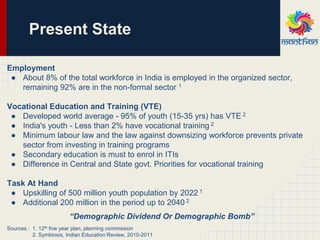
Present State
Employment
● About 8% of the total workforce in India is employed in the organized sector,
remaining 92% are in the non-formal sector 1
Vocational Education and Training (VTE)
● Developed world average - 95% of youth (15-35 yrs) has VTE 2
● India's youth - Less than 2% have vocational training 2
● Minimum labour law and the law against downsizing workforce prevents private
sector from investing in training programs
● Secondary education is must to enrol in ITIs
● Difference in Central and State govt. Priorities for vocational training
Task At Hand
● Upskilling of 500 million youth population by 2022 1
● Additional 200 million in the period up to 2040 2
“Demographic Dividend Or Demographic Bomb”
Sources : 1. 12th five year plan, planning commission
2. Symbiosis, Indian Education Review, 2010-2011
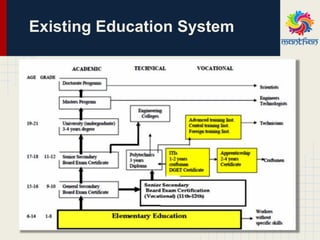
Existing Education System
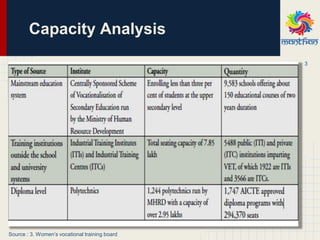
Capacity Analysis
3
Source : 3. Women’s vocational training board
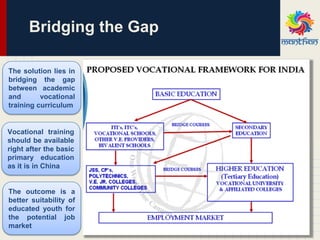
Bridging the Gap
The solution lies in
bridging the gap
between academic
and vocational
training curriculum
The outcome is a
better suitability of
educated youth for
the potential job
market
Vocational training
should be available
right after the basic
primary education
as it is in China
Recommendations - Structural
1) National Board for Vocational Education (Example: Australian National Training
Authority)
a) developing a national Technical Vocational Education and Training (TVET) system
and national strategies with respect to vocational education
b) ensuring close interaction between industries and TVET providers
c) developing effective training market for public and private needs
d) enhancing efficiency and productivity of TVET providers
2) National Vocational Education Policy (Example : Australia)
For establishing equivalence for degrees, diplomas and certifications in the
vocational education sector for lateral and vertical mobility across various learning
sectors that is, secondary, vocational and higher education
3) National Vocational Education Assessment and Accreditation Council
to formulate a regulatory and quality/standards framework
4) Introduction of SSC (Vocational) (Example : China)
5) Lateral/Vertical Mobility, Industrial Participation
Industry participation is must especially in Governance, Curriculum Design,
Placements and Funding, Monitoring Outcome. A PPP Model can be also created
where GOI and Industry can come together to invest in infrastructure and train
students in latest skills
Example : National Skill Development Corporation India (NSDC)
6) Teacher Training
Vocational Educational Qualifications should be insisted (eg. Bachelors in Vocational
Education).Continuous skill development and upgradation of teachers can be done
through Teachers Training Programs conducted by Teacher Training Centers
7) Vocational Universities
Learning pedagogy with a special focus on skill based and hands-on learning and
training.Emphasis on life coping skills and general educational skills such as Liberal
arts subjects, English competency, entrepreneur skills, problem solving, team work,
leadership, management courses etc.
Recommendations - Structural
(Contd.)
1) Budgetary Provision and Financial Support
● Tax incentives & subidized land for setting up ITIs/ITCs and SD institutes
● Provision of liberal loans for setting up these institutes
● Bank loans to students for VE&T, skill development & entrepreneurial projects
2) Strengthen PPP & Industry Participation
● Establish and strengthen Institute Management Committees in all ITIs/ITCs
● Enhanced role of Chambers of Commerce / Industry Associations
● Encourage alternative private initiatives - even if commercial in nature
3) Policy Initiative
● Setup state level skill development missions
● Promote multiple modes of delivery
● Sensitization and awareness across departments and at grass root level
4) Capacity Building
● Involve and mobilize retired professionals from industry willing to contribute
● Women not ready to work full time to be roped in part-time
● Involve working professionals for training on voluntary or paid basis
Recommendations - Facilitation
Women Involvement
• Majority of Indian women are housewives - do possess a variety of skills but the
products/services are not marketed
● Only 11.2% of female workers possessed marketable skills
● Young Women's Global Skills Program is an initiative in support, skills
development and vocational educational for young Indian women.
● NGOs like India Vision Foundation, Dia Foundation are working for VET for
women
● Ministry for Women and Child empowerment need to build institutes that cater to
serving the needs of women and adolescent girls for vocational skill training
● Awareness programs and facilitation for women to get into the workforce
Source : 4. Women’s vocational training board
References
● Enhancing Skills and Faster Generation of Employment, www.12thplan.gov.in
● Directorate General of Employment & Training (DGET) Ministry of Labour &
Employment, Government of India, http://dget.gov.in/
● Indian Education Review, http://www.indiaeducationreview.com/
● Froy, F. and S. Giguère (2010), "Putting in Place Jobs that Last: A Guide to
Rebuilding Quality Employment at Local Level", OECD Local Economic and
Employment Development (LEED) Working Papers, No. 2010/13, OECD
Publishing.
● Women’s vocational training board, http://www.wboard.co.in/

NayiDisha

  • 1.
    Manthan Boosting Skillsets “The greatestservice a man can do is to enable others to stand on their own feet” - Upanishads Presented By: Team : Nayi Disha Institute : IIM Bangalore
  • 2.
    Present State Employment ● About8% of the total workforce in India is employed in the organized sector, remaining 92% are in the non-formal sector 1 Vocational Education and Training (VTE) ● Developed world average - 95% of youth (15-35 yrs) has VTE 2 ● India's youth - Less than 2% have vocational training 2 ● Minimum labour law and the law against downsizing workforce prevents private sector from investing in training programs ● Secondary education is must to enrol in ITIs ● Difference in Central and State govt. Priorities for vocational training Task At Hand ● Upskilling of 500 million youth population by 2022 1 ● Additional 200 million in the period up to 2040 2 “Demographic Dividend Or Demographic Bomb” Sources : 1. 12th five year plan, planning commission 2. Symbiosis, Indian Education Review, 2010-2011
  • 3.
  • 4.
    Capacity Analysis 3 Source :3. Women’s vocational training board
  • 5.
    Bridging the Gap Thesolution lies in bridging the gap between academic and vocational training curriculum The outcome is a better suitability of educated youth for the potential job market Vocational training should be available right after the basic primary education as it is in China
  • 6.
    Recommendations - Structural 1)National Board for Vocational Education (Example: Australian National Training Authority) a) developing a national Technical Vocational Education and Training (TVET) system and national strategies with respect to vocational education b) ensuring close interaction between industries and TVET providers c) developing effective training market for public and private needs d) enhancing efficiency and productivity of TVET providers 2) National Vocational Education Policy (Example : Australia) For establishing equivalence for degrees, diplomas and certifications in the vocational education sector for lateral and vertical mobility across various learning sectors that is, secondary, vocational and higher education 3) National Vocational Education Assessment and Accreditation Council to formulate a regulatory and quality/standards framework 4) Introduction of SSC (Vocational) (Example : China)
  • 7.
    5) Lateral/Vertical Mobility,Industrial Participation Industry participation is must especially in Governance, Curriculum Design, Placements and Funding, Monitoring Outcome. A PPP Model can be also created where GOI and Industry can come together to invest in infrastructure and train students in latest skills Example : National Skill Development Corporation India (NSDC) 6) Teacher Training Vocational Educational Qualifications should be insisted (eg. Bachelors in Vocational Education).Continuous skill development and upgradation of teachers can be done through Teachers Training Programs conducted by Teacher Training Centers 7) Vocational Universities Learning pedagogy with a special focus on skill based and hands-on learning and training.Emphasis on life coping skills and general educational skills such as Liberal arts subjects, English competency, entrepreneur skills, problem solving, team work, leadership, management courses etc. Recommendations - Structural (Contd.)
  • 8.
    1) Budgetary Provisionand Financial Support ● Tax incentives & subidized land for setting up ITIs/ITCs and SD institutes ● Provision of liberal loans for setting up these institutes ● Bank loans to students for VE&T, skill development & entrepreneurial projects 2) Strengthen PPP & Industry Participation ● Establish and strengthen Institute Management Committees in all ITIs/ITCs ● Enhanced role of Chambers of Commerce / Industry Associations ● Encourage alternative private initiatives - even if commercial in nature 3) Policy Initiative ● Setup state level skill development missions ● Promote multiple modes of delivery ● Sensitization and awareness across departments and at grass root level 4) Capacity Building ● Involve and mobilize retired professionals from industry willing to contribute ● Women not ready to work full time to be roped in part-time ● Involve working professionals for training on voluntary or paid basis Recommendations - Facilitation
  • 9.
    Women Involvement • Majorityof Indian women are housewives - do possess a variety of skills but the products/services are not marketed ● Only 11.2% of female workers possessed marketable skills ● Young Women's Global Skills Program is an initiative in support, skills development and vocational educational for young Indian women. ● NGOs like India Vision Foundation, Dia Foundation are working for VET for women ● Ministry for Women and Child empowerment need to build institutes that cater to serving the needs of women and adolescent girls for vocational skill training ● Awareness programs and facilitation for women to get into the workforce Source : 4. Women’s vocational training board
  • 10.
    References ● Enhancing Skillsand Faster Generation of Employment, www.12thplan.gov.in ● Directorate General of Employment & Training (DGET) Ministry of Labour & Employment, Government of India, http://dget.gov.in/ ● Indian Education Review, http://www.indiaeducationreview.com/ ● Froy, F. and S. Giguère (2010), "Putting in Place Jobs that Last: A Guide to Rebuilding Quality Employment at Local Level", OECD Local Economic and Employment Development (LEED) Working Papers, No. 2010/13, OECD Publishing. ● Women’s vocational training board, http://www.wboard.co.in/