1 
Vocational Education in Schools 
An Indian Perspective 
Dr Alka Bhargava 
Director 
Ministry of Human Resource Development
 Population of over 1.2 billion and a workforce of 
460 million 
 Unemployment by the current daily status 
measure is 6.2% of the labour force 
 Median age of India is 24 years 
 54% of India's rural workforce is self-employed 
 42.6% of population in urban areas is self-employed 
 Over 70% of the labour force in all sectors 
combined (organized and unorganized) is either 
illiterate or educated below the primary level 
2 
Demographics
Demand Supply Mismatch 
 Age Group 15-29 
 only 2% have undergone formal vocational training 
 8% acquired skills at work place 
 93% of workforce in unorganized sectors 
 New entrants to the workforce every year: 12.8m 
 Existing skill development capacity: 3.1 million 
3
Need for Vocationalisation 
1.66 cr 
2.89 cr 
5.54 cr 
No. in 
Higher 
Secondary 
Schools 
60,383 schools 
No. in 
Secondary 
Schools 
1,23,265 schools 
No. in 
Upper 
Primary 
Schools 
3,36,638 schools
% of Students in Vocational Education 
100 
90 
80 
70 
60 
50 
40 
30 
20 
10 
0 
50 
30 
96 
40 
70 
5 
5
6 
Age of introducing VE 
INTERNATIONAL 
SCENARIO 
0 2 4 6 8 10 12 14 16 18 20 
FINLAND 
HUNGARY 
KOREA 
MEXICO 
NEW ZEALAND 
NORWAY 
PARAGUAY 
SWEDEN 
SWITZERLAND 
SA 
RUSSIA 
BRAZIL 
INDIA 
FRANCE 
CHINA 
JAPAN 
GERMANY 
AUSTRALIA 
USA 
UK
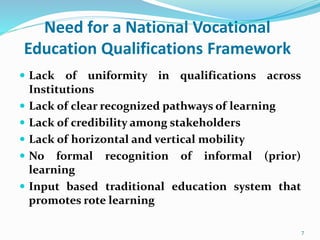
 Lack of uniformity in qualifications across 
Institutions 
 Lack of clear recognized pathways of learning 
 Lack of credibility among stakeholders 
 Lack of horizontal and vertical mobility 
 No formal recognition of informal (prior) 
learning 
 Input based traditional education system that 
promotes rote learning 
7 
Need for a National Vocational 
Education Qualifications Framework
8 
Architecture of NVEQF 
Level General Education Qualifications TVET qualifications 
10 Doctorates NCC 8 
9 Masters NCC 7 
8 Post Graduate Certificates, Post Graduate 
Diplomas and Bachelor Degrees (Honours) 
NCC 6 
7 Bachelor Degrees and Graduate Diplomas NCC 5 
6 Graduate Certificates/Advanced Diplomas NCC 4 
5 Diplomas NCC 3 
4 Class XII (General Academic/Vocational 
Education) 
NCC 2 
3 Class XI (General Academic/ Vocational 
Education) 
National Competence 
Certificate 1 (NCC 1) 
2 Class X (Pre-vocational) NCWP-2 
1 Class IX 
(Pre-vocational) 
National Certificate for 
Work Preparation 1 
(NCWP-1)
9 
Industry – a Major Player in TVET reforms 
 Demand Driven - Involvement of Industry to 
identify skills required and gaps in demand 
and supply (LMIS based) 
 Competencies acquired to align with skill 
requirements of employers/labour market. 
 Industry’s involvement in delivery and joint 
certification 
 Industry financing of TVET
10 
Sector Skill Councils 
No Sector Sector Skill Council 
1. Automobile Automotive Skill Development Council 
2. Security Security Knowledge and Skill Development 
Council 
3. Energy Indian Energy Skill Development Council 
4. Retailing Retailers Association Skill Council of India 
5. Film, Media, Broadcasting, 
Entertainment and 
Animation 
Film, Media, Broadcasting, Entertainment 
and Animation Skill Council 
6. Information Technology and 
IT enabled Services 
Information Technology and IT enabled 
Services Skill Development Council
11 
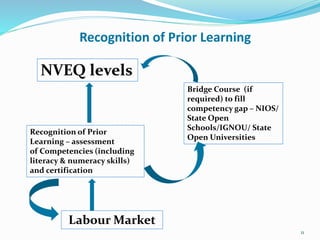
Recognition of Prior Learning 
Bridge Course (if 
required) to fill 
competency gap – NIOS/ 
State Open 
Schools/IGNOU/ State 
Open Universities 
NVEQ levels 
Recognition of Prior 
Learning – assessment 
of Competencies (including 
literacy & numeracy skills) 
and certification 
LabourMarket
12 
Management Mechanism 
INTER-MINISTERIAL COMMITTEE ON NVEQF (Advisory) 
(MHRD, NSDC and MoL&E to coordinate implementation 
of norms and standards of NVEQF) 
NSDC, SSCs SUPPORTED BY NATIONAL LEVEL INSTITUTES 
(Develop Sector Occupation Map, National Occupation Standards 
(NOS), Competency Based Curriculum (CBC), Training Packages) 
NATIONAL QUALIFICATIONS BODY 
(Register and approve Qualifications, NOS, CBC and Training Packages)
STATE LEVEL TVET BODY: DEPTS OF EDUCATION + INDUSTRY+ LABOUR +STATE 
SKILL COUNCILS (to be established) 
(Identify local opportunities and skill requirements and assist in establishment of 
linkages, training delivery, funding, monitoring, etc.) 
REGISTERED EDUCATION AND TRAINING PROVIDERS (RETP) 
(Deliver locally relevant courses within the nationally endorsed NVEQs) 
CBSE (CBVE) / STATE BOARDS OF EDUCATION / POLYTECHNICS / 
UNIVERSITIES AND SECTOR SKILL COUNCILS 
(conduct assessment for respective qualification levels) 
13 
Management Mechanism
Goals and Objectives of VE in Schools 
Bridge the gap between 
demand and supply of 
skilled work force 
Enhance employability of 
the youth 
Establish close synergy with 
industry at all levels 
To be offered in 
Classes IX –XII 
NVEQF
Salient Features of Revised Scheme 
 Strengthening of existing vocational education 
schools 
 Establishment of new vocational education 
schools 
 Assistance to run private vocational education 
schools under PPP mode 
 Assistance to NGOs for innovative practices 
 In-service training for existing VE teachers and 
induction training for new VE teachers 
Contd…
Salient Features of Revised Scheme (contd.) 
 Development of competency based modules for each 
individual vocational course 
 It will be mandatory to revise the curriculum once in 
three years to ensure that it is guided by the needs of 
the industry 
 Setting of a Vocational Education Cell in CBSE 
 A strong partnership with the industry/employers in 
all activities right from selection of courses, 
curriculum development, teaching processes, resource 
persons, assessment and certification
New Courses introduced by CBSE 
 Financial Market Management (joint certification with 
National Stock Exchange) 
 Healthcare Sciences 
 Mass Media studies and Media Production (Whistling 
Woods International, Mumbai) 
 Hospitality and Tourism (National Council of Hotel 
Management and Catering Technology, New Delhi) 
 Geospatial Technology (Rolta India Ltd, Mumbai) 
 Some courses have been revised and made more 
relevant in today’s context 
Enrollment in VE is about 37,000 in over 850 CBSE affiliated schools
National Institute of Open Schooling 
 Open Basic Education (OBE) Programme for children 
upto 14 years, adolescents and adults 
 Secondary Education Course 
 Senior Secondary Education Course 
 Vocational Education courses/Programmes (1313 
Accredited Vocational Institutes offering about 80 
vocational courses) 
 Life Enrichment Programmes 
 Open Schools in 15 States 
2264 study centres, over 18.5 lakh students
PSS Central Institute of Vocational 
Education (PSSCIVE) 
 Premier institute of NCERT for teacher training and 
curricular development 
 A UNEVOC Centre 
 Divisions 
Agriculture 
Business and Commerce 
Engineering and Technology 
Health and Education for the Disabled 
Home Science 
Humanities Science and Education 
19
Challenges 
 Synergy / partnership with industry 
 Development of unorganised / non industrial sectors 
 Availability of qualified vocational teachers 
 Development of competency based modules 
 Credits data base 
 Establishment of equivalency between general and 
vocational courses 
 Seamless progression into higher education 
 Horizontal mobility, if and where desired 
20
21

Indian vocational-education-system

  • 1.
    1 Vocational Educationin Schools An Indian Perspective Dr Alka Bhargava Director Ministry of Human Resource Development
  • 2.
     Population ofover 1.2 billion and a workforce of 460 million  Unemployment by the current daily status measure is 6.2% of the labour force  Median age of India is 24 years  54% of India's rural workforce is self-employed  42.6% of population in urban areas is self-employed  Over 70% of the labour force in all sectors combined (organized and unorganized) is either illiterate or educated below the primary level 2 Demographics
  • 3.
    Demand Supply Mismatch  Age Group 15-29  only 2% have undergone formal vocational training  8% acquired skills at work place  93% of workforce in unorganized sectors  New entrants to the workforce every year: 12.8m  Existing skill development capacity: 3.1 million 3
  • 4.
    Need for Vocationalisation 1.66 cr 2.89 cr 5.54 cr No. in Higher Secondary Schools 60,383 schools No. in Secondary Schools 1,23,265 schools No. in Upper Primary Schools 3,36,638 schools
  • 5.
    % of Studentsin Vocational Education 100 90 80 70 60 50 40 30 20 10 0 50 30 96 40 70 5 5
  • 6.
    6 Age ofintroducing VE INTERNATIONAL SCENARIO 0 2 4 6 8 10 12 14 16 18 20 FINLAND HUNGARY KOREA MEXICO NEW ZEALAND NORWAY PARAGUAY SWEDEN SWITZERLAND SA RUSSIA BRAZIL INDIA FRANCE CHINA JAPAN GERMANY AUSTRALIA USA UK
  • 7.
     Lack ofuniformity in qualifications across Institutions  Lack of clear recognized pathways of learning  Lack of credibility among stakeholders  Lack of horizontal and vertical mobility  No formal recognition of informal (prior) learning  Input based traditional education system that promotes rote learning 7 Need for a National Vocational Education Qualifications Framework
  • 8.
    8 Architecture ofNVEQF Level General Education Qualifications TVET qualifications 10 Doctorates NCC 8 9 Masters NCC 7 8 Post Graduate Certificates, Post Graduate Diplomas and Bachelor Degrees (Honours) NCC 6 7 Bachelor Degrees and Graduate Diplomas NCC 5 6 Graduate Certificates/Advanced Diplomas NCC 4 5 Diplomas NCC 3 4 Class XII (General Academic/Vocational Education) NCC 2 3 Class XI (General Academic/ Vocational Education) National Competence Certificate 1 (NCC 1) 2 Class X (Pre-vocational) NCWP-2 1 Class IX (Pre-vocational) National Certificate for Work Preparation 1 (NCWP-1)
  • 9.
    9 Industry –a Major Player in TVET reforms  Demand Driven - Involvement of Industry to identify skills required and gaps in demand and supply (LMIS based)  Competencies acquired to align with skill requirements of employers/labour market.  Industry’s involvement in delivery and joint certification  Industry financing of TVET
  • 10.
    10 Sector SkillCouncils No Sector Sector Skill Council 1. Automobile Automotive Skill Development Council 2. Security Security Knowledge and Skill Development Council 3. Energy Indian Energy Skill Development Council 4. Retailing Retailers Association Skill Council of India 5. Film, Media, Broadcasting, Entertainment and Animation Film, Media, Broadcasting, Entertainment and Animation Skill Council 6. Information Technology and IT enabled Services Information Technology and IT enabled Services Skill Development Council
  • 11.
    11 Recognition ofPrior Learning Bridge Course (if required) to fill competency gap – NIOS/ State Open Schools/IGNOU/ State Open Universities NVEQ levels Recognition of Prior Learning – assessment of Competencies (including literacy & numeracy skills) and certification LabourMarket
  • 12.
    12 Management Mechanism INTER-MINISTERIAL COMMITTEE ON NVEQF (Advisory) (MHRD, NSDC and MoL&E to coordinate implementation of norms and standards of NVEQF) NSDC, SSCs SUPPORTED BY NATIONAL LEVEL INSTITUTES (Develop Sector Occupation Map, National Occupation Standards (NOS), Competency Based Curriculum (CBC), Training Packages) NATIONAL QUALIFICATIONS BODY (Register and approve Qualifications, NOS, CBC and Training Packages)
  • 13.
    STATE LEVEL TVETBODY: DEPTS OF EDUCATION + INDUSTRY+ LABOUR +STATE SKILL COUNCILS (to be established) (Identify local opportunities and skill requirements and assist in establishment of linkages, training delivery, funding, monitoring, etc.) REGISTERED EDUCATION AND TRAINING PROVIDERS (RETP) (Deliver locally relevant courses within the nationally endorsed NVEQs) CBSE (CBVE) / STATE BOARDS OF EDUCATION / POLYTECHNICS / UNIVERSITIES AND SECTOR SKILL COUNCILS (conduct assessment for respective qualification levels) 13 Management Mechanism
  • 14.
    Goals and Objectivesof VE in Schools Bridge the gap between demand and supply of skilled work force Enhance employability of the youth Establish close synergy with industry at all levels To be offered in Classes IX –XII NVEQF
  • 15.
    Salient Features ofRevised Scheme  Strengthening of existing vocational education schools  Establishment of new vocational education schools  Assistance to run private vocational education schools under PPP mode  Assistance to NGOs for innovative practices  In-service training for existing VE teachers and induction training for new VE teachers Contd…
  • 16.
    Salient Features ofRevised Scheme (contd.)  Development of competency based modules for each individual vocational course  It will be mandatory to revise the curriculum once in three years to ensure that it is guided by the needs of the industry  Setting of a Vocational Education Cell in CBSE  A strong partnership with the industry/employers in all activities right from selection of courses, curriculum development, teaching processes, resource persons, assessment and certification
  • 17.
    New Courses introducedby CBSE  Financial Market Management (joint certification with National Stock Exchange)  Healthcare Sciences  Mass Media studies and Media Production (Whistling Woods International, Mumbai)  Hospitality and Tourism (National Council of Hotel Management and Catering Technology, New Delhi)  Geospatial Technology (Rolta India Ltd, Mumbai)  Some courses have been revised and made more relevant in today’s context Enrollment in VE is about 37,000 in over 850 CBSE affiliated schools
  • 18.
    National Institute ofOpen Schooling  Open Basic Education (OBE) Programme for children upto 14 years, adolescents and adults  Secondary Education Course  Senior Secondary Education Course  Vocational Education courses/Programmes (1313 Accredited Vocational Institutes offering about 80 vocational courses)  Life Enrichment Programmes  Open Schools in 15 States 2264 study centres, over 18.5 lakh students
  • 19.
    PSS Central Instituteof Vocational Education (PSSCIVE)  Premier institute of NCERT for teacher training and curricular development  A UNEVOC Centre  Divisions Agriculture Business and Commerce Engineering and Technology Health and Education for the Disabled Home Science Humanities Science and Education 19
  • 20.
    Challenges  Synergy/ partnership with industry  Development of unorganised / non industrial sectors  Availability of qualified vocational teachers  Development of competency based modules  Credits data base  Establishment of equivalency between general and vocational courses  Seamless progression into higher education  Horizontal mobility, if and where desired 20
  • 21.

Editor's Notes

  • #4 .
  • #6 2.7 million graduates from colleges every year