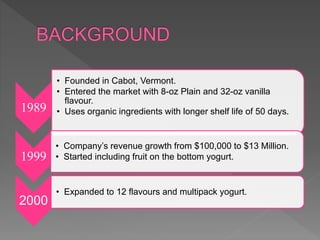
1989
• Founded in Cabot, Vermont.
• Entered the market with 8-oz Plain and 32-oz vanilla
flavour.
• Uses organic ingredients with longer shelf life of 50 days.
1999
• Company’s revenue growth from $100,000 to $13 Million.
• Started including fruit on the bottom yogurt.
2000
• Expanded to 12 flavours and multipack yogurt.
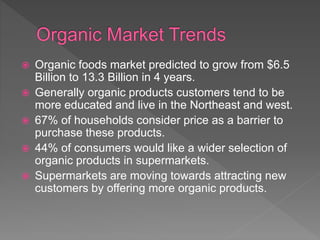
 Organic foods market predicted to grow from $6.5
Billion to 13.3 Billion in 4 years.
 Generally organic products customers tend to be
more educated and live in the Northeast and west.
 67% of households consider price as a barrier to
purchase these products.
 44% of consumers would like a wider selection of
organic products in supermarkets.
 Supermarkets are moving towards attracting new
customers by offering more organic products.
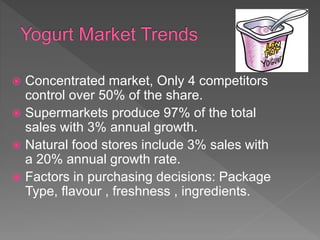
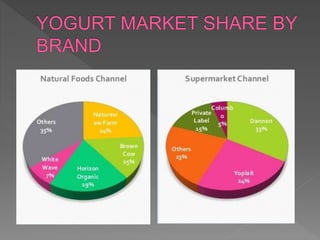
 Concentrated market, Only 4 competitors
control over 50% of the share.
 Supermarkets produce 97% of the total
sales with 3% annual growth.
 Natural food stores include 3% sales with
a 20% annual growth rate.
 Factors in purchasing decisions: Package
Type, flavour , freshness , ingredients.
 They have to make strategic marketing decisions to
grow revenues to $20 Million from their current $13
Million before the end of 2001.
 Target Market: Yogurt is consumed by 40% of the US
population. Among those 70% are women. Organic
dairy products are bought by 74% of heavy organic
buyers and 29% of light organic buyers.
 Attain highest possible valuation in order to secure new
investors or position itself for acquisition.
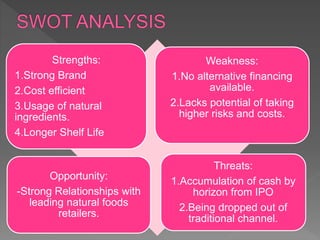
Strengths:
1.Strong Brand
2.Cost efficient
3.Usage of natural
ingredients.
4.Longer Shelf Life
Weakness:
1.No alternative financing
available.
2.Lacks potential of taking
higher risks and costs.
Opportunity:
-Strong Relationships with
leading natural foods
retailers.
Threats:
1.Accumulation of cash by
horizon from IPO
2.Being dropped out of
traditional channel.
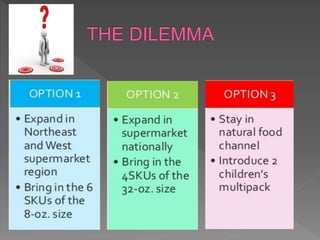
Expand 4 SKU’s of the
32-oz product line
nationally.
Expand 2 SKU’s of a
children’s multipack into the
natural foods channel.
 Go with Option 1-
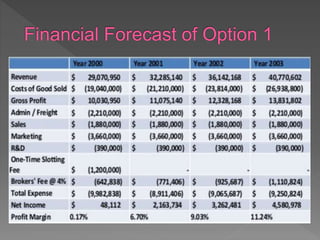
 Reach beyond the target objective of $20
Million revenue by the end of 2001with a
forecast of more than $31 Million.
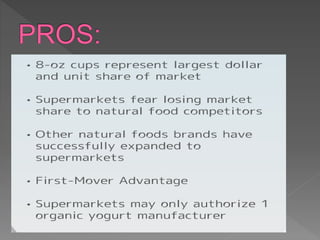
 8-oz yogurt is the highest demand.
 Supermarkets can expose to more range of
customers.
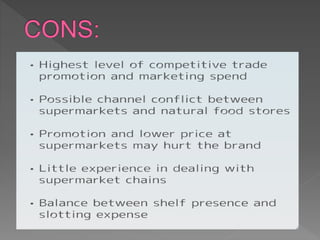
 A bit risky but in the long term will generate
revenues of 200%
This case study was compiled in marketing
management Internship course under the
guidance of Prof. Sameer Mathur (IIM Lucknow)
 By – Simarpreet Singh Chawla
 Thapar University(2nd Year)

Natureview Farm Case Study

  • 2.
    1989 • Founded inCabot, Vermont. • Entered the market with 8-oz Plain and 32-oz vanilla flavour. • Uses organic ingredients with longer shelf life of 50 days. 1999 • Company’s revenue growth from $100,000 to $13 Million. • Started including fruit on the bottom yogurt. 2000 • Expanded to 12 flavours and multipack yogurt.
  • 3.
     Organic foodsmarket predicted to grow from $6.5 Billion to 13.3 Billion in 4 years.  Generally organic products customers tend to be more educated and live in the Northeast and west.  67% of households consider price as a barrier to purchase these products.  44% of consumers would like a wider selection of organic products in supermarkets.  Supermarkets are moving towards attracting new customers by offering more organic products.
  • 4.
     Concentrated market,Only 4 competitors control over 50% of the share.  Supermarkets produce 97% of the total sales with 3% annual growth.  Natural food stores include 3% sales with a 20% annual growth rate.  Factors in purchasing decisions: Package Type, flavour , freshness , ingredients.
  • 5.
     They haveto make strategic marketing decisions to grow revenues to $20 Million from their current $13 Million before the end of 2001.  Target Market: Yogurt is consumed by 40% of the US population. Among those 70% are women. Organic dairy products are bought by 74% of heavy organic buyers and 29% of light organic buyers.  Attain highest possible valuation in order to secure new investors or position itself for acquisition.
  • 6.
    Strengths: 1.Strong Brand 2.Cost efficient 3.Usageof natural ingredients. 4.Longer Shelf Life Weakness: 1.No alternative financing available. 2.Lacks potential of taking higher risks and costs. Opportunity: -Strong Relationships with leading natural foods retailers. Threats: 1.Accumulation of cash by horizon from IPO 2.Being dropped out of traditional channel.
  • 14.
    Expand 4 SKU’sof the 32-oz product line nationally.
  • 18.
    Expand 2 SKU’sof a children’s multipack into the natural foods channel.
  • 22.
     Go withOption 1-  Reach beyond the target objective of $20 Million revenue by the end of 2001with a forecast of more than $31 Million.  8-oz yogurt is the highest demand.  Supermarkets can expose to more range of customers.  A bit risky but in the long term will generate revenues of 200%
  • 23.
    This case studywas compiled in marketing management Internship course under the guidance of Prof. Sameer Mathur (IIM Lucknow)  By – Simarpreet Singh Chawla  Thapar University(2nd Year)