Naturalistic
Observation
Topics Will be
Discuss
Introduction &
History
Types and
Variations
Examples and
Case Studies
Data Collection
Techniques
Challenges and
Limitations
Naturalistic Observation
 Present the historical
evolution and origins of
naturalistic observation
as a research method,
including its early use
and development.
 Cover the basic
principles and provide a
clear definition.
 Explain the various
types and variations of
naturalistic
observation, such as
structured versus
unstructured
observation, and how
they are applied in
research.
 Provide specific
examples and case
studies where
naturalistic observation
has been used
effectively to study
behaviors or
phenomena, illustrating
its practical
applications.
 Explain the various
techniques and
methods used for data
collection in
naturalistic
observation, including
the importance of
maintaining
objectivity.
 Explore the challenges
and limitations
associated with
naturalistic observation,
including issues like
observer interference,
time-consuming nature,
and potential bias
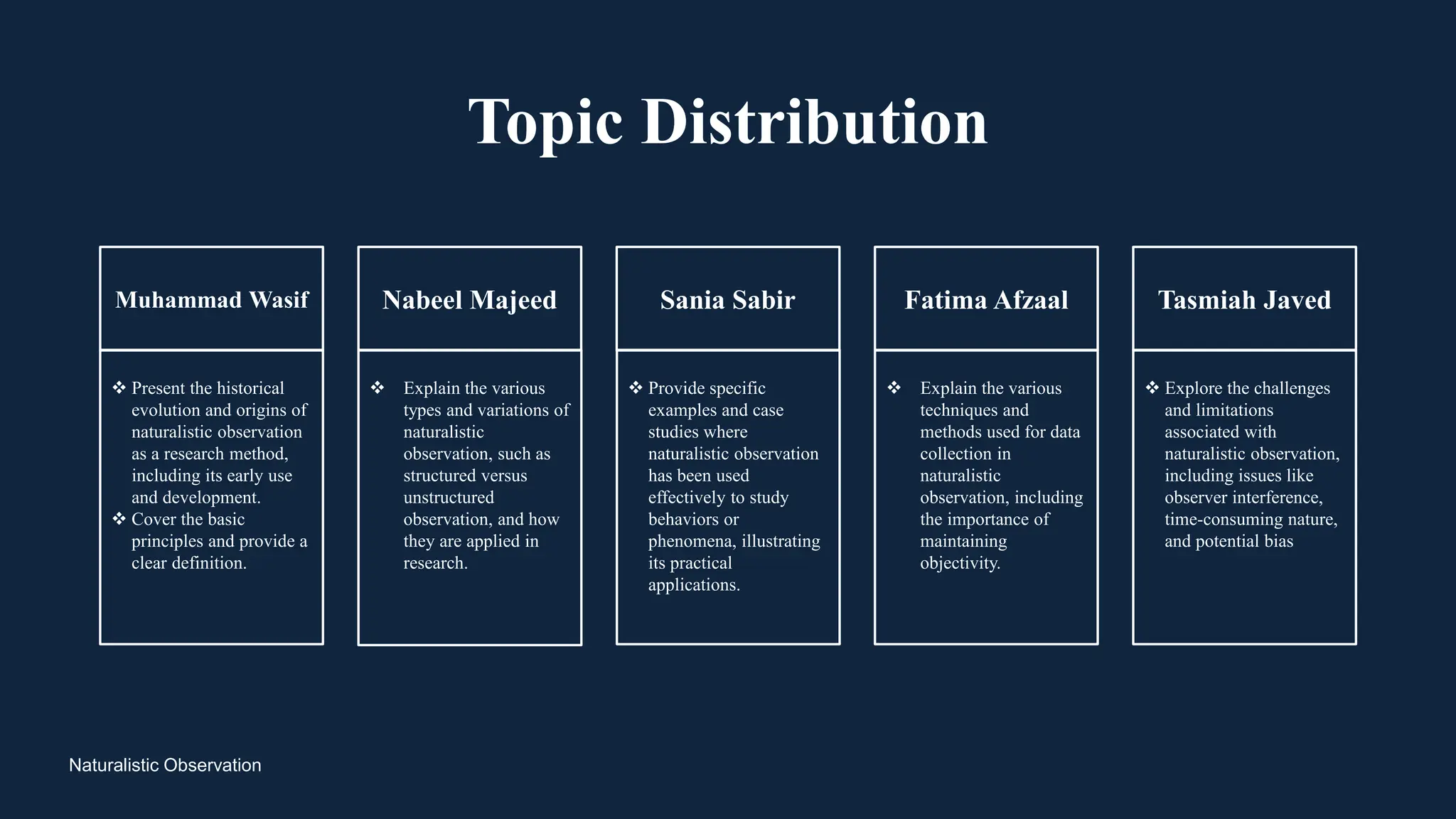
Muhammad Wasif
Topic Distribution
Nabeel Majeed Sania Sabir Fatima Afzaal Tasmiah Javed
Naturalistic Observation
Introduction &
History
Present the historical evolution and origins of
naturalistic observation as a research method,
including its early use and development.
Cover the basic principles and provide a clear
definition.
Introduction
Naturalistic observation is a research method in
psychology and other social sciences that involves
observing and recording the behavior of individuals or
groups in their natural environment. This method has a
rich historical evolution and origins dating back to the
late 19th and early 20th centuries
Naturalistic Observation 5
History of
Naturalistic
Observation
EVOLUTION AND
ORIGINS DATING
BACK TO THE
LATE 19TH AND
EARLY 20TH
CENTURIES
Evolution and origins
dating back to the
late 19th and early
20th centuries
Charles Darwin (1830s-1870s)
The foundations of naturalistic observation can be traced back to Charles
Darwin's work on evolution. His extensive observations of plants and animals in
their natural habitats influenced the development of this method.
William James (late 19th century)
Often referred to as the "Father of American Psychology," William James
emphasized the importance of studying behavior in its natural context. He
encouraged researchers to observe and describe human experiences and behavior
as they occur naturally.
Child Development Studies
Researchers like Jean Piaget and Lev Vygotsky employed naturalistic
observation in their studies of child development. They observed children in
natural settings to better understand cognitive and social development.
7
The Chicago School of Sociology (early 20th century)
Sociologists at the University of Chicago, including George Herbert Mead and
Charles Horton Cooley, adopted naturalistic observation to study human
behavior in urban settings. Their research contributed to the development of
symbolic interactionism and the understanding of social interactions.
“A research method in which behavior is observed and
documented in its natural environment without
manipulation by the researcher.”
Definition
Naturalistic Observation
Core Concepts:
1. Natural Environment
2. Non-Interference
3. Unobtrusive Observation
4. Description and Documentation
5. Contextual Understanding
6. Qualitative Data
7. Inductive Approach
8. Ecological Validity
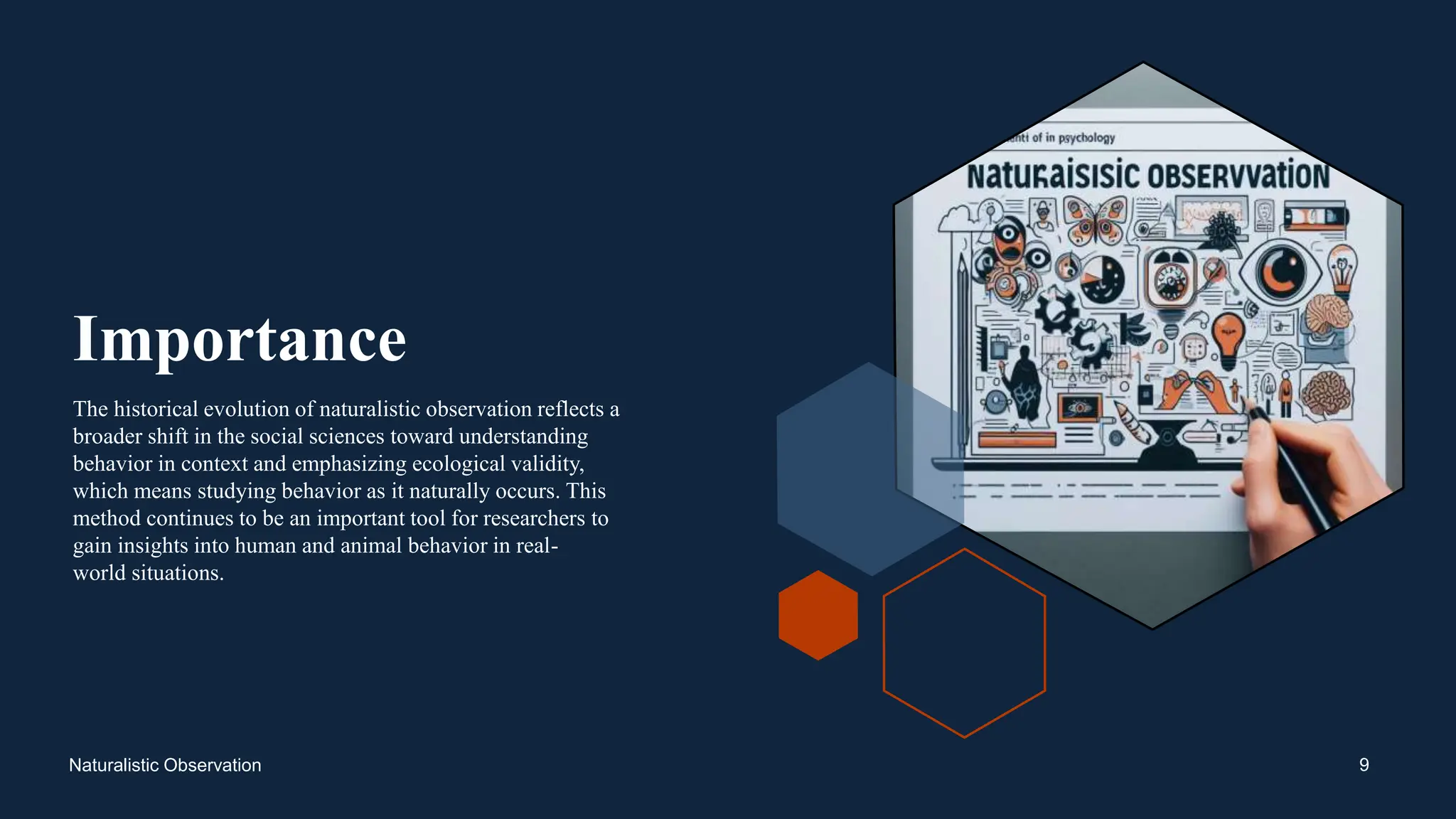
Importance
The historical evolution of naturalistic observation reflects a
broader shift in the social sciences toward understanding
behavior in context and emphasizing ecological validity,
which means studying behavior as it naturally occurs. This
method continues to be an important tool for researchers to
gain insights into human and animal behavior in real-
world situations.
Naturalistic Observation 9
Types and
Variations
 Explain the various types and variations of
naturalistic observation, such as structured
versus unstructured observation, and how they
are applied in research.
Types and
Variations
Participant Observation
The researcher becomes an active participant in the environment they are
observing. This allows them to gain a deeper understanding of the subject's
perspective.
Non-Participant Observation
In this approach, the researcher observes without directly participating in the
activities. This can be less intrusive but may limit the researcher's understanding
of the subject's experience.
Structured Observation
Researchers use specific criteria to guide their observations. This can include
checklists, coding systems, or predetermined categories for behaviors.
11
Observations are conducted without the subjects being aware they are being
observed. This reduces the chance of the "Hawthorne effect" (altering behavior
when aware of being observed) but can raise ethical concerns.
Researchers do not use predefined criteria, allowing for more open-ended and
exploratory observations. This approach can be more flexible but may require
more interpretive analysis.
Unstructured Observation
Hidden Observation
Types and
Variations
Systematic Sampling
Researchers collect data at specific time intervals or under specific conditions,
making it easier to analyze patterns and trends.
Event Sampling
Focusing on specific events or behaviors, researchers record when and how these
events occur
Time Sampling
Observations are made at specific time intervals, giving insights into the
prevalence of behaviors over time.
12
Using technology to capture observations can provide a more detailed and
accurate record of behavior. However, it may raise privacy and ethical concerns.
Detailed, written descriptions of the observed behaviors, context, and any other
relevant information are recorded during or after the observation.
Field Notes
Video or Audio Recording
Examples and Case
Studies
 Provide specific examples and case studies
where naturalistic observation has been used
effectively to study behaviors or phenomena,
illustrating its practical applications.
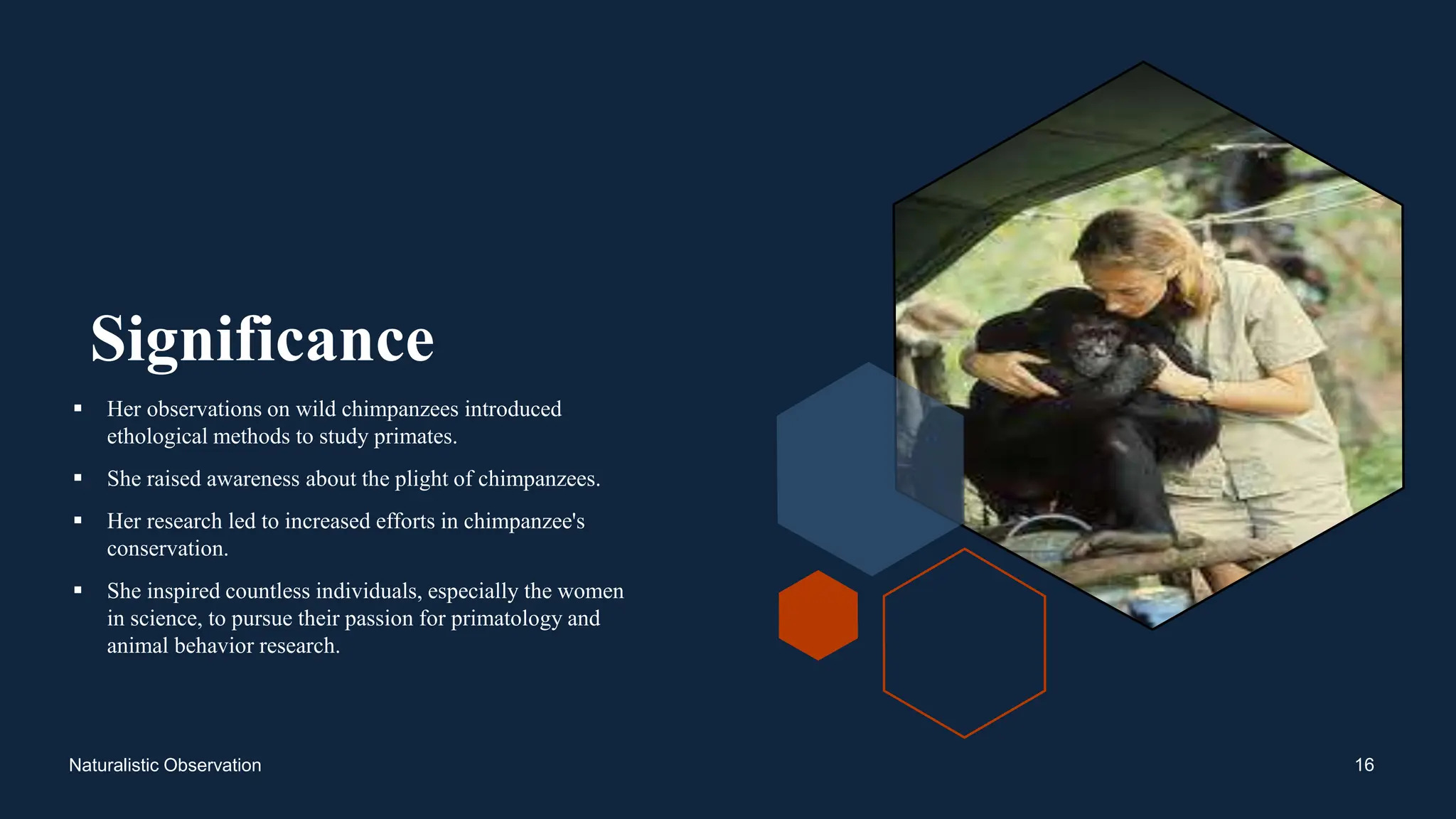
Jane Goodall's
Chimp Research
Introduction
 Jane Goodall's is renowned for her groundbreaking
research on Chimpanzees in Tanzania's Gombe
Stream National Park.
 She worked for several decades.
 Her work provided valuable insights into primate
behavior, communication and social structure.
 Her research had an enduring impact on the field of
primatology.
Naturalistic Observation 14
Naturalistic Observation
 In 1960, Jane went on her journey to observe and in the wild.
 Study Chimpanzees
 She had very formal scientific training.
 She established Gombe Stream Research center and began her research.
Background
Findings
 Tool use: She documented chimpanzees tools, such as sticks to using extract termites from mounds, revealing their
cognitive abilities.
 Social structures: Her research revealed the complex social hierarchies behaviors within chimpanzee communities, which
showed their. similarities to human societies.
 Communication: Her work demonstrated that chimpanzees had a rich collection of Vocalizations. and gestures, with
distinct me. meanings.
 Hunting: The documentation revealed Chimpanzee hunting and consuming meat challenge the idea that they were pulley
herbivorous.
 Conservation: Her long-term study on chimpanzees contributed to our understanding of their (long) lifespan and need for
their conservation efforts.
Significance
 Her observations on wild chimpanzees introduced
ethological methods to study primates.
 She raised awareness about the plight of chimpanzees.
 Her research led to increased efforts in chimpanzee's
conservation.
 She inspired countless individuals, especially the women
in science, to pursue their passion for primatology and
animal behavior research.
Naturalistic Observation 16
Data Collection
Techniques
 Explain the various techniques and methods
used for data collection in naturalistic
observation, including the importance of
maintaining objectivity.
Naturalistic Observation
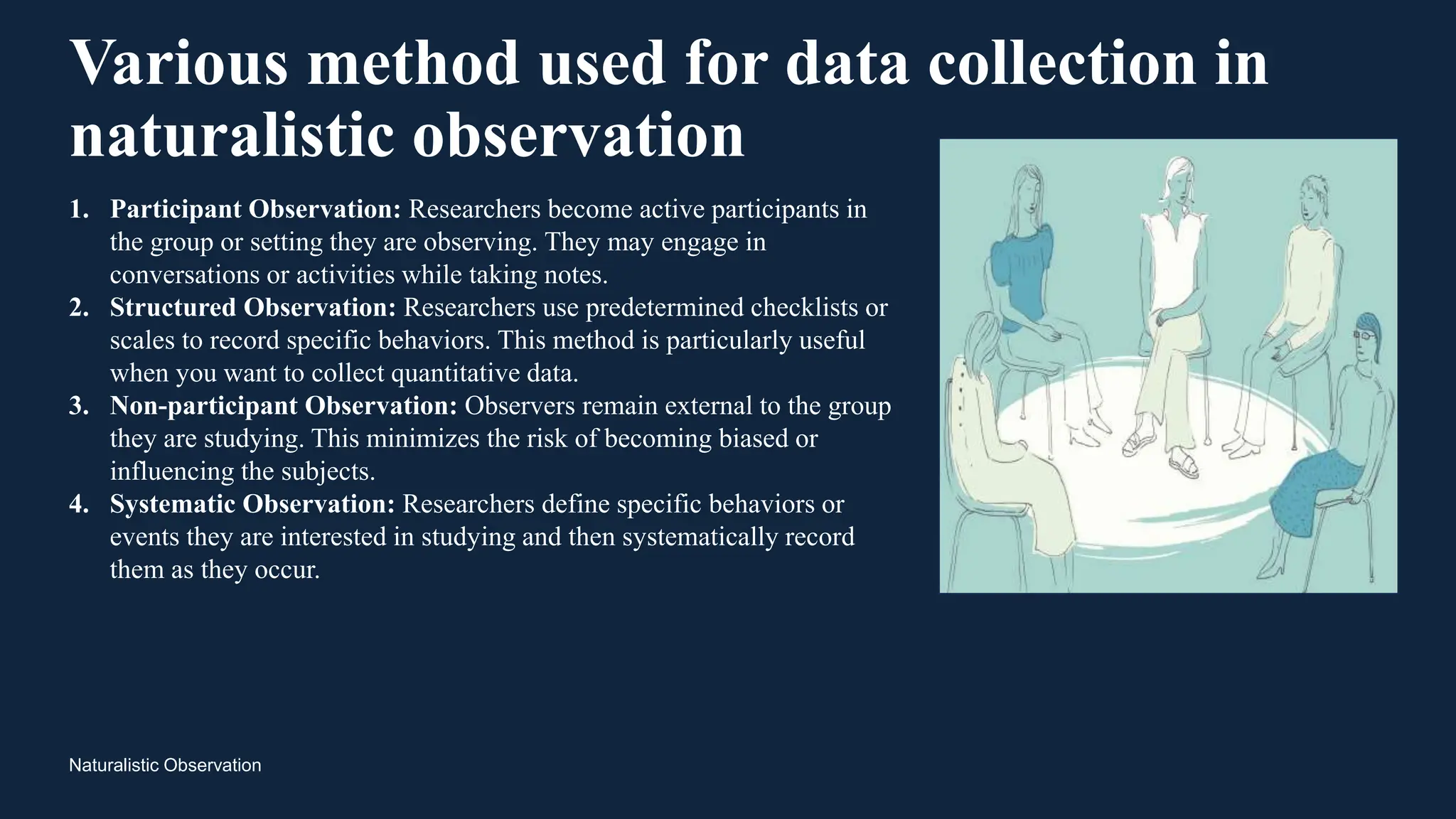
1. Participant Observation: Researchers become active participants in
the group or setting they are observing. They may engage in
conversations or activities while taking notes.
2. Structured Observation: Researchers use predetermined checklists or
scales to record specific behaviors. This method is particularly useful
when you want to collect quantitative data.
3. Non-participant Observation: Observers remain external to the group
they are studying. This minimizes the risk of becoming biased or
influencing the subjects.
4. Systematic Observation: Researchers define specific behaviors or
events they are interested in studying and then systematically record
them as they occur.
Various method used for data collection in
naturalistic observation
Naturalistic Observation
Reducing Bias: Objectivity is crucial to minimize bias in observations. Researchers should avoid imposing their own beliefs,
expectations, or interpretations on the data.
Reliability: Objectivity enhances the reliability of the data. Multiple observers can replicate the study, and if they maintain objectivity,
they should obtain similar results.
Validity: Maintaining objectivity ensures the validity of the observations. Valid data accurately represent the behaviors and
interactions being studied.
Ethical Considerations: Objectivity helps protect the rights and privacy of the observed individuals. Observers should avoid making
judgments or violating ethical standards.
Data Analysis: Objectively collected data are easier to analyze. Researchers can use statistical methods to draw meaningful
conclusions from the observations.
Generalizability: Objectivity in data collection enhances the generalizability of the findings. When observers are objective, the results
are more likely to apply to a broader population.
Transparency: Objectivity makes the research process more transparent.
Note:
In naturalistic observation, it's essential to strike a balance between maintaining objectivity and being immersed in the environment to
capture genuine behaviors. Clear objectives and a well-defined research plan are key to conducting effective and ethical naturalistic
observations while producing valuable insights into human behavior.
Importance of Maintaining Objectivity
Challenges and
Limitations
Explore the challenges and limitations
associated with naturalistic observation,
including issues like observer interference,
time-consuming nature, and potential bias
Naturalistic Observation
Challenges of naturalistic observation:
1. It allows researchers to directly observe individuals in their natural setting. People react differently when they find themselves in a situation that
takes them out of their comfort zone. Individuals in laboratory settings may even try to provide the specific results that researchers want – or do
the opposite and try to sabotage the project.
2. It gives scientists a first-hand look at social behavior. People will react differently in natural social situations compared to how they respond in
settings where they know their interactions are under observation. Social researchers can observe choices in the natural setting that may even let
them see things that may never occur in a laboratory setting. These unique observations can then inspire further investigation into specific
behaviors.
3. It allows researchers to study ideas that cannot be manipulated otherwise. Naturalistic observation makes it possible for researchers to study
concepts that could not be manipulated if they were in a lab setting because of the ethics involved. Take a study on prisoner behaviors as an
example of this.
4. It helps to support the external validity of a research effort. When social scientists are observing behavior, the choices made in a laboratory
setting do not always translate to a generalization found in the larger population or demographic behind studied. If the initial findings of a lab
setting can be seen in a natural setting under similar condition.
5. It allows for multiple methods of data collection. Researchers have a variety of techniques available to them when they need to collect data from
naturalistic observation methods. They might write down the number of times they see a specific choice or action during a specific time, make a
video recording of the individuals involved, or create an observer narrative which describes the session. Audio recordings are suitable in some
situations as well.
6. It creates the potential for more genuine reactions. Social scientists who use the naturalistic observation approach to their research can receive
realistic and accurate reactions from the individuals they track when compared to other methods of data collection. This process is even suitable
for non-human subjects
Naturalistic Observation
Limitations of naturalistic observation:
1. It can be challenging to control for outside variables. Perhaps the most significant disadvantage of
naturalistic observation is that researchers can sometimes struggle to determine what the exact cause
of behaviors or choices is due to the presence of outside variables.
2. It does not always generate accurate data. People will still react differently when they know that
they are under observation even though they are in a natural setting. There is an accountability
factor that humans have a sensitivity toward when dealing with personal choices, ethics, and
morality.
3. It may cause conformity concerns with the collected data. Some people will also attempt to behave
in a specific way or offer choices that they believe will conform to what their expectation is for the
purpose of the research study.
4. It creates information that can sometimes be subjective. When there are multiple observers of
behavior or choice involved in a research product, then each person could draw a different
conclusion from the same behaviors that everyone witnessed.
5. It takes more time to complete naturalistic observations. This research methods requires more of a
time commitment when compared to the other options available to social scientists. It takes longer
for specific choices or behaviors to appear, especially when someone can recall that they are under
observation.
6. It cannot account for observer bias. There are no firm conclusions available in the naturalistic
observation process because there is no way to account for observational bias. Although this
disadvantage applies to almost any research method, this option relies on the direct observation of
behavior to collect information.
Thank you
Any Question!

Naturalistic observation pesentation.pptx

  • 1.
  • 2.
    Topics Will be Discuss Introduction& History Types and Variations Examples and Case Studies Data Collection Techniques Challenges and Limitations Naturalistic Observation
  • 3.
     Present thehistorical evolution and origins of naturalistic observation as a research method, including its early use and development.  Cover the basic principles and provide a clear definition.  Explain the various types and variations of naturalistic observation, such as structured versus unstructured observation, and how they are applied in research.  Provide specific examples and case studies where naturalistic observation has been used effectively to study behaviors or phenomena, illustrating its practical applications.  Explain the various techniques and methods used for data collection in naturalistic observation, including the importance of maintaining objectivity.  Explore the challenges and limitations associated with naturalistic observation, including issues like observer interference, time-consuming nature, and potential bias Muhammad Wasif Topic Distribution Nabeel Majeed Sania Sabir Fatima Afzaal Tasmiah Javed Naturalistic Observation
  • 4.
    Introduction & History Present thehistorical evolution and origins of naturalistic observation as a research method, including its early use and development. Cover the basic principles and provide a clear definition.
  • 5.
    Introduction Naturalistic observation isa research method in psychology and other social sciences that involves observing and recording the behavior of individuals or groups in their natural environment. This method has a rich historical evolution and origins dating back to the late 19th and early 20th centuries Naturalistic Observation 5
  • 6.
    History of Naturalistic Observation EVOLUTION AND ORIGINSDATING BACK TO THE LATE 19TH AND EARLY 20TH CENTURIES
  • 7.
    Evolution and origins datingback to the late 19th and early 20th centuries Charles Darwin (1830s-1870s) The foundations of naturalistic observation can be traced back to Charles Darwin's work on evolution. His extensive observations of plants and animals in their natural habitats influenced the development of this method. William James (late 19th century) Often referred to as the "Father of American Psychology," William James emphasized the importance of studying behavior in its natural context. He encouraged researchers to observe and describe human experiences and behavior as they occur naturally. Child Development Studies Researchers like Jean Piaget and Lev Vygotsky employed naturalistic observation in their studies of child development. They observed children in natural settings to better understand cognitive and social development. 7 The Chicago School of Sociology (early 20th century) Sociologists at the University of Chicago, including George Herbert Mead and Charles Horton Cooley, adopted naturalistic observation to study human behavior in urban settings. Their research contributed to the development of symbolic interactionism and the understanding of social interactions.
  • 8.
    “A research methodin which behavior is observed and documented in its natural environment without manipulation by the researcher.” Definition Naturalistic Observation Core Concepts: 1. Natural Environment 2. Non-Interference 3. Unobtrusive Observation 4. Description and Documentation 5. Contextual Understanding 6. Qualitative Data 7. Inductive Approach 8. Ecological Validity
  • 9.
    Importance The historical evolutionof naturalistic observation reflects a broader shift in the social sciences toward understanding behavior in context and emphasizing ecological validity, which means studying behavior as it naturally occurs. This method continues to be an important tool for researchers to gain insights into human and animal behavior in real- world situations. Naturalistic Observation 9
  • 10.
    Types and Variations  Explainthe various types and variations of naturalistic observation, such as structured versus unstructured observation, and how they are applied in research.
  • 11.
    Types and Variations Participant Observation Theresearcher becomes an active participant in the environment they are observing. This allows them to gain a deeper understanding of the subject's perspective. Non-Participant Observation In this approach, the researcher observes without directly participating in the activities. This can be less intrusive but may limit the researcher's understanding of the subject's experience. Structured Observation Researchers use specific criteria to guide their observations. This can include checklists, coding systems, or predetermined categories for behaviors. 11 Observations are conducted without the subjects being aware they are being observed. This reduces the chance of the "Hawthorne effect" (altering behavior when aware of being observed) but can raise ethical concerns. Researchers do not use predefined criteria, allowing for more open-ended and exploratory observations. This approach can be more flexible but may require more interpretive analysis. Unstructured Observation Hidden Observation
  • 12.
    Types and Variations Systematic Sampling Researcherscollect data at specific time intervals or under specific conditions, making it easier to analyze patterns and trends. Event Sampling Focusing on specific events or behaviors, researchers record when and how these events occur Time Sampling Observations are made at specific time intervals, giving insights into the prevalence of behaviors over time. 12 Using technology to capture observations can provide a more detailed and accurate record of behavior. However, it may raise privacy and ethical concerns. Detailed, written descriptions of the observed behaviors, context, and any other relevant information are recorded during or after the observation. Field Notes Video or Audio Recording
  • 13.
    Examples and Case Studies Provide specific examples and case studies where naturalistic observation has been used effectively to study behaviors or phenomena, illustrating its practical applications.
  • 14.
    Jane Goodall's Chimp Research Introduction Jane Goodall's is renowned for her groundbreaking research on Chimpanzees in Tanzania's Gombe Stream National Park.  She worked for several decades.  Her work provided valuable insights into primate behavior, communication and social structure.  Her research had an enduring impact on the field of primatology. Naturalistic Observation 14
  • 15.
    Naturalistic Observation  In1960, Jane went on her journey to observe and in the wild.  Study Chimpanzees  She had very formal scientific training.  She established Gombe Stream Research center and began her research. Background Findings  Tool use: She documented chimpanzees tools, such as sticks to using extract termites from mounds, revealing their cognitive abilities.  Social structures: Her research revealed the complex social hierarchies behaviors within chimpanzee communities, which showed their. similarities to human societies.  Communication: Her work demonstrated that chimpanzees had a rich collection of Vocalizations. and gestures, with distinct me. meanings.  Hunting: The documentation revealed Chimpanzee hunting and consuming meat challenge the idea that they were pulley herbivorous.  Conservation: Her long-term study on chimpanzees contributed to our understanding of their (long) lifespan and need for their conservation efforts.
  • 16.
    Significance  Her observationson wild chimpanzees introduced ethological methods to study primates.  She raised awareness about the plight of chimpanzees.  Her research led to increased efforts in chimpanzee's conservation.  She inspired countless individuals, especially the women in science, to pursue their passion for primatology and animal behavior research. Naturalistic Observation 16
  • 17.
    Data Collection Techniques  Explainthe various techniques and methods used for data collection in naturalistic observation, including the importance of maintaining objectivity.
  • 18.
    Naturalistic Observation 1. ParticipantObservation: Researchers become active participants in the group or setting they are observing. They may engage in conversations or activities while taking notes. 2. Structured Observation: Researchers use predetermined checklists or scales to record specific behaviors. This method is particularly useful when you want to collect quantitative data. 3. Non-participant Observation: Observers remain external to the group they are studying. This minimizes the risk of becoming biased or influencing the subjects. 4. Systematic Observation: Researchers define specific behaviors or events they are interested in studying and then systematically record them as they occur. Various method used for data collection in naturalistic observation
  • 19.
    Naturalistic Observation Reducing Bias:Objectivity is crucial to minimize bias in observations. Researchers should avoid imposing their own beliefs, expectations, or interpretations on the data. Reliability: Objectivity enhances the reliability of the data. Multiple observers can replicate the study, and if they maintain objectivity, they should obtain similar results. Validity: Maintaining objectivity ensures the validity of the observations. Valid data accurately represent the behaviors and interactions being studied. Ethical Considerations: Objectivity helps protect the rights and privacy of the observed individuals. Observers should avoid making judgments or violating ethical standards. Data Analysis: Objectively collected data are easier to analyze. Researchers can use statistical methods to draw meaningful conclusions from the observations. Generalizability: Objectivity in data collection enhances the generalizability of the findings. When observers are objective, the results are more likely to apply to a broader population. Transparency: Objectivity makes the research process more transparent. Note: In naturalistic observation, it's essential to strike a balance between maintaining objectivity and being immersed in the environment to capture genuine behaviors. Clear objectives and a well-defined research plan are key to conducting effective and ethical naturalistic observations while producing valuable insights into human behavior. Importance of Maintaining Objectivity
  • 20.
    Challenges and Limitations Explore thechallenges and limitations associated with naturalistic observation, including issues like observer interference, time-consuming nature, and potential bias
  • 21.
    Naturalistic Observation Challenges ofnaturalistic observation: 1. It allows researchers to directly observe individuals in their natural setting. People react differently when they find themselves in a situation that takes them out of their comfort zone. Individuals in laboratory settings may even try to provide the specific results that researchers want – or do the opposite and try to sabotage the project. 2. It gives scientists a first-hand look at social behavior. People will react differently in natural social situations compared to how they respond in settings where they know their interactions are under observation. Social researchers can observe choices in the natural setting that may even let them see things that may never occur in a laboratory setting. These unique observations can then inspire further investigation into specific behaviors. 3. It allows researchers to study ideas that cannot be manipulated otherwise. Naturalistic observation makes it possible for researchers to study concepts that could not be manipulated if they were in a lab setting because of the ethics involved. Take a study on prisoner behaviors as an example of this. 4. It helps to support the external validity of a research effort. When social scientists are observing behavior, the choices made in a laboratory setting do not always translate to a generalization found in the larger population or demographic behind studied. If the initial findings of a lab setting can be seen in a natural setting under similar condition. 5. It allows for multiple methods of data collection. Researchers have a variety of techniques available to them when they need to collect data from naturalistic observation methods. They might write down the number of times they see a specific choice or action during a specific time, make a video recording of the individuals involved, or create an observer narrative which describes the session. Audio recordings are suitable in some situations as well. 6. It creates the potential for more genuine reactions. Social scientists who use the naturalistic observation approach to their research can receive realistic and accurate reactions from the individuals they track when compared to other methods of data collection. This process is even suitable for non-human subjects
  • 22.
    Naturalistic Observation Limitations ofnaturalistic observation: 1. It can be challenging to control for outside variables. Perhaps the most significant disadvantage of naturalistic observation is that researchers can sometimes struggle to determine what the exact cause of behaviors or choices is due to the presence of outside variables. 2. It does not always generate accurate data. People will still react differently when they know that they are under observation even though they are in a natural setting. There is an accountability factor that humans have a sensitivity toward when dealing with personal choices, ethics, and morality. 3. It may cause conformity concerns with the collected data. Some people will also attempt to behave in a specific way or offer choices that they believe will conform to what their expectation is for the purpose of the research study. 4. It creates information that can sometimes be subjective. When there are multiple observers of behavior or choice involved in a research product, then each person could draw a different conclusion from the same behaviors that everyone witnessed. 5. It takes more time to complete naturalistic observations. This research methods requires more of a time commitment when compared to the other options available to social scientists. It takes longer for specific choices or behaviors to appear, especially when someone can recall that they are under observation. 6. It cannot account for observer bias. There are no firm conclusions available in the naturalistic observation process because there is no way to account for observational bias. Although this disadvantage applies to almost any research method, this option relies on the direct observation of behavior to collect information.
  • 23.