WORLD BANK
Presented by;
Anju sapkota
Bph 4th year
Introduction
• The world bank is an internationally supported bank
that provides financial and technical assistance to
developing countries for development programs with
the stated goal of reducing poverty.
• “We are not a bank in the ordinary sense but a unique
partnership to reduce poverty and support
development”.
• The World Bank (WB) provides low-interest loans,
interest-free credit and grants to developing countries
Conti..
These loans are for education, health, infrastructure,
communications and many other purposes.
Unlike other financial institutions, WB does not operate
for profit.
The World Bank Group (WBG) is a family of five
international organizations that make leveraged loans to
developing countries.
World Bank generally refers to just the IBRD and IDA,
whereas the term World Bank Group or WBG is used to
refer to all five institutions collectively
Conti..
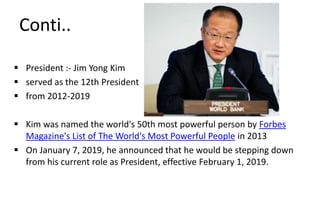
 President :- Jim Yong Kim
 served as the 12th President
 from 2012-2019
 Kim was named the world's 50th most powerful person by Forbes
Magazine's List of The World's Most Powerful People in 2013
 On January 7, 2019, he announced that he would be stepping down
from his current role as President, effective February 1, 2019.
Conti..
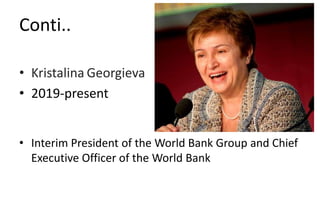
• Kristalina Georgieva
• 2019-present
• Interim President of the World Bank Group and Chief
Executive Officer of the World Bank
Conti..
• Established :- July 1,1944
• Headquarters :- Washington, DC
• Membership :- 189 countries (including Nepal
Sep 6, 1961 )
• offices in over 130 locations (world)
Structure
• The World Bank is made up of 189 member countries.
• These member countries, or shareholders are
represented by a Board of Governors, who are the
ultimate policymakers at the World Bank.
• Generally, the governors are member countries'
ministers of finance or ministers of development
• They meet once a year at the Annual Meetings of the
Boards of Governors of the World Bank Group and
the International Monetary Fund
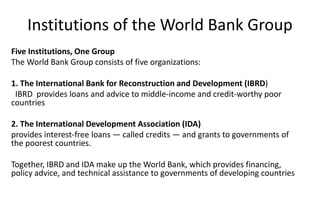
Institutions of the World Bank Group
Five Institutions, One Group
The World Bank Group consists of five organizations:
1. The International Bank for Reconstruction and Development (IBRD)
IBRD provides loans and advice to middle-income and credit-worthy poor
countries
2. The International Development Association (IDA)
provides interest-free loans — called credits — and grants to governments of
the poorest countries.
Together, IBRD and IDA make up the World Bank, which provides financing,
policy advice, and technical assistance to governments of developing countries
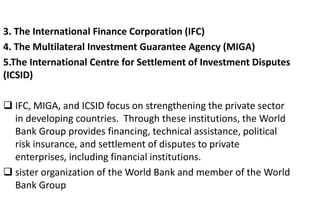
3. The International Finance Corporation (IFC)
4. The Multilateral Investment Guarantee Agency (MIGA)
5.The International Centre for Settlement of Investment Disputes
(ICSID)
 IFC, MIGA, and ICSID focus on strengthening the private sector
in developing countries. Through these institutions, the World
Bank Group provides financing, technical assistance, political
risk insurance, and settlement of disputes to private
enterprises, including financial institutions.
 sister organization of the World Bank and member of the World
Bank Group
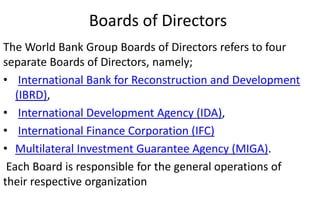
Boards of Directors
The World Bank Group Boards of Directors refers to four
separate Boards of Directors, namely;
• International Bank for Reconstruction and Development
(IBRD),
• International Development Agency (IDA),
• International Finance Corporation (IFC)
• Multilateral Investment Guarantee Agency (MIGA).
Each Board is responsible for the general operations of
their respective organization
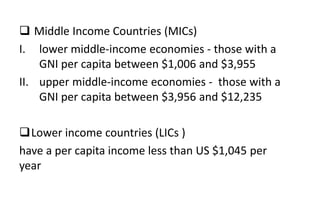
 Middle Income Countries (MICs)
I. lower middle-income economies - those with a
GNI per capita between $1,006 and $3,955
II. upper middle-income economies - those with a
GNI per capita between $3,956 and $12,235
Lower income countries (LICs )
have a per capita income less than US $1,045 per
year
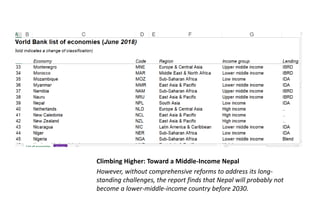
Climbing Higher: Toward a Middle-Income Nepal
However, without comprehensive reforms to address its long-
standing challenges, the report finds that Nepal will probably not
become a lower-middle-income country before 2030.
HISTORY
• Conceived in 1944 at the Bretton Woods Monetary Conference in Bretton
Woods, New Hampshire
• the World Bank’s initial aim was to help rebuild European countries
devastated by World War II.
• Its first loan was to France in 1947 for post-war reconstruction.
• In the 1950s and 60s, the funding of large infrastructure projects, such as
dams, electrical grids, irrigation systems, and roads was the Bank’s primary
focus.
• In the 1970s, the Bank shifted its attention to poverty eradication.
• In the 1980s, the Bank continued to enlarge its focus on issues of social
development
GOALS
• The World Bank Group has set goals for the
world to achieve by 2030:
End extreme poverty by decreasing the
percentage of people living on less than $1.90
a day to no more than 3%
Areas of operation
• Agriculture and Food
• Climate Change
• Disaster Risk
Management
• Education
• Energy
• Environment
• Extractive Industries
• Financial Inclusion
• Financial Sector
• Forests
• Fragility, Conflict, and
Violence
• Gender
• Governance
• Health
• Inequality and Shared
Prosperity
• Infrastructure & Public-Private
Partnerships
• Jobs & Development
• Macroeconomics and Fiscal
Management
• Nutrition
• Poverty
• Regional Integration
• Social Development
• Social Protection
• Trade
• Transport
• Urban Development
• Water
• Sanitation
• Water in Agriculture
• Water Resources
Management
Health
• The World Bank Group is committed to
helping governments achieve universal health
coverage (UHC) by 2030, which has the
potential to transform the health and well-
being of individuals and societies.
Strategy
• The Bank provides financing and policy advice to improve
service delivery and expand access to quality, affordable health
care.
• During the period from fiscal year 2000 to 2016, the World
Bank invested US$35 billion in the Health, Nutrition and
Population (HNP) related areas.
• The Bank currently manages an active HNP portfolio of
US$14.5 billion in net commitments, and over US$1 billion in
trust funds.
• The WBG has focused its health sector investments
and research in areas that are especially vital to
helping countries achieve UHC by 2030
• working closely with donors, development partners,
governments, and the private sector
FOCUS AREA
• Ending preventable maternal and child mortality
• Reducing stunting and improved nutrition for infants
and children
• Strengthening health systems and health financing
• Ensuring pandemic preparedness and response;
• Promoting sexual and reproductive health and rights
• The prevention and treatment of communicable
diseases.
Result
• During fiscal years 2011 to 2017, 602 million
people received essential health services
through the World Bank’s IDA funds
HEALTH RELATED PROJECT IN NEPAL
Nepal
country director:- Mr. Kenichi Ohashi
• The World Bank Yak & Yeti Hotel Complex
• Durbar Marg Kathmandu, Nepal
• (postal address: P.O. Box 798)
• Tel: (977-1) 4226792
• Fax: (977-1) 4225112
• E-mail: Kohashi@worldbank.org Web:
http://www.worldbank.org/np
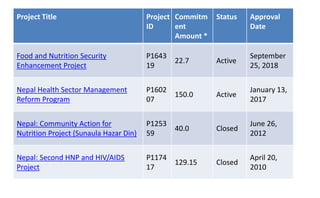
Project Title Project
ID
Commitm
ent
Amount *
Status Approval
Date
Food and Nutrition Security
Enhancement Project
P1643
19
22.7 Active
September
25, 2018
Nepal Health Sector Management
Reform Program
P1602
07
150.0 Active
January 13,
2017
Nepal: Community Action for
Nutrition Project (Sunaula Hazar Din)
P1253
59
40.0 Closed
June 26,
2012
Nepal: Second HNP and HIV/AIDS
Project
P1174
17
129.15 Closed
April 20,
2010
• * For active and closed projects, the commitment amount at Board
approval is shown in US$ millions.
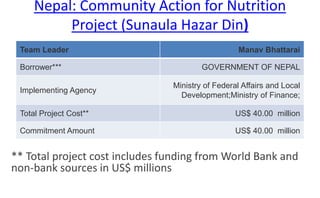
Nepal: Community Action for Nutrition
Project (Sunaula Hazar Din)
Team Leader Manav Bhattarai
Borrower*** GOVERNMENT OF NEPAL
Implementing Agency
Ministry of Federal Affairs and Local
Development;Ministry of Finance;
Total Project Cost** US$ 40.00 million
Commitment Amount US$ 40.00 million
** Total project cost includes funding from World Bank and
non-bank sources in US$ millions
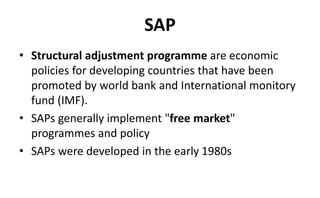
SAP
• Structural adjustment programme are economic
policies for developing countries that have been
promoted by world bank and International monitory
fund (IMF).
• SAPs generally implement "free market"
programmes and policy
• SAPs were developed in the early 1980s
Components of SAP
• Sharp cut in public spending (health education
communication)
• Lifting the price on staple food.
• Freezing of wages
• Production of food for export
• Liberalization of trade policies
• Efforts to attract foreign investors by tax breaks
• Privatization of public services
critisism
• It was started to reduce poverty but it support
United States’ business interests.
• The President of the Bank is always a citizen of
the United States.
• Thank you

World bank

  • 1.
    WORLD BANK Presented by; Anjusapkota Bph 4th year
  • 2.
    Introduction • The worldbank is an internationally supported bank that provides financial and technical assistance to developing countries for development programs with the stated goal of reducing poverty. • “We are not a bank in the ordinary sense but a unique partnership to reduce poverty and support development”. • The World Bank (WB) provides low-interest loans, interest-free credit and grants to developing countries
  • 3.
    Conti.. These loans arefor education, health, infrastructure, communications and many other purposes. Unlike other financial institutions, WB does not operate for profit. The World Bank Group (WBG) is a family of five international organizations that make leveraged loans to developing countries. World Bank generally refers to just the IBRD and IDA, whereas the term World Bank Group or WBG is used to refer to all five institutions collectively
  • 4.
    Conti..  President :-Jim Yong Kim  served as the 12th President  from 2012-2019  Kim was named the world's 50th most powerful person by Forbes Magazine's List of The World's Most Powerful People in 2013  On January 7, 2019, he announced that he would be stepping down from his current role as President, effective February 1, 2019.
  • 5.
    Conti.. • Kristalina Georgieva •2019-present • Interim President of the World Bank Group and Chief Executive Officer of the World Bank
  • 6.
    Conti.. • Established :-July 1,1944 • Headquarters :- Washington, DC • Membership :- 189 countries (including Nepal Sep 6, 1961 ) • offices in over 130 locations (world)
  • 7.
    Structure • The WorldBank is made up of 189 member countries. • These member countries, or shareholders are represented by a Board of Governors, who are the ultimate policymakers at the World Bank. • Generally, the governors are member countries' ministers of finance or ministers of development • They meet once a year at the Annual Meetings of the Boards of Governors of the World Bank Group and the International Monetary Fund
  • 8.
    Institutions of theWorld Bank Group Five Institutions, One Group The World Bank Group consists of five organizations: 1. The International Bank for Reconstruction and Development (IBRD) IBRD provides loans and advice to middle-income and credit-worthy poor countries 2. The International Development Association (IDA) provides interest-free loans — called credits — and grants to governments of the poorest countries. Together, IBRD and IDA make up the World Bank, which provides financing, policy advice, and technical assistance to governments of developing countries
  • 9.
    3. The InternationalFinance Corporation (IFC) 4. The Multilateral Investment Guarantee Agency (MIGA) 5.The International Centre for Settlement of Investment Disputes (ICSID)  IFC, MIGA, and ICSID focus on strengthening the private sector in developing countries. Through these institutions, the World Bank Group provides financing, technical assistance, political risk insurance, and settlement of disputes to private enterprises, including financial institutions.  sister organization of the World Bank and member of the World Bank Group
  • 10.
    Boards of Directors TheWorld Bank Group Boards of Directors refers to four separate Boards of Directors, namely; • International Bank for Reconstruction and Development (IBRD), • International Development Agency (IDA), • International Finance Corporation (IFC) • Multilateral Investment Guarantee Agency (MIGA). Each Board is responsible for the general operations of their respective organization
  • 11.
     Middle IncomeCountries (MICs) I. lower middle-income economies - those with a GNI per capita between $1,006 and $3,955 II. upper middle-income economies - those with a GNI per capita between $3,956 and $12,235 Lower income countries (LICs ) have a per capita income less than US $1,045 per year
  • 12.
    Climbing Higher: Towarda Middle-Income Nepal However, without comprehensive reforms to address its long- standing challenges, the report finds that Nepal will probably not become a lower-middle-income country before 2030.
  • 13.
    HISTORY • Conceived in1944 at the Bretton Woods Monetary Conference in Bretton Woods, New Hampshire • the World Bank’s initial aim was to help rebuild European countries devastated by World War II. • Its first loan was to France in 1947 for post-war reconstruction. • In the 1950s and 60s, the funding of large infrastructure projects, such as dams, electrical grids, irrigation systems, and roads was the Bank’s primary focus. • In the 1970s, the Bank shifted its attention to poverty eradication. • In the 1980s, the Bank continued to enlarge its focus on issues of social development
  • 14.
    GOALS • The WorldBank Group has set goals for the world to achieve by 2030: End extreme poverty by decreasing the percentage of people living on less than $1.90 a day to no more than 3%
  • 15.
    Areas of operation •Agriculture and Food • Climate Change • Disaster Risk Management • Education • Energy • Environment • Extractive Industries • Financial Inclusion • Financial Sector • Forests • Fragility, Conflict, and Violence • Gender • Governance
  • 16.
    • Health • Inequalityand Shared Prosperity • Infrastructure & Public-Private Partnerships • Jobs & Development • Macroeconomics and Fiscal Management • Nutrition • Poverty • Regional Integration • Social Development • Social Protection • Trade • Transport • Urban Development • Water • Sanitation • Water in Agriculture • Water Resources Management
  • 17.
    Health • The WorldBank Group is committed to helping governments achieve universal health coverage (UHC) by 2030, which has the potential to transform the health and well- being of individuals and societies.
  • 18.
    Strategy • The Bankprovides financing and policy advice to improve service delivery and expand access to quality, affordable health care. • During the period from fiscal year 2000 to 2016, the World Bank invested US$35 billion in the Health, Nutrition and Population (HNP) related areas. • The Bank currently manages an active HNP portfolio of US$14.5 billion in net commitments, and over US$1 billion in trust funds.
  • 19.
    • The WBGhas focused its health sector investments and research in areas that are especially vital to helping countries achieve UHC by 2030 • working closely with donors, development partners, governments, and the private sector
  • 20.
    FOCUS AREA • Endingpreventable maternal and child mortality • Reducing stunting and improved nutrition for infants and children • Strengthening health systems and health financing • Ensuring pandemic preparedness and response; • Promoting sexual and reproductive health and rights • The prevention and treatment of communicable diseases.
  • 21.
    Result • During fiscalyears 2011 to 2017, 602 million people received essential health services through the World Bank’s IDA funds
  • 22.
  • 23.
    Nepal country director:- Mr.Kenichi Ohashi • The World Bank Yak & Yeti Hotel Complex • Durbar Marg Kathmandu, Nepal • (postal address: P.O. Box 798) • Tel: (977-1) 4226792 • Fax: (977-1) 4225112 • E-mail: Kohashi@worldbank.org Web: http://www.worldbank.org/np
  • 24.
    Project Title Project ID Commitm ent Amount* Status Approval Date Food and Nutrition Security Enhancement Project P1643 19 22.7 Active September 25, 2018 Nepal Health Sector Management Reform Program P1602 07 150.0 Active January 13, 2017 Nepal: Community Action for Nutrition Project (Sunaula Hazar Din) P1253 59 40.0 Closed June 26, 2012 Nepal: Second HNP and HIV/AIDS Project P1174 17 129.15 Closed April 20, 2010
  • 25.
    • * Foractive and closed projects, the commitment amount at Board approval is shown in US$ millions.
  • 26.
    Nepal: Community Actionfor Nutrition Project (Sunaula Hazar Din) Team Leader Manav Bhattarai Borrower*** GOVERNMENT OF NEPAL Implementing Agency Ministry of Federal Affairs and Local Development;Ministry of Finance; Total Project Cost** US$ 40.00 million Commitment Amount US$ 40.00 million ** Total project cost includes funding from World Bank and non-bank sources in US$ millions
  • 27.
    SAP • Structural adjustmentprogramme are economic policies for developing countries that have been promoted by world bank and International monitory fund (IMF). • SAPs generally implement "free market" programmes and policy • SAPs were developed in the early 1980s
  • 28.
    Components of SAP •Sharp cut in public spending (health education communication) • Lifting the price on staple food. • Freezing of wages • Production of food for export • Liberalization of trade policies • Efforts to attract foreign investors by tax breaks • Privatization of public services
  • 29.
    critisism • It wasstarted to reduce poverty but it support United States’ business interests. • The President of the Bank is always a citizen of the United States.
  • 30.

Editor's Notes

  • #3 DONATION
  • #4 use (something) to maximum advantage
  • #13 lending
  • #14 Bretton Woods is an area within the town of Carroll, New Hampshire, United Stat
  • #15 Promote shared prosperity by fostering the income growth of the bottom 40% for every country
  • #29  removal or loosening of restrictions on something, typically an economic or political system