NATIONAL
HEALTH PROGRAMS
IN
INDIA
AN INTRODUCTION
Dr. Jasminkumar Viramgami
Reader & H.O.D.,
Dept. of Swasthavritta,
Govt. Akhandanand Ayurved College, Ahmedabad, Gujarat
Dr. J M Viramgami, Reader Swasthavritta, GAAC
Follow us:
Facebook:
• https://fb.me/SwasthavrittaGAAC
Youtube:
• https://www.youtube.com/channel/UCPvrBlyheQcqwBXs1egxzWw
SlideShare:
• https://www.slideshare.net/SwasthvrittaAkhandan
Dr. J M Viramgami, Reader Swasthavritta, GAAC
Introduction
• Ever since India became free, Govt. of
India has been putting various efforts to
improve (to promote) the health status of
the people.
• Prominent among these measures are the
National Health Programmes.
• As per the recommendations of Bhore
Committee,
• Govt. of India formulated and launched
specific programs right from the inception
of Five Year Plans (from 1951)
Dr. J M Viramgami, Reader Swasthavritta, GAAC
• Launched by Central Govt. to improve the
health of the people.
• Technical, Material assistance and Financial
help is also provided by---
International agencies like- WHO, UNICEF,
UNFPA, World Bank
Foreign agencies like-SIDA, DANIDA, NORAD,
USAID
Sometime helped by Non-Govt. & Other
agencies.
Dr. J M Viramgami, Reader Swasthavritta, GAAC
Reasons
•To control/Eradication of communicable
diseases and health problems
•Improvement of environmental sanitation
•Raising the standard of nutrition
•Control of population
•Improving rural health
Dr. J M Viramgami, Reader Swasthavritta, GAAC
Why National HealthPrograms?
• Disease burden is high
• Geographical spread
• Proven strategies for prevention and control
are available
• Adequate infrastructure is in place
• Resources for programme implementation are
available.
Dr. J M Viramgami, Reader Swasthavritta, GAAC
NHPs are of three kinds:
• 100 % centrally sponsored, but implementation
by State Govt.
• 50:50 centrally sponsored, implementation by
State Govt. 50 % expenses incurred by Central
Govt. and remaining 50 % by the State Govt.
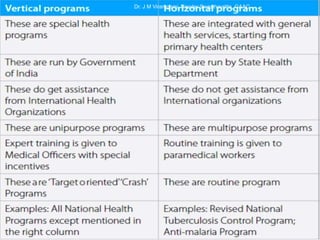
• Vertical programs: In this type both the
implementation and incurring expenditure is by
the Central Govt. only.
Dr. J M Viramgami, Reader Swasthavritta, GAAC
Vertical Health Programs
• Separate Health Structures with strong central
management dedicated to the planning, management
& implementation of selected interventions
Advantages
• Clear objectives & targets motivates the staff
• Operational planning is focused & easy to deliver
• Efficient & effective delivery
• Better ability to monitor restricted output
Dr. J M Viramgami, Reader Swasthavritta, GAAC
Disadvantages
• No capacity to accommodate extra work in
disasters
• Resources used for specific activities only
• De-skilling of health worker
• No focus on overall development
• Dependent on donors for funding
• Placement of workers after completion-
Challenging
• Long term public motivation not sustained
• May not be cost effective in long run
Dr. J M Viramgami, Reader Swasthavritta, GAAC
Integrated Health Programs
Advantages
• Help national development on a broader
perspective
• Incorporates multi-dimensional concept of health
• Efficient & effective delivery through inter-sectoral
collaboration
• Has capacity to accommodate extra work
• Responds to community needs
• Cost effective in long run
Dr. J M Viramgami, Reader Swasthavritta, GAAC
• Sometimes fail to target priority
effectively
• Complex programming may lead to more
failure
• Lack of expertise in integrated
programme management
Disadvantages
Dr. J M Viramgami, Reader Swasthavritta, GAAC
Types of Programs
• Programmes for Communicable Diseases
• Programmes for Non Communicable
Diseases
• National Nutritional Programs
• Program related to System Strengthening
/ Welfare/ Other
• National Health Policies
Dr. J M Viramgami, Reader Swasthavritta, GAAC
Programmes for Communicable Diseases
• National Vector Borne Diseases Control Programme
(NVBDCP)
• Revised National Tuberculosis Control Programme
(RNTCP)
• National Leprosy Eradication Programme (NLEP)
• National AIDS Control Programme (NACP)
• Universal Immunization Programme (UIP)
• National Guinea worm Eradication Programme
• Yaws Control Programme
Dr. J M Viramgami, Reader Swasthavritta, GAAC
• Integrated Disease Surveillance Programme
• National Polio Eradication Program
(1995)
• National Acute Respiratory Infections
Control Program
• National Diarrheal Disease Control
Program
Dr. J M Viramgami, Reader Swasthavritta, GAAC
Programmes for Non Communicable Diseases
• National Cancer Control Program
• National Mental Health Program
• National Diabetes Control Program
• National Program for Control and treatment of
Occupational Diseases
• National Program for Control of Blindness
• National program for control of diabetes,
cardiovascular disease and stroke
• National program for prevention and control of
deafness
Dr. J M Viramgami, Reader Swasthavritta, GAAC
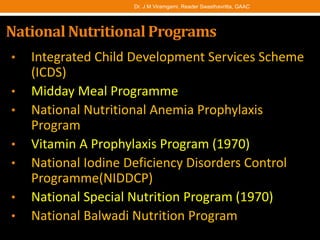
National Nutritional Programs
• Integrated Child Development Services Scheme
(ICDS)
• Midday Meal Programme
• National Nutritional Anemia Prophylaxis
Program
• Vitamin A Prophylaxis Program (1970)
• National Iodine Deficiency Disorders Control
Programme(NIDDCP)
• National Special Nutrition Program (1970)
• National Balwadi Nutrition Program
Dr. J M Viramgami, Reader Swasthavritta, GAAC
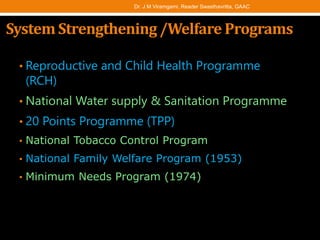
System Strengthening /Welfare Programs
• Reproductive and Child Health Programme
(RCH)
• National Water supply & Sanitation Programme
• 20 Points Programme (TPP)
• National Tobacco Control Program
• National Family Welfare Program (1953)
• Minimum Needs Program (1974)
Dr. J M Viramgami, Reader Swasthavritta, GAAC
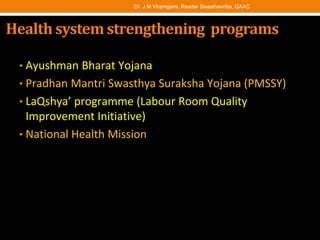
Health system strengthening programs
• Ayushman Bharat Yojana
• Pradhan Mantri Swasthya Suraksha Yojana (PMSSY)
• LaQshya’ programme (Labour Room Quality
Improvement Initiative)
• National Health Mission
Dr. J M Viramgami, Reader Swasthavritta, GAAC
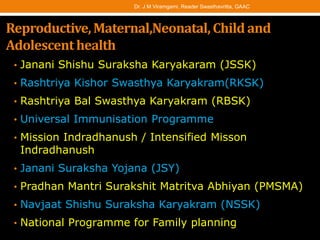
Reproductive,Maternal,Neonatal,Child and
Adolescenthealth
• Janani Shishu Suraksha Karyakaram (JSSK)
• Rashtriya Kishor Swasthya Karyakram(RKSK)
• Rashtriya Bal Swasthya Karyakram (RBSK)
• Universal Immunisation Programme
• Mission Indradhanush / Intensified Misson
Indradhanush
• Janani Suraksha Yojana (JSY)
• Pradhan Mantri Surakshit Matritva Abhiyan (PMSMA)
• Navjaat Shishu Suraksha Karyakram (NSSK)
• National Programme for Family planning
Dr. J M Viramgami, Reader Swasthavritta, GAAC
National Health Policies
• National Health Policy 2002
• National Population Policy 2000
• National AIDS control and Prevention Policy
• National Blood Policy
• National Policy for empowerment of Women 2001
• National Charter for Children
• National Youth Policy 2001998
• National Nutrition Policy
Dr. J M Viramgami, Reader Swasthavritta, GAAC
Follow us:
Facebook:
• https://fb.me/SwasthavrittaGAAC
Youtube:
• https://www.youtube.com/channel/UCPvrBlyheQcqwBXs1egxzWw
SlideShare:
• https://www.slideshare.net/SwasthvrittaAkhandan
THANK YOU
Dr. J M Viramgami, Reader Swasthavritta, GAAC
National Anti Malaria Programme
(NAMP)
• major public health problems in India.
• An organized national level program for its control in the
country has been in operation since 1953.
Dr. J M Viramgami, Reader Swasthavritta, GAAC
• Strategies included
active and passive search for malaria cases and their
treatment and
on door residual spraying with DDT twice a year in areas
worth splendid rate greater than 10%.
• The programme led to a significant reduction in malaria
cases in the country. From 75 million cases in 1953 the
incidence of malaria was brought to 2 million
Dr. J M Viramgami, Reader Swasthavritta, GAAC
National malaria eradication program
(NMEP)
• Encouraged by the excellent results achieved, the Govt. of
India launched NMEP in 1958 with the objective of
eradicating the disease from the country.
• The launch of NMEP paid back quick dividends by
bringing down malaria cases to 0.1 million and no deaths
due to malaria in the country within six years of its
implementation.
Dr. J M Viramgami, Reader Swasthavritta, GAAC
Vector control measures
these comprises of
measures against the adult mosquito,
measures against the larva and
educating the mass
Dr. J M Viramgami, Reader Swasthavritta, GAAC
Anti- adult measures
• Residual spraying: DDT, BHC, Malathion and fenitrothion
are used for indoor as well asoutdoor spraying.
• Space spraying: involves application of insecticides as fog
or mist using special spraying equipments.
Dr. J M Viramgami, Reader Swasthavritta, GAAC
Anti larval measures
• application of larvicidal oil(MLO) temephos in the
water collections every week
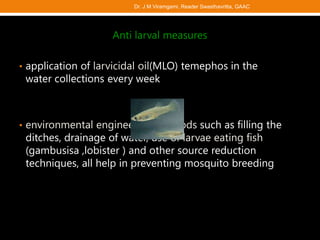
• environmental engineering methods such as filling the
ditches, drainage of water, use of larvae eating fish
(gambusisa ,lobister ) and other source reduction
techniques, all help in preventing mosquito breeding
Dr. J M Viramgami, Reader Swasthavritta, GAAC
Self protection
• protection from mosquito bites by various methods such
as mosquito repellanant creams , mosquito nets and fine
wire meshing of windows and doors , coils , full-length
clothes etc
Dr. J M Viramgami, Reader Swasthavritta, GAAC
National filarial control programme
• Lymphatic filariasis is endemic in 20 states and union
territories.
• The national filarial control programme has been in
operation since 1955
• In June 1978, the operational component of the NFCP
merged worth the urban malaria scheme for maximum
utilization of available resources
Dr. J M Viramgami, Reader Swasthavritta, GAAC
• Filarial control strategy includes
vector control through anti larval operations
source reduction
Detection and treatment of microfilaria carriers
morbidity management .
Dr. J M Viramgami, Reader Swasthavritta, GAAC
Revised filaria control strategy
• The strategy follows the who recommendation of annual
single doss mass drug therapy with DEC/DEC with
albendazole as supplement to existing NFCP strategy for 5
years or more in highly endemic districts to reduce
transmission of filaria to a very significant low level .
Dr. J M Viramgami, Reader Swasthavritta, GAAC
• In pursuit of achieving the goal of elimination of
lymphatic filariasis by 2015, govt of India has launched
nation wide mass drug administration (MDA) of DEC in
202 endemic districts of the country.
Dr. J M Viramgami, Reader Swasthavritta, GAAC
National Vector borne diseases Control
Programme (NVBDCP)
• concerned with the prevention and control of vector
borne diseases namely Malaria, Dengue, Kala azar,
Filariasis, Chikungunya fever and Japanese Encephalitis.
Dr. J M Viramgami, Reader Swasthavritta, GAAC
Strategy under NVBDCP
1. Disease management
2. Integrated Vector management (for transmission risk
reduction)
3. Supportive Interventions
Behaviour Change Communication(BCC)
Public Private Partnership(PPP)
Dr. J M Viramgami, Reader Swasthavritta, GAAC

National health programme intro

  • 1.
    NATIONAL HEALTH PROGRAMS IN INDIA AN INTRODUCTION Dr.Jasminkumar Viramgami Reader & H.O.D., Dept. of Swasthavritta, Govt. Akhandanand Ayurved College, Ahmedabad, Gujarat Dr. J M Viramgami, Reader Swasthavritta, GAAC
  • 2.
    Follow us: Facebook: • https://fb.me/SwasthavrittaGAAC Youtube: •https://www.youtube.com/channel/UCPvrBlyheQcqwBXs1egxzWw SlideShare: • https://www.slideshare.net/SwasthvrittaAkhandan Dr. J M Viramgami, Reader Swasthavritta, GAAC
  • 3.
    Introduction • Ever sinceIndia became free, Govt. of India has been putting various efforts to improve (to promote) the health status of the people. • Prominent among these measures are the National Health Programmes. • As per the recommendations of Bhore Committee, • Govt. of India formulated and launched specific programs right from the inception of Five Year Plans (from 1951) Dr. J M Viramgami, Reader Swasthavritta, GAAC
  • 4.
    • Launched byCentral Govt. to improve the health of the people. • Technical, Material assistance and Financial help is also provided by--- International agencies like- WHO, UNICEF, UNFPA, World Bank Foreign agencies like-SIDA, DANIDA, NORAD, USAID Sometime helped by Non-Govt. & Other agencies. Dr. J M Viramgami, Reader Swasthavritta, GAAC
  • 5.
    Reasons •To control/Eradication ofcommunicable diseases and health problems •Improvement of environmental sanitation •Raising the standard of nutrition •Control of population •Improving rural health Dr. J M Viramgami, Reader Swasthavritta, GAAC
  • 6.
    Why National HealthPrograms? •Disease burden is high • Geographical spread • Proven strategies for prevention and control are available • Adequate infrastructure is in place • Resources for programme implementation are available. Dr. J M Viramgami, Reader Swasthavritta, GAAC
  • 7.
    NHPs are ofthree kinds: • 100 % centrally sponsored, but implementation by State Govt. • 50:50 centrally sponsored, implementation by State Govt. 50 % expenses incurred by Central Govt. and remaining 50 % by the State Govt. • Vertical programs: In this type both the implementation and incurring expenditure is by the Central Govt. only. Dr. J M Viramgami, Reader Swasthavritta, GAAC
  • 8.
    Vertical Health Programs •Separate Health Structures with strong central management dedicated to the planning, management & implementation of selected interventions Advantages • Clear objectives & targets motivates the staff • Operational planning is focused & easy to deliver • Efficient & effective delivery • Better ability to monitor restricted output Dr. J M Viramgami, Reader Swasthavritta, GAAC
  • 9.
    Disadvantages • No capacityto accommodate extra work in disasters • Resources used for specific activities only • De-skilling of health worker • No focus on overall development • Dependent on donors for funding • Placement of workers after completion- Challenging • Long term public motivation not sustained • May not be cost effective in long run Dr. J M Viramgami, Reader Swasthavritta, GAAC
  • 10.
    Integrated Health Programs Advantages •Help national development on a broader perspective • Incorporates multi-dimensional concept of health • Efficient & effective delivery through inter-sectoral collaboration • Has capacity to accommodate extra work • Responds to community needs • Cost effective in long run Dr. J M Viramgami, Reader Swasthavritta, GAAC
  • 11.
    • Sometimes failto target priority effectively • Complex programming may lead to more failure • Lack of expertise in integrated programme management Disadvantages Dr. J M Viramgami, Reader Swasthavritta, GAAC
  • 12.
    Dr. J MViramgami, Reader Swasthavritta, GAAC
  • 13.
    Types of Programs •Programmes for Communicable Diseases • Programmes for Non Communicable Diseases • National Nutritional Programs • Program related to System Strengthening / Welfare/ Other • National Health Policies Dr. J M Viramgami, Reader Swasthavritta, GAAC
  • 14.
    Programmes for CommunicableDiseases • National Vector Borne Diseases Control Programme (NVBDCP) • Revised National Tuberculosis Control Programme (RNTCP) • National Leprosy Eradication Programme (NLEP) • National AIDS Control Programme (NACP) • Universal Immunization Programme (UIP) • National Guinea worm Eradication Programme • Yaws Control Programme Dr. J M Viramgami, Reader Swasthavritta, GAAC
  • 15.
    • Integrated DiseaseSurveillance Programme • National Polio Eradication Program (1995) • National Acute Respiratory Infections Control Program • National Diarrheal Disease Control Program Dr. J M Viramgami, Reader Swasthavritta, GAAC
  • 16.
    Programmes for NonCommunicable Diseases • National Cancer Control Program • National Mental Health Program • National Diabetes Control Program • National Program for Control and treatment of Occupational Diseases • National Program for Control of Blindness • National program for control of diabetes, cardiovascular disease and stroke • National program for prevention and control of deafness Dr. J M Viramgami, Reader Swasthavritta, GAAC
  • 17.
    National Nutritional Programs •Integrated Child Development Services Scheme (ICDS) • Midday Meal Programme • National Nutritional Anemia Prophylaxis Program • Vitamin A Prophylaxis Program (1970) • National Iodine Deficiency Disorders Control Programme(NIDDCP) • National Special Nutrition Program (1970) • National Balwadi Nutrition Program Dr. J M Viramgami, Reader Swasthavritta, GAAC
  • 18.
    System Strengthening /WelfarePrograms • Reproductive and Child Health Programme (RCH) • National Water supply & Sanitation Programme • 20 Points Programme (TPP) • National Tobacco Control Program • National Family Welfare Program (1953) • Minimum Needs Program (1974) Dr. J M Viramgami, Reader Swasthavritta, GAAC
  • 19.
    Health system strengtheningprograms • Ayushman Bharat Yojana • Pradhan Mantri Swasthya Suraksha Yojana (PMSSY) • LaQshya’ programme (Labour Room Quality Improvement Initiative) • National Health Mission Dr. J M Viramgami, Reader Swasthavritta, GAAC
  • 20.
    Reproductive,Maternal,Neonatal,Child and Adolescenthealth • JananiShishu Suraksha Karyakaram (JSSK) • Rashtriya Kishor Swasthya Karyakram(RKSK) • Rashtriya Bal Swasthya Karyakram (RBSK) • Universal Immunisation Programme • Mission Indradhanush / Intensified Misson Indradhanush • Janani Suraksha Yojana (JSY) • Pradhan Mantri Surakshit Matritva Abhiyan (PMSMA) • Navjaat Shishu Suraksha Karyakram (NSSK) • National Programme for Family planning Dr. J M Viramgami, Reader Swasthavritta, GAAC
  • 21.
    National Health Policies •National Health Policy 2002 • National Population Policy 2000 • National AIDS control and Prevention Policy • National Blood Policy • National Policy for empowerment of Women 2001 • National Charter for Children • National Youth Policy 2001998 • National Nutrition Policy Dr. J M Viramgami, Reader Swasthavritta, GAAC
  • 22.
    Follow us: Facebook: • https://fb.me/SwasthavrittaGAAC Youtube: •https://www.youtube.com/channel/UCPvrBlyheQcqwBXs1egxzWw SlideShare: • https://www.slideshare.net/SwasthvrittaAkhandan THANK YOU Dr. J M Viramgami, Reader Swasthavritta, GAAC
  • 23.
    National Anti MalariaProgramme (NAMP) • major public health problems in India. • An organized national level program for its control in the country has been in operation since 1953. Dr. J M Viramgami, Reader Swasthavritta, GAAC
  • 24.
    • Strategies included activeand passive search for malaria cases and their treatment and on door residual spraying with DDT twice a year in areas worth splendid rate greater than 10%. • The programme led to a significant reduction in malaria cases in the country. From 75 million cases in 1953 the incidence of malaria was brought to 2 million Dr. J M Viramgami, Reader Swasthavritta, GAAC
  • 25.
    National malaria eradicationprogram (NMEP) • Encouraged by the excellent results achieved, the Govt. of India launched NMEP in 1958 with the objective of eradicating the disease from the country. • The launch of NMEP paid back quick dividends by bringing down malaria cases to 0.1 million and no deaths due to malaria in the country within six years of its implementation. Dr. J M Viramgami, Reader Swasthavritta, GAAC
  • 26.
    Vector control measures thesecomprises of measures against the adult mosquito, measures against the larva and educating the mass Dr. J M Viramgami, Reader Swasthavritta, GAAC
  • 27.
    Anti- adult measures •Residual spraying: DDT, BHC, Malathion and fenitrothion are used for indoor as well asoutdoor spraying. • Space spraying: involves application of insecticides as fog or mist using special spraying equipments. Dr. J M Viramgami, Reader Swasthavritta, GAAC
  • 28.
    Anti larval measures •application of larvicidal oil(MLO) temephos in the water collections every week • environmental engineering methods such as filling the ditches, drainage of water, use of larvae eating fish (gambusisa ,lobister ) and other source reduction techniques, all help in preventing mosquito breeding Dr. J M Viramgami, Reader Swasthavritta, GAAC
  • 29.
    Self protection • protectionfrom mosquito bites by various methods such as mosquito repellanant creams , mosquito nets and fine wire meshing of windows and doors , coils , full-length clothes etc Dr. J M Viramgami, Reader Swasthavritta, GAAC
  • 30.
    National filarial controlprogramme • Lymphatic filariasis is endemic in 20 states and union territories. • The national filarial control programme has been in operation since 1955 • In June 1978, the operational component of the NFCP merged worth the urban malaria scheme for maximum utilization of available resources Dr. J M Viramgami, Reader Swasthavritta, GAAC
  • 31.
    • Filarial controlstrategy includes vector control through anti larval operations source reduction Detection and treatment of microfilaria carriers morbidity management . Dr. J M Viramgami, Reader Swasthavritta, GAAC
  • 32.
    Revised filaria controlstrategy • The strategy follows the who recommendation of annual single doss mass drug therapy with DEC/DEC with albendazole as supplement to existing NFCP strategy for 5 years or more in highly endemic districts to reduce transmission of filaria to a very significant low level . Dr. J M Viramgami, Reader Swasthavritta, GAAC
  • 33.
    • In pursuitof achieving the goal of elimination of lymphatic filariasis by 2015, govt of India has launched nation wide mass drug administration (MDA) of DEC in 202 endemic districts of the country. Dr. J M Viramgami, Reader Swasthavritta, GAAC
  • 34.
    National Vector bornediseases Control Programme (NVBDCP) • concerned with the prevention and control of vector borne diseases namely Malaria, Dengue, Kala azar, Filariasis, Chikungunya fever and Japanese Encephalitis. Dr. J M Viramgami, Reader Swasthavritta, GAAC
  • 35.
    Strategy under NVBDCP 1.Disease management 2. Integrated Vector management (for transmission risk reduction) 3. Supportive Interventions Behaviour Change Communication(BCC) Public Private Partnership(PPP) Dr. J M Viramgami, Reader Swasthavritta, GAAC

Editor's Notes

  • #2 Series of National Health Programs lectures