States,
Nations and
Globalization
PhilippinePoliticsandGovernance
Lesson4
Table of Contents
03
Nations
01
The Concept of State
02
Elements ofthe State
04
Globalization
The Concept of
State
01
Meaning of State
• A state is a community of persons more or less
numerous permanently occupying a definite portion of
territory, having a government of their own to which the
great body of inhabitants render obedience and enjoying
freedom from external control(DeLeon, Hector).
• a nation or territory considered as
an organized political community
under one government.
The Elements of
a State
02
Elements of a State
1. PEOPLEis the organization of human beings living
together as acommunity.
2. TERRITORY refers to the territorial domains over which
the state exercises control or sovereignty which includes
all the land, sea and airspace the state exercises
jurisdiction on.
Elements of a State
3. GOVERNMENTis an agency to which the political ideology
of the state is expressed and carried out.
4. SOVEREIGNTYit is the power of the state to enforce the
law over its people within its jurisdiction and demand
obedience from them.
Two Types of Sovereignty
1. Internal Sovereignty - the power of the state to
command authority within itsjurisdiction.
2. External Sovereignty - the power and freedom
of the state to carry out its activities without
foreign domination or control.
THE PHILIPPINE TERRITORY
Article 1 Section 1 of the 1987 Constitution states the NATIONALTERRITORYof
the Philippines:
Art.1 Sec.1 1997 Constitution NATIONALTERRITORY
The national territory comprises the Philippines archipelago, with all the
islands and waters embraced therein, and all other territories over
sovereignty or jurisdiction, consisting of its terrestrial, fluvial and aerial
domains, including its territorial sea, the seabed, the subsoil, the insular
shelves and other submarine areas. The waters around, between and
connecting the island of the archipelago, regardless of their breath and
dimensions form part of the internal waters of the Philippines.
Duties of the State
The following are the concerns of the state which are also
considered as itsduties or responsibilities.
1. Peace and order and nationalsecurity
2. Political harmony orgood laws
3. Social justice
4. Economic development
5. Individual and collective development ofpeople
The Concept
of Nation
03
THE CONCEPT OF NATION
Anation is a group of people bound
together by certain characteristicsand
shares the same history, ancestry,
culture, andlanguage.
THE CONCEPT OF NATION
“i
Benedict Anderson asserted that nations were
imagined communities” it is imagined because
even though people do not know each other or do
not meet all the members, they share the same
common history, culture, language and tradition
that are practiced by every member. They have
the same feelings of belongingness and talk the
same events that were part of their history even
though they were miles away from oneanother.
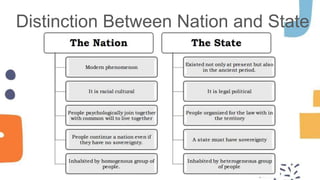
Distinction Between Nation and State
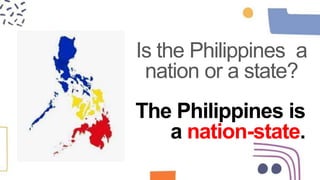
The Philippines is
a nation-state.
Is the Philippines a
nation or a state?
WHAT IS A NATION-STATE?
The Oxford English Dictionary defines nation-state as
“an independent political state formed from a
people who share a common national identity
(historically, culturally, or ethnically"
A nation-state is a self-governed
political entity occupied by people who
speak the same language and share a
commonhistory and culture.
The Concept of
Globalization
04
WHATISGLOBALIZATION?
Globalization is a process of
interaction and integration among
the people, companies, and
governments of different nations, a
process driven by international
trade and investment and aided by
information technology.
WHAT IS GLOBALIZATION?
Globalization is the gradual process
of political, economic and cultural
integration brought about by
increased trade, exchange of
ideas, and political relations among
the states of theworld.
Forms of GLOBALIZATION
1. Economic Globalization
Refers to the interconnectedness of
economies through trade and the
exchange of resources.
2. Cultural Globalization
-It is the process whereby information,
commodities and images that have been
produced in one part of the world enter
into a global flow that tends to ‘flatten
out’ cultural differences between
nations, regions andindividuals.
Forms of GLOBALIZATION
3. Political Globalization
-Refers to the amount of political co-
operation that exists between different
countries. This ties in with the belief that
“umbrella” global organizations are better
placed than individual states to prevent
conflict.
Forms of GLOBALIZATION
AdvantagesofGLOBALIZATION
1. Global politics opens up opportunities
for states to render aid to each
other, provides avenues for
dialogue and cooperation, and
ensures that states learn from
eachother.
Advantages of GLOBALIZATION
2. Economic globalization enables
emerging markets and industries to
thrive due to trade liberalization, and
provides states opportunities for
economic development.
AdvantagesofGLOBALIZATION
3. Cultural globalization has given
rise to a global community that
accepts and celebratesdiversity.
DisadvantagesofGLOBALIZATION
1. Critics of globalization consider it as a
detriment to the welfare of some
states, as global interests often run
counter to nationalinterest.
2. Economic globalization has rendered
some developing nations helpless in
the face of competitions in the
global market.
DisadvantagesofGLOBALIZATION
3. The supranational character of
globalization, likewise, is seen
as a limitation to national
sovereignty.
DisadvantagesofGLOBALIZATION
4. The refusal of powerful states to
abide by international law standards
also limits the effectiveness of
global cooperation
DisadvantagesofGLOBALIZATION

PPG - Lesson 4 State, Nation, and Globalization.pptx

  • 1.
  • 2.
    Table of Contents 03 Nations 01 TheConcept of State 02 Elements ofthe State 04 Globalization
  • 3.
  • 4.
    Meaning of State •A state is a community of persons more or less numerous permanently occupying a definite portion of territory, having a government of their own to which the great body of inhabitants render obedience and enjoying freedom from external control(DeLeon, Hector). • a nation or territory considered as an organized political community under one government.
  • 5.
  • 6.
    Elements of aState 1. PEOPLEis the organization of human beings living together as acommunity. 2. TERRITORY refers to the territorial domains over which the state exercises control or sovereignty which includes all the land, sea and airspace the state exercises jurisdiction on.
  • 7.
    Elements of aState 3. GOVERNMENTis an agency to which the political ideology of the state is expressed and carried out. 4. SOVEREIGNTYit is the power of the state to enforce the law over its people within its jurisdiction and demand obedience from them.
  • 8.
    Two Types ofSovereignty 1. Internal Sovereignty - the power of the state to command authority within itsjurisdiction. 2. External Sovereignty - the power and freedom of the state to carry out its activities without foreign domination or control.
  • 9.
    THE PHILIPPINE TERRITORY Article1 Section 1 of the 1987 Constitution states the NATIONALTERRITORYof the Philippines: Art.1 Sec.1 1997 Constitution NATIONALTERRITORY The national territory comprises the Philippines archipelago, with all the islands and waters embraced therein, and all other territories over sovereignty or jurisdiction, consisting of its terrestrial, fluvial and aerial domains, including its territorial sea, the seabed, the subsoil, the insular shelves and other submarine areas. The waters around, between and connecting the island of the archipelago, regardless of their breath and dimensions form part of the internal waters of the Philippines.
  • 10.
    Duties of theState The following are the concerns of the state which are also considered as itsduties or responsibilities. 1. Peace and order and nationalsecurity 2. Political harmony orgood laws 3. Social justice 4. Economic development 5. Individual and collective development ofpeople
  • 11.
  • 12.
    THE CONCEPT OFNATION Anation is a group of people bound together by certain characteristicsand shares the same history, ancestry, culture, andlanguage.
  • 13.
    THE CONCEPT OFNATION “i Benedict Anderson asserted that nations were imagined communities” it is imagined because even though people do not know each other or do not meet all the members, they share the same common history, culture, language and tradition that are practiced by every member. They have the same feelings of belongingness and talk the same events that were part of their history even though they were miles away from oneanother.
  • 14.
  • 15.
    The Philippines is anation-state. Is the Philippines a nation or a state?
  • 16.
    WHAT IS ANATION-STATE? The Oxford English Dictionary defines nation-state as “an independent political state formed from a people who share a common national identity (historically, culturally, or ethnically" A nation-state is a self-governed political entity occupied by people who speak the same language and share a commonhistory and culture.
  • 17.
  • 18.
    WHATISGLOBALIZATION? Globalization is aprocess of interaction and integration among the people, companies, and governments of different nations, a process driven by international trade and investment and aided by information technology.
  • 19.
    WHAT IS GLOBALIZATION? Globalizationis the gradual process of political, economic and cultural integration brought about by increased trade, exchange of ideas, and political relations among the states of theworld.
  • 20.
    Forms of GLOBALIZATION 1.Economic Globalization Refers to the interconnectedness of economies through trade and the exchange of resources.
  • 21.
    2. Cultural Globalization -Itis the process whereby information, commodities and images that have been produced in one part of the world enter into a global flow that tends to ‘flatten out’ cultural differences between nations, regions andindividuals. Forms of GLOBALIZATION
  • 22.
    3. Political Globalization -Refersto the amount of political co- operation that exists between different countries. This ties in with the belief that “umbrella” global organizations are better placed than individual states to prevent conflict. Forms of GLOBALIZATION
  • 23.
    AdvantagesofGLOBALIZATION 1. Global politicsopens up opportunities for states to render aid to each other, provides avenues for dialogue and cooperation, and ensures that states learn from eachother.
  • 24.
    Advantages of GLOBALIZATION 2.Economic globalization enables emerging markets and industries to thrive due to trade liberalization, and provides states opportunities for economic development.
  • 25.
    AdvantagesofGLOBALIZATION 3. Cultural globalizationhas given rise to a global community that accepts and celebratesdiversity.
  • 26.
    DisadvantagesofGLOBALIZATION 1. Critics ofglobalization consider it as a detriment to the welfare of some states, as global interests often run counter to nationalinterest.
  • 27.
    2. Economic globalizationhas rendered some developing nations helpless in the face of competitions in the global market. DisadvantagesofGLOBALIZATION
  • 28.
    3. The supranationalcharacter of globalization, likewise, is seen as a limitation to national sovereignty. DisadvantagesofGLOBALIZATION
  • 29.
    4. The refusalof powerful states to abide by international law standards also limits the effectiveness of global cooperation DisadvantagesofGLOBALIZATION