FREEDOM
OF THE
HUMAN PERSON
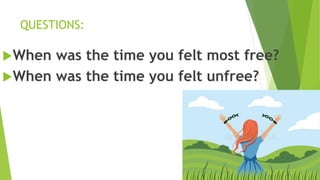
QUESTIONS:
When was the time you felt most free?
When was the time you felt unfree?
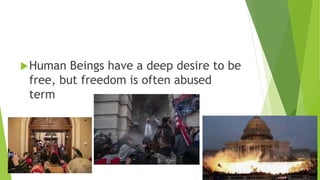
Human Beings have a deep desire to be
free, but freedom is often abused
term
Question:
What truly is freedom?
THE NATURE OF FREEDOM
 Does freedom means:
- The ability to choose our own government
- Being able to live our own personal
lifestyle.
- Being safe and secure from evils that
threaten us like disease, poverty, and
political expression.
MEANING OF FREEDOM Freedom
 is a word with many meanings.
 There is:
 Political
 Economic
 Social
 Emotional
 spiritual
QUESTIONS:
Does freedom mean the ability to do
whatever we choose? Or is it the
ability to do what we ought to do?
FREEDOM OF CHOICE
 Deals with freedom of thought
 Freedom of will
REAL FREEDOM
 Are we really free?
 We have to deal with freedom of
choice or freedom of will
PROBLEM OF FREEDOM AND
NECESSITY
 There is a conflict between our feeling of
freedom and the many reasons that seem
to suggest that our actions are not free.
 REWARD vs. PUNISHMENT
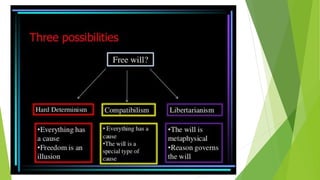
There are basically three views on
this issue between free will and
necessity:
 Determinism
Libertarianism
Compatibilism
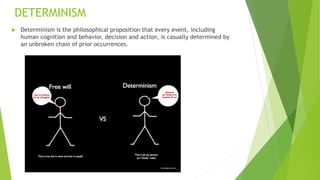
DETERMINISM
 Determinism is the philosophical proposition that every event, including
human cognition and behavior, decision and action, is casually determined by
an unbroken chain of prior occurrences.
LIBERTARIANISM
 Libertarianism is the view that humans have free will,
and that we have the freedom to choose what we
want, and that our choices are not pre-determined. It
allows the existence of the concepts of “good” and
“evil” because people have the capacity to do either
of those with the ability to have chosen the
alternative. Many religious people are Libertarianists
and some use the existence of free will as proof of a
divine creator.
An Example
 Suppose, that someone thinks that Bible forbids same-sex marriage. Rawls
would say that even if the majority agrees with this view, it can’t impose it
on others. They wouldn’t accept what the Bible says as a reason.
 This doesn’t mean you have to come up with reasons that absolutely
everyone could acknowledge. You only have t provide reasons to reasonable
people. Rawls calls this process public reason.
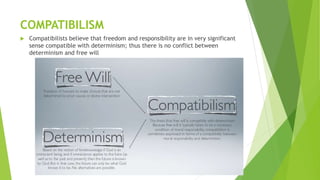
COMPATIBILISM
 Compatibilists believe that freedom and responsibility are in very significant
sense compatible with determinism; thus there is no conflict between
determinism and free will
Freedom
Freedom
Freedom
Freedom

Freedom

  • 1.
  • 2.
    QUESTIONS: When was thetime you felt most free? When was the time you felt unfree?
  • 4.
    Human Beings havea deep desire to be free, but freedom is often abused term
  • 5.
  • 6.
    THE NATURE OFFREEDOM  Does freedom means: - The ability to choose our own government - Being able to live our own personal lifestyle. - Being safe and secure from evils that threaten us like disease, poverty, and political expression.
  • 7.
    MEANING OF FREEDOMFreedom  is a word with many meanings.  There is:  Political  Economic  Social  Emotional  spiritual
  • 8.
    QUESTIONS: Does freedom meanthe ability to do whatever we choose? Or is it the ability to do what we ought to do?
  • 9.
    FREEDOM OF CHOICE Deals with freedom of thought  Freedom of will
  • 10.
    REAL FREEDOM  Arewe really free?  We have to deal with freedom of choice or freedom of will
  • 13.
    PROBLEM OF FREEDOMAND NECESSITY  There is a conflict between our feeling of freedom and the many reasons that seem to suggest that our actions are not free.  REWARD vs. PUNISHMENT
  • 14.
    There are basicallythree views on this issue between free will and necessity:  Determinism Libertarianism Compatibilism
  • 15.
    DETERMINISM  Determinism isthe philosophical proposition that every event, including human cognition and behavior, decision and action, is casually determined by an unbroken chain of prior occurrences.
  • 16.
    LIBERTARIANISM  Libertarianism isthe view that humans have free will, and that we have the freedom to choose what we want, and that our choices are not pre-determined. It allows the existence of the concepts of “good” and “evil” because people have the capacity to do either of those with the ability to have chosen the alternative. Many religious people are Libertarianists and some use the existence of free will as proof of a divine creator.
  • 17.
    An Example  Suppose,that someone thinks that Bible forbids same-sex marriage. Rawls would say that even if the majority agrees with this view, it can’t impose it on others. They wouldn’t accept what the Bible says as a reason.  This doesn’t mean you have to come up with reasons that absolutely everyone could acknowledge. You only have t provide reasons to reasonable people. Rawls calls this process public reason.
  • 18.
    COMPATIBILISM  Compatibilists believethat freedom and responsibility are in very significant sense compatible with determinism; thus there is no conflict between determinism and free will