Methods of Philosophy
Philosophy brings the human person to a
level of thinking and/or expression that
develops wisdom and further learning.
When you failed, for the first time, you
then realized what made you fail; and so,
the next time you are faced with a
similar situation, you already know
better how to approach it in order to
succeed.
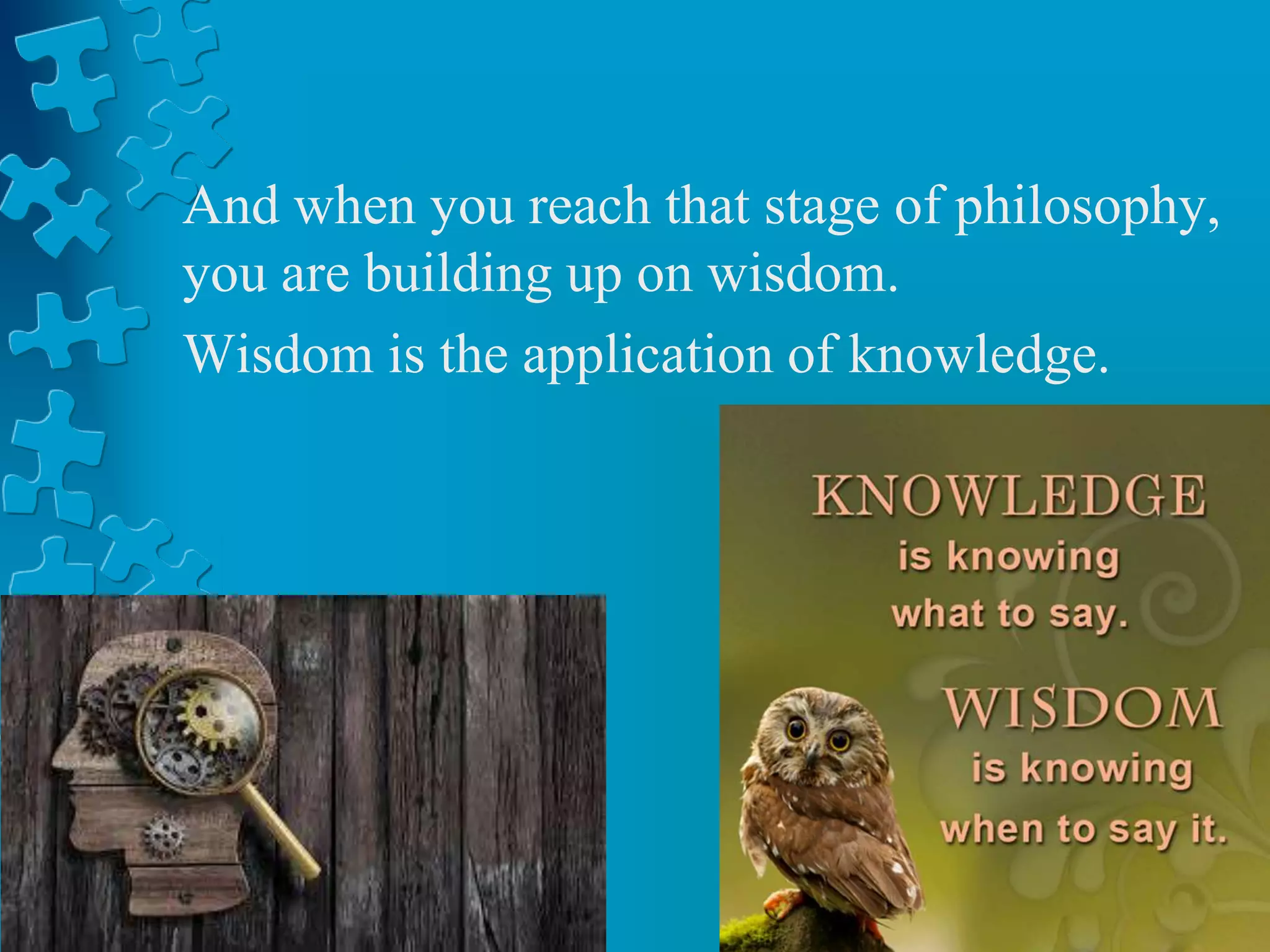
And when you reach that stage of philosophy,
you are building up on wisdom.
Wisdom is the application of knowledge.
• There are four different methods of
philosophizing
• logic,
• existentialism,
• analytic tradition, and
• phenomenology.
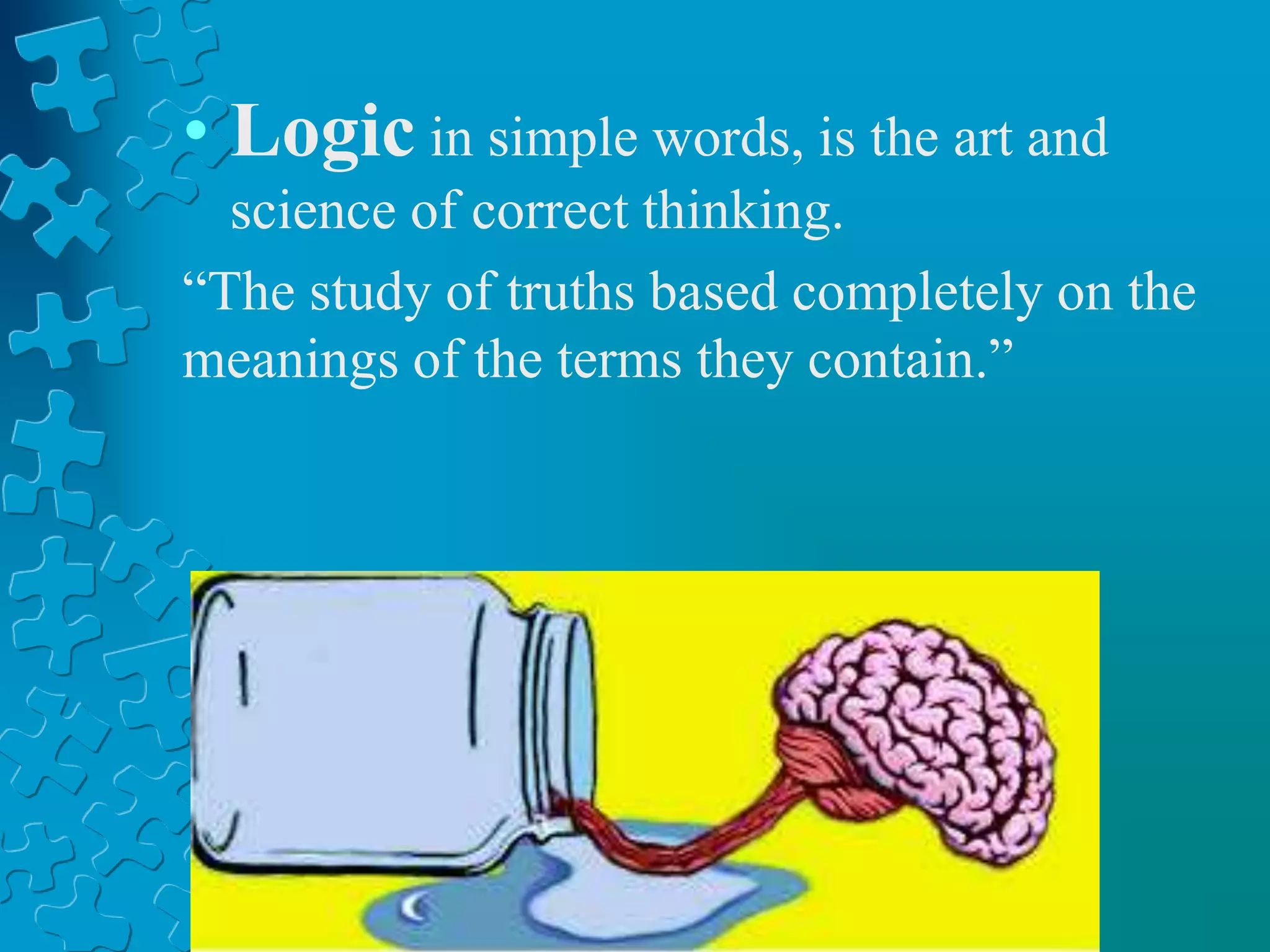
• Logic in simple words, is the art and
science of correct thinking.
“The study of truths based completely on the
meanings of the terms they contain.”
⚫ The foundation of a logical argument is its
proposition, or statement.
⚫ The proposition is either accurate (true) or
not accurate (false).
⚫ Premises are the propositions used to build
the argument.
⚫ The argument is then built on premises.
⚫ Then an inference is made from the
premises.
⚫ Finally, a conclusion is drawn.
Existentialism
• is a philosophical view that assert the
individuality of any human person making
him free to make choices of what he is and
what he can become.
• This means that you students are unique and
would most likely have a future that is true
to your own person and not what is being
dictated by your parent nor your friends.
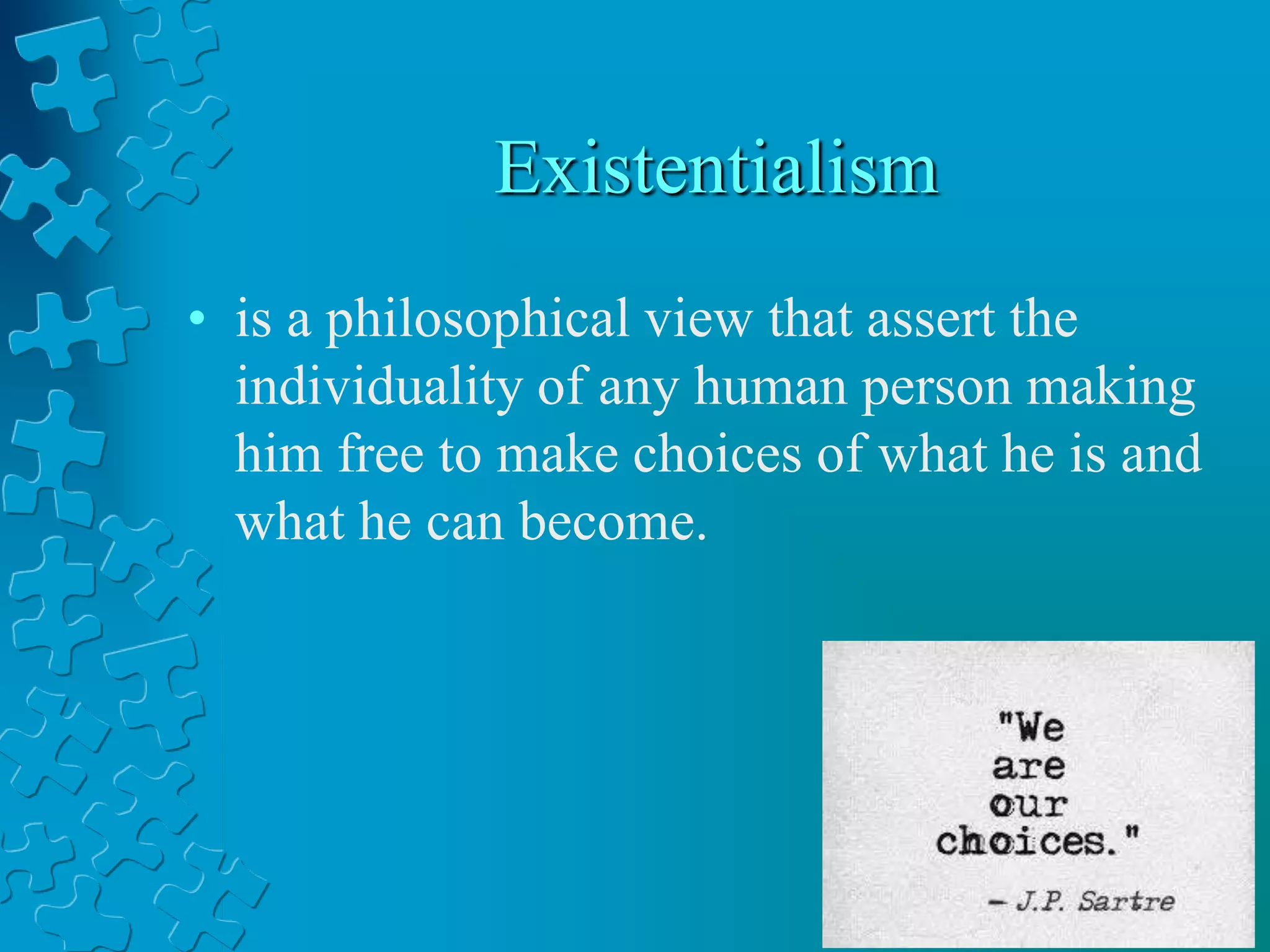
• At what Jean-Paul Sartre says, “Freedom is
the identity of man.”
• Existentialism teaches one enjoy freedom
but with due responsibility on what is
wrong and is right.
• Through this method, you can discover
more sets of truth without any limitations.
As a man who has freedom you must put to
mind that you are accountable of your
choices and decision in life.
Analytic Philosophy
• states that, “assumption of truth only
becomes true after it shall have gone
through validation, experimentation or any
scientific approach for that matter.
• In school setting for example, there are
questions teachers ask that may elicit
different responses, but there is only one
definite correct answer and this answer is
usually supported by a concept or a theory
which is a product of scientific process.
• Analytic Philosophy teaches you that it’s
not how you see things and how you
perceive them, but how they are processed
through rigorous and valid methods.
• Hence, exact truth is seen in the lens of due
scientific process.
• In life, you must remember that truth is
accompanied with process.
Phenomenology
• brings varied perceptions over a thing to a
common end that certain things no matter
how different the perspective of people
towards it due to their experiences would
receive justification to its being.
• For example, in this image you may look at
it as half full, some look at it as half empty.
This thing may appear in different
perspectives.
• In applying phenomenology, one must go
back to its original meaning or “thing-init-
self” (according to Encyclopedia) that is
simply a glass of water.
• Things may appear to you in different ways.
Yet, what is important is to see its essence.
• This phenomenological way brings you to
the essence of anything.
• Hence, also see the importance of the
things that you encounter for there is always
essential meaning why things exist.
• For you to make use of logic a tool in
understanding complex proposition
presented in statements or texts, you may
use two types of reasoning:
• DEDUCTIVE
• INDUCTIVE
Deductive Reasoning
• There are usually complex thoughts we
encounter, and it takes a hard time to
understand what is expressed in it.
• But with the help of deductive reasoning we
can chunk the entire thought into smaller
units to arrive at a simpler presentation.
• Examples
• Premises: All Teachers are smart people.
Some smart people are studious.
Conclusion: Some smart people are
teachers.
• Premises: All students are kind. Pedro is a
student.
• Conclusion: Pedro is kind.
Inductive Logic
• there are presentations of statements or
ideas wherein its specific details come first
before generalizations are being laid.
• In this case, use bottom up approach in
trying to understand the concept. "bottom
up," meaning that it takes specific
information and makes a broad
generalization that is considered probable,
allowing for the fact that the conclusion
may not be accurate.
• Premises: Peru is a drunkard. Lucky is one
of the brothers of Peru.
• Conclusion: In this case, you could use
inductive reasoning to offer an opinion that
it was probably Lucky, and his other
brothers are also drunkard.
• Explanation: The probability of your
assumption may not necessarily be true for
lucky and his other brothers might have
different priority in terms of drinking liquor.
• Premises: Going to public places increases
high possibility to acquire COVID19. Rose
goes to the market every day.
• Conclusion: Therefore, Rose is COVID-19
infected.
• Explanation: The probability of your
assumption may not necessarily be true for
Rose might follow the proper protocol.
• Logic allows you to think accordingly about
anything, making your reasoning correct,
and removing any possible bias that
influence your judgement.
• Through this method of philosophizing you
will be critically capable of weighing what
is probable and what is true.
• When applied to life, this will allow good
consequences and benefits.
Methods of Philosophy

Methods of Philosophy

  • 1.
  • 2.
    Philosophy brings thehuman person to a level of thinking and/or expression that develops wisdom and further learning. When you failed, for the first time, you then realized what made you fail; and so, the next time you are faced with a similar situation, you already know better how to approach it in order to succeed.
  • 3.
    And when youreach that stage of philosophy, you are building up on wisdom. Wisdom is the application of knowledge.
  • 4.
    • There arefour different methods of philosophizing • logic, • existentialism, • analytic tradition, and • phenomenology.
  • 5.
    • Logic insimple words, is the art and science of correct thinking. “The study of truths based completely on the meanings of the terms they contain.”
  • 6.
    ⚫ The foundationof a logical argument is its proposition, or statement. ⚫ The proposition is either accurate (true) or not accurate (false). ⚫ Premises are the propositions used to build the argument. ⚫ The argument is then built on premises. ⚫ Then an inference is made from the premises. ⚫ Finally, a conclusion is drawn.
  • 7.
    Existentialism • is aphilosophical view that assert the individuality of any human person making him free to make choices of what he is and what he can become.
  • 8.
    • This meansthat you students are unique and would most likely have a future that is true to your own person and not what is being dictated by your parent nor your friends. • At what Jean-Paul Sartre says, “Freedom is the identity of man.”
  • 11.
    • Existentialism teachesone enjoy freedom but with due responsibility on what is wrong and is right. • Through this method, you can discover more sets of truth without any limitations. As a man who has freedom you must put to mind that you are accountable of your choices and decision in life.
  • 12.
    Analytic Philosophy • statesthat, “assumption of truth only becomes true after it shall have gone through validation, experimentation or any scientific approach for that matter.
  • 13.
    • In schoolsetting for example, there are questions teachers ask that may elicit different responses, but there is only one definite correct answer and this answer is usually supported by a concept or a theory which is a product of scientific process.
  • 14.
    • Analytic Philosophyteaches you that it’s not how you see things and how you perceive them, but how they are processed through rigorous and valid methods. • Hence, exact truth is seen in the lens of due scientific process. • In life, you must remember that truth is accompanied with process.
  • 15.
    Phenomenology • brings variedperceptions over a thing to a common end that certain things no matter how different the perspective of people towards it due to their experiences would receive justification to its being.
  • 16.
    • For example,in this image you may look at it as half full, some look at it as half empty. This thing may appear in different perspectives. • In applying phenomenology, one must go back to its original meaning or “thing-init- self” (according to Encyclopedia) that is simply a glass of water.
  • 17.
    • Things mayappear to you in different ways. Yet, what is important is to see its essence. • This phenomenological way brings you to the essence of anything. • Hence, also see the importance of the things that you encounter for there is always essential meaning why things exist.
  • 18.
    • For youto make use of logic a tool in understanding complex proposition presented in statements or texts, you may use two types of reasoning: • DEDUCTIVE • INDUCTIVE
  • 19.
    Deductive Reasoning • Thereare usually complex thoughts we encounter, and it takes a hard time to understand what is expressed in it. • But with the help of deductive reasoning we can chunk the entire thought into smaller units to arrive at a simpler presentation.
  • 20.
    • Examples • Premises:All Teachers are smart people. Some smart people are studious. Conclusion: Some smart people are teachers. • Premises: All students are kind. Pedro is a student. • Conclusion: Pedro is kind.
  • 21.
    Inductive Logic • thereare presentations of statements or ideas wherein its specific details come first before generalizations are being laid. • In this case, use bottom up approach in trying to understand the concept. "bottom up," meaning that it takes specific information and makes a broad generalization that is considered probable, allowing for the fact that the conclusion may not be accurate.
  • 22.
    • Premises: Peruis a drunkard. Lucky is one of the brothers of Peru. • Conclusion: In this case, you could use inductive reasoning to offer an opinion that it was probably Lucky, and his other brothers are also drunkard. • Explanation: The probability of your assumption may not necessarily be true for lucky and his other brothers might have different priority in terms of drinking liquor.
  • 23.
    • Premises: Goingto public places increases high possibility to acquire COVID19. Rose goes to the market every day. • Conclusion: Therefore, Rose is COVID-19 infected. • Explanation: The probability of your assumption may not necessarily be true for Rose might follow the proper protocol.
  • 25.
    • Logic allowsyou to think accordingly about anything, making your reasoning correct, and removing any possible bias that influence your judgement. • Through this method of philosophizing you will be critically capable of weighing what is probable and what is true. • When applied to life, this will allow good consequences and benefits.