Some Views on  Narrative Structure Narrative Theories & Theorists
Narrative serves a number of purposes: It delivers the Story in Visual & Dialogue  It decides what order information is to be delivered and when It places the audience on the side of the protagonist by way of ‘privileging’ their perspective above others It establishes the pace of the text It delivers implicit messages & values (Ideology) which support the perspectives of the makers. Narrative Purposes
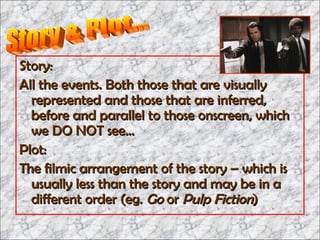
Story: All the events. Both those that are visually represented and those that are inferred, before and parallel to those onscreen, which we DO NOT see… Plot: The filmic arrangement of the story – which is usually less than the story and may be in a different order (eg.  Go  or  Pulp Fiction ) Story & Plot...
The world of the Film’s Story   Everything that is going on in the fictional reality on screen. This is why the most common use of the term is to describe SOUND as either  Diegetic  (as in dialogue & naturalistic background noise)  or  Non-Diegetic  (use of ‘mood’ music in a scene) Romantic Violins in a Love Scene…  Diegesis
Continuity Editing: A style of Editing which creates the impression of seamlessness (invisible editing) which draws the Audience in to the world of film – when a character walks through a door to the left, they enter the next room from the right to create the impression that the room is ‘real’ Montage Editing: A term used in a number of different ways but here, in contrast to the aforementioned Continuity editing – a style of editing which employs effects to create particular moods or meanings, particularly when shots are crashed together without logical progression or relationships. Eg: The Shower scene in Psycho or Action sequences. Editing...
Compression of Time: Most films operate a high degree of Ellipsis or Time manipulation. In order to move the story forward, the audience only ‘sees’ the moments in time which are relevant to the Narrative.  Some texts operate time as a more balanced ‘Real time’ construction but Classical/Post Classical Hollywood Narrative maintains strict control over Narrative Time. Ellipsis
Use of Narrative to create Suspense and Audience expectations…  Restricted or Unrestricted Narratives determine how much information is released to the Audience at a time… What do they need to know and when? Eg  the Mystery companion Clare (Katie Holmes) has in the opening sequence of “Go” – not revealed until the final quarter as the relevance of it would have challenged the suspense of the central narrative sequences… Restricted & Unrestricted Narratives
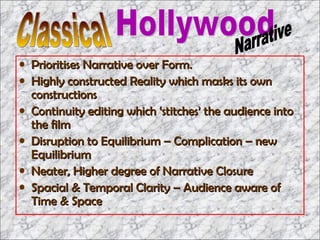
Prioritises Narrative over Form. Highly constructed Reality which masks its own constructions Continuity editing which ‘stitches’ the audience into the film Disruption to Equilibrium – Complication – new Equilibrium Neater, Higher degree of Narrative Closure Spacial & Temporal Clarity – Audience aware of Time & Space Classical Hollywood Narrative
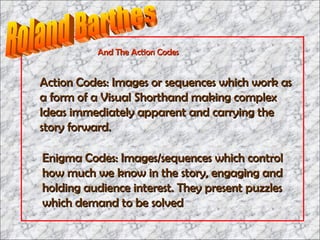
Action Codes: Images or sequences which work as a form of a Visual Shorthand making complex Ideas immediately apparent and carrying the story forward. Enigma Codes: Images/sequences which control how much we know in the story, engaging and holding audience interest. They present puzzles which demand to be solved And The Action Codes Roland Barthes
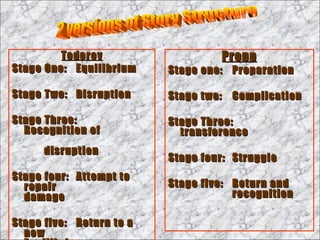
Todorov Stage One:  Equilibrium Stage Two:  Disruption Stage Three:  Recognition of  disruption Stage four:  Attempt to repair  damage Stage five:  Return to a new  Equilibrium Propp Stage one:  Preparation Stage two:  Complication Stage Three: transference Stage four:  Struggle Stage five: Return and  recognition 2 versions of Story Structure
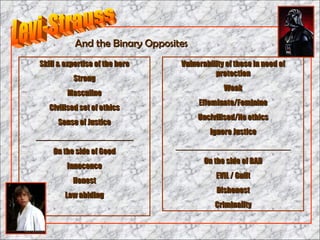
And the Binary Opposites Vulnerability of those in need of protection Weak Effeminate/Feminine Uncivilised/No ethics Ignore Justice __________________________ On the side of BAD EVIL / Guilt Dishonest Criminality Levi-Strauss Skill & expertise of the hero Strong Masculine Civilised set of ethics Sense of Justice ______________________ On the side of Good Innocence Honest Law abiding
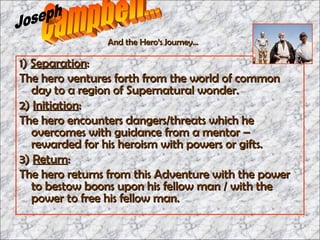
1)  Separation : The hero ventures forth from the world of common day to a region of Supernatural wonder. 2)  Initiation : The hero encounters dangers/threats which he overcomes with guidance from a mentor – rewarded for his heroism with powers or gifts.  3)  Return : The hero returns from this Adventure with the power to bestow boons upon his fellow man / with the power to free his fellow man. Campbell... Joseph And the Hero’s Journey…

Narrative v2

  • 1.
    Some Views on Narrative Structure Narrative Theories & Theorists
  • 2.
    Narrative serves anumber of purposes: It delivers the Story in Visual & Dialogue It decides what order information is to be delivered and when It places the audience on the side of the protagonist by way of ‘privileging’ their perspective above others It establishes the pace of the text It delivers implicit messages & values (Ideology) which support the perspectives of the makers. Narrative Purposes
  • 3.
    Story: All theevents. Both those that are visually represented and those that are inferred, before and parallel to those onscreen, which we DO NOT see… Plot: The filmic arrangement of the story – which is usually less than the story and may be in a different order (eg. Go or Pulp Fiction ) Story & Plot...
  • 4.
    The world ofthe Film’s Story Everything that is going on in the fictional reality on screen. This is why the most common use of the term is to describe SOUND as either Diegetic (as in dialogue & naturalistic background noise) or Non-Diegetic (use of ‘mood’ music in a scene) Romantic Violins in a Love Scene… Diegesis
  • 5.
    Continuity Editing: Astyle of Editing which creates the impression of seamlessness (invisible editing) which draws the Audience in to the world of film – when a character walks through a door to the left, they enter the next room from the right to create the impression that the room is ‘real’ Montage Editing: A term used in a number of different ways but here, in contrast to the aforementioned Continuity editing – a style of editing which employs effects to create particular moods or meanings, particularly when shots are crashed together without logical progression or relationships. Eg: The Shower scene in Psycho or Action sequences. Editing...
  • 6.
    Compression of Time:Most films operate a high degree of Ellipsis or Time manipulation. In order to move the story forward, the audience only ‘sees’ the moments in time which are relevant to the Narrative. Some texts operate time as a more balanced ‘Real time’ construction but Classical/Post Classical Hollywood Narrative maintains strict control over Narrative Time. Ellipsis
  • 7.
    Use of Narrativeto create Suspense and Audience expectations… Restricted or Unrestricted Narratives determine how much information is released to the Audience at a time… What do they need to know and when? Eg the Mystery companion Clare (Katie Holmes) has in the opening sequence of “Go” – not revealed until the final quarter as the relevance of it would have challenged the suspense of the central narrative sequences… Restricted & Unrestricted Narratives
  • 8.
    Prioritises Narrative overForm. Highly constructed Reality which masks its own constructions Continuity editing which ‘stitches’ the audience into the film Disruption to Equilibrium – Complication – new Equilibrium Neater, Higher degree of Narrative Closure Spacial & Temporal Clarity – Audience aware of Time & Space Classical Hollywood Narrative
  • 9.
    Action Codes: Imagesor sequences which work as a form of a Visual Shorthand making complex Ideas immediately apparent and carrying the story forward. Enigma Codes: Images/sequences which control how much we know in the story, engaging and holding audience interest. They present puzzles which demand to be solved And The Action Codes Roland Barthes
  • 10.
    Todorov Stage One: Equilibrium Stage Two: Disruption Stage Three: Recognition of disruption Stage four: Attempt to repair damage Stage five: Return to a new Equilibrium Propp Stage one: Preparation Stage two: Complication Stage Three: transference Stage four: Struggle Stage five: Return and recognition 2 versions of Story Structure
  • 11.
    And the BinaryOpposites Vulnerability of those in need of protection Weak Effeminate/Feminine Uncivilised/No ethics Ignore Justice __________________________ On the side of BAD EVIL / Guilt Dishonest Criminality Levi-Strauss Skill & expertise of the hero Strong Masculine Civilised set of ethics Sense of Justice ______________________ On the side of Good Innocence Honest Law abiding
  • 12.
    1) Separation: The hero ventures forth from the world of common day to a region of Supernatural wonder. 2) Initiation : The hero encounters dangers/threats which he overcomes with guidance from a mentor – rewarded for his heroism with powers or gifts. 3) Return : The hero returns from this Adventure with the power to bestow boons upon his fellow man / with the power to free his fellow man. Campbell... Joseph And the Hero’s Journey…