Narrative Codes
Roland Barthes 1915-1980
 Roland Barthes describes a text as: “a galaxy of signifiers, not a structure of signified; it has
no beginning; it is reversible; we gain access to it by several entrances, none of which can
be authoritatively declared to be the main one; the codes it mobilizes extend as far as the
eye can read, they are indeterminable...the systems of meaning can take over this
absolutely plural text, but their number is never closed, based as it is on the infinity of
language...”
 Roland Barthes narrowed down the action of a text in to five codes which are woven in to
any narrative.
 Action code
 Cultural code
 Engima code
 Semic code
 Code of oppositions
The Action Code
 The Action Code also builds tension,
referring to any other action or event that
indicates something else is going to
happen, and indicate to the audience what
the next logical step is and which hence
gets the reader guessing as to what will
happen next.
The Cultural Code
 Cultural codes are codes that are used by, and understood
by, members of a particular culture e.g. Scottish people,
Punk Rockers, Christians, the Police, criminals. Cultural
codes can be found in what people wear, how they speak,
their mannerisms, vehicles, buildings, colours, background
sounds, music, flags, symbols and many other things.
 The cultural code is used in order for the narrative to make
a sense to a culturally or socially aware audience.
The Semic Code
 This code refers to connotation within the story that
gives additional meaning. It is by the use of extended
meaning that can be applied to words that the directors
can paint rich pictures with relatively limited text and the
way they do this is a common indication of their writing
skills.
 Signs and meanings in the text tell the audience about
the narrative and characters. These then layer a further
meaning over the literal one.
The Enigma Code
 The Enigma Code refers to any element of the story that is not fully
explained and hence becomes a mystery to the reader. The purpose of
the author in this is typically to keep the audience guessing, arresting
the enigma, until the final scenes when all is revealed and all loose
ends are tied off and closure is achieved.
 This is achieved through controlling how much and what information is
given to the audience. The mysteries within the narrative frustrate the
audience and make them want to know more.
 We achieved this in our thriller opening as the viewer watching will want
to know who the hooded figure is and who is the hand on the tree. This will
frustrate the audience as they want to know who it is, but they wouldn't
know who until right at the end of the film.
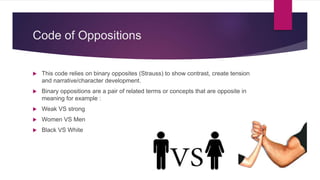
Code of Oppositions
 This code relies on binary opposites (Strauss) to show contrast, create tension
and narrative/character development.
 Binary oppositions are a pair of related terms or concepts that are opposite in
meaning for example :
 Weak VS strong
 Women VS Men
 Black VS White

Media Narrative Codes

  • 1.
  • 2.
    Roland Barthes 1915-1980 Roland Barthes describes a text as: “a galaxy of signifiers, not a structure of signified; it has no beginning; it is reversible; we gain access to it by several entrances, none of which can be authoritatively declared to be the main one; the codes it mobilizes extend as far as the eye can read, they are indeterminable...the systems of meaning can take over this absolutely plural text, but their number is never closed, based as it is on the infinity of language...”  Roland Barthes narrowed down the action of a text in to five codes which are woven in to any narrative.  Action code  Cultural code  Engima code  Semic code  Code of oppositions
  • 3.
    The Action Code The Action Code also builds tension, referring to any other action or event that indicates something else is going to happen, and indicate to the audience what the next logical step is and which hence gets the reader guessing as to what will happen next.
  • 4.
    The Cultural Code Cultural codes are codes that are used by, and understood by, members of a particular culture e.g. Scottish people, Punk Rockers, Christians, the Police, criminals. Cultural codes can be found in what people wear, how they speak, their mannerisms, vehicles, buildings, colours, background sounds, music, flags, symbols and many other things.  The cultural code is used in order for the narrative to make a sense to a culturally or socially aware audience.
  • 5.
    The Semic Code This code refers to connotation within the story that gives additional meaning. It is by the use of extended meaning that can be applied to words that the directors can paint rich pictures with relatively limited text and the way they do this is a common indication of their writing skills.  Signs and meanings in the text tell the audience about the narrative and characters. These then layer a further meaning over the literal one.
  • 6.
    The Enigma Code The Enigma Code refers to any element of the story that is not fully explained and hence becomes a mystery to the reader. The purpose of the author in this is typically to keep the audience guessing, arresting the enigma, until the final scenes when all is revealed and all loose ends are tied off and closure is achieved.  This is achieved through controlling how much and what information is given to the audience. The mysteries within the narrative frustrate the audience and make them want to know more.  We achieved this in our thriller opening as the viewer watching will want to know who the hooded figure is and who is the hand on the tree. This will frustrate the audience as they want to know who it is, but they wouldn't know who until right at the end of the film.
  • 7.
    Code of Oppositions This code relies on binary opposites (Strauss) to show contrast, create tension and narrative/character development.  Binary oppositions are a pair of related terms or concepts that are opposite in meaning for example :  Weak VS strong  Women VS Men  Black VS White