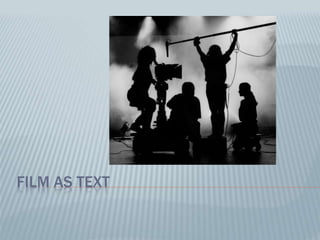
FILM AS TEXT
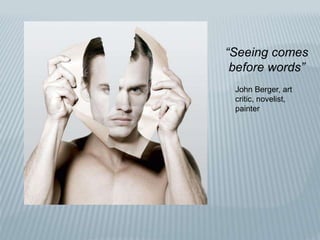
“Seeing comes
before words”
John Berger, art
critic, novelist,
painter
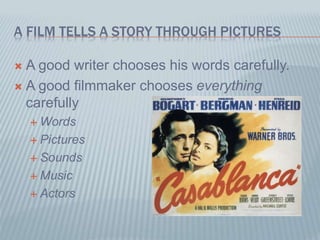
A FILM TELLS A STORY THROUGH PICTURES
 A good writer chooses his words carefully.
 A good filmmaker chooses everything
carefully
 Words
 Pictures
 Sounds
 Music
 Actors
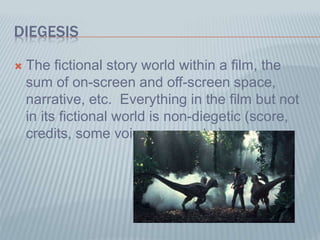
DIEGESIS
 The fictional story world within a film, the
sum of on-screen and off-screen space,
narrative, etc. Everything in the film but not
in its fictional world is non-diegetic (score,
credits, some voice-overs, etc.)
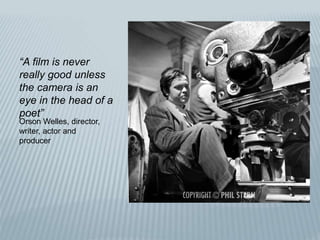
“A film is never
really good unless
the camera is an
eye in the head of a
poet”
Orson Welles, director,
writer, actor and
producer
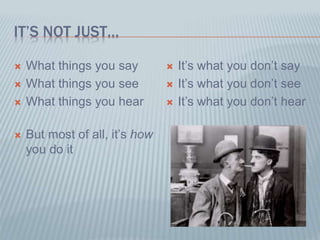
IT’S NOT JUST…
 What things you say
 What things you see
 What things you hear
 But most of all, it’s how
you do it
 It’s what you don’t say
 It’s what you don’t see
 It’s what you don’t hear
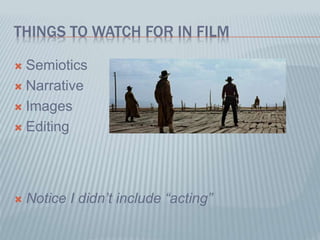
THINGS TO WATCH FOR IN FILM
 Semiotics
 Narrative
 Images
 Editing
 Notice I didn’t include “acting”
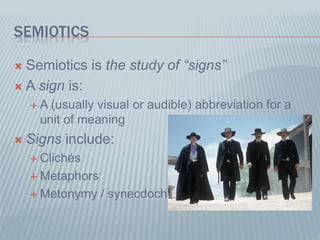
SEMIOTICS
 Semiotics is the study of “signs”
 A sign is:
 A (usually visual or audible) abbreviation for a
unit of meaning
 Signs include:
 Clichés
 Metaphors
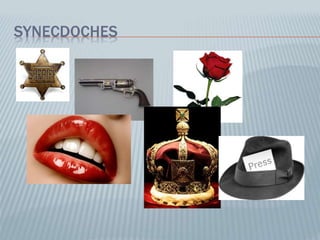
 Metonymy / synecdoche
SYNECDOCHES
SEMIOTICS (2)
 Sign as object (physical): what we see, hear,
etc. the signifier (perception)
 Sign as concept (psychological): how we
react to the sign  the signified (meaning)
 Denotation  the direct meaning of the sign
 Connotation  the indirect meaning of the
sign
SEMIOTICS (3)
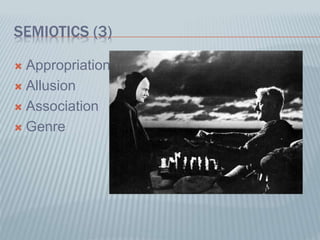
 Appropriation
 Allusion
 Association
 Genre
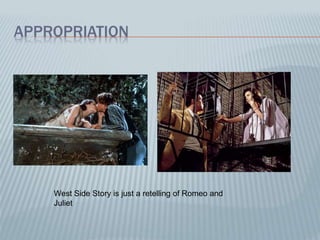
APPROPRIATION
West Side Story is just a retelling of Romeo and
Juliet
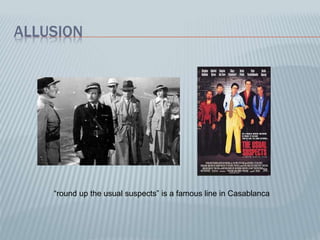
ALLUSION
“round up the usual suspects” is a famous line in Casablanca
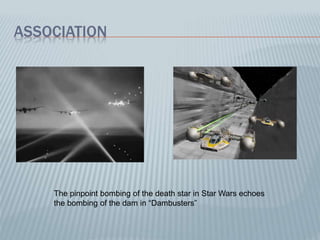
ASSOCIATION
The pinpoint bombing of the death star in Star Wars echoes
the bombing of the dam in “Dambusters”
GENRES
 Action and adventure
 Sci-Fi
 Western
 Crime, detective and
thriller, courtroom
 Horror
 Comedy
 Romance
 Rom-Com
 Western
 Road Movie
 Buddy film
 Bio-pic
 Fantasy/sword and
sorcery
 War movie
 Chick-flick
 Screwball comedy
 Costume and historical
drama
 Disaster movie
 Film noir
 Musical and dance
 Teen movie
 Fight film
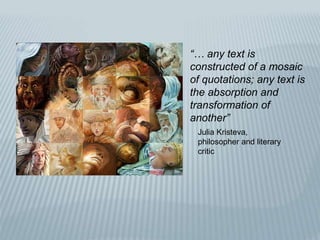
“… any text is
constructed of a mosaic
of quotations; any text is
the absorption and
transformation of
another”
Julia Kristeva,
philosopher and literary
critic
ROLAND BARTHES: FIVE SYSTEMS OF MEANING
 The enigma code keeps the audience guessing and delaying
revelation until the end..
 The connotative code refers to connotation within the story that
gives additional meaning.
 The action (or proairetic) code builds tension by using actions that
indicate a deeper meaning.
 The symbolic code organizes semantic meanings into broader
and deeper sets of meaning. This is typically done by antithesis,
where pairs of meanings are created, such as good/evil, etc.
 The cultural (or referential) code: This code refers to anything that
is founded on some kind of canonical works that cannot be
challenged and is assumed to be a foundation for truth. Typically
this involves either science or religion, although other canons
such as magical truths may be used in fantasy stories.
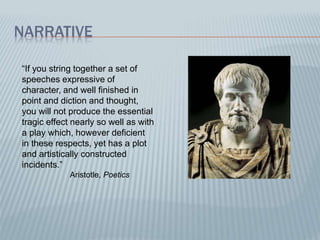
NARRATIVE
“If you string together a set of
speeches expressive of
character, and well finished in
point and diction and thought,
you will not produce the essential
tragic effect nearly so well as with
a play which, however deficient
in these respects, yet has a plot
and artistically constructed
incidents.”
Aristotle, Poetics
ROLAND BARTHES ON NARRATIVE
 Narratives are written, verbal or visual
 Narratives are constructed, they don’t just
appear. They consist of events that are
selected
 All human and cultural interaction is
governed by narrative, not just fiction
 Narratives have existed as long as man
could think.
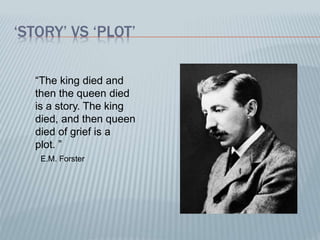
‘STORY’ VS ‘PLOT’
“The king died and
then the queen died
is a story. The king
died, and then queen
died of grief is a
plot. ”
E.M. Forster
STORY VS PLOT
 Story: The linear
construction of both
represented and
inferred narrative
events
 Plot: the sum of story
and non-diegetic
elements, such as
camera angles, editing,
sound, titles, etc., that
gives causality to the
narrative
 Non-diegetic: anything
in the film but not in its
fictional world
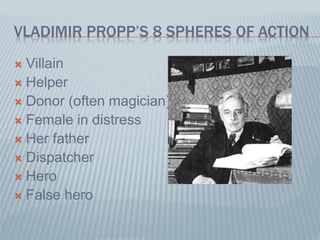
VLADIMIR PROPP’S 8 SPHERES OF ACTION
 Villain
 Helper
 Donor (often magician)
 Female in distress
 Her father
 Dispatcher
 Hero
 False hero
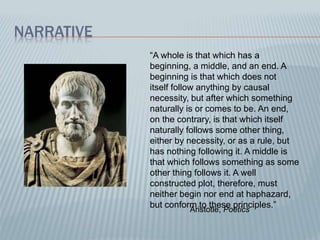
NARRATIVE
“A whole is that which has a
beginning, a middle, and an end. A
beginning is that which does not
itself follow anything by causal
necessity, but after which something
naturally is or comes to be. An end,
on the contrary, is that which itself
naturally follows some other thing,
either by necessity, or as a rule, but
has nothing following it. A middle is
that which follows something as some
other thing follows it. A well
constructed plot, therefore, must
neither begin nor end at haphazard,
but conform to these principles.”
Aristotle, Poetics
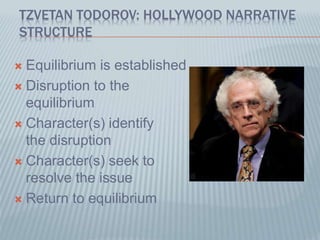
TZVETAN TODOROV: HOLLYWOOD NARRATIVE
STRUCTURE
 Equilibrium is established
 Disruption to the
equilibrium
 Character(s) identify
the disruption
 Character(s) seek to
resolve the issue
 Return to equilibrium
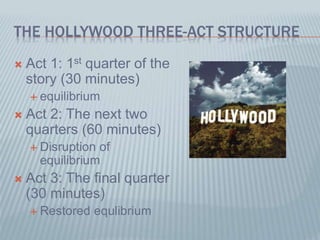
THE HOLLYWOOD THREE-ACT STRUCTURE
 Act 1: 1st quarter of the
story (30 minutes)
 equilibrium
 Act 2: The next two
quarters (60 minutes)
 Disruption of
equilibrium
 Act 3: The final quarter
(30 minutes)
 Restored equlibrium
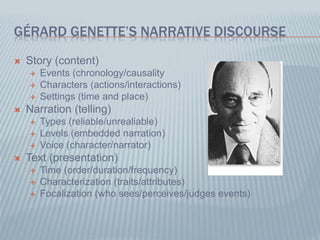
GÉRARD GENETTE’S NARRATIVE DISCOURSE
 Story (content)
 Events (chronology/causality
 Characters (actions/interactions)
 Settings (time and place)
 Narration (telling)
 Types (reliable/unrealiable)
 Levels (embedded narration)
 Voice (character/narrator)
 Text (presentation)
 Time (order/duration/frequency)
 Characterization (traits/attributes)
 Focalization (who sees/perceives/judges events)
STORY
 Events: things happen, but what is the causal
relationship between them?
 Characters: their actions and interactions.
Note: a character who does not act or
interact is part of the setting
 Setting: the time and place; it frames the
characters and events
NARRATION
 Extradiegetic: a voice-over by someone not
in the film
 Homodiegetic: a voice-over by someone in
the film, or a character who directly speaks to
the camera
 Intra-diegetic: when characters speak to one
another – In a film, dialogue is to further plot
or characterization, not for no reason
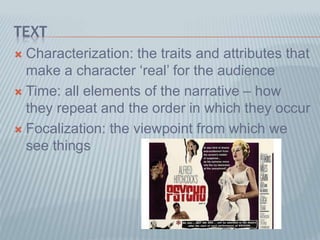
TEXT
 Characterization: the traits and attributes that
make a character ‘real’ for the audience
 Time: all elements of the narrative – how
they repeat and the order in which they occur
 Focalization: the viewpoint from which we
see things
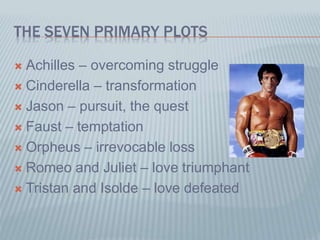
THE SEVEN PRIMARY PLOTS
 Achilles – overcoming struggle
 Cinderella – transformation
 Jason – pursuit, the quest
 Faust – temptation
 Orpheus – irrevocable loss
 Romeo and Juliet – love triumphant
 Tristan and Isolde – love defeated
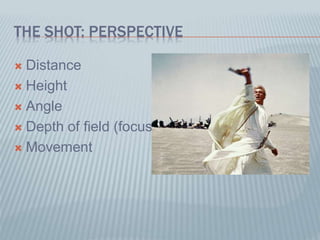
THE SHOT: PERSPECTIVE
 Distance
 Height
 Angle
 Depth of field (focus)
 Movement
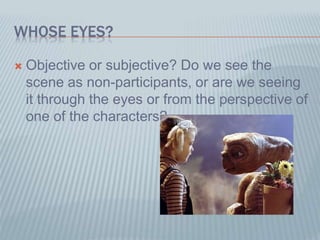
WHOSE EYES?
 Objective or subjective? Do we see the
scene as non-participants, or are we seeing
it through the eyes or from the perspective of
one of the characters?
THE VISUAL DEVICES
 Camera angles
 On-screen and off-screen space
 Shot distances
 Composition/in the frame (mise en scène)
 Lighting
 Camera movement (panning, tilting, moving)
 Zoom and reverse zoom
 Duration
 Time
ANGLES: STRAIGHT ON
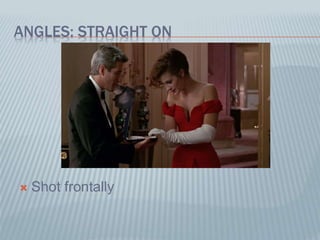
 Shot frontally
LOW ANGLE
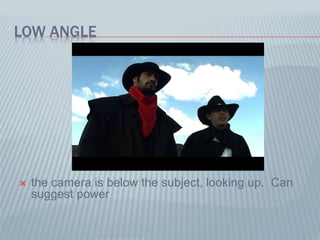
 the camera is below the subject, looking up. Can
suggest power
HIGH ANGLE
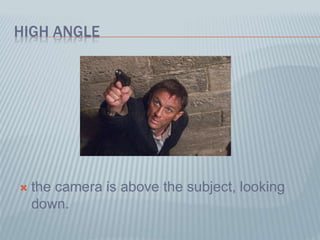
 the camera is above the subject, looking
down.
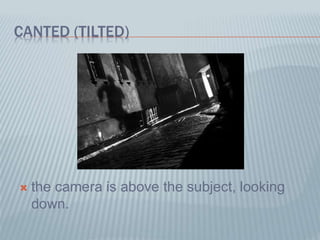
CANTED (TILTED)
 the camera is above the subject, looking
down.
SHOT DURATION AND TIME
 Typical today: shot length 4-6 seconds
(before 1960 8-11 seconds)
 A “long take” can be much longer (60
seconds)
 Fast motion: camera films at less than 24
FPS and is shown at that speed
 Slow motion: camera films at more than 24
FPS and is shown at that speed
 Simulated slow motion
CAMERA MOVEMENT
 Pan(orama): the camera pans left or right, like turning
its head horizontally
 Tilt: the camera tilts up and down vertically
 Tracking (dolly or trucking): the camera is moves on a
track
 Steadicam: mounted on a camera operator such that
it moves smoothly
 Hand-held: camera operator moves it, creates a
shaky effect
 Zoom (simulated movement)
 Reverse zoom (simulated movement)
ON-SCREEN AND OFF-SCREEN SPACE
 Left of the frame
 Right of the frame
 Top of the frame
 Bottom of the frame
 Back of the frame
 Front of the frame (the
fourth wall)
 It is spoken about in
dialogue
 A character or object
leaves the frame
 A character or object
(re-) enters the frame
 A character looks at
something outside the
frame
 Sound outside the
frame
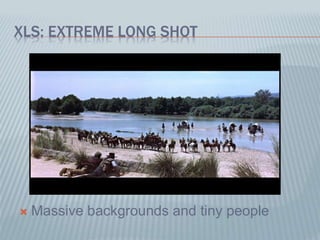
XLS: EXTREME LONG SHOT
 Massive backgrounds and tiny people
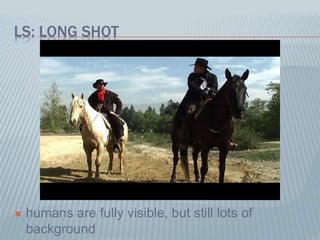
LS: LONG SHOT
 humans are fully visible, but still lots of
background
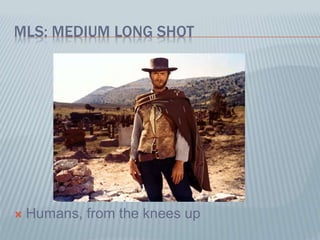
MLS: MEDIUM LONG SHOT
 Humans, from the knees up
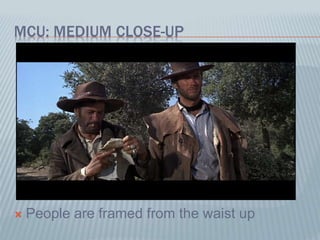
MCU: MEDIUM CLOSE-UP
 People are framed from the waist up
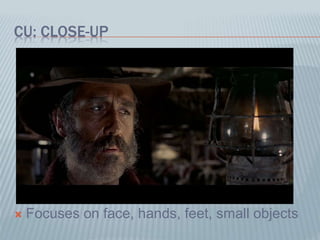
CU: CLOSE-UP
 Focuses on face, hands, feet, small objects
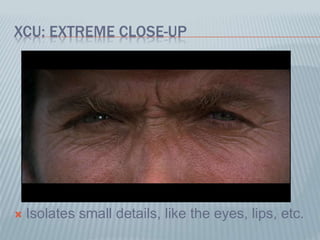
XCU: EXTREME CLOSE-UP
 Isolates small details, like the eyes, lips, etc.
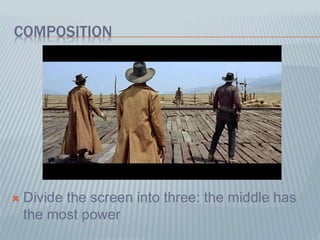
COMPOSITION
 Divide the screen into three: the middle has
the most power
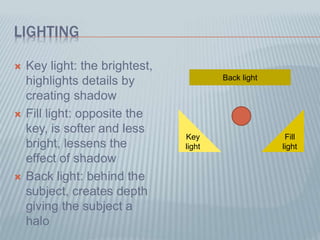
LIGHTING
 Key light: the brightest,
highlights details by
creating shadow
 Fill light: opposite the
key, is softer and less
bright, lessens the
effect of shadow
 Back light: behind the
subject, creates depth
giving the subject a
halo
Key
light
Fill
light
Back light
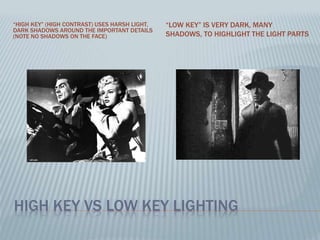
HIGH KEY VS LOW KEY LIGHTING
“HIGH KEY” (HIGH CONTRAST) USES HARSH LIGHT,
DARK SHADOWS AROUND THE IMPORTANT DETAILS
(NOTE NO SHADOWS ON THE FACE)
“LOW KEY” IS VERY DARK, MANY
SHADOWS, TO HIGHLIGHT THE LIGHT PARTS
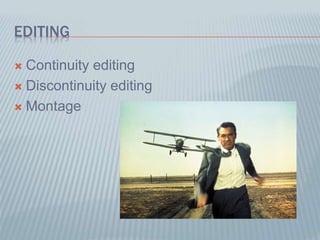
EDITING
 Continuity editing
 Discontinuity editing
 Montage
CONTINUITY EDITING: THE RULES
 Tell the story. Take out anything that gets in
the way; minimize repetition
 Construct and preserve coherence of space
 Maintain continuity of time
 Create and sustain graphic and rhythmic
relations
 Hide the means of construction from the
viewer
TECHNIQUES
 180º rule: if in one shot, a character walks left to right and leaves
the frame on the right, in the next shot, he enters from the left.
 Match-on-action: if in one shot the character opens the door and
walks through, the next shot shows him walking without repeating
the door opening
 Eyeline matches: If the character looks down at someone off-
screen, and in the next shot, we see the person looking back,
then he must look up at a matching angle
 30º rule: If a new shot/scene sequence is begun, it must be
greater than 30º or it will disturb continuity
 Shot-reverse-shot editing: when cutting from one character to
another, they stay always on the same side of the screen:
http://www.youtube.com/watch?v=QLkUHZ1qips
TRANSITIONS
 Techniques to create ellipses (jumps in time
or space)
 Dissolve: a smooth transition
 Fade (to black or another color)
 Wipe
 Irises
 Freeze-frame
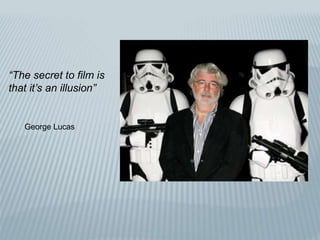
“The secret to film is
that it’s an illusion”
George Lucas

Film as text

  • 1.
  • 2.
    “Seeing comes before words” JohnBerger, art critic, novelist, painter
  • 3.
    A FILM TELLSA STORY THROUGH PICTURES  A good writer chooses his words carefully.  A good filmmaker chooses everything carefully  Words  Pictures  Sounds  Music  Actors
  • 4.
    DIEGESIS  The fictionalstory world within a film, the sum of on-screen and off-screen space, narrative, etc. Everything in the film but not in its fictional world is non-diegetic (score, credits, some voice-overs, etc.)
  • 5.
    “A film isnever really good unless the camera is an eye in the head of a poet” Orson Welles, director, writer, actor and producer
  • 6.
    IT’S NOT JUST… What things you say  What things you see  What things you hear  But most of all, it’s how you do it  It’s what you don’t say  It’s what you don’t see  It’s what you don’t hear
  • 7.
    THINGS TO WATCHFOR IN FILM  Semiotics  Narrative  Images  Editing  Notice I didn’t include “acting”
  • 8.
    SEMIOTICS  Semiotics isthe study of “signs”  A sign is:  A (usually visual or audible) abbreviation for a unit of meaning  Signs include:  Clichés  Metaphors  Metonymy / synecdoche
  • 9.
  • 10.
    SEMIOTICS (2)  Signas object (physical): what we see, hear, etc. the signifier (perception)  Sign as concept (psychological): how we react to the sign  the signified (meaning)  Denotation  the direct meaning of the sign  Connotation  the indirect meaning of the sign
  • 11.
    SEMIOTICS (3)  Appropriation Allusion  Association  Genre
  • 12.
    APPROPRIATION West Side Storyis just a retelling of Romeo and Juliet
  • 13.
    ALLUSION “round up theusual suspects” is a famous line in Casablanca
  • 14.
    ASSOCIATION The pinpoint bombingof the death star in Star Wars echoes the bombing of the dam in “Dambusters”
  • 15.
    GENRES  Action andadventure  Sci-Fi  Western  Crime, detective and thriller, courtroom  Horror  Comedy  Romance  Rom-Com  Western  Road Movie  Buddy film  Bio-pic  Fantasy/sword and sorcery  War movie  Chick-flick  Screwball comedy  Costume and historical drama  Disaster movie  Film noir  Musical and dance  Teen movie  Fight film
  • 16.
    “… any textis constructed of a mosaic of quotations; any text is the absorption and transformation of another” Julia Kristeva, philosopher and literary critic
  • 17.
    ROLAND BARTHES: FIVESYSTEMS OF MEANING  The enigma code keeps the audience guessing and delaying revelation until the end..  The connotative code refers to connotation within the story that gives additional meaning.  The action (or proairetic) code builds tension by using actions that indicate a deeper meaning.  The symbolic code organizes semantic meanings into broader and deeper sets of meaning. This is typically done by antithesis, where pairs of meanings are created, such as good/evil, etc.  The cultural (or referential) code: This code refers to anything that is founded on some kind of canonical works that cannot be challenged and is assumed to be a foundation for truth. Typically this involves either science or religion, although other canons such as magical truths may be used in fantasy stories.
  • 18.
    NARRATIVE “If you stringtogether a set of speeches expressive of character, and well finished in point and diction and thought, you will not produce the essential tragic effect nearly so well as with a play which, however deficient in these respects, yet has a plot and artistically constructed incidents.” Aristotle, Poetics
  • 19.
    ROLAND BARTHES ONNARRATIVE  Narratives are written, verbal or visual  Narratives are constructed, they don’t just appear. They consist of events that are selected  All human and cultural interaction is governed by narrative, not just fiction  Narratives have existed as long as man could think.
  • 20.
    ‘STORY’ VS ‘PLOT’ “Theking died and then the queen died is a story. The king died, and then queen died of grief is a plot. ” E.M. Forster
  • 21.
    STORY VS PLOT Story: The linear construction of both represented and inferred narrative events  Plot: the sum of story and non-diegetic elements, such as camera angles, editing, sound, titles, etc., that gives causality to the narrative  Non-diegetic: anything in the film but not in its fictional world
  • 22.
    VLADIMIR PROPP’S 8SPHERES OF ACTION  Villain  Helper  Donor (often magician)  Female in distress  Her father  Dispatcher  Hero  False hero
  • 23.
    NARRATIVE “A whole isthat which has a beginning, a middle, and an end. A beginning is that which does not itself follow anything by causal necessity, but after which something naturally is or comes to be. An end, on the contrary, is that which itself naturally follows some other thing, either by necessity, or as a rule, but has nothing following it. A middle is that which follows something as some other thing follows it. A well constructed plot, therefore, must neither begin nor end at haphazard, but conform to these principles.” Aristotle, Poetics
  • 24.
    TZVETAN TODOROV: HOLLYWOODNARRATIVE STRUCTURE  Equilibrium is established  Disruption to the equilibrium  Character(s) identify the disruption  Character(s) seek to resolve the issue  Return to equilibrium
  • 25.
    THE HOLLYWOOD THREE-ACTSTRUCTURE  Act 1: 1st quarter of the story (30 minutes)  equilibrium  Act 2: The next two quarters (60 minutes)  Disruption of equilibrium  Act 3: The final quarter (30 minutes)  Restored equlibrium
  • 26.
    GÉRARD GENETTE’S NARRATIVEDISCOURSE  Story (content)  Events (chronology/causality  Characters (actions/interactions)  Settings (time and place)  Narration (telling)  Types (reliable/unrealiable)  Levels (embedded narration)  Voice (character/narrator)  Text (presentation)  Time (order/duration/frequency)  Characterization (traits/attributes)  Focalization (who sees/perceives/judges events)
  • 27.
    STORY  Events: thingshappen, but what is the causal relationship between them?  Characters: their actions and interactions. Note: a character who does not act or interact is part of the setting  Setting: the time and place; it frames the characters and events
  • 28.
    NARRATION  Extradiegetic: avoice-over by someone not in the film  Homodiegetic: a voice-over by someone in the film, or a character who directly speaks to the camera  Intra-diegetic: when characters speak to one another – In a film, dialogue is to further plot or characterization, not for no reason
  • 29.
    TEXT  Characterization: thetraits and attributes that make a character ‘real’ for the audience  Time: all elements of the narrative – how they repeat and the order in which they occur  Focalization: the viewpoint from which we see things
  • 30.
    THE SEVEN PRIMARYPLOTS  Achilles – overcoming struggle  Cinderella – transformation  Jason – pursuit, the quest  Faust – temptation  Orpheus – irrevocable loss  Romeo and Juliet – love triumphant  Tristan and Isolde – love defeated
  • 31.
    THE SHOT: PERSPECTIVE Distance  Height  Angle  Depth of field (focus)  Movement
  • 32.
    WHOSE EYES?  Objectiveor subjective? Do we see the scene as non-participants, or are we seeing it through the eyes or from the perspective of one of the characters?
  • 33.
    THE VISUAL DEVICES Camera angles  On-screen and off-screen space  Shot distances  Composition/in the frame (mise en scène)  Lighting  Camera movement (panning, tilting, moving)  Zoom and reverse zoom  Duration  Time
  • 34.
  • 35.
    LOW ANGLE  thecamera is below the subject, looking up. Can suggest power
  • 36.
    HIGH ANGLE  thecamera is above the subject, looking down.
  • 37.
    CANTED (TILTED)  thecamera is above the subject, looking down.
  • 38.
    SHOT DURATION ANDTIME  Typical today: shot length 4-6 seconds (before 1960 8-11 seconds)  A “long take” can be much longer (60 seconds)  Fast motion: camera films at less than 24 FPS and is shown at that speed  Slow motion: camera films at more than 24 FPS and is shown at that speed  Simulated slow motion
  • 39.
    CAMERA MOVEMENT  Pan(orama):the camera pans left or right, like turning its head horizontally  Tilt: the camera tilts up and down vertically  Tracking (dolly or trucking): the camera is moves on a track  Steadicam: mounted on a camera operator such that it moves smoothly  Hand-held: camera operator moves it, creates a shaky effect  Zoom (simulated movement)  Reverse zoom (simulated movement)
  • 40.
    ON-SCREEN AND OFF-SCREENSPACE  Left of the frame  Right of the frame  Top of the frame  Bottom of the frame  Back of the frame  Front of the frame (the fourth wall)  It is spoken about in dialogue  A character or object leaves the frame  A character or object (re-) enters the frame  A character looks at something outside the frame  Sound outside the frame
  • 41.
    XLS: EXTREME LONGSHOT  Massive backgrounds and tiny people
  • 42.
    LS: LONG SHOT humans are fully visible, but still lots of background
  • 43.
    MLS: MEDIUM LONGSHOT  Humans, from the knees up
  • 44.
    MCU: MEDIUM CLOSE-UP People are framed from the waist up
  • 45.
    CU: CLOSE-UP  Focuseson face, hands, feet, small objects
  • 46.
    XCU: EXTREME CLOSE-UP Isolates small details, like the eyes, lips, etc.
  • 47.
    COMPOSITION  Divide thescreen into three: the middle has the most power
  • 48.
    LIGHTING  Key light:the brightest, highlights details by creating shadow  Fill light: opposite the key, is softer and less bright, lessens the effect of shadow  Back light: behind the subject, creates depth giving the subject a halo Key light Fill light Back light
  • 49.
    HIGH KEY VSLOW KEY LIGHTING “HIGH KEY” (HIGH CONTRAST) USES HARSH LIGHT, DARK SHADOWS AROUND THE IMPORTANT DETAILS (NOTE NO SHADOWS ON THE FACE) “LOW KEY” IS VERY DARK, MANY SHADOWS, TO HIGHLIGHT THE LIGHT PARTS
  • 50.
    EDITING  Continuity editing Discontinuity editing  Montage
  • 51.
    CONTINUITY EDITING: THERULES  Tell the story. Take out anything that gets in the way; minimize repetition  Construct and preserve coherence of space  Maintain continuity of time  Create and sustain graphic and rhythmic relations  Hide the means of construction from the viewer
  • 52.
    TECHNIQUES  180º rule:if in one shot, a character walks left to right and leaves the frame on the right, in the next shot, he enters from the left.  Match-on-action: if in one shot the character opens the door and walks through, the next shot shows him walking without repeating the door opening  Eyeline matches: If the character looks down at someone off- screen, and in the next shot, we see the person looking back, then he must look up at a matching angle  30º rule: If a new shot/scene sequence is begun, it must be greater than 30º or it will disturb continuity  Shot-reverse-shot editing: when cutting from one character to another, they stay always on the same side of the screen: http://www.youtube.com/watch?v=QLkUHZ1qips
  • 53.
    TRANSITIONS  Techniques tocreate ellipses (jumps in time or space)  Dissolve: a smooth transition  Fade (to black or another color)  Wipe  Irises  Freeze-frame
  • 54.
    “The secret tofilm is that it’s an illusion” George Lucas