Editing in trailer research
By: Annamaria Noto
Psychological Horrors
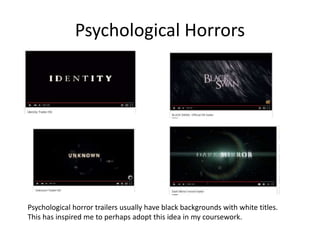
Psychological horror trailers usually have black backgrounds with white titles.
This has inspired me to perhaps adopt this idea in my coursework.
What are some immediate editing
techniques they use and why?
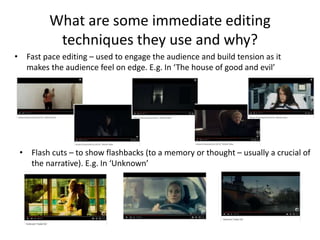
• Fast pace editing – used to engage the audience and build tension as it
makes the audience feel on edge. E.g. In ‘The house of good and evil’
• Flash cuts – to show flashbacks (to a memory or thought – usually a crucial of
the narrative). E.g. In ‘Unknown’
…
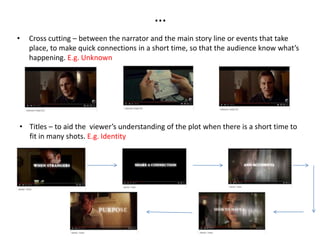
• Cross cutting – between the narrator and the main story line or events that take
place, to make quick connections in a short time, so that the audience know what’s
happening. E.g. Unknown
• Titles – to aid the viewer’s understanding of the plot when there is a short time to
fit in many shots. E.g. Identity
How does the pace change and why?
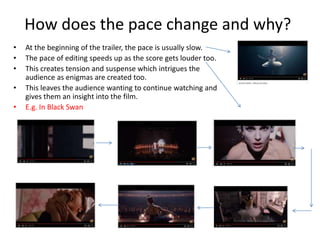
• At the beginning of the trailer, the pace is usually slow.
• The pace of editing speeds up as the score gets louder too.
• This creates tension and suspense which intrigues the
audience as enigmas are created too.
• This leaves the audience wanting to continue watching and
gives them an insight into the film.
• E.g. In Black Swan
What editing techniques are used in different genres
and why? (what editing techniques are conventional
to specific genres)
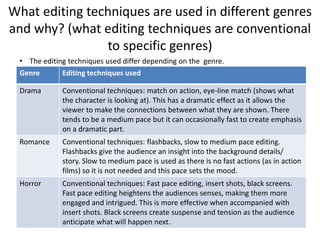
Genre Editing techniques used
Drama Conventional techniques: match on action, eye-line match (shows what
the character is looking at). This has a dramatic effect as it allows the
viewer to make the connections between what they are shown. There
tends to be a medium pace but it can occasionally fast to create emphasis
on a dramatic part.
Romance Conventional techniques: flashbacks, slow to medium pace editing.
Flashbacks give the audience an insight into the background details/
story. Slow to medium pace is used as there is no fast actions (as in action
films) so it is not needed and this pace sets the mood.
Horror Conventional techniques: Fast pace editing, insert shots, black screens.
Fast pace editing heightens the audiences senses, making them more
engaged and intrigued. This is more effective when accompanied with
insert shots. Black screens create suspense and tension as the audience
anticipate what will happen next.
• The editing techniques used differ depending on the genre.
How does the editing connect/ compliment
the plot and narrative structure?
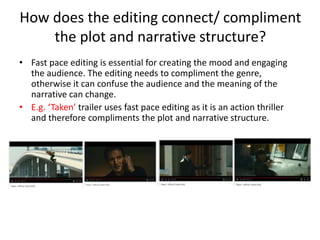
• Fast pace editing is essential for creating the mood and engaging
the audience. The editing needs to compliment the genre,
otherwise it can confuse the audience and the meaning of the
narrative can change.
• E.g. ‘Taken’ trailer uses fast pace editing as it is an action thriller
and therefore compliments the plot and narrative structure.
What editing techniques do you find inspirational?
• Fast pace editing – as it is most appropriate for this genre and is
a conventional technique which the audience expect. Moreover,
it is successful in creating the mood and capturing the audience’s
attention.
• Non linear narrative – to intrigue the audience from the start as
want to find out what happens.
• Flashbacks – as they add mystery and leave the audience with
unanswered questions. They are effective when recounting a
past, or a background story essential to understanding the
narrative.

A5 editing in trailer research

  • 1.
    Editing in trailerresearch By: Annamaria Noto
  • 2.
    Psychological Horrors Psychological horrortrailers usually have black backgrounds with white titles. This has inspired me to perhaps adopt this idea in my coursework.
  • 3.
    What are someimmediate editing techniques they use and why? • Fast pace editing – used to engage the audience and build tension as it makes the audience feel on edge. E.g. In ‘The house of good and evil’ • Flash cuts – to show flashbacks (to a memory or thought – usually a crucial of the narrative). E.g. In ‘Unknown’
  • 4.
    … • Cross cutting– between the narrator and the main story line or events that take place, to make quick connections in a short time, so that the audience know what’s happening. E.g. Unknown • Titles – to aid the viewer’s understanding of the plot when there is a short time to fit in many shots. E.g. Identity
  • 5.
    How does thepace change and why? • At the beginning of the trailer, the pace is usually slow. • The pace of editing speeds up as the score gets louder too. • This creates tension and suspense which intrigues the audience as enigmas are created too. • This leaves the audience wanting to continue watching and gives them an insight into the film. • E.g. In Black Swan
  • 6.
    What editing techniquesare used in different genres and why? (what editing techniques are conventional to specific genres) Genre Editing techniques used Drama Conventional techniques: match on action, eye-line match (shows what the character is looking at). This has a dramatic effect as it allows the viewer to make the connections between what they are shown. There tends to be a medium pace but it can occasionally fast to create emphasis on a dramatic part. Romance Conventional techniques: flashbacks, slow to medium pace editing. Flashbacks give the audience an insight into the background details/ story. Slow to medium pace is used as there is no fast actions (as in action films) so it is not needed and this pace sets the mood. Horror Conventional techniques: Fast pace editing, insert shots, black screens. Fast pace editing heightens the audiences senses, making them more engaged and intrigued. This is more effective when accompanied with insert shots. Black screens create suspense and tension as the audience anticipate what will happen next. • The editing techniques used differ depending on the genre.
  • 7.
    How does theediting connect/ compliment the plot and narrative structure? • Fast pace editing is essential for creating the mood and engaging the audience. The editing needs to compliment the genre, otherwise it can confuse the audience and the meaning of the narrative can change. • E.g. ‘Taken’ trailer uses fast pace editing as it is an action thriller and therefore compliments the plot and narrative structure.
  • 8.
    What editing techniquesdo you find inspirational? • Fast pace editing – as it is most appropriate for this genre and is a conventional technique which the audience expect. Moreover, it is successful in creating the mood and capturing the audience’s attention. • Non linear narrative – to intrigue the audience from the start as want to find out what happens. • Flashbacks – as they add mystery and leave the audience with unanswered questions. They are effective when recounting a past, or a background story essential to understanding the narrative.