Assignment 15:

Narrative Theory
Leticia Silva
Noor Naoum
Katia Martins
Judy Ibelgauptiene
Part A: Todorov Task 1
Part A: Todorov Task 2
He believes that that the narrative structure works in 5 stages:


1) Equilibrium- meaning that there is a sense of normality that everything is normal and
calm.


2) Disequilibrium- that there is a destruction to the normality causing a problem/
conflict.


3) Recognition of disequilibrium- meaning that the characters recognise the disturbance.


4) Attempt to repair disequilibrium- meaning that the character will try and final a
resolution for the problem.


5) New equilibrium- meaning that there is a resolution but it means that everything is
solved but things will never be the same as it was in the beginning.


He also believes that stages 2-4 can be repeated as many times in order to create tension
for the audience and have them waiting until the end for the resolution.
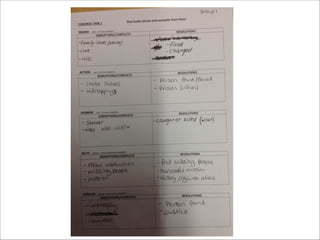
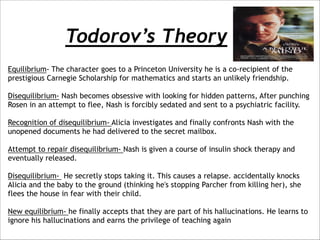
Todorov’s Theory
Equilibrium- The character goes to a Princeton University he is a co-recipient of the
prestigious Carnegie Scholarship for mathematics and starts an unlikely friendship.


Disequilibrium- Nash becomes obsessive with looking for hidden patterns, After punching
Rosen in an attempt to flee, Nash is forcibly sedated and sent to a psychiatric facility.


Recognition of disequilibrium- Alicia investigates and finally confronts Nash with the
unopened documents he had delivered to the secret mailbox.


Attempt to repair disequilibrium- Nash is given a course of insulin shock therapy and
eventually released.


Disequilibrium- He secretly stops taking it. This causes a relapse. accidentally knocks
Alicia and the baby to the ground (thinking he's stopping Parcher from killing her), she
flees the house in fear with their child.


New equilibrium- he finally accepts that they are part of his hallucinations. He learns to
ignore his hallucinations and earns the privilege of teaching again
Part B: Strauss

Strauss’ theory of binary opposites
• His theory is that there is a binary opposite
that creates a better narrative structure in
order for the movie to flow and make sense.
• He believes that this theory is fundamental
for our everyday lives to make sense and to
have meanings.
• He believes that the binary theory works for
everything such as : books, films, plays and
stories.
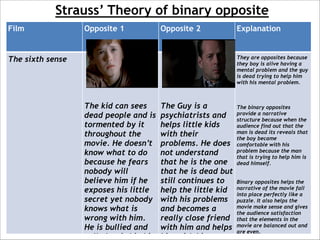
Strauss’ Theory of binary opposite
Film

Opposite 1

Opposite 2

Explanation

The sixth sense


They are opposites because
they boy is alive having a
mental problem and the guy
is dead trying to help him
with his mental problem.

The kid can sees
dead people and is
tormented by it
throughout the
movie. He doesn’t
know what to do
because he fears
nobody will
believe him if he
exposes his little
secret yet nobody
knows what is
wrong with him.
He is bullied and
called weird in his

The Guy is a
psychiatrists and
helps little kids
with their
problems. He does
not understand
that he is the one
that he is dead but
still continues to
help the little kid
with his problems
and becomes a
really close friend
with him and helps
him with his


The binary opposites
provide a narrative
structure because when the
audience find out that the
man is dead its reveals that
the boy became
comfortable with his
problem because the man
that is trying to help him is
dead himself.


Binary opposites helps the
narrative of the movie fall
into place perfectly like a
puzzle. It also helps the
movie make sense and gives
the audience satisfaction
that the elements in the
movie are balanced out and
are even.
Part C: Barthes
Barthes theory
Barthes theory is that there is 5
different codes that make the
audience seek answers and clues.
They are
The enigma code
Action code
Semantic code
Symbolic Code
Cultural code
Enigma code
• Narratives set up as puzzle for the
audience to solve.
• Like if there is an unopened letter you
would probably be wondering what is in
the letter.
• The purpose of this is to delay the ending
to create tension between the audience
and the film.
Enigma code
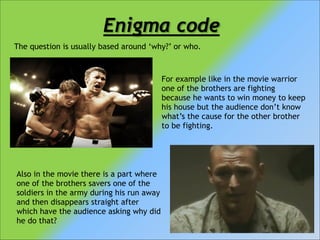
The question is usually based around ‘why?’ or who.

For example like in the movie warrior
one of the brothers are fighting
because he wants to win money to keep
his house but the audience don’t know
what’s the cause for the other brother
to be fighting.

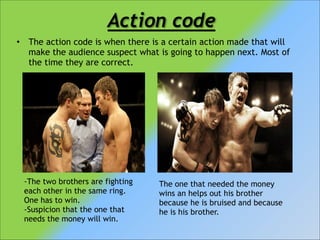
Also in the movie there is a part where
one of the brothers savers one of the
soldiers in the army during his run away
and then disappears straight after
which have the audience asking why did
he do that?
Action code
•

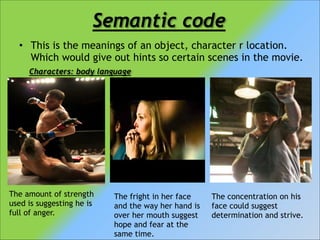
The action code is when there is a certain action made that will
make the audience suspect what is going to happen next. Most of
the time they are correct.

-The two brothers are fighting
each other in the same ring.
One has to win.
-Suspicion that the one that
needs the money will win.

The one that needed the money
wins an helps out his brother
because he is bruised and because
he is his brother.
Semantic code
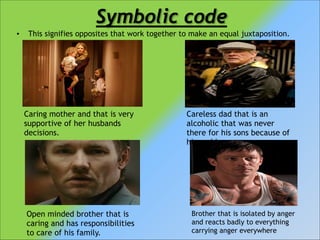
• This is the meanings of an object, character r location.
Which would give out hints so certain scenes in the movie.
Characters: body language

The amount of strength
used is suggesting he is
full of anger.

The fright in her face
and the way her hand is
over her mouth suggest
hope and fear at the
same time.

The concentration on his
face could suggest
determination and strive.
Symbolic code
•

This signifies opposites that work together to make an equal juxtaposition.

Caring mother and that is very
supportive of her husbands
decisions.

Open minded brother that is
caring and has responsibilities
to care of his family.

Careless dad that is an
alcoholic that was never
there for his sons because of
his problems.

Brother that is isolated by anger
and reacts badly to everything
carrying anger everywhere
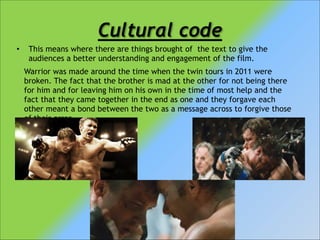
Cultural code
•

This means where there are things brought of the text to give the
audiences a better understanding and engagement of the film.
Warrior was made around the time when the twin tours in 2011 were
broken. The fact that the brother is mad at the other for not being there
for him and for leaving him on his own in the time of most help and the
fact that they came together in the end as one and they forgave each
other meant a bond between the two as a message across to forgive those
of their error.
Part D: Propp
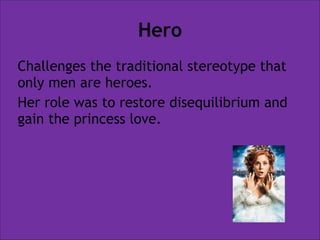
Hero
Challenges the traditional stereotype that
only men are heroes.
Her role was to restore disequilibrium and
gain the princess love.
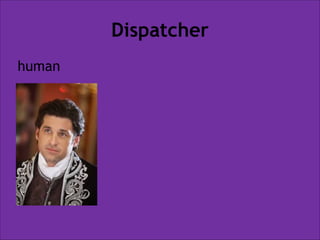
Dispatcher
human
Villain
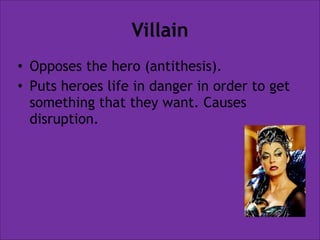
• Opposes the hero (antithesis).
• Puts heroes life in danger in order to get
something that they want. Causes
disruption.
Donor
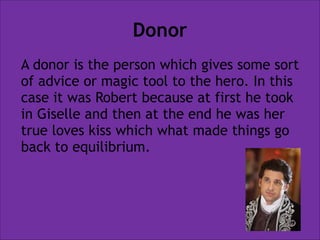
A donor is the person which gives some sort
of advice or magic tool to the hero. In this
case it was Robert because at first he took
in Giselle and then at the end he was her
true loves kiss which what made things go
back to equilibrium.
Helper
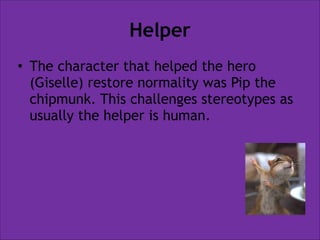
• The character that helped the hero
(Giselle) restore normality was Pip the
chipmunk. This challenges stereotypes as
usually the helper is human.
False Hero
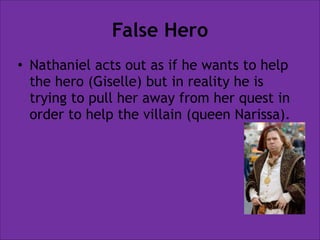
• Nathaniel acts out as if he wants to help
the hero (Giselle) but in reality he is
trying to pull her away from her quest in
order to help the villain (queen Narissa).
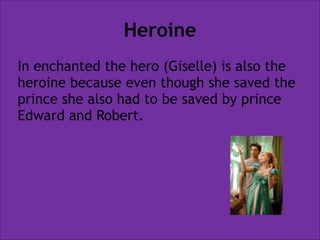
Heroine
In enchanted the hero (Giselle) is also the
heroine because even though she saved the
prince she also had to be saved by prince
Edward and Robert.
Part E: Other Terms
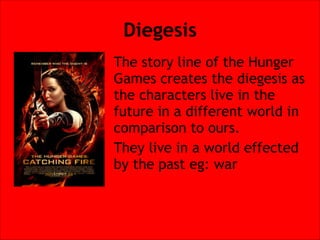
Diegesis
The story line of the Hunger
Games creates the diegesis as
the characters live in the
future in a different world in
comparison to ours.
They live in a world effected
by the past eg: war
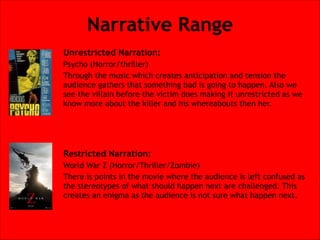
Narrative Range
Unrestricted Narration:
Psycho (Horror/thriller)
Through the music which creates anticipation and tension the
audience gathers that something bad is going to happen. Also we
see the villain before the victim does making it unrestricted as we
know more about the killer and his whereabouts then her.


Restricted Narration:
World War Z (Horror/Thriller/Zombie)
There is points in the movie where the audience is left confused as
the stereotypes of what should happen next are challenged. This
creates an enigma as the audience is not sure what happen next.
Narrative Depth
Objective Character Identification:
In 127 hours the audience is given unique
access to the characters thoughts, dreams,
fantasies and memories.


Subjective Character Identification:
In the film Sex and The City the viewer is
given unique access to what all the
characters can see and do.
Part F: Cameron

(Modular Narratives)
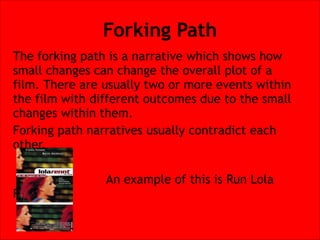
Forking Path
The forking path is a narrative which shows how
small changes can change the overall plot of a
film. There are usually two or more events within
the film with different outcomes due to the small
changes within them.
Forking path narratives usually contradict each
other.


Run.

An example of this is Run Lola
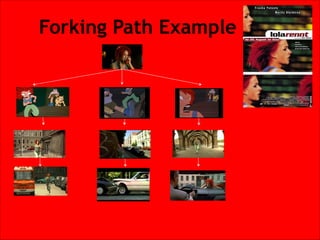
Forking Path Example
Episodic
There are two types of episodic narrative.


Abstract:
A series which has a non-narrative formal system
and appears to dictate the organisation of narrative
elements eg: numbers or alphabet sequence.


Anthology:
Consists of series with short tales which are
disconnected but all share one random similarity.
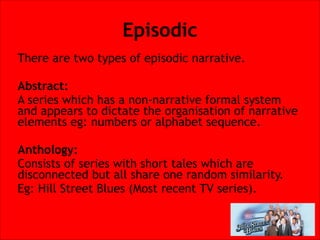
Eg: Hill Street Blues (Most recent TV series).
Anachronic
This is where the narrative involves flashbacks
or flash-forwards with no clear dominance over
any of the narrative threads. Meaning there is an
inconsistence chronological order.


For example:
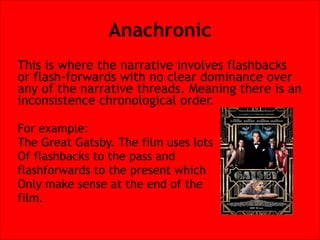
The Great Gatsby. The film uses lots
Of flashbacks to the pass and
flashforwards to the present which
Only make sense at the end of the
film.
Split Screen
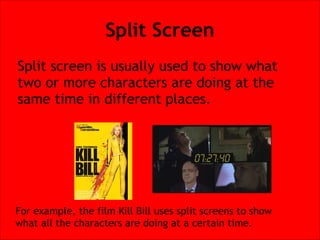
Split screen is usually used to show what
two or more characters are doing at the
same time in different places.

For example, the film Kill Bill uses split screens to show
what all the characters are doing at a certain time.

Assignment 15: Narrative Theory

  • 1.
    Assignment 15:
 Narrative Theory LeticiaSilva Noor Naoum Katia Martins Judy Ibelgauptiene
  • 2.
  • 4.
  • 5.
    He believes thatthat the narrative structure works in 5 stages: 1) Equilibrium- meaning that there is a sense of normality that everything is normal and calm. 2) Disequilibrium- that there is a destruction to the normality causing a problem/ conflict. 3) Recognition of disequilibrium- meaning that the characters recognise the disturbance. 4) Attempt to repair disequilibrium- meaning that the character will try and final a resolution for the problem. 5) New equilibrium- meaning that there is a resolution but it means that everything is solved but things will never be the same as it was in the beginning. He also believes that stages 2-4 can be repeated as many times in order to create tension for the audience and have them waiting until the end for the resolution.
  • 6.
    Todorov’s Theory Equilibrium- Thecharacter goes to a Princeton University he is a co-recipient of the prestigious Carnegie Scholarship for mathematics and starts an unlikely friendship. Disequilibrium- Nash becomes obsessive with looking for hidden patterns, After punching Rosen in an attempt to flee, Nash is forcibly sedated and sent to a psychiatric facility. Recognition of disequilibrium- Alicia investigates and finally confronts Nash with the unopened documents he had delivered to the secret mailbox. Attempt to repair disequilibrium- Nash is given a course of insulin shock therapy and eventually released. Disequilibrium- He secretly stops taking it. This causes a relapse. accidentally knocks Alicia and the baby to the ground (thinking he's stopping Parcher from killing her), she flees the house in fear with their child. New equilibrium- he finally accepts that they are part of his hallucinations. He learns to ignore his hallucinations and earns the privilege of teaching again
  • 7.
    Part B: Strauss
 Strauss’theory of binary opposites
  • 8.
    • His theoryis that there is a binary opposite that creates a better narrative structure in order for the movie to flow and make sense. • He believes that this theory is fundamental for our everyday lives to make sense and to have meanings. • He believes that the binary theory works for everything such as : books, films, plays and stories.
  • 9.
    Strauss’ Theory ofbinary opposite Film Opposite 1 Opposite 2 Explanation The sixth sense They are opposites because they boy is alive having a mental problem and the guy is dead trying to help him with his mental problem. The kid can sees dead people and is tormented by it throughout the movie. He doesn’t know what to do because he fears nobody will believe him if he exposes his little secret yet nobody knows what is wrong with him. He is bullied and called weird in his The Guy is a psychiatrists and helps little kids with their problems. He does not understand that he is the one that he is dead but still continues to help the little kid with his problems and becomes a really close friend with him and helps him with his The binary opposites provide a narrative structure because when the audience find out that the man is dead its reveals that the boy became comfortable with his problem because the man that is trying to help him is dead himself. Binary opposites helps the narrative of the movie fall into place perfectly like a puzzle. It also helps the movie make sense and gives the audience satisfaction that the elements in the movie are balanced out and are even.
  • 10.
  • 11.
    Barthes theory Barthes theoryis that there is 5 different codes that make the audience seek answers and clues. They are The enigma code Action code Semantic code Symbolic Code Cultural code
  • 12.
    Enigma code • Narrativesset up as puzzle for the audience to solve. • Like if there is an unopened letter you would probably be wondering what is in the letter. • The purpose of this is to delay the ending to create tension between the audience and the film.
  • 13.
    Enigma code The questionis usually based around ‘why?’ or who. For example like in the movie warrior one of the brothers are fighting because he wants to win money to keep his house but the audience don’t know what’s the cause for the other brother to be fighting. Also in the movie there is a part where one of the brothers savers one of the soldiers in the army during his run away and then disappears straight after which have the audience asking why did he do that?
  • 14.
    Action code • The actioncode is when there is a certain action made that will make the audience suspect what is going to happen next. Most of the time they are correct. -The two brothers are fighting each other in the same ring. One has to win. -Suspicion that the one that needs the money will win. The one that needed the money wins an helps out his brother because he is bruised and because he is his brother.
  • 15.
    Semantic code • Thisis the meanings of an object, character r location. Which would give out hints so certain scenes in the movie. Characters: body language The amount of strength used is suggesting he is full of anger. The fright in her face and the way her hand is over her mouth suggest hope and fear at the same time. The concentration on his face could suggest determination and strive.
  • 16.
    Symbolic code • This signifiesopposites that work together to make an equal juxtaposition. Caring mother and that is very supportive of her husbands decisions. Open minded brother that is caring and has responsibilities to care of his family. Careless dad that is an alcoholic that was never there for his sons because of his problems. Brother that is isolated by anger and reacts badly to everything carrying anger everywhere
  • 17.
    Cultural code • This meanswhere there are things brought of the text to give the audiences a better understanding and engagement of the film. Warrior was made around the time when the twin tours in 2011 were broken. The fact that the brother is mad at the other for not being there for him and for leaving him on his own in the time of most help and the fact that they came together in the end as one and they forgave each other meant a bond between the two as a message across to forgive those of their error.
  • 18.
  • 19.
    Hero Challenges the traditionalstereotype that only men are heroes. Her role was to restore disequilibrium and gain the princess love.
  • 20.
  • 21.
    Villain • Opposes thehero (antithesis). • Puts heroes life in danger in order to get something that they want. Causes disruption.
  • 22.
    Donor A donor isthe person which gives some sort of advice or magic tool to the hero. In this case it was Robert because at first he took in Giselle and then at the end he was her true loves kiss which what made things go back to equilibrium.
  • 23.
    Helper • The characterthat helped the hero (Giselle) restore normality was Pip the chipmunk. This challenges stereotypes as usually the helper is human.
  • 24.
    False Hero • Nathanielacts out as if he wants to help the hero (Giselle) but in reality he is trying to pull her away from her quest in order to help the villain (queen Narissa).
  • 25.
    Heroine In enchanted thehero (Giselle) is also the heroine because even though she saved the prince she also had to be saved by prince Edward and Robert.
  • 26.
  • 27.
    Diegesis The story lineof the Hunger Games creates the diegesis as the characters live in the future in a different world in comparison to ours. They live in a world effected by the past eg: war
  • 28.
    Narrative Range Unrestricted Narration: Psycho(Horror/thriller) Through the music which creates anticipation and tension the audience gathers that something bad is going to happen. Also we see the villain before the victim does making it unrestricted as we know more about the killer and his whereabouts then her. Restricted Narration: World War Z (Horror/Thriller/Zombie) There is points in the movie where the audience is left confused as the stereotypes of what should happen next are challenged. This creates an enigma as the audience is not sure what happen next.
  • 29.
    Narrative Depth Objective CharacterIdentification: In 127 hours the audience is given unique access to the characters thoughts, dreams, fantasies and memories. Subjective Character Identification: In the film Sex and The City the viewer is given unique access to what all the characters can see and do.
  • 30.
  • 31.
    Forking Path The forkingpath is a narrative which shows how small changes can change the overall plot of a film. There are usually two or more events within the film with different outcomes due to the small changes within them. Forking path narratives usually contradict each other. Run. An example of this is Run Lola
  • 32.
  • 33.
    Episodic There are twotypes of episodic narrative. Abstract: A series which has a non-narrative formal system and appears to dictate the organisation of narrative elements eg: numbers or alphabet sequence. Anthology: Consists of series with short tales which are disconnected but all share one random similarity. Eg: Hill Street Blues (Most recent TV series).
  • 34.
    Anachronic This is wherethe narrative involves flashbacks or flash-forwards with no clear dominance over any of the narrative threads. Meaning there is an inconsistence chronological order. For example: The Great Gatsby. The film uses lots Of flashbacks to the pass and flashforwards to the present which Only make sense at the end of the film.
  • 35.
    Split Screen Split screenis usually used to show what two or more characters are doing at the same time in different places. For example, the film Kill Bill uses split screens to show what all the characters are doing at a certain time.