Planning
Here is my timetable of my schedule from
planning up to the deadline for coursework.
In order to this this I have filled in my
calendar with all my deadlines and plan for
the next few months. This is help me
organise my time well and helps me not be
overloaded with work or past deadlines.
Genre Conventions
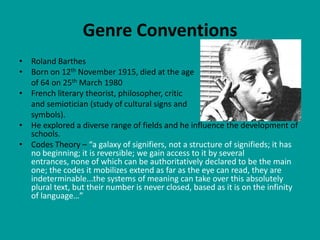
• Roland Barthes
• Born on 12th November 1915, died at the age
  of 64 on 25th March 1980
• French literary theorist, philosopher, critic
  and semiotician (study of cultural signs and
  symbols).
• He explored a diverse range of fields and he influence the development of
  schools.
• Codes Theory – “a galaxy of signifiers, not a structure of signifieds; it has
  no beginning; it is reversible; we gain access to it by several
  entrances, none of which can be authoritatively declared to be the main
  one; the codes it mobilizes extend as far as the eye can read, they are
  indeterminable...the systems of meaning can take over this absolutely
  plural text, but their number is never closed, based as it is on the infinity
  of language…”
This means…
• There more than one way to understand the
  meanings of text
• Start looking at a narrative in one way but can
  also look at it at a different angle and create a
  entirely different meaning
• Text are “open” or “closed”
• Open – loads of possibilities and meanings
• Closed – harder to think of possibilities
Codes
• The Hermeneutic Code (HER)

• The Enigma/Proairetic Code (ACT)

• The Semantic Code (SEM)
The Hermeneutic Code
• The voice of the truth
• The way the story avoids telling the truth or revealing all the facts
• Allowing to drop clues throughout to help create mystery
• Snares: deliberately avoiding the truth
• Equivocations: partial or incomplete answers
• Jammings: openly acknowledge that there is no answer to a
  problem
• I am doing a thriller trailer which suggest this could be a good code
  to imply this to my trailer
• Leaving clues in my trailer will intrigue my audience and help to
  create the unstable atmosphere when they watch it, creating
  mystery.
The Enigma/Proairetic Code
•   Empirical voice
•   Referring to any other action/event that indicates something else is going to
    happen
•   Which gets the audience guessing to what will happen next
•   The hermeneutic code and proairetic codes work together to develop the story's
    tension and keeps the audience interested.
•   Barthes described them as:
•   “...dependent on ... two sequential codes: the revelation of truth and the
    coordination of the actions represented: there is the same constraint in the
    gradual order of melody and in the equally gradual order of the narrative
    sequence.”
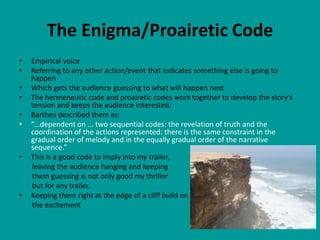
•   This is a good code to imply into my trailer,
    leaving the audience hanging and keeping
    them guessing is not only good my thriller
    but for any trailer.
•   Keeping them right at the edge of a cliff build on
    the excitement
The Semantic Code
• The voice of the person
• Points to any element that suggest a
  particular meaning through connotations
• Gives additional meaning
• These signs describe characters, settings and events.
• The semantic codes allows to ‘show’ instead of ‘tell’ by
  describing material things
• I will imply this code into my trailer because this will
  put my trailer on a higher level of understanding and
  will make the audience think. This also give further
  meaning.
Costumes
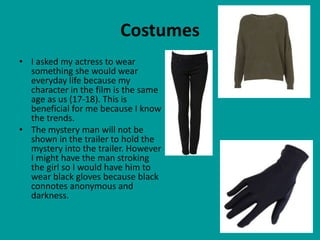
• I asked my actress to wear
  something she would wear
  everyday life because my
  character in the film is the same
  age as us (17-18). This is
  beneficial for me because I know
  the trends.
• The mystery man will not be
  shown in the trailer to hold the
  mystery into the trailer. However
  I might have the man stroking
  the girl so I would have him to
  wear black gloves because black
  connotes anonymous and
  darkness.
Props
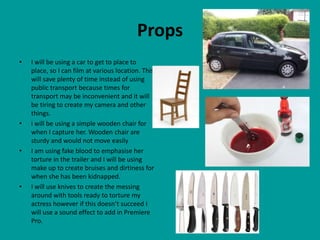
•   I will be using a car to get to place to
    place, so I can film at various location. This
    will save plenty of time instead of using
    public transport because times for
    transport may be inconvenient and it will
    be tiring to create my camera and other
    things.
•   i will be using a simple wooden chair for
    when I capture her. Wooden chair are
    sturdy and would not move easily
•   I am using fake blood to emphasise her
    torture in the trailer and I will be using
    make up to create bruises and dirtiness for
    when she has been kidnapped.
•   I will use knives to create the messing
    around with tools ready to torture my
    actress however if this doesn’t succeed I
    will use a sound effect to add in Premiere
    Pro.
Location
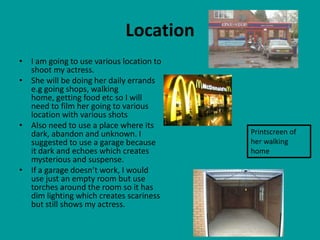
• I am going to use various location to
  shoot my actress.
• She will be doing her daily errands
  e.g going shops, walking
  home, getting food etc so I will
  need to film her going to various
  location with various shots
• Also need to use a place where its
  dark, abandon and unknown. I            Printscreen of
  suggested to use a garage because       her walking
  it dark and echoes which creates        home
  mysterious and suspense.
• If a garage doesn’t work, I would
  use just an empty room but use
  torches around the room so it has
  dim lighting which creates scariness
  but still shows my actress.
Communicating with my actress
• Now technology has be
  advanced, I can now
  communicate with her through
  mobile phone and because of
  the Web 2.0, I can also
  communicate with social
  networks such a Email, Twitter
  and Facebook.
• Mobile phones are more faster
  to communicate because I can
  always ring if plans are changed
  and always cancel and let that
  person know straight away.
Narrative - Vladimir Yakovlevich
                      Propp
•   Was a Russian and Soviet scholar who analysed the basic plot workings of Russian folks tales to find
    their simplest irreducible narrative elements
•   He conclude that al the characters could be resolved into 8 board character types in the 100 tales
    he analysed:
•   The hero – usually man, who restores the narrative equilibrium and is on question
•   The villain – creates the narrative disruption
•   The donor – gives the hero something (object, information or advice) which helps in resolution of
    the narrative
•   The dispatcher – sends the hero on his way
•   The false hero – who tempts the hero away from his quest
•   The helper – helps the hero in the task of restoring equilibrium
•   The princess – the victim. Most threatened by the villain and has to be saved
•   The father – usually gives the princess away to the hero at the narrative conclusion and rewards the
    hero
•   Propp’s theory is quite difficult to link to the films I have research which are on thrillers.
•   I have researched there is a ‘hero’ and ‘villain’ but isn't
    a ‘princess’ or the ‘father’.
•   His films are much related to James Bond films
•   I am going to challenge this theory because my ‘hero’ would
    be female. Stereotypically the hero is male
Levi-Strauss Binary Oppositions
•   Was a French anthropologist who lived in the early 1900s
•   Believe that the way we understand certain world depends not so much on the
    meaning but much more by our difference between the word
•   Looked at narrative structure in terms of binary oppositions
•   Binary oppositions are sets of opposite values which as good and evil
•   People say the concept of good will be the opposite of evil
•   Levi-Strauss was not interested in looking at the order in which events were
    arranged but was interested in the arrangements of themes.
•   For example: a science film we can identity the binary opposites which are created
    by the narrative:
•   Good vs. evil
•   Humans vs. aliens
•   Past vs. present
•   Normal vs. strange
•   Earth vs. space
•   I am going to put this theory into my trailer, because binary oppositions are a good
    way of narrative
Character Development
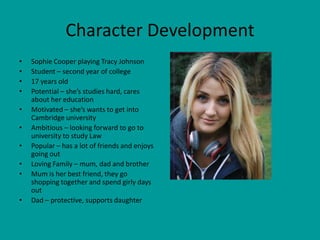
•   Sophie Cooper playing Tracy Johnson
•   Student – second year of college
•   17 years old
•   Potential – she’s studies hard, cares
    about her education
•   Motivated – she’s wants to get into
    Cambridge university
•   Ambitious – looking forward to go to
    university to study Law
•   Popular – has a lot of friends and enjoys
    going out
•   Loving Family – mum, dad and brother
•   Mum is her best friend, they go
    shopping together and spend girly days
    out
•   Dad – protective, supports daughter
Character Development
• Mystery Man
• 45 years old
• Suspicious –
  untrustworthy, doubtful
• Alone – always on his own, prefer
  to live on his own
• Personal – very private man, keeps
  things hidden
• Unseen – invisible, doesn’t like
  been seen around
• Quiet – silence man, doesn’t talk
  much
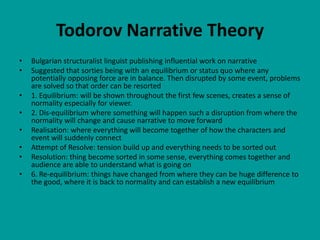
Todorov Narrative Theory
•   Bulgarian structuralist linguist publishing influential work on narrative
•   Suggested that sorties being with an equilibrium or status quo where any
    potentially opposing force are in balance. Then disrupted by some event, problems
    are solved so that order can be resorted
•   1. Equilibrium: will be shown throughout the first few scenes, creates a sense of
    normality especially for viewer.
•   2. Dis-equilibrium where something will happen such a disruption from where the
    normality will change and cause narrative to move forward
•   Realisation: where everything will become together of how the characters and
    event will suddenly connect
•   Attempt of Resolve: tension build up and everything needs to be sorted out
•   Resolution: thing become sorted in some sense, everything comes together and
    audience are able to understand what is going on
•   6. Re-equilibrium: things have changed from where they can be huge difference to
    the good, where it is back to normality and can establish a new equilibrium
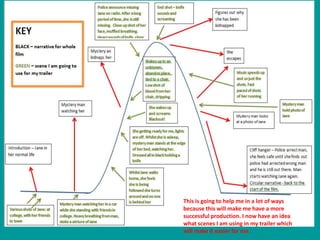
This is going to help me in a lot of ways
because this will make me have a more
successful production. I now have an idea
what scenes I am using in my trailer which
will make it easier for me.
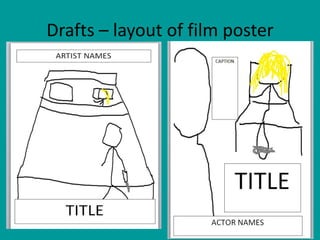
Drafts – layout of film poster
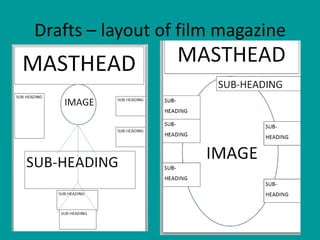
Drafts – layout of film magazine

Planning

  • 1.
  • 2.
    Here is mytimetable of my schedule from planning up to the deadline for coursework. In order to this this I have filled in my calendar with all my deadlines and plan for the next few months. This is help me organise my time well and helps me not be overloaded with work or past deadlines.
  • 3.
    Genre Conventions • RolandBarthes • Born on 12th November 1915, died at the age of 64 on 25th March 1980 • French literary theorist, philosopher, critic and semiotician (study of cultural signs and symbols). • He explored a diverse range of fields and he influence the development of schools. • Codes Theory – “a galaxy of signifiers, not a structure of signifieds; it has no beginning; it is reversible; we gain access to it by several entrances, none of which can be authoritatively declared to be the main one; the codes it mobilizes extend as far as the eye can read, they are indeterminable...the systems of meaning can take over this absolutely plural text, but their number is never closed, based as it is on the infinity of language…”
  • 4.
    This means… • Theremore than one way to understand the meanings of text • Start looking at a narrative in one way but can also look at it at a different angle and create a entirely different meaning • Text are “open” or “closed” • Open – loads of possibilities and meanings • Closed – harder to think of possibilities
  • 5.
    Codes • The HermeneuticCode (HER) • The Enigma/Proairetic Code (ACT) • The Semantic Code (SEM)
  • 6.
    The Hermeneutic Code •The voice of the truth • The way the story avoids telling the truth or revealing all the facts • Allowing to drop clues throughout to help create mystery • Snares: deliberately avoiding the truth • Equivocations: partial or incomplete answers • Jammings: openly acknowledge that there is no answer to a problem • I am doing a thriller trailer which suggest this could be a good code to imply this to my trailer • Leaving clues in my trailer will intrigue my audience and help to create the unstable atmosphere when they watch it, creating mystery.
  • 7.
    The Enigma/Proairetic Code • Empirical voice • Referring to any other action/event that indicates something else is going to happen • Which gets the audience guessing to what will happen next • The hermeneutic code and proairetic codes work together to develop the story's tension and keeps the audience interested. • Barthes described them as: • “...dependent on ... two sequential codes: the revelation of truth and the coordination of the actions represented: there is the same constraint in the gradual order of melody and in the equally gradual order of the narrative sequence.” • This is a good code to imply into my trailer, leaving the audience hanging and keeping them guessing is not only good my thriller but for any trailer. • Keeping them right at the edge of a cliff build on the excitement
  • 8.
    The Semantic Code •The voice of the person • Points to any element that suggest a particular meaning through connotations • Gives additional meaning • These signs describe characters, settings and events. • The semantic codes allows to ‘show’ instead of ‘tell’ by describing material things • I will imply this code into my trailer because this will put my trailer on a higher level of understanding and will make the audience think. This also give further meaning.
  • 9.
    Costumes • I askedmy actress to wear something she would wear everyday life because my character in the film is the same age as us (17-18). This is beneficial for me because I know the trends. • The mystery man will not be shown in the trailer to hold the mystery into the trailer. However I might have the man stroking the girl so I would have him to wear black gloves because black connotes anonymous and darkness.
  • 10.
    Props • I will be using a car to get to place to place, so I can film at various location. This will save plenty of time instead of using public transport because times for transport may be inconvenient and it will be tiring to create my camera and other things. • i will be using a simple wooden chair for when I capture her. Wooden chair are sturdy and would not move easily • I am using fake blood to emphasise her torture in the trailer and I will be using make up to create bruises and dirtiness for when she has been kidnapped. • I will use knives to create the messing around with tools ready to torture my actress however if this doesn’t succeed I will use a sound effect to add in Premiere Pro.
  • 11.
    Location • I amgoing to use various location to shoot my actress. • She will be doing her daily errands e.g going shops, walking home, getting food etc so I will need to film her going to various location with various shots • Also need to use a place where its dark, abandon and unknown. I Printscreen of suggested to use a garage because her walking it dark and echoes which creates home mysterious and suspense. • If a garage doesn’t work, I would use just an empty room but use torches around the room so it has dim lighting which creates scariness but still shows my actress.
  • 12.
    Communicating with myactress • Now technology has be advanced, I can now communicate with her through mobile phone and because of the Web 2.0, I can also communicate with social networks such a Email, Twitter and Facebook. • Mobile phones are more faster to communicate because I can always ring if plans are changed and always cancel and let that person know straight away.
  • 13.
    Narrative - VladimirYakovlevich Propp • Was a Russian and Soviet scholar who analysed the basic plot workings of Russian folks tales to find their simplest irreducible narrative elements • He conclude that al the characters could be resolved into 8 board character types in the 100 tales he analysed: • The hero – usually man, who restores the narrative equilibrium and is on question • The villain – creates the narrative disruption • The donor – gives the hero something (object, information or advice) which helps in resolution of the narrative • The dispatcher – sends the hero on his way • The false hero – who tempts the hero away from his quest • The helper – helps the hero in the task of restoring equilibrium • The princess – the victim. Most threatened by the villain and has to be saved • The father – usually gives the princess away to the hero at the narrative conclusion and rewards the hero • Propp’s theory is quite difficult to link to the films I have research which are on thrillers. • I have researched there is a ‘hero’ and ‘villain’ but isn't a ‘princess’ or the ‘father’. • His films are much related to James Bond films • I am going to challenge this theory because my ‘hero’ would be female. Stereotypically the hero is male
  • 14.
    Levi-Strauss Binary Oppositions • Was a French anthropologist who lived in the early 1900s • Believe that the way we understand certain world depends not so much on the meaning but much more by our difference between the word • Looked at narrative structure in terms of binary oppositions • Binary oppositions are sets of opposite values which as good and evil • People say the concept of good will be the opposite of evil • Levi-Strauss was not interested in looking at the order in which events were arranged but was interested in the arrangements of themes. • For example: a science film we can identity the binary opposites which are created by the narrative: • Good vs. evil • Humans vs. aliens • Past vs. present • Normal vs. strange • Earth vs. space • I am going to put this theory into my trailer, because binary oppositions are a good way of narrative
  • 15.
    Character Development • Sophie Cooper playing Tracy Johnson • Student – second year of college • 17 years old • Potential – she’s studies hard, cares about her education • Motivated – she’s wants to get into Cambridge university • Ambitious – looking forward to go to university to study Law • Popular – has a lot of friends and enjoys going out • Loving Family – mum, dad and brother • Mum is her best friend, they go shopping together and spend girly days out • Dad – protective, supports daughter
  • 16.
    Character Development • MysteryMan • 45 years old • Suspicious – untrustworthy, doubtful • Alone – always on his own, prefer to live on his own • Personal – very private man, keeps things hidden • Unseen – invisible, doesn’t like been seen around • Quiet – silence man, doesn’t talk much
  • 17.
    Todorov Narrative Theory • Bulgarian structuralist linguist publishing influential work on narrative • Suggested that sorties being with an equilibrium or status quo where any potentially opposing force are in balance. Then disrupted by some event, problems are solved so that order can be resorted • 1. Equilibrium: will be shown throughout the first few scenes, creates a sense of normality especially for viewer. • 2. Dis-equilibrium where something will happen such a disruption from where the normality will change and cause narrative to move forward • Realisation: where everything will become together of how the characters and event will suddenly connect • Attempt of Resolve: tension build up and everything needs to be sorted out • Resolution: thing become sorted in some sense, everything comes together and audience are able to understand what is going on • 6. Re-equilibrium: things have changed from where they can be huge difference to the good, where it is back to normality and can establish a new equilibrium
  • 18.
    This is goingto help me in a lot of ways because this will make me have a more successful production. I now have an idea what scenes I am using in my trailer which will make it easier for me.
  • 19.
    Drafts – layoutof film poster
  • 20.
    Drafts – layoutof film magazine