Narrative Structure in Film 
How Films Tell Stories
WWhhaatt iiss NNaarrrraattiivvee FFoorrmm?? 
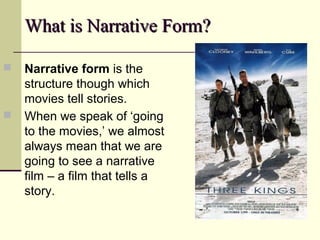
 Narrative form is the 
structure though which 
movies tell stories. 
 When we speak of ‘going 
to the movies,’ we almost 
always mean that we are 
going to see a narrative 
film – a film that tells a 
story.
NNaarrrraattiivveess aarree EEvveerryywwhheerree 
 Narratives appear throughout media and 
society – in novels, plays, comic books, 
television shows and even commercials. 
 Narratives are most common in fiction film, 
3 
but appear in all basic types of film: 
 Documentaries 
 Animated films 
 Experimental and avant-garde films 
 Short Films
EEvveennttss OOccccuurr iinn SSppaaccee aanndd TTiimmee 
 A narrative is an account of a string of events 
4 
occurring in space and time. 
 Narratives do not unfold randomly, but rather 
as an ordered series of events connected by 
the logic of cause and effect. 
 This logic of cause and effect ties together 
character traits, goals, obstacles and 
actions.
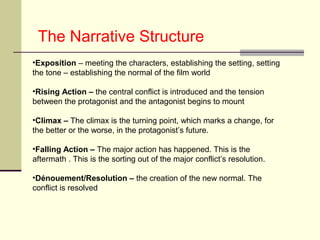
The Narrative Structure
The Narrative Structure 
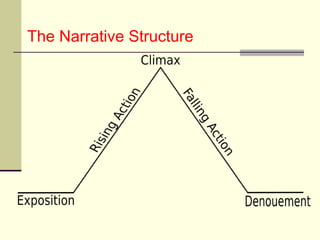
•Exposition – meeting the characters, establishing the setting, setting 
the tone – establishing the normal of the film world 
•Rising Action – the central conflict is introduced and the tension 
between the protagonist and the antagonist begins to mount 
•Climax – The climax is the turning point, which marks a change, for 
the better or the worse, in the protagonist’s future. 
•Falling Action – The major action has happened. This is the 
aftermath . This is the sorting out of the major conflict’s resolution. 
•Dénouement/Resolution – the creation of the new normal. The 
conflict is resolved
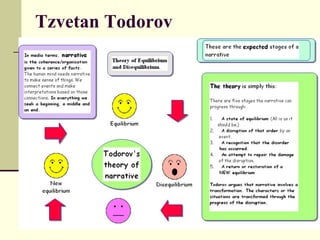
 Typically a narrative begins with one situation 
(Exposition). 
 A series of changes occurs according to a 
pattern of cause and effect. 
 Finally a new situation arises – through 
character choice and conflict – that restores 
equilibrium to the world of the story and brings 
about the end of the narrative. 
 The new story equilibrium almost always results 
in character change. 
7 
HHooww NNaarrrraattiivvee UUnnffoollddss
Tzvetan Todorov
EExxaammppllee 
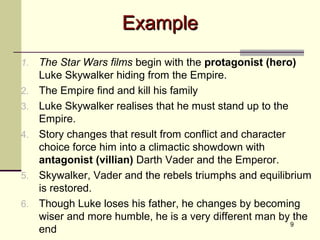
1. The Star Wars films begin with the protagonist (hero) 
9 
Luke Skywalker hiding from the Empire. 
2. The Empire find and kill his family 
3. Luke Skywalker realises that he must stand up to the 
Empire. 
4. Story changes that result from conflict and character 
choice force him into a climactic showdown with 
antagonist (villian) Darth Vader and the Emperor. 
5. Skywalker, Vader and the rebels triumphs and equilibrium 
is restored. 
6. Though Luke loses his father, he changes by becoming 
wiser and more humble, he is a very different man by the 
end
CChhaarraacctteerr 
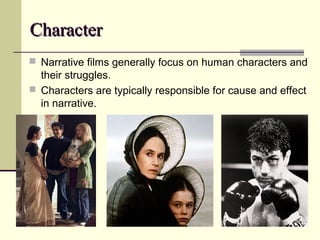
 Narrative films generally focus on human characters and 
their struggles. 
 Characters are typically responsible for cause and effect 
in narrative.
11 
CChhaarraacctteerr TTrraaiittss 
Traits are attitudes, skills, habits, tastes, 
psychological drives and any other qualities that 
distinguish a character. 
Traits in opening scenes are relevant to later 
scenes; this is related to cause and effect.
12 
EExxaammpplleess 
In The Star Wars films, Luke’s character traits 
are introduced early on and pay off in later 
scenes. 
They include his knowledge of the Force, his 
survival skills, his ability with a light saber, and 
his impetuousness.
CChhaarraacctteerr:: CChhooiicceess aanndd GGooaallss 
 Characters create cause and effect through 
choices that lead to conflict and consequences. 
 These patterns are designed so that the viewer 
clearly sees and understands them. 
 Characters posses traits, face conflicts, make 
choices and undergo changes that enable or 
hinder pursuit of a specific goal. 
 You will need to establish traits, choices and 
goals in your opening two mins
CChhaarraacctteerr:: GGooaallss aanndd oobbssttaacclleess 
 Goals might include solving a crime, getting 
revenge, finding a missing perosn. 
 Characters encounter obstacles in pursuing 
these goals – the collision of goals and obstacles 
create conflict and thus drama.
15 
SSeelleeccttiinngg aanndd OOrrggaanniizziinngg EEvveennttss 
 Feature films have a running time or screen 
time of between 90 and 180 minutes. But the 
stories they tell rarely take place in that amount 
of time. 
 In order to tell a story that may cover months or 
years, the filmmakers must choose to present 
certain events and leave others out or reorder 
events. 
 This is extremely true in the case of thriller films 
where the narrative is often extremely complex
16 
TThhee SSttoorryy aanndd tthhee PPlloott 
 The writer transforms a complete chronological 
story into an abbreviated, recognized version of 
events that plays out on the screen for the 
audience. 
 Often the differences are referred to as story and 
plot.
17 
TThhee SSttoorryy 
 The story is the chronological narrative, in its 
entirety. 
 It include events that take place during the span 
of time of the plot that are implied (backstory) but 
not always shown in detail
18 
TThhee PPlloott 
 The plot entails more than simply omitting events 
from the story – it also involves reordering events 
– some times using flashbacks and 
flashforwards. 
 Repositioning events influences the way 
audiences understand them and is often used in 
thriller films to create confusion, suspense, and 
mystery.
Levi-Strauss and binary oppositions. 
 Claude Levi Strauss, a French theorist (not 
the jeans!) gave media studies a number of 
influential theories that help us to understand 
how meaning is established quickly in 
openings. 
 Binary Oppositions create meaning through 
establishing what something is not. We 
understand the world through a system of 
power weighted oppositions and it is often 
these oppositions that drive the narrative.
Binary Oppositions 
 Man vs Woman 
 White vs Black 
 Young vs Old 
 Hero vs Villain 
 West vs East 
 Good vs Bad 
 Which of these lists have the most power?
TThhrriilllleerr FFiillmmss aanndd NNaarrrraattiivvee 
Thriller Film is a genre that revolves around anticipation 
and suspense. The aim for Thrillers is to keep the 
audience alert and on the edge of their seats. The 
protagonist in these films is set against a problem – an 
escape, a mission, or a mystery. No matter what sub-genre 
a Thriller film falls into, it will emphasize the danger 
that the protagonist faces. The tension with the main 
problem is built on throughout the film and leads to a highly 
stressful climax. 
As media students you need to know HOW to achieve 
this
Specific Narrative features of Thrillers 
 Plot twists and turns – complex, makes audience work 
 Flashbacks – dark past, adds to characters, confusion 
 Narrative retardation – confuses the audience, makes them 
work 
 Red herrings - confuses the audience, makes them work 
 Chases / pursuits – tension/ excitement 
 Mysterious characters - shady past / duplicitous / unsure of 
intentions, keep audience guessing 
 Deadlines - bomb timer, ransom demands, creates tension 
 Morally complex characters - makes the audience work 
 Enigma codes 
 Cliff hangers – tension, suspense, anxiety 
 Misdirection - confuses the audience, makes them work 
 Multiple lines of action – confusion, makes audience work
The Opening of Shutter Island 
 Watch this opening carefully looking for key 
narrative features (up to 8:48) 
 In your groups discuss and apply general 
narrative theory and specific narrative 
conventions of Thriller – in what ways is 
Shutter Island using general narrative 
theories, developing them, challenging them. 
 How typical ‘Thriller’ is it?
The Set Up 
 What does the set up reveal to the audience about 
setting? Where is this place? What gives you 
information? 
 What does the set up reveal to the audience about 
characters? Choose one character and explain HOW 
the set up reveals this information. 
 What does the set up reveal to the audience about 
interrelationship between characters? About their goals? 
Are there any things you learn here that become 
important later on? 
 What is this ‘world’ like? Safe? Happy? Dangerous? 
How do you know? 
 What possible conflicts or strains are there that will 
become part of the story later on? 
 How does this film opening fit with the codes and 
conventions of Thriller films?

04.narrative structure in films

  • 1.
    Narrative Structure inFilm How Films Tell Stories
  • 2.
    WWhhaatt iiss NNaarrrraattiivveeFFoorrmm??  Narrative form is the structure though which movies tell stories.  When we speak of ‘going to the movies,’ we almost always mean that we are going to see a narrative film – a film that tells a story.
  • 3.
    NNaarrrraattiivveess aarree EEvveerryywwhheerree  Narratives appear throughout media and society – in novels, plays, comic books, television shows and even commercials.  Narratives are most common in fiction film, 3 but appear in all basic types of film:  Documentaries  Animated films  Experimental and avant-garde films  Short Films
  • 4.
    EEvveennttss OOccccuurr iinnSSppaaccee aanndd TTiimmee  A narrative is an account of a string of events 4 occurring in space and time.  Narratives do not unfold randomly, but rather as an ordered series of events connected by the logic of cause and effect.  This logic of cause and effect ties together character traits, goals, obstacles and actions.
  • 5.
  • 6.
    The Narrative Structure •Exposition – meeting the characters, establishing the setting, setting the tone – establishing the normal of the film world •Rising Action – the central conflict is introduced and the tension between the protagonist and the antagonist begins to mount •Climax – The climax is the turning point, which marks a change, for the better or the worse, in the protagonist’s future. •Falling Action – The major action has happened. This is the aftermath . This is the sorting out of the major conflict’s resolution. •Dénouement/Resolution – the creation of the new normal. The conflict is resolved
  • 7.
     Typically anarrative begins with one situation (Exposition).  A series of changes occurs according to a pattern of cause and effect.  Finally a new situation arises – through character choice and conflict – that restores equilibrium to the world of the story and brings about the end of the narrative.  The new story equilibrium almost always results in character change. 7 HHooww NNaarrrraattiivvee UUnnffoollddss
  • 8.
  • 9.
    EExxaammppllee 1. TheStar Wars films begin with the protagonist (hero) 9 Luke Skywalker hiding from the Empire. 2. The Empire find and kill his family 3. Luke Skywalker realises that he must stand up to the Empire. 4. Story changes that result from conflict and character choice force him into a climactic showdown with antagonist (villian) Darth Vader and the Emperor. 5. Skywalker, Vader and the rebels triumphs and equilibrium is restored. 6. Though Luke loses his father, he changes by becoming wiser and more humble, he is a very different man by the end
  • 10.
    CChhaarraacctteerr  Narrativefilms generally focus on human characters and their struggles.  Characters are typically responsible for cause and effect in narrative.
  • 11.
    11 CChhaarraacctteerr TTrraaiittss Traits are attitudes, skills, habits, tastes, psychological drives and any other qualities that distinguish a character. Traits in opening scenes are relevant to later scenes; this is related to cause and effect.
  • 12.
    12 EExxaammpplleess InThe Star Wars films, Luke’s character traits are introduced early on and pay off in later scenes. They include his knowledge of the Force, his survival skills, his ability with a light saber, and his impetuousness.
  • 13.
    CChhaarraacctteerr:: CChhooiicceess aannddGGooaallss  Characters create cause and effect through choices that lead to conflict and consequences.  These patterns are designed so that the viewer clearly sees and understands them.  Characters posses traits, face conflicts, make choices and undergo changes that enable or hinder pursuit of a specific goal.  You will need to establish traits, choices and goals in your opening two mins
  • 14.
    CChhaarraacctteerr:: GGooaallss aannddoobbssttaacclleess  Goals might include solving a crime, getting revenge, finding a missing perosn.  Characters encounter obstacles in pursuing these goals – the collision of goals and obstacles create conflict and thus drama.
  • 15.
    15 SSeelleeccttiinngg aannddOOrrggaanniizziinngg EEvveennttss  Feature films have a running time or screen time of between 90 and 180 minutes. But the stories they tell rarely take place in that amount of time.  In order to tell a story that may cover months or years, the filmmakers must choose to present certain events and leave others out or reorder events.  This is extremely true in the case of thriller films where the narrative is often extremely complex
  • 16.
    16 TThhee SSttoorryyaanndd tthhee PPlloott  The writer transforms a complete chronological story into an abbreviated, recognized version of events that plays out on the screen for the audience.  Often the differences are referred to as story and plot.
  • 17.
    17 TThhee SSttoorryy  The story is the chronological narrative, in its entirety.  It include events that take place during the span of time of the plot that are implied (backstory) but not always shown in detail
  • 18.
    18 TThhee PPlloott  The plot entails more than simply omitting events from the story – it also involves reordering events – some times using flashbacks and flashforwards.  Repositioning events influences the way audiences understand them and is often used in thriller films to create confusion, suspense, and mystery.
  • 19.
    Levi-Strauss and binaryoppositions.  Claude Levi Strauss, a French theorist (not the jeans!) gave media studies a number of influential theories that help us to understand how meaning is established quickly in openings.  Binary Oppositions create meaning through establishing what something is not. We understand the world through a system of power weighted oppositions and it is often these oppositions that drive the narrative.
  • 20.
    Binary Oppositions Man vs Woman  White vs Black  Young vs Old  Hero vs Villain  West vs East  Good vs Bad  Which of these lists have the most power?
  • 21.
    TThhrriilllleerr FFiillmmss aannddNNaarrrraattiivvee Thriller Film is a genre that revolves around anticipation and suspense. The aim for Thrillers is to keep the audience alert and on the edge of their seats. The protagonist in these films is set against a problem – an escape, a mission, or a mystery. No matter what sub-genre a Thriller film falls into, it will emphasize the danger that the protagonist faces. The tension with the main problem is built on throughout the film and leads to a highly stressful climax. As media students you need to know HOW to achieve this
  • 22.
    Specific Narrative featuresof Thrillers  Plot twists and turns – complex, makes audience work  Flashbacks – dark past, adds to characters, confusion  Narrative retardation – confuses the audience, makes them work  Red herrings - confuses the audience, makes them work  Chases / pursuits – tension/ excitement  Mysterious characters - shady past / duplicitous / unsure of intentions, keep audience guessing  Deadlines - bomb timer, ransom demands, creates tension  Morally complex characters - makes the audience work  Enigma codes  Cliff hangers – tension, suspense, anxiety  Misdirection - confuses the audience, makes them work  Multiple lines of action – confusion, makes audience work
  • 23.
    The Opening ofShutter Island  Watch this opening carefully looking for key narrative features (up to 8:48)  In your groups discuss and apply general narrative theory and specific narrative conventions of Thriller – in what ways is Shutter Island using general narrative theories, developing them, challenging them.  How typical ‘Thriller’ is it?
  • 24.
    The Set Up  What does the set up reveal to the audience about setting? Where is this place? What gives you information?  What does the set up reveal to the audience about characters? Choose one character and explain HOW the set up reveals this information.  What does the set up reveal to the audience about interrelationship between characters? About their goals? Are there any things you learn here that become important later on?  What is this ‘world’ like? Safe? Happy? Dangerous? How do you know?  What possible conflicts or strains are there that will become part of the story later on?  How does this film opening fit with the codes and conventions of Thriller films?