UNIT 22 TASK 1: HOW NOT TO
SUCK
BTEC Creative Media
WHAT GRADE DO YOU WANT?
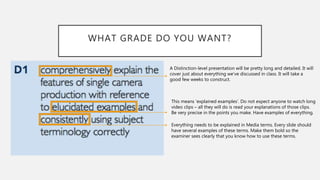
A Distinction-level presentation will be pretty long and detailed. It will
cover just about everything we’ve discussed in class. It will take a
good few weeks to construct.
This means ‘explained examples’. Do not expect anyone to watch long
video clips – all they will do is read your explanations of those clips.
Be very precise in the points you make. Have examples of everything.
Everything needs to be explained in Media terms. Every slide should
have several examples of these terms. Make them bold so the
examiner sees clearly that you know how to use these terms.
WHAT TO INCLUDE?
WHAT TO INCLUDE?
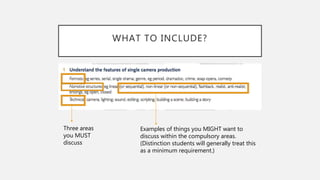
Three areas
you MUST
discuss
Examples of things you MIGHT want to
discuss within the compulsory areas.
(Distinction students will generally treat this
as a minimum requirement.)
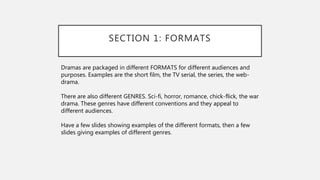
SECTION 1: FORMATS
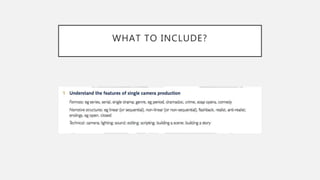
Dramas are packaged in different FORMATS for different audiences and
purposes. Examples are the short film, the TV serial, the series, the web-
drama.
There are also different GENRES. Sci-fi, horror, romance, chick-flick, the war
drama. These genres have different conventions and they appeal to
different audiences.
Have a few slides showing examples of the different formats, then a few
slides giving examples of different genres.
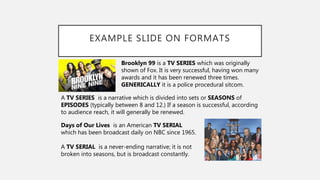
EXAMPLE SLIDE ON FORMATS
Brooklyn 99 is a TV SERIES which was originally
shown of Fox. It is very successful, having won many
awards and it has been renewed three times.
GENERICALLY it is a police procedural sitcom.
A TV SERIES is a narrative which is divided into sets or SEASONS of
EPISODES (typically between 8 and 12.) If a season is successful, according
to audience reach, it will generally be renewed.
Days of Our Lives is an American TV SERIAL
which has been broadcast daily on NBC since 1965.
A TV SERIAL is a never-ending narrative; it is not
broken into seasons, but is broadcast constantly.
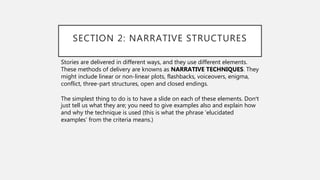
SECTION 2: NARRATIVE STRUCTURES
Stories are delivered in different ways, and they use different elements.
These methods of delivery are knowns as NARRATIVE TECHNIQUES. They
might include linear or non-linear plots, flashbacks, voiceovers, enigma,
conflict, three-part structures, open and closed endings.
The simplest thing to do is to have a slide on each of these elements. Don’t
just tell us what they are; you need to give examples also and explain how
and why the technique is used (this is what the phrase ‘elucidated
examples’ from the criteria means.)
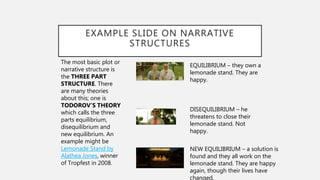
EXAMPLE SLIDE ON NARRATIVE
STRUCTURES
The most basic plot or
narrative structure is
the THREE PART
STRUCTURE. There
are many theories
about this; one is
TODOROV’S THEORY
which calls the three
parts equilibrium,
disequilibrium and
new equilibrium. An
example might be
Lemonade Stand by
Alathea Jones, winner
of Tropfest in 2008.
EQUILIBRIUM – they own a
lemonade stand. They are
happy.
DISEQUILIBRIUM – he
threatens to close their
lemonade stand. Not
happy.
NEW EQUILIBRIUM – a solution is
found and they all work on the
lemonade stand. They are happy
again, though their lives have
changed.
SECTION 3: TECHNICAL
Probably the biggest section, though it depends on you. You need to write about:
• Cinematography – camera shots and movements; lighting
• Sound Design
• Editing
• Scripting (you might do this in the narrative section…)
• How all of this builds a scene.
When talking about these technical details, by far the easiest thing to do is
to analyse actual examples. Feel free to use the examples we’ve seen in
class; but it is always far more impressive (and exemplary of the
‘independence’ required to get beyond a pass) to find your own. The same
scene can be used as an example of many things.
EXAMPLE SLIDES ON TECHNICAL CODES
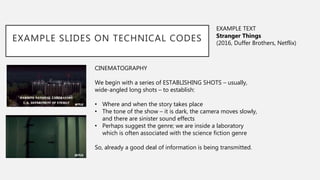
CINEMATOGRAPHY
We begin with a series of ESTABLISHING SHOTS – usually,
wide-angled long shots – to establish:
• Where and when the story takes place
• The tone of the show – it is dark, the camera moves slowly,
and there are sinister sound effects
• Perhaps suggest the genre; we are inside a laboratory
which is often associated with the science fiction genre
So, already a good deal of information is being transmitted.
EXAMPLE TEXT
Stranger Things
(2016, Duffer Brothers, Netflix)
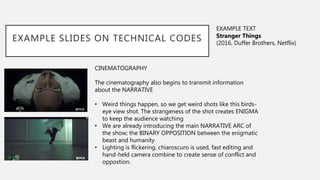
CINEMATOGRAPHY
The cinematography also begins to transmit information
about the NARRATIVE
• Weird things happen, so we get weird shots like this birds-
eye view shot. The strangeness of the shot creates ENIGMA
to keep the audience watching
• We are already introducing the main NARRATIVE ARC of
the show; the BINARY OPPOSITION between the enigmatic
beast and humanity
• Lighting is flickering, chiaroscuro is used, fast editing and
hand-held camera combine to create sense of conflict and
oppostion.
EXAMPLE SLIDES ON TECHNICAL CODES
EXAMPLE TEXT
Stranger Things
(2016, Duffer Brothers, Netflix)
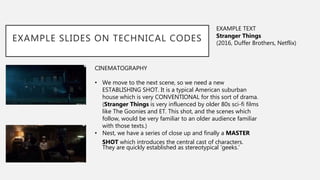
CINEMATOGRAPHY
• We move to the next scene, so we need a new
ESTABLISHING SHOT. It is a typical American suburban
house which is very CONVENTIONAL for this sort of drama.
(Stranger Things is very influenced by older 80s sci-fi films
like The Goonies and ET. This shot, and the scenes which
follow, would be very familiar to an older audience familiar
with those texts.)
• Nest, we have a series of close up and finally a MASTER
SHOT which introduces the central cast of characters.
They are quickly established as stereotypical ’geeks.’
EXAMPLE SLIDES ON TECHNICAL CODES
EXAMPLE TEXT
Stranger Things
(2016, Duffer Brothers, Netflix)
GETTING STARTED!
• Decide what examples you are going to use. Have a mix of TV dramas
and short films.
• Make a plan. If it’s a powerpoint, decide how many sections and how
many slides you are going to have.
• If it’s a video essay, plan and write your voiceover. Again, decide how
many sections you want and assemble them separately.
• Don’t expect your audience to watch much (or any, possibly) video.
Nobody actually watches the video embedded in presentations. A few
seconds at most. Extract the piece of video which makes your point.
• Aim for ten minutes of film or 50 or so slides as a minimum. As far as
possible, make sure all your points link to something on the assessment
criteria.
• Content is most important, but presentation matters also.
• Ask teachers to check what you are doing as you go along. You should
know what grade you are going to get long before you get it.

Btec single camera presentation

  • 1.
    UNIT 22 TASK1: HOW NOT TO SUCK BTEC Creative Media
  • 2.
    WHAT GRADE DOYOU WANT?
  • 3.
    WHAT GRADE DOYOU WANT? A Distinction-level presentation will be pretty long and detailed. It will cover just about everything we’ve discussed in class. It will take a good few weeks to construct. This means ‘explained examples’. Do not expect anyone to watch long video clips – all they will do is read your explanations of those clips. Be very precise in the points you make. Have examples of everything. Everything needs to be explained in Media terms. Every slide should have several examples of these terms. Make them bold so the examiner sees clearly that you know how to use these terms.
  • 4.
  • 5.
    WHAT TO INCLUDE? Threeareas you MUST discuss Examples of things you MIGHT want to discuss within the compulsory areas. (Distinction students will generally treat this as a minimum requirement.)
  • 6.
    SECTION 1: FORMATS Dramasare packaged in different FORMATS for different audiences and purposes. Examples are the short film, the TV serial, the series, the web- drama. There are also different GENRES. Sci-fi, horror, romance, chick-flick, the war drama. These genres have different conventions and they appeal to different audiences. Have a few slides showing examples of the different formats, then a few slides giving examples of different genres.
  • 7.
    EXAMPLE SLIDE ONFORMATS Brooklyn 99 is a TV SERIES which was originally shown of Fox. It is very successful, having won many awards and it has been renewed three times. GENERICALLY it is a police procedural sitcom. A TV SERIES is a narrative which is divided into sets or SEASONS of EPISODES (typically between 8 and 12.) If a season is successful, according to audience reach, it will generally be renewed. Days of Our Lives is an American TV SERIAL which has been broadcast daily on NBC since 1965. A TV SERIAL is a never-ending narrative; it is not broken into seasons, but is broadcast constantly.
  • 8.
    SECTION 2: NARRATIVESTRUCTURES Stories are delivered in different ways, and they use different elements. These methods of delivery are knowns as NARRATIVE TECHNIQUES. They might include linear or non-linear plots, flashbacks, voiceovers, enigma, conflict, three-part structures, open and closed endings. The simplest thing to do is to have a slide on each of these elements. Don’t just tell us what they are; you need to give examples also and explain how and why the technique is used (this is what the phrase ‘elucidated examples’ from the criteria means.)
  • 9.
    EXAMPLE SLIDE ONNARRATIVE STRUCTURES The most basic plot or narrative structure is the THREE PART STRUCTURE. There are many theories about this; one is TODOROV’S THEORY which calls the three parts equilibrium, disequilibrium and new equilibrium. An example might be Lemonade Stand by Alathea Jones, winner of Tropfest in 2008. EQUILIBRIUM – they own a lemonade stand. They are happy. DISEQUILIBRIUM – he threatens to close their lemonade stand. Not happy. NEW EQUILIBRIUM – a solution is found and they all work on the lemonade stand. They are happy again, though their lives have changed.
  • 10.
    SECTION 3: TECHNICAL Probablythe biggest section, though it depends on you. You need to write about: • Cinematography – camera shots and movements; lighting • Sound Design • Editing • Scripting (you might do this in the narrative section…) • How all of this builds a scene. When talking about these technical details, by far the easiest thing to do is to analyse actual examples. Feel free to use the examples we’ve seen in class; but it is always far more impressive (and exemplary of the ‘independence’ required to get beyond a pass) to find your own. The same scene can be used as an example of many things.
  • 11.
    EXAMPLE SLIDES ONTECHNICAL CODES CINEMATOGRAPHY We begin with a series of ESTABLISHING SHOTS – usually, wide-angled long shots – to establish: • Where and when the story takes place • The tone of the show – it is dark, the camera moves slowly, and there are sinister sound effects • Perhaps suggest the genre; we are inside a laboratory which is often associated with the science fiction genre So, already a good deal of information is being transmitted. EXAMPLE TEXT Stranger Things (2016, Duffer Brothers, Netflix)
  • 12.
    CINEMATOGRAPHY The cinematography alsobegins to transmit information about the NARRATIVE • Weird things happen, so we get weird shots like this birds- eye view shot. The strangeness of the shot creates ENIGMA to keep the audience watching • We are already introducing the main NARRATIVE ARC of the show; the BINARY OPPOSITION between the enigmatic beast and humanity • Lighting is flickering, chiaroscuro is used, fast editing and hand-held camera combine to create sense of conflict and oppostion. EXAMPLE SLIDES ON TECHNICAL CODES EXAMPLE TEXT Stranger Things (2016, Duffer Brothers, Netflix)
  • 13.
    CINEMATOGRAPHY • We moveto the next scene, so we need a new ESTABLISHING SHOT. It is a typical American suburban house which is very CONVENTIONAL for this sort of drama. (Stranger Things is very influenced by older 80s sci-fi films like The Goonies and ET. This shot, and the scenes which follow, would be very familiar to an older audience familiar with those texts.) • Nest, we have a series of close up and finally a MASTER SHOT which introduces the central cast of characters. They are quickly established as stereotypical ’geeks.’ EXAMPLE SLIDES ON TECHNICAL CODES EXAMPLE TEXT Stranger Things (2016, Duffer Brothers, Netflix)
  • 14.
    GETTING STARTED! • Decidewhat examples you are going to use. Have a mix of TV dramas and short films. • Make a plan. If it’s a powerpoint, decide how many sections and how many slides you are going to have. • If it’s a video essay, plan and write your voiceover. Again, decide how many sections you want and assemble them separately. • Don’t expect your audience to watch much (or any, possibly) video. Nobody actually watches the video embedded in presentations. A few seconds at most. Extract the piece of video which makes your point. • Aim for ten minutes of film or 50 or so slides as a minimum. As far as possible, make sure all your points link to something on the assessment criteria. • Content is most important, but presentation matters also. • Ask teachers to check what you are doing as you go along. You should know what grade you are going to get long before you get it.