Narrative Theories
LOOK INTO THE NARRATIVE THEORIES AND
HOW THEY LINK TO THE CREATION OF YOUR
MAGAZINE
Theorists
After researching into different theorists, I can see that there are many
who use the theory to explain narrative structure. Narrative is the way in
which a story is told in both fictional and non-fictional media texts.
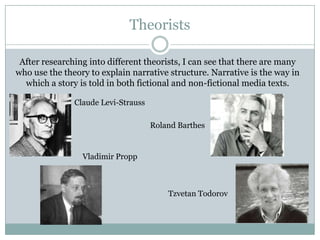
Claude Levi-Strauss
Roland Barthes

Vladimir Propp

Tzvetan Todorov
Vladimir Propp
Propp was a Russian critic and literary
theorist. Propp proposed that it was possible
to classify the characters and their actions
into clearly defined roles and functions, his
character roles included:
 The hero (seeks something)
 The villain (opposes the hero)
 The donor (helps the hero by providing a
magic object)
 The dispatcher (sends the hero on their
way)
 The false hero (falsely assuming the role
of the hero)
 The helper (gives support to the hero)
 The princess (the reward for the hero, but
also needs protection from the villain)
 The father
Tzvetan Todorov
Todorov was a Bulgarian literary theorist. He
suggested that most narratives start with a state of
equilibrium in which life is “normal” and
protagonists happy. The state of normality is
disrupted by an outside force which has to be
fought against in order to return to a state of
equilibrium. Todorov suggested that conventional
narratives are structured in five stages:
 A state of equilibrium at the outset
 A disruption of the equilibrium by some action
 A recognition that there has been a disruption
 An attempt to repair the disruption
 A reinstatement of the equilibrium
Equilibrium – Disequilibrium – New Equilibrium
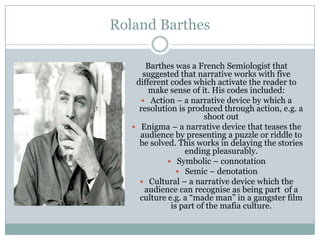
Roland Barthes
Barthes was a French Semiologist that
suggested that narrative works with five
different codes which activate the reader to
make sense of it. His codes included:
 Action – a narrative device by which a
resolution is produced through action, e.g. a
shoot out
 Enigma – a narrative device that teases the
audience by presenting a puzzle or riddle to
be solved. This works in delaying the stories
ending pleasurably.
 Symbolic – connotation
 Semic – denotation
 Cultural – a narrative device which the
audience can recognise as being part of a
culture e.g. a “made man” in a gangster film
is part of the mafia culture.
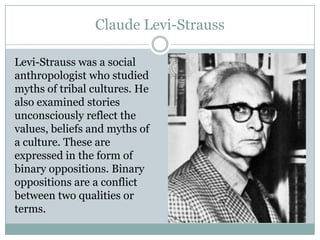
Claude Levi-Strauss
Levi-Strauss was a social
anthropologist who studied
myths of tribal cultures. He
also examined stories
unconsciously reflect the
values, beliefs and myths of
a culture. These are
expressed in the form of
binary oppositions. Binary
oppositions are a conflict
between two qualities or
terms.

Narrative theories

  • 1.
    Narrative Theories LOOK INTOTHE NARRATIVE THEORIES AND HOW THEY LINK TO THE CREATION OF YOUR MAGAZINE
  • 2.
    Theorists After researching intodifferent theorists, I can see that there are many who use the theory to explain narrative structure. Narrative is the way in which a story is told in both fictional and non-fictional media texts. Claude Levi-Strauss Roland Barthes Vladimir Propp Tzvetan Todorov
  • 3.
    Vladimir Propp Propp wasa Russian critic and literary theorist. Propp proposed that it was possible to classify the characters and their actions into clearly defined roles and functions, his character roles included:  The hero (seeks something)  The villain (opposes the hero)  The donor (helps the hero by providing a magic object)  The dispatcher (sends the hero on their way)  The false hero (falsely assuming the role of the hero)  The helper (gives support to the hero)  The princess (the reward for the hero, but also needs protection from the villain)  The father
  • 4.
    Tzvetan Todorov Todorov wasa Bulgarian literary theorist. He suggested that most narratives start with a state of equilibrium in which life is “normal” and protagonists happy. The state of normality is disrupted by an outside force which has to be fought against in order to return to a state of equilibrium. Todorov suggested that conventional narratives are structured in five stages:  A state of equilibrium at the outset  A disruption of the equilibrium by some action  A recognition that there has been a disruption  An attempt to repair the disruption  A reinstatement of the equilibrium Equilibrium – Disequilibrium – New Equilibrium
  • 5.
    Roland Barthes Barthes wasa French Semiologist that suggested that narrative works with five different codes which activate the reader to make sense of it. His codes included:  Action – a narrative device by which a resolution is produced through action, e.g. a shoot out  Enigma – a narrative device that teases the audience by presenting a puzzle or riddle to be solved. This works in delaying the stories ending pleasurably.  Symbolic – connotation  Semic – denotation  Cultural – a narrative device which the audience can recognise as being part of a culture e.g. a “made man” in a gangster film is part of the mafia culture.
  • 6.
    Claude Levi-Strauss Levi-Strauss wasa social anthropologist who studied myths of tribal cultures. He also examined stories unconsciously reflect the values, beliefs and myths of a culture. These are expressed in the form of binary oppositions. Binary oppositions are a conflict between two qualities or terms.