Narrative theory
By Emre Kebir
What is narrative theory?
The definition of narrative theory is ‘the way in which a story is
told in both fictional and non-fictional media texts’. There are
many different theories from different individuals regarding
narrative theory, with many theorists interpreting different
aspects of narrative in certain ways.
Propp's Theory
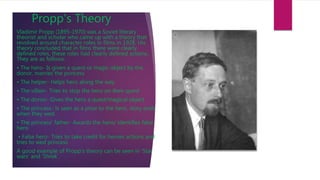
Vladimir Propp (1895-1970) was a Soviet literary
theorist and scholar who came up with a theory that
revolved around character roles in films in 1928. His
theory concluded that in films there were clearly
defined roles, these roles had clearly defined actions.
They are as follows:
• The hero- Is given a quest or magic object by the
donor, marries the princess
• The helper- Helps hero along the way
• The villain- Tries to stop the hero on their quest
• The donor- Gives the hero a quest/magical object
• The princess- Is seen as a prize to the hero, story ends
when they wed.
• The princess’ father- Awards the hero/ identifies false
hero
• False hero- Tries to take credit for heroes actions and
tries to wed princess
A good example of Propp’s theory can be seen in ‘Star
wars’ and ‘Shrek’.
Levi-Strauss’ theory
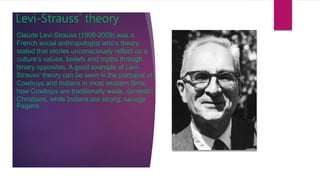
Claude Levi-Strauss (1908-2009) was a
French social anthropologist who’s theory
stated that stories unconsciously reflect on a
culture’s values, beliefs and myths through
binary opposites. A good example of Levi-
Strauss’ theory can be seen in the portrayal of
Cowboys and Indians in most western films,
how Cowboys are traditionally weak, domestic
Christians, while Indians are strong, savage
Pagans.
Todorov’s theory
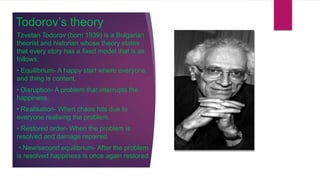
Tzvetan Todorov (born 1939) is a Bulgarian
theorist and historian whose theory states
that every story has a fixed model that is as
follows:
• Equilibrium- A happy start where everyone
and thing is content.
• Disruption- A problem that interrupts the
happiness.
• Realisation- When chaos hits due to
everyone realising the problem.
• Restored order- When the problem is
resolved and damage repaired.
• New/second equilibrium- After the problem
is resolved happiness is once again restored.
Barthes' Theory
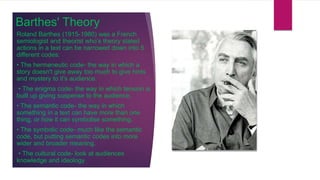
Roland Barthes (1915-1980) was a French
semiologist and theorist who’s theory stated
actions in a text can be narrowed down into 5
different codes:
• The hermeneutic code- the way in which a
story doesn't give away too much to give hints
and mystery to it’s audience.
• The enigma code- the way in which tension is
built up giving suspense to the audience.
• The semantic code- the way in which
something in a text can have more than one
thing, or how it can symbolise something.
• The symbolic code- much like the semantic
code, but putting semantic codes into more
wider and broader meaning.
• The cultural code- look at audiences
knowledge and ideology.

Theorists

  • 1.
  • 2.
    What is narrativetheory? The definition of narrative theory is ‘the way in which a story is told in both fictional and non-fictional media texts’. There are many different theories from different individuals regarding narrative theory, with many theorists interpreting different aspects of narrative in certain ways.
  • 3.
    Propp's Theory Vladimir Propp(1895-1970) was a Soviet literary theorist and scholar who came up with a theory that revolved around character roles in films in 1928. His theory concluded that in films there were clearly defined roles, these roles had clearly defined actions. They are as follows: • The hero- Is given a quest or magic object by the donor, marries the princess • The helper- Helps hero along the way • The villain- Tries to stop the hero on their quest • The donor- Gives the hero a quest/magical object • The princess- Is seen as a prize to the hero, story ends when they wed. • The princess’ father- Awards the hero/ identifies false hero • False hero- Tries to take credit for heroes actions and tries to wed princess A good example of Propp’s theory can be seen in ‘Star wars’ and ‘Shrek’.
  • 4.
    Levi-Strauss’ theory Claude Levi-Strauss(1908-2009) was a French social anthropologist who’s theory stated that stories unconsciously reflect on a culture’s values, beliefs and myths through binary opposites. A good example of Levi- Strauss’ theory can be seen in the portrayal of Cowboys and Indians in most western films, how Cowboys are traditionally weak, domestic Christians, while Indians are strong, savage Pagans.
  • 5.
    Todorov’s theory Tzvetan Todorov(born 1939) is a Bulgarian theorist and historian whose theory states that every story has a fixed model that is as follows: • Equilibrium- A happy start where everyone and thing is content. • Disruption- A problem that interrupts the happiness. • Realisation- When chaos hits due to everyone realising the problem. • Restored order- When the problem is resolved and damage repaired. • New/second equilibrium- After the problem is resolved happiness is once again restored.
  • 6.
    Barthes' Theory Roland Barthes(1915-1980) was a French semiologist and theorist who’s theory stated actions in a text can be narrowed down into 5 different codes: • The hermeneutic code- the way in which a story doesn't give away too much to give hints and mystery to it’s audience. • The enigma code- the way in which tension is built up giving suspense to the audience. • The semantic code- the way in which something in a text can have more than one thing, or how it can symbolise something. • The symbolic code- much like the semantic code, but putting semantic codes into more wider and broader meaning. • The cultural code- look at audiences knowledge and ideology.