NARRATIVE THEORIES
‘The way in which a story is told in both fictional and non-fictional media
texts’
VLADMIR PROPP
He was a Russian critic and literary theorist, who analysed
over 100 Russian fairy tales in the 1920’s. He proposed that it
was possible to classify the characters and their actions into
clearly defined roles and functions.
• The Hero – seeks something
• The Villain – opposes the hero
• The Donor – helps the hero by providing a magic object
• The Dispatcher – sends the hero on his way
• The False Hero – falsely assuming the role of hero
• The Helper – gives support to the hero
• The Princess – the reward for the hero, but also needs protection from the
villain
• Her Father
TZVETAN TODOROV
He was a Bulgarian literary theorist, suggesting
most narratives start with a state of equilibrium in
which life is ‘normal’ and protagonist’s happy. This
state of normality is disrupted by an outside force,
which has to be fought against in order to return to
a state of equilibrium. This model can easily be
applied to a wide range of films.
Equilibrium Disequilibrium New Equilibrium
ROLAND BARTHES
He was a French semiologist, suggesting that
narrative works with five different codes which
activate the audience to make sense of it.
• Action –a resolution is produced through action e.g. a shoot-out
• Enigma – teases the audience by presenting a puzzle or riddle to be
solved. Works to delay the story’s ending pleasurably.
• Symbolic – connotation
• Semic – denotation
• Cultural – the audience can recognise as being part of a culture e.g.
‘‘made man’’ in gangster film is part of the mafia culture.
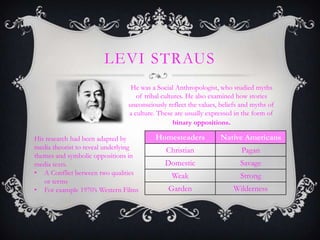
LEVI STRAUS
He was a Social Anthropologist, who studied myths
of tribal cultures. He also examined how stories
unconsciously reflect the values, beliefs and myths of
a culture. These are usually expressed in the form of
binary oppositions.
His research had been adapted by
media theorist to reveal underlying
themes and symbolic oppositions in
media texts.
• A Conflict between two qualities
or terms
• For example 1970’s Western Films
Homesteaders Native Americans
Christian Pagan
Domestic Savage
Weak Strong
Garden Wilderness
PARADOX
My narrative for ‘Paradox’ fits in with Roland's’ Barthes
theory. This is because my film includes;
• Action – discovering the meaning of the religious
book James Cathron find in the old village church
• Enigma – riddle is found in the opening sequence
making the audience think which delays the story's
ending

Narrative Theories

  • 1.
    NARRATIVE THEORIES ‘The wayin which a story is told in both fictional and non-fictional media texts’
  • 2.
    VLADMIR PROPP He wasa Russian critic and literary theorist, who analysed over 100 Russian fairy tales in the 1920’s. He proposed that it was possible to classify the characters and their actions into clearly defined roles and functions. • The Hero – seeks something • The Villain – opposes the hero • The Donor – helps the hero by providing a magic object • The Dispatcher – sends the hero on his way • The False Hero – falsely assuming the role of hero • The Helper – gives support to the hero • The Princess – the reward for the hero, but also needs protection from the villain • Her Father
  • 3.
    TZVETAN TODOROV He wasa Bulgarian literary theorist, suggesting most narratives start with a state of equilibrium in which life is ‘normal’ and protagonist’s happy. This state of normality is disrupted by an outside force, which has to be fought against in order to return to a state of equilibrium. This model can easily be applied to a wide range of films. Equilibrium Disequilibrium New Equilibrium
  • 4.
    ROLAND BARTHES He wasa French semiologist, suggesting that narrative works with five different codes which activate the audience to make sense of it. • Action –a resolution is produced through action e.g. a shoot-out • Enigma – teases the audience by presenting a puzzle or riddle to be solved. Works to delay the story’s ending pleasurably. • Symbolic – connotation • Semic – denotation • Cultural – the audience can recognise as being part of a culture e.g. ‘‘made man’’ in gangster film is part of the mafia culture.
  • 5.
    LEVI STRAUS He wasa Social Anthropologist, who studied myths of tribal cultures. He also examined how stories unconsciously reflect the values, beliefs and myths of a culture. These are usually expressed in the form of binary oppositions. His research had been adapted by media theorist to reveal underlying themes and symbolic oppositions in media texts. • A Conflict between two qualities or terms • For example 1970’s Western Films Homesteaders Native Americans Christian Pagan Domestic Savage Weak Strong Garden Wilderness
  • 6.
    PARADOX My narrative for‘Paradox’ fits in with Roland's’ Barthes theory. This is because my film includes; • Action – discovering the meaning of the religious book James Cathron find in the old village church • Enigma – riddle is found in the opening sequence making the audience think which delays the story's ending