Narrative Theorist
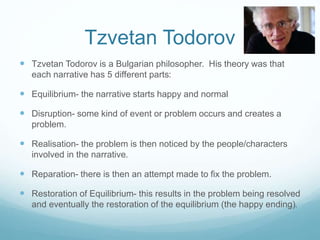
Tzvetan Todorov 
 Tzvetan Todorov is a Bulgarian philosopher. His theory was that 
each narrative has 5 different parts: 
 Equilibrium- the narrative starts happy and normal 
 Disruption- some kind of event or problem occurs and creates a 
problem. 
 Realisation- the problem is then noticed by the people/characters 
involved in the narrative. 
 Reparation- there is then an attempt made to fix the problem. 
 Restoration of Equilibrium- this results in the problem being resolved 
and eventually the restoration of the equilibrium (the happy ending).
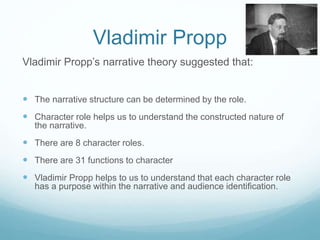
Vladimir Propp 
Vladimir Propp’s narrative theory suggested that: 
 The narrative structure can be determined by the role. 
 Character role helps us to understand the constructed nature of 
the narrative. 
 There are 8 character roles. 
 There are 31 functions to character 
 Vladimir Propp helps to us to understand that each character role 
has a purpose within the narrative and audience identification.
These character roles are: 
 The villain, who struggles with the hero (formally known as the antagonist) 
 The donor, 
 The helper, 
 The Princess, a sought-for person (and/or her father), who exists as a goal 
and often recognizes and marries hero and/or punishes villain 
 The dispatcher, 
 The hero, who departs on a search (seeker-hero), reacts to the donor and 
weds 
 The false hero (or antihero or usurper), who claims to be the hero, often 
seeking and reacting like a real hero (ie by trying to marry the princess).
Claude Levi- Shrauss 
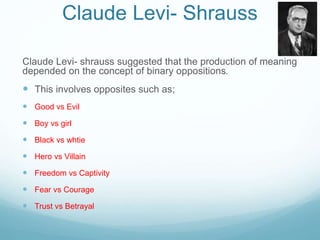
Claude Levi- shrauss suggested that the production of meaning 
depended on the concept of binary oppositions. 
 This involves opposites such as; 
 Good vs Evil 
 Boy vs girl 
 Black vs whtie 
 Hero vs Villain 
 Freedom vs Captivity 
 Fear vs Courage 
 Trust vs Betrayal
Roland Barthes 
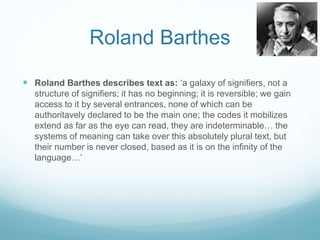
 Roland Barthes describes text as: ‘a galaxy of signifiers, not a 
structure of signifiers; it has no beginning; it is reversible; we gain 
access to it by several entrances, none of which can be 
authoritavely declared to be the main one; the codes it mobilizes 
extend as far as the eye can read, they are indeterminable… the 
systems of meaning can take over this absolutely plural text, but 
their number is never closed, based as it is on the infinity of the 
language…’
 We have done this task to research the theorists to give us a wider 
knowledge into documentaries and their structure and origins. 
Using the information found whilst carrying out this task helped us 
in deciding what narrative theorist to follow. We have chosen to 
follow Claude Levi-Shrauss’ narrative theorist as we are going to 
be portraying the good vs evil of social media in terms of the 
impact that social media is having on our generation.

Post 5a

  • 1.
  • 2.
    Tzvetan Todorov Tzvetan Todorov is a Bulgarian philosopher. His theory was that each narrative has 5 different parts:  Equilibrium- the narrative starts happy and normal  Disruption- some kind of event or problem occurs and creates a problem.  Realisation- the problem is then noticed by the people/characters involved in the narrative.  Reparation- there is then an attempt made to fix the problem.  Restoration of Equilibrium- this results in the problem being resolved and eventually the restoration of the equilibrium (the happy ending).
  • 3.
    Vladimir Propp VladimirPropp’s narrative theory suggested that:  The narrative structure can be determined by the role.  Character role helps us to understand the constructed nature of the narrative.  There are 8 character roles.  There are 31 functions to character  Vladimir Propp helps to us to understand that each character role has a purpose within the narrative and audience identification.
  • 4.
    These character rolesare:  The villain, who struggles with the hero (formally known as the antagonist)  The donor,  The helper,  The Princess, a sought-for person (and/or her father), who exists as a goal and often recognizes and marries hero and/or punishes villain  The dispatcher,  The hero, who departs on a search (seeker-hero), reacts to the donor and weds  The false hero (or antihero or usurper), who claims to be the hero, often seeking and reacting like a real hero (ie by trying to marry the princess).
  • 5.
    Claude Levi- Shrauss Claude Levi- shrauss suggested that the production of meaning depended on the concept of binary oppositions.  This involves opposites such as;  Good vs Evil  Boy vs girl  Black vs whtie  Hero vs Villain  Freedom vs Captivity  Fear vs Courage  Trust vs Betrayal
  • 6.
    Roland Barthes Roland Barthes describes text as: ‘a galaxy of signifiers, not a structure of signifiers; it has no beginning; it is reversible; we gain access to it by several entrances, none of which can be authoritavely declared to be the main one; the codes it mobilizes extend as far as the eye can read, they are indeterminable… the systems of meaning can take over this absolutely plural text, but their number is never closed, based as it is on the infinity of the language…’
  • 7.
     We havedone this task to research the theorists to give us a wider knowledge into documentaries and their structure and origins. Using the information found whilst carrying out this task helped us in deciding what narrative theorist to follow. We have chosen to follow Claude Levi-Shrauss’ narrative theorist as we are going to be portraying the good vs evil of social media in terms of the impact that social media is having on our generation.