NARRATIVE
THEORISTS
Media Studies A2
NARRATIVE:
Narrative: the way in which a
story is told in both fictional
and non-fictional media
texts.
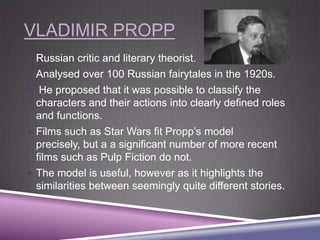
VLADIMIR PROPP
 Russian critic and literary theorist.
 Analysed over 100 Russian fairytales in the 1920s.
 He proposed that it was possible to classify the

characters and their actions into clearly defined roles
and functions.
 Films such as Star Wars fit Propp‟s model
precisely, but a a significant number of more recent
films such as Pulp Fiction do not.
 The model is useful, however as it highlights the
similarities between seemingly quite different stories.
PROPP‟S CHARACTER ROLES
 The hero (seeks something).
 The villain (opposes the hero).
 The donor (helps the hero by providing a magic object).
 The dispatcher (sends the hero on his way).
 The false hero (falsely assuming the role of hero).
 The helper (gives support to the hero).
 The princess (the reward for the hero, but also needs protection

from the villain).
 Her father (highly grateful to the hero, often rewards him).
TZVETAN TODOROV
 Bulgarian literary theorist.
 Suggests most narratives start with a state of

equilibrium in which life is „normal‟ and protagonists
happy.
 This state of normality is disrupted by an outside
force, which has to be fought against in order to
return to a state of equilibrium.
 This model can easily be applied to a wide range of
films.
TODOROV‟S EQUILIBRIUM

Equilibrium

Disequilibrium

An occurrence
Everyone is causes disruption
happy and normal

The problem
is recognized

New
Equilibrium

It is solved and
goes back to a
normal state
There is an attempt
to fix the issue
ROLAND BARTHES
French semiologist.
Suggested that narrative works with five

different codes which activate the reader to
make sense of it.
He said that media texts may be either open or
closed.
 Used the terms „denotation‟ and „connotation‟
to analyse images.
BARTHES‟ CODES
 Action – a narrative device by which a resolution is

produced through action, e.g. a shoot-out.
 Enigma – a narrative device that teases the audience
by presenting a puzzle or riddle to be solved. Works to
delay the story‟s ending pleasurably.
 Symbolic – (connotation).
 Semic – (denotation).
 Cultural – a narrative device which the audience can
recognise as being part of a culture e.g. a “made man”
in a gangster film is part of the mafia culture.
CLAUDE LEVI-STRAUSS
 Social Anthropologist.
 Studied myths of tribal cultures.
 Examined how stories unconsciously reflect the

values, beliefs and myths of a culture.
 These are usually expressed in the form of binary
oppositions.
 His research has been adapted by media theorists
to reveal underlying themes and symbolic
oppositions in media texts.
LEVI-STRAUSS‟ BINARY
OPPOSITIONS
A conflict between two qualities or terms.
For example 1970‟s Western films:
Homesteaders

Native Americans

christian

pagan

domestic

savage

weak

strong

garden
inside society

wilderness
outside society

Narrative Theorists

  • 1.
  • 2.
    NARRATIVE: Narrative: the wayin which a story is told in both fictional and non-fictional media texts.
  • 3.
    VLADIMIR PROPP  Russiancritic and literary theorist.  Analysed over 100 Russian fairytales in the 1920s.  He proposed that it was possible to classify the characters and their actions into clearly defined roles and functions.  Films such as Star Wars fit Propp‟s model precisely, but a a significant number of more recent films such as Pulp Fiction do not.  The model is useful, however as it highlights the similarities between seemingly quite different stories.
  • 4.
    PROPP‟S CHARACTER ROLES The hero (seeks something).  The villain (opposes the hero).  The donor (helps the hero by providing a magic object).  The dispatcher (sends the hero on his way).  The false hero (falsely assuming the role of hero).  The helper (gives support to the hero).  The princess (the reward for the hero, but also needs protection from the villain).  Her father (highly grateful to the hero, often rewards him).
  • 5.
    TZVETAN TODOROV  Bulgarianliterary theorist.  Suggests most narratives start with a state of equilibrium in which life is „normal‟ and protagonists happy.  This state of normality is disrupted by an outside force, which has to be fought against in order to return to a state of equilibrium.  This model can easily be applied to a wide range of films.
  • 6.
    TODOROV‟S EQUILIBRIUM Equilibrium Disequilibrium An occurrence Everyoneis causes disruption happy and normal The problem is recognized New Equilibrium It is solved and goes back to a normal state There is an attempt to fix the issue
  • 7.
    ROLAND BARTHES French semiologist. Suggestedthat narrative works with five different codes which activate the reader to make sense of it. He said that media texts may be either open or closed.  Used the terms „denotation‟ and „connotation‟ to analyse images.
  • 8.
    BARTHES‟ CODES  Action– a narrative device by which a resolution is produced through action, e.g. a shoot-out.  Enigma – a narrative device that teases the audience by presenting a puzzle or riddle to be solved. Works to delay the story‟s ending pleasurably.  Symbolic – (connotation).  Semic – (denotation).  Cultural – a narrative device which the audience can recognise as being part of a culture e.g. a “made man” in a gangster film is part of the mafia culture.
  • 9.
    CLAUDE LEVI-STRAUSS  SocialAnthropologist.  Studied myths of tribal cultures.  Examined how stories unconsciously reflect the values, beliefs and myths of a culture.  These are usually expressed in the form of binary oppositions.  His research has been adapted by media theorists to reveal underlying themes and symbolic oppositions in media texts.
  • 10.
    LEVI-STRAUSS‟ BINARY OPPOSITIONS A conflictbetween two qualities or terms. For example 1970‟s Western films: Homesteaders Native Americans christian pagan domestic savage weak strong garden inside society wilderness outside society