NARRATIVE THEORIES
A narrative is a sort of retelling of a story and how it is told. There are several
theories from different people of how a narrative can be laid out.
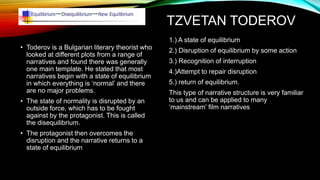
TZVETAN TODEROV
• Toderov is a Bulgarian literary theorist who
looked at different plots from a range of
narratives and found there was generally
one main template. He stated that most
narratives begin with a state of equilibrium
in which everything is ‘normal’ and there
are no major problems.
• The state of normality is disrupted by an
outside force, which has to be fought
against by the protagonist. This is called
the disequilibrium.
• The protagonist then overcomes the
disruption and the narrative returns to a
state of equilibrium
1.) A state of equilibrium
2.) Disruption of equilibrium by some action
3.) Recognition of interruption
4.)Attempt to repair disruption
5.) return of equilibrium.
This type of narrative structure is very familiar
to us and can be applied to many
‘mainstream’ film narratives
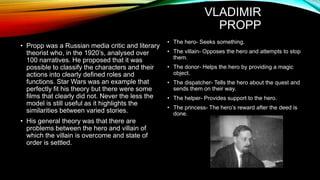
VLADIMIR
PROPP
• Propp was a Russian media critic and literary
theorist who, in the 1920’s, analysed over
100 narratives. He proposed that it was
possible to classify the characters and their
actions into clearly defined roles and
functions. Star Wars was an example that
perfectly fit his theory but there were some
films that clearly did not. Never the less the
model is still useful as it highlights the
similarities between varied stories.
• His general theory was that there are
problems between the hero and villain of
which the villain is overcome and state of
order is settled.
• The hero- Seeks something.
• The villain- Opposes the hero and attempts to stop
them.
• The donor- Helps the hero by providing a magic
object.
• The dispatcher- Tells the hero about the quest and
sends them on their way.
• The helper- Provides support to the hero.
• The princess- The hero’s reward after the deed is
done.
CLAUDE LEVI-STRAUS
• He is a social anthropologist who
studied myths of tribal cultures. From
his research he found that stories,
uncontrollably, reflect the values and
beliefs of a culture.
• These are usually expressed in the
form of binary oppositions.
• His research has been adapted by
media theorists to explain the themes
and symbolic oppositions in media
texts
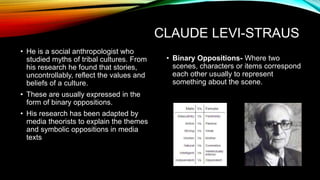
• Binary Oppositions- Where two
scenes, characters or items correspond
each other usually to represent
something about the scene.
ROLAND BARTHES
• He is a French sociologists who
suggested that narrative works with five
different codes which activate the
reader to make sense of it.
• Action- a narrative device by which a
resolution is produced through action.
• Enigma – a narrative device that teases the
audience by presenting a puzzle or riddle to
be solved.
• Semic- Denotation.
• Symbolic- Connotation.
• Cultural – a narrative device which the
audience can recognise as being part of a
culture.
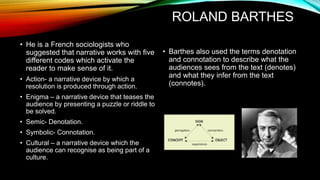
• Barthes also used the terms denotation
and connotation to describe what the
audiences sees from the text (denotes)
and what they infer from the text
(connotes).

Narrative

  • 1.
    NARRATIVE THEORIES A narrativeis a sort of retelling of a story and how it is told. There are several theories from different people of how a narrative can be laid out.
  • 2.
    TZVETAN TODEROV • Toderovis a Bulgarian literary theorist who looked at different plots from a range of narratives and found there was generally one main template. He stated that most narratives begin with a state of equilibrium in which everything is ‘normal’ and there are no major problems. • The state of normality is disrupted by an outside force, which has to be fought against by the protagonist. This is called the disequilibrium. • The protagonist then overcomes the disruption and the narrative returns to a state of equilibrium 1.) A state of equilibrium 2.) Disruption of equilibrium by some action 3.) Recognition of interruption 4.)Attempt to repair disruption 5.) return of equilibrium. This type of narrative structure is very familiar to us and can be applied to many ‘mainstream’ film narratives
  • 3.
    VLADIMIR PROPP • Propp wasa Russian media critic and literary theorist who, in the 1920’s, analysed over 100 narratives. He proposed that it was possible to classify the characters and their actions into clearly defined roles and functions. Star Wars was an example that perfectly fit his theory but there were some films that clearly did not. Never the less the model is still useful as it highlights the similarities between varied stories. • His general theory was that there are problems between the hero and villain of which the villain is overcome and state of order is settled. • The hero- Seeks something. • The villain- Opposes the hero and attempts to stop them. • The donor- Helps the hero by providing a magic object. • The dispatcher- Tells the hero about the quest and sends them on their way. • The helper- Provides support to the hero. • The princess- The hero’s reward after the deed is done.
  • 4.
    CLAUDE LEVI-STRAUS • Heis a social anthropologist who studied myths of tribal cultures. From his research he found that stories, uncontrollably, reflect the values and beliefs of a culture. • These are usually expressed in the form of binary oppositions. • His research has been adapted by media theorists to explain the themes and symbolic oppositions in media texts • Binary Oppositions- Where two scenes, characters or items correspond each other usually to represent something about the scene.
  • 5.
    ROLAND BARTHES • Heis a French sociologists who suggested that narrative works with five different codes which activate the reader to make sense of it. • Action- a narrative device by which a resolution is produced through action. • Enigma – a narrative device that teases the audience by presenting a puzzle or riddle to be solved. • Semic- Denotation. • Symbolic- Connotation. • Cultural – a narrative device which the audience can recognise as being part of a culture. • Barthes also used the terms denotation and connotation to describe what the audiences sees from the text (denotes) and what they infer from the text (connotes).