Claude Levi-Strauss
Claude Levi-Strauss was a French anthropologist, ethnologist and the founder
of intellectual movement, or structuralism.
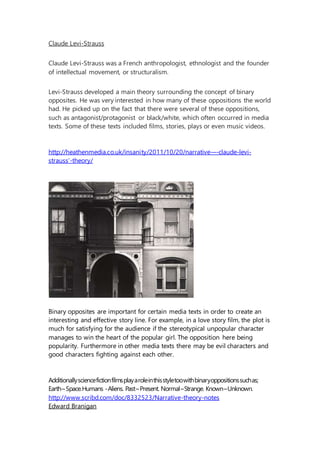
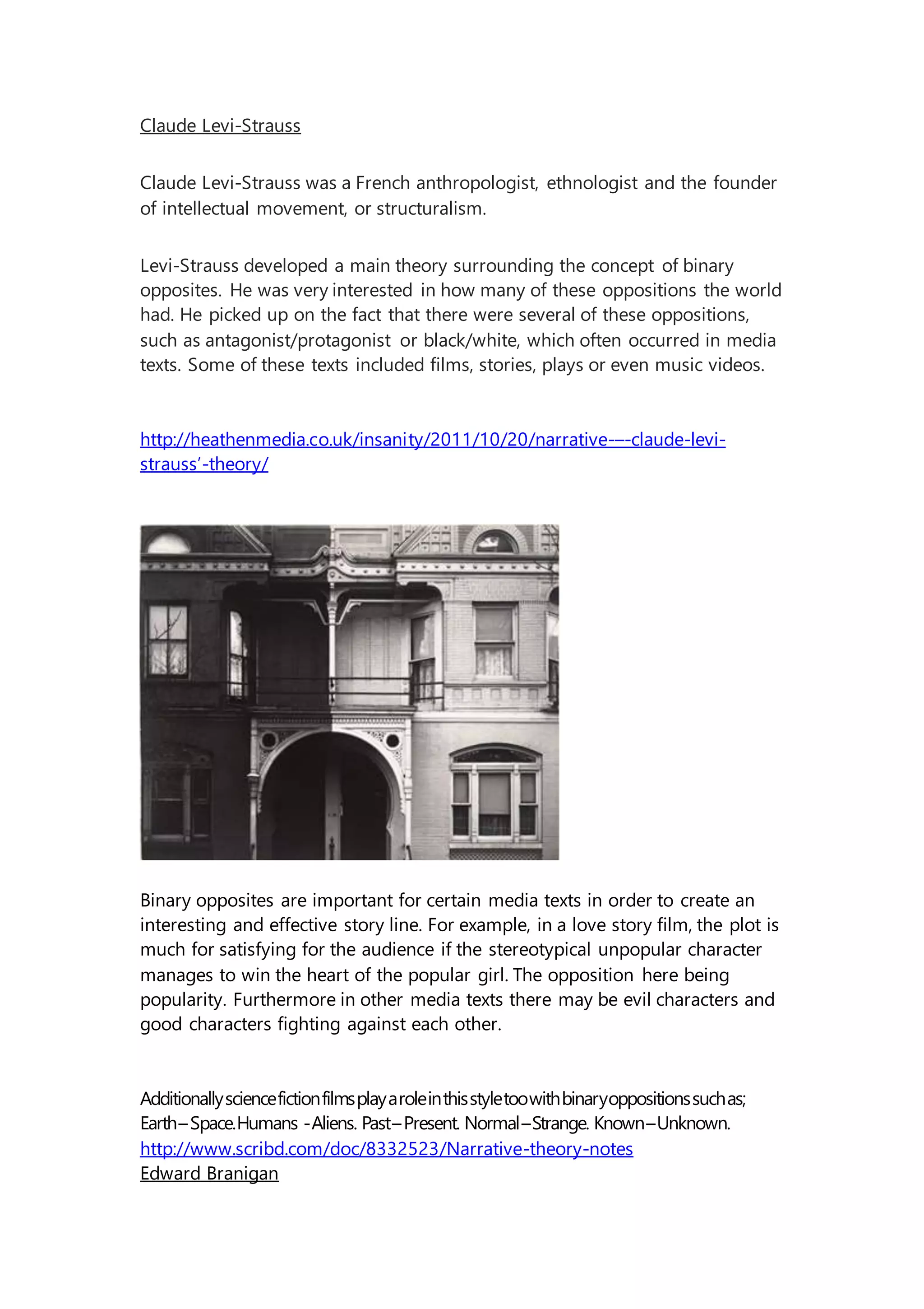
Levi-Strauss developed a main theory surrounding the concept of binary
opposites. He was very interested in how many of these oppositions the world
had. He picked up on the fact that there were several of these oppositions,
such as antagonist/protagonist or black/white, which often occurred in media
texts. Some of these texts included films, stories, plays or even music videos.
http://heathenmedia.co.uk/insanity/2011/10/20/narrative-–-claude-levi-
strauss’-theory/
Binary opposites are important for certain media texts in order to create an
interesting and effective story line. For example, in a love story film, the plot is
much for satisfying for the audience if the stereotypical unpopular character
manages to win the heart of the popular girl. The opposition here being
popularity. Furthermore in other media texts there may be evil characters and
good characters fighting against each other.
Additionallysciencefictionfilmsplayaroleinthisstyletoowithbinaryoppositionssuchas;
Earth–Space.Humans -Aliens. Past–Present. Normal–Strange. Known–Unknown.
http://www.scribd.com/doc/8332523/Narrative-theory-notes
Edward Branigan
Branigan suggests that narrative is ‘a way of organising spatial and temporal
data into a cause-effect chain of events with a beginning, a middle and end
that embodies a judgement about the nature of events.’
Narration, according to Branigan, should be understood as “the overall
regulation and distribution of knowledge which determines how and when a
spectator acquires knowledge [of narrative events]” (1992).
http://www.slideshare.net/jphibbert1979/narrative-theory-7091030
http://perspectivecriticism.com/2013/01/21/narration-in-film-edward-
branigan-on-point-of-view-versus-focalization-laura-copier/
Vladimir Propp
Vladimir Propp, a Russian critic. Characters, according to Propp, have a narrative
function; they provide a structure for the text.
Characters that perform a function
The Hero – a character that seeks something
The Villain – who opposes or actively blocks the hero’s quest
The Donor – who provides an object with magical properties
The Dispatcher – who sends the hero on his/her quest via a message
The False Hero – who disrupts the hero’s success by making false claims
The Helper – who aids the hero
The Princess – acts as the reward for the hero and the object of the villain’s
plots
Her Father – who acts to reward the hero for his effort
Actions as functions of narrative
Preparation
A community/kingdom/family is in an ordered state of being
A member of the community/kingdom/family leaves home
A warning is given to the leaders of the community or a rule is imposed on the hero
The warning is discounted/ the rule is broken
The villain attempts to discover something about the victim of the broken rule
The villain tries to deceive the victim to gain advantage
The victim unwittingly helps the villain
Complication
A state of disorder
The villain harms a member of the community/kingdom/family
One of the members of the community/kingdom/family desires something
The hero is sent to get what is desired
The hero plans action against the villain
Transference
The hero leaves home
The hero is tested or attacked/ he meets the test and is given a magical gift or helper
The hero reacts to the donor
The hero arrives at the place he can fulfil his quest
Struggle
There is a struggle between the hero and the villain
|The hero is branded
The villain is overcome
The state of disorder is settled
Return
The hero returns
The hero is pursued
The hero escapes or is rescued
The hero arrives home and is not recognised
A false hero claims rewards
A task is set for the hero
The task is accomplished
Recognition
The hero is recognised
The false hero or villain is unmasked
The false hero is punished
The hero attains the reward (princess/ kingdom)
To Propp events are not just about character and action but also about progressing
the narrative.
http://www.adamranson.plus.com/Propp.htm
http://media-studies-thriller.blogspot.de/2011/03/vladimir-propps-narrative-
theory.html
http://heathenmedia.co.uk/praise/2011/11/03/vladimir-propps-narrative-theory/
Tsuetan Todorov
Tzvetan Todorov is a Franco-Bulgarian philosopher. He proposed a theory
surrounding the different sections of a media narrative. The theory simply proposes
that;
 The fictional environment begins with a state of equilibrium (everything is as
it should be).
 It then suffers some disruption (disequilibrium).
 And finally a new equilibrium is produced at the end of the narrative.
http://www.adamranson.plus.com/TODOROV.HTM
http://www.mediaknowall.com/gcse/keyconceptsgcse/keycon.php?pageID=na
rrative
Roland Barthes –Barthes codes
All you need to know, again, very basically, is that texts may be ´open´ (ie unravelled
in a lot of different ways) or ´closed´ (there is only one obvious thread to pull on).
Barthes also decided that the threads that you pull on to try and unravel meaning are
called narrative codes and that they could be categorised in the following five ways:
 Action/proiarectic code& enigma code (ie Answers & questions)
 Symbols & Signs
 Points of Cultural Reference
 Simple description/reproduction
http://www.mediaknowall.com/as_alevel/alevkeyconcepts/alevelkeycon.php?pageID=
narrative
Robert Mckee
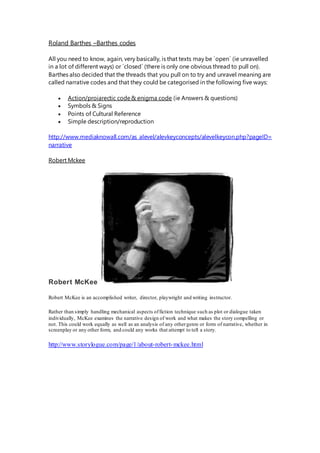
Robert McKee
Robert McKee is an accomplished writer, director, playwright and writing instructor.
Rather than simply handling mechanical aspects offiction technique such as plot or dialogue taken
individually, McKee examines the narrative design of work and what makes the story compelling or
not. This could work equally as well as an analysis of any othergenre or form of narrative, whether in
screenplay or any other form, and could any works that attempt to tell a story.
http://www.storylogue.com/page/1/about-robert-mckee.html
Claude levi

Claude levi

  • 1.
    Claude Levi-Strauss Claude Levi-Strausswas a French anthropologist, ethnologist and the founder of intellectual movement, or structuralism. Levi-Strauss developed a main theory surrounding the concept of binary opposites. He was very interested in how many of these oppositions the world had. He picked up on the fact that there were several of these oppositions, such as antagonist/protagonist or black/white, which often occurred in media texts. Some of these texts included films, stories, plays or even music videos. http://heathenmedia.co.uk/insanity/2011/10/20/narrative-–-claude-levi- strauss’-theory/ Binary opposites are important for certain media texts in order to create an interesting and effective story line. For example, in a love story film, the plot is much for satisfying for the audience if the stereotypical unpopular character manages to win the heart of the popular girl. The opposition here being popularity. Furthermore in other media texts there may be evil characters and good characters fighting against each other. Additionallysciencefictionfilmsplayaroleinthisstyletoowithbinaryoppositionssuchas; Earth–Space.Humans -Aliens. Past–Present. Normal–Strange. Known–Unknown. http://www.scribd.com/doc/8332523/Narrative-theory-notes Edward Branigan
  • 2.
    Branigan suggests thatnarrative is ‘a way of organising spatial and temporal data into a cause-effect chain of events with a beginning, a middle and end that embodies a judgement about the nature of events.’ Narration, according to Branigan, should be understood as “the overall regulation and distribution of knowledge which determines how and when a spectator acquires knowledge [of narrative events]” (1992). http://www.slideshare.net/jphibbert1979/narrative-theory-7091030 http://perspectivecriticism.com/2013/01/21/narration-in-film-edward- branigan-on-point-of-view-versus-focalization-laura-copier/ Vladimir Propp Vladimir Propp, a Russian critic. Characters, according to Propp, have a narrative function; they provide a structure for the text. Characters that perform a function The Hero – a character that seeks something The Villain – who opposes or actively blocks the hero’s quest The Donor – who provides an object with magical properties The Dispatcher – who sends the hero on his/her quest via a message The False Hero – who disrupts the hero’s success by making false claims The Helper – who aids the hero The Princess – acts as the reward for the hero and the object of the villain’s plots Her Father – who acts to reward the hero for his effort Actions as functions of narrative Preparation A community/kingdom/family is in an ordered state of being A member of the community/kingdom/family leaves home
  • 3.
    A warning isgiven to the leaders of the community or a rule is imposed on the hero The warning is discounted/ the rule is broken The villain attempts to discover something about the victim of the broken rule The villain tries to deceive the victim to gain advantage The victim unwittingly helps the villain Complication A state of disorder The villain harms a member of the community/kingdom/family One of the members of the community/kingdom/family desires something The hero is sent to get what is desired The hero plans action against the villain Transference The hero leaves home The hero is tested or attacked/ he meets the test and is given a magical gift or helper The hero reacts to the donor The hero arrives at the place he can fulfil his quest Struggle There is a struggle between the hero and the villain |The hero is branded The villain is overcome The state of disorder is settled Return The hero returns The hero is pursued
  • 4.
    The hero escapesor is rescued The hero arrives home and is not recognised A false hero claims rewards A task is set for the hero The task is accomplished Recognition The hero is recognised The false hero or villain is unmasked The false hero is punished The hero attains the reward (princess/ kingdom) To Propp events are not just about character and action but also about progressing the narrative. http://www.adamranson.plus.com/Propp.htm http://media-studies-thriller.blogspot.de/2011/03/vladimir-propps-narrative- theory.html http://heathenmedia.co.uk/praise/2011/11/03/vladimir-propps-narrative-theory/ Tsuetan Todorov Tzvetan Todorov is a Franco-Bulgarian philosopher. He proposed a theory surrounding the different sections of a media narrative. The theory simply proposes that;  The fictional environment begins with a state of equilibrium (everything is as it should be).  It then suffers some disruption (disequilibrium).  And finally a new equilibrium is produced at the end of the narrative. http://www.adamranson.plus.com/TODOROV.HTM http://www.mediaknowall.com/gcse/keyconceptsgcse/keycon.php?pageID=na rrative
  • 5.
    Roland Barthes –Barthescodes All you need to know, again, very basically, is that texts may be ´open´ (ie unravelled in a lot of different ways) or ´closed´ (there is only one obvious thread to pull on). Barthes also decided that the threads that you pull on to try and unravel meaning are called narrative codes and that they could be categorised in the following five ways:  Action/proiarectic code& enigma code (ie Answers & questions)  Symbols & Signs  Points of Cultural Reference  Simple description/reproduction http://www.mediaknowall.com/as_alevel/alevkeyconcepts/alevelkeycon.php?pageID= narrative Robert Mckee Robert McKee Robert McKee is an accomplished writer, director, playwright and writing instructor. Rather than simply handling mechanical aspects offiction technique such as plot or dialogue taken individually, McKee examines the narrative design of work and what makes the story compelling or not. This could work equally as well as an analysis of any othergenre or form of narrative, whether in screenplay or any other form, and could any works that attempt to tell a story. http://www.storylogue.com/page/1/about-robert-mckee.html