Nanotechnology in
Dentistry
Done By :
Omar Hassem ,Karim
Mohamed ,Mark Nabeel
,Mena George
Under supervision of:
A.Prof Samah Kamel
2
What is Nanotechology ?
 It is the study and application of
extremely small things
 It involves the ability to see and to
control individual atoms and
molecules
Why NANO ?
Because nano particles are
governed by a different set
of physics that govern
ordinary objects, so they
can be used for a wide
variety of uses
3
4
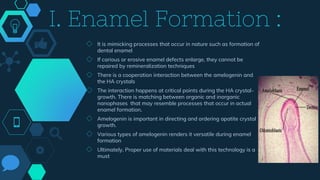
I. Enamel Formation :
◇ It is mimicking processes that occur in nature such as formation of
dental enamel
◇ If carious or erosive enamel defects enlarge, they cannot be
repaired by remineralization techniques
◇ There is a cooperation interaction between the amelogenin and
the HA crystals
◇ The interaction happens at critical points during the HA crystal-
growth. There is matching between organic and inorganic
nanophases that may resemble processes that occur in actual
enamel formation.
◇ Amelogenin is important in directing and ordering apatite crystal
growth.
◇ Various types of amelogenin renders it versatile during enamel
formation
◇ Ultimately, Proper use of materials deal with this technology is a
must
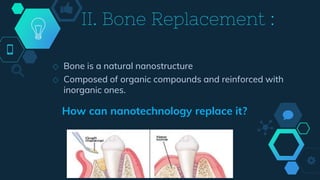
II. Bone Replacement :
How can nanotechnology replace it?
◇ Bone is a natural nanostructure
◇ Composed of organic compounds and reinforced with
inorganic ones.
7
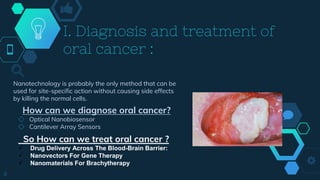
I. Diagnosis and treatment of
oral cancer :
Nanotechnology is probably the only method that can be
used for site-specific action without causing side effects
by killing the normal cells.
How can we diagnose oral cancer?
◇ Optical Nanobiosensor
◇ Cantilever Array Sensors
8
So How can we treat oral cancer ?
 Drug Delivery Across The Blood-Brain Barrier:
 Nanovectors For Gene Therapy
 Nanomaterials For Brachytherapy
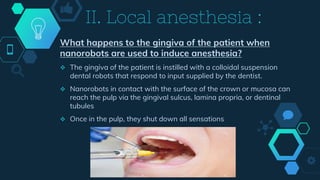
What happens to the gingiva of the patient when
nanorobots are used to induce anesthesia?
 The gingiva of the patient is instilled with a colloidal suspension
dental robots that respond to input supplied by the dentist.
 Nanorobots in contact with the surface of the crown or mucosa can
reach the pulp via the gingival sulcus, lamina propria, or dentinal
tubules
 Once in the pulp, they shut down all sensations
II. Local anesthesia :
III. Dentin Hypersensitivity :
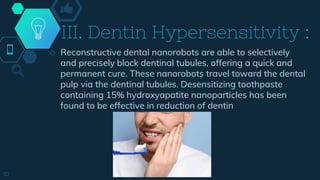
◇ Reconstructive dental nanorobots are able to selectively
and precisely block dentinal tubules, offering a quick and
permanent cure. These nanorobots travel toward the dental
pulp via the dentinal tubules. Desensitizing toothpaste
containing 15% hydroxyapatite nanoparticles has been
found to be effective in reduction of dentin
10
IV:- Orthodontic Nanorobots :
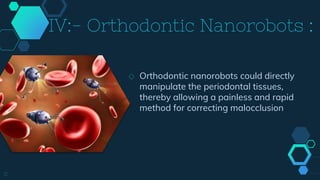
◇ Orthodontic nanorobots could directly
manipulate the periodontal tissues,
thereby allowing a painless and rapid
method for correcting malocclusion
11
V. Preventing dental caries :
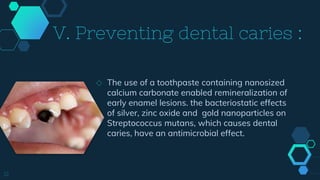
◇ The use of a toothpaste containing nanosized
calcium carbonate enabled remineralization of
early enamel lesions. the bacteriostatic effects
of silver, zinc oxide and gold nanoparticles on
Streptococcus mutans, which causes dental
caries, have an antimicrobial effect.
12
13
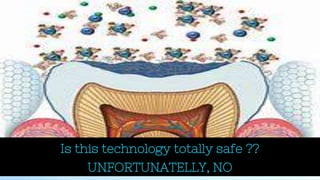
Is this technology totally safe ??
UNFORTUNATELLY, NO
15
16
Future of nanotechnology
in dentistry
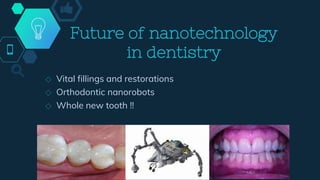
◇ Vital fillings and restorations
◇ Orthodontic nanorobots
◇ Whole new tooth !!
Thanks!
Any questions?
18
References
◇ Moradian-Oldak J, Du C, Falini G. On the formation of amelogenin microribbons. Eur J Oral Sci.
2006;114(Suppl 1):289–296. discussion 327–289, 382
◇ Moradian-Oldak J, Goldberg M. Amelogenin supra-molecular assembly in vitro compared with
the architecture of the forming enamel matrix. Cells Tissues Organs. 2005;181(3–4):202–218.
◇ Mimicking the Self-Organized Microstructure of Tooth Enamel.Wang L, Guan X, Yin H,
Moradian-Oldak J, Nancollas GHJ Phys Chem C Nanomater Interfaces. 2008 Mar 22;
112(15):5892-5899.
◇ Enzymatic Processing of Amelogenin during Continuous Crystallization of Apatite.Uskoković V,
Kim MK, Li W, Habelitz SJ Mater Res. 2008 Dec; 23(12):3184-3195.
◇ Du C, Falini G, Fermani S, Abbott C, Moradian-Oldak J. Supramolecular assembly of amelogenin
nanospheres into birefringent microribbons. Science. 2005;307(5714):1450–1454.
◇ Enamel inspired nanocomposite fabrication through amelogenin supramolecular assembly.Fan
Y, Sun Z, Wang R, Abbott C, Moradian-Oldak JBiomaterials. 2007 Jul; 28(19):3034-42.
◇ Hannig, Matthias, and Christian Hannig. “Nanomaterials in Preventive Dentistry.” Nature News,
Nature Publishing Group, 27 June 2010, www.nature.com/articles/nnano.2010.83?message-
#Bib1.
◇ Meador, Michael. “Nanotechnology 101: The Biggest Thing You've Never Seen- Mike Meador's
Lecture at the Royal Institution of Great Britain on Oct 20, 2015.” Nano, 20 Oct. 2015,
www.nano.gov/node/1529.19
◇ https://www.aegisdentalnetwork.com/cced/2017/05/nanotechnology-in-dentistry-clinical-
applications-benefits-and-hazards (may2017-volume38-Issue5)
◇ https://www.dovepress.com/nanotechnology-in-dentistry-prevention-diagnosis-and-therapy-
peer-reviewed-fulltext-article-IJN (8 October 2015 Volume 2015:10(1) Pages 6371—6394
◇ https://onlinelibrary.wiley.com/doi/full/10.1111/j.2041-1626.2011.00046.x (17 February 2011)
◇ (Freitas, 2000) (Kumar and Vijayalakshmi, 2006)
◇ Shashirekha, Govind, et al. “Nanotechnology in Dentistry: Clinical Applications, Benefits, and
Hazards: Compendium.” Nanotechnology in Dentistry: Clinical Applications, Benefits, and
Hazards | Compendium, 1 May 2017,
www.aegisdentalnetwork.com/cced/2017/05/nanotechnology-in-dentistry-clinical-
applications-benefits-and-hazards.
◇ Ozak, Sule Tugba, and Pelin Ozkan. “Nanotechnology and Dentistry.” European Journal of
Dentistry, Dental Investigations Society, Jan. 2013,
www.ncbi.nlm.nih.gov/pmc/articles/PMC3571524/.
20

Nanotechnology in dentistry

  • 1.
    Nanotechnology in Dentistry Done By: Omar Hassem ,Karim Mohamed ,Mark Nabeel ,Mena George Under supervision of: A.Prof Samah Kamel
  • 2.
  • 3.
    What is Nanotechology?  It is the study and application of extremely small things  It involves the ability to see and to control individual atoms and molecules Why NANO ? Because nano particles are governed by a different set of physics that govern ordinary objects, so they can be used for a wide variety of uses 3
  • 4.
  • 5.
    I. Enamel Formation: ◇ It is mimicking processes that occur in nature such as formation of dental enamel ◇ If carious or erosive enamel defects enlarge, they cannot be repaired by remineralization techniques ◇ There is a cooperation interaction between the amelogenin and the HA crystals ◇ The interaction happens at critical points during the HA crystal- growth. There is matching between organic and inorganic nanophases that may resemble processes that occur in actual enamel formation. ◇ Amelogenin is important in directing and ordering apatite crystal growth. ◇ Various types of amelogenin renders it versatile during enamel formation ◇ Ultimately, Proper use of materials deal with this technology is a must
  • 6.
    II. Bone Replacement: How can nanotechnology replace it? ◇ Bone is a natural nanostructure ◇ Composed of organic compounds and reinforced with inorganic ones.
  • 7.
  • 8.
    I. Diagnosis andtreatment of oral cancer : Nanotechnology is probably the only method that can be used for site-specific action without causing side effects by killing the normal cells. How can we diagnose oral cancer? ◇ Optical Nanobiosensor ◇ Cantilever Array Sensors 8 So How can we treat oral cancer ?  Drug Delivery Across The Blood-Brain Barrier:  Nanovectors For Gene Therapy  Nanomaterials For Brachytherapy
  • 9.
    What happens tothe gingiva of the patient when nanorobots are used to induce anesthesia?  The gingiva of the patient is instilled with a colloidal suspension dental robots that respond to input supplied by the dentist.  Nanorobots in contact with the surface of the crown or mucosa can reach the pulp via the gingival sulcus, lamina propria, or dentinal tubules  Once in the pulp, they shut down all sensations II. Local anesthesia :
  • 10.
    III. Dentin Hypersensitivity: ◇ Reconstructive dental nanorobots are able to selectively and precisely block dentinal tubules, offering a quick and permanent cure. These nanorobots travel toward the dental pulp via the dentinal tubules. Desensitizing toothpaste containing 15% hydroxyapatite nanoparticles has been found to be effective in reduction of dentin 10
  • 11.
    IV:- Orthodontic Nanorobots: ◇ Orthodontic nanorobots could directly manipulate the periodontal tissues, thereby allowing a painless and rapid method for correcting malocclusion 11
  • 12.
    V. Preventing dentalcaries : ◇ The use of a toothpaste containing nanosized calcium carbonate enabled remineralization of early enamel lesions. the bacteriostatic effects of silver, zinc oxide and gold nanoparticles on Streptococcus mutans, which causes dental caries, have an antimicrobial effect. 12
  • 13.
  • 14.
    Is this technologytotally safe ?? UNFORTUNATELLY, NO
  • 15.
  • 16.
  • 17.
    Future of nanotechnology indentistry ◇ Vital fillings and restorations ◇ Orthodontic nanorobots ◇ Whole new tooth !!
  • 18.
  • 19.
    References ◇ Moradian-Oldak J,Du C, Falini G. On the formation of amelogenin microribbons. Eur J Oral Sci. 2006;114(Suppl 1):289–296. discussion 327–289, 382 ◇ Moradian-Oldak J, Goldberg M. Amelogenin supra-molecular assembly in vitro compared with the architecture of the forming enamel matrix. Cells Tissues Organs. 2005;181(3–4):202–218. ◇ Mimicking the Self-Organized Microstructure of Tooth Enamel.Wang L, Guan X, Yin H, Moradian-Oldak J, Nancollas GHJ Phys Chem C Nanomater Interfaces. 2008 Mar 22; 112(15):5892-5899. ◇ Enzymatic Processing of Amelogenin during Continuous Crystallization of Apatite.Uskoković V, Kim MK, Li W, Habelitz SJ Mater Res. 2008 Dec; 23(12):3184-3195. ◇ Du C, Falini G, Fermani S, Abbott C, Moradian-Oldak J. Supramolecular assembly of amelogenin nanospheres into birefringent microribbons. Science. 2005;307(5714):1450–1454. ◇ Enamel inspired nanocomposite fabrication through amelogenin supramolecular assembly.Fan Y, Sun Z, Wang R, Abbott C, Moradian-Oldak JBiomaterials. 2007 Jul; 28(19):3034-42. ◇ Hannig, Matthias, and Christian Hannig. “Nanomaterials in Preventive Dentistry.” Nature News, Nature Publishing Group, 27 June 2010, www.nature.com/articles/nnano.2010.83?message- #Bib1. ◇ Meador, Michael. “Nanotechnology 101: The Biggest Thing You've Never Seen- Mike Meador's Lecture at the Royal Institution of Great Britain on Oct 20, 2015.” Nano, 20 Oct. 2015, www.nano.gov/node/1529.19
  • 20.
    ◇ https://www.aegisdentalnetwork.com/cced/2017/05/nanotechnology-in-dentistry-clinical- applications-benefits-and-hazards (may2017-volume38-Issue5) ◇https://www.dovepress.com/nanotechnology-in-dentistry-prevention-diagnosis-and-therapy- peer-reviewed-fulltext-article-IJN (8 October 2015 Volume 2015:10(1) Pages 6371—6394 ◇ https://onlinelibrary.wiley.com/doi/full/10.1111/j.2041-1626.2011.00046.x (17 February 2011) ◇ (Freitas, 2000) (Kumar and Vijayalakshmi, 2006) ◇ Shashirekha, Govind, et al. “Nanotechnology in Dentistry: Clinical Applications, Benefits, and Hazards: Compendium.” Nanotechnology in Dentistry: Clinical Applications, Benefits, and Hazards | Compendium, 1 May 2017, www.aegisdentalnetwork.com/cced/2017/05/nanotechnology-in-dentistry-clinical- applications-benefits-and-hazards. ◇ Ozak, Sule Tugba, and Pelin Ozkan. “Nanotechnology and Dentistry.” European Journal of Dentistry, Dental Investigations Society, Jan. 2013, www.ncbi.nlm.nih.gov/pmc/articles/PMC3571524/. 20