NANOTECHNOLOGY IN
DENTISTRY
DR Sara Bahaa Mohamed
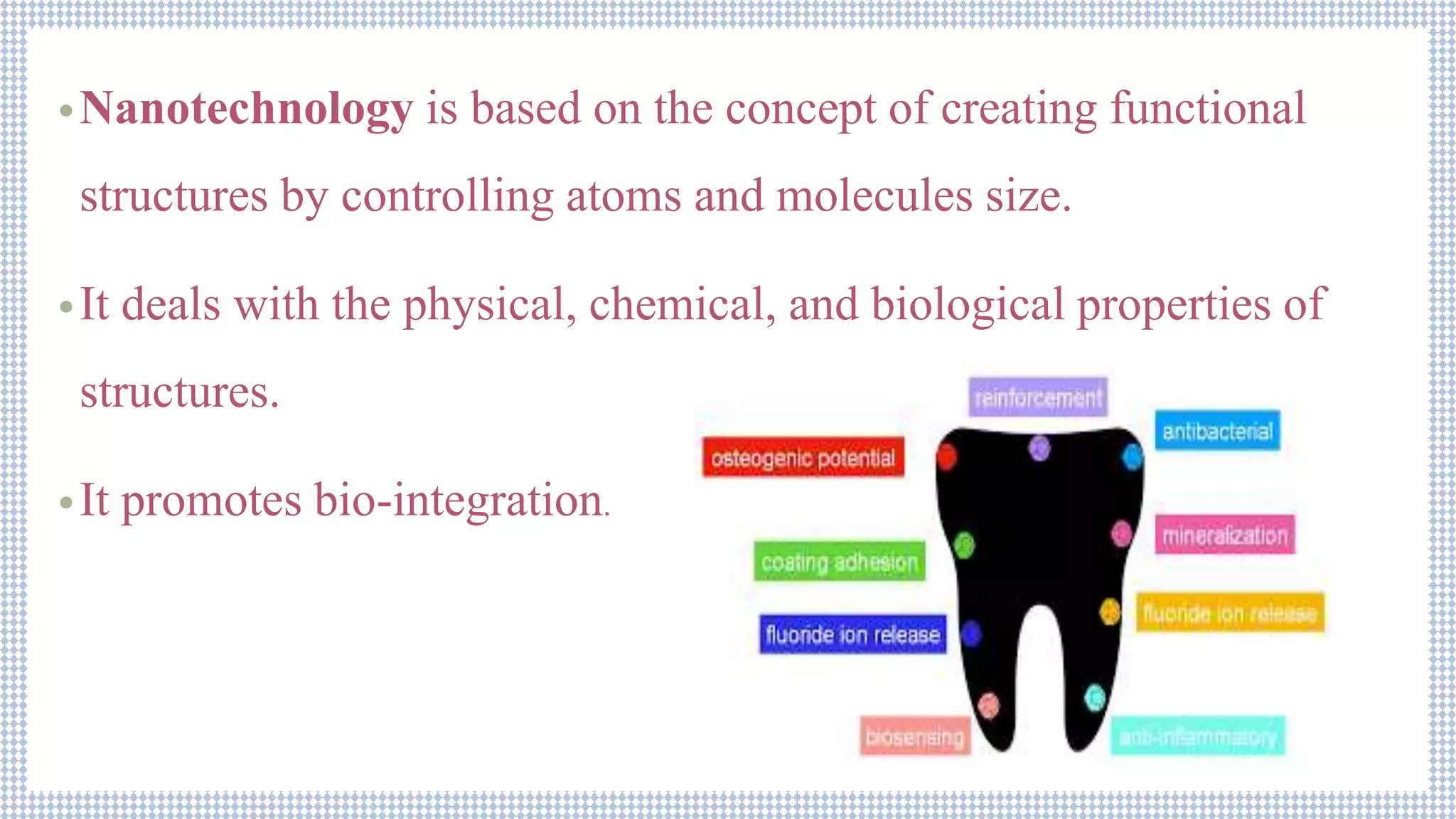
•Nanotechnology is based on the concept of creating functional
structures by controlling atoms and molecules size.
•It deals with the physical, chemical, and biological properties of
structures.
•It promotes bio-integration.
•Why Need Nanomaterials in Dentistry?
nanotechnology is important to manufacture synthetic
nanomaterials closely matching in morphology and have
properties similar to natural dental tissues.
Classification of Nanotechnology
A) Top Down Approach
-Nanomaterials are synthesized by breaking down of bulk solids into nanosizes. Top-down processing
has been and will be the dominant process in semiconductor manufacturing.
B) Bottom-up Approach
-Nanomaterials are assembling the atoms/molecules together. Instead of taking material away to
make structures, the bottom up approach selectively adds atoms to create structures.
APPLICATIONS IN DENTISTRY:
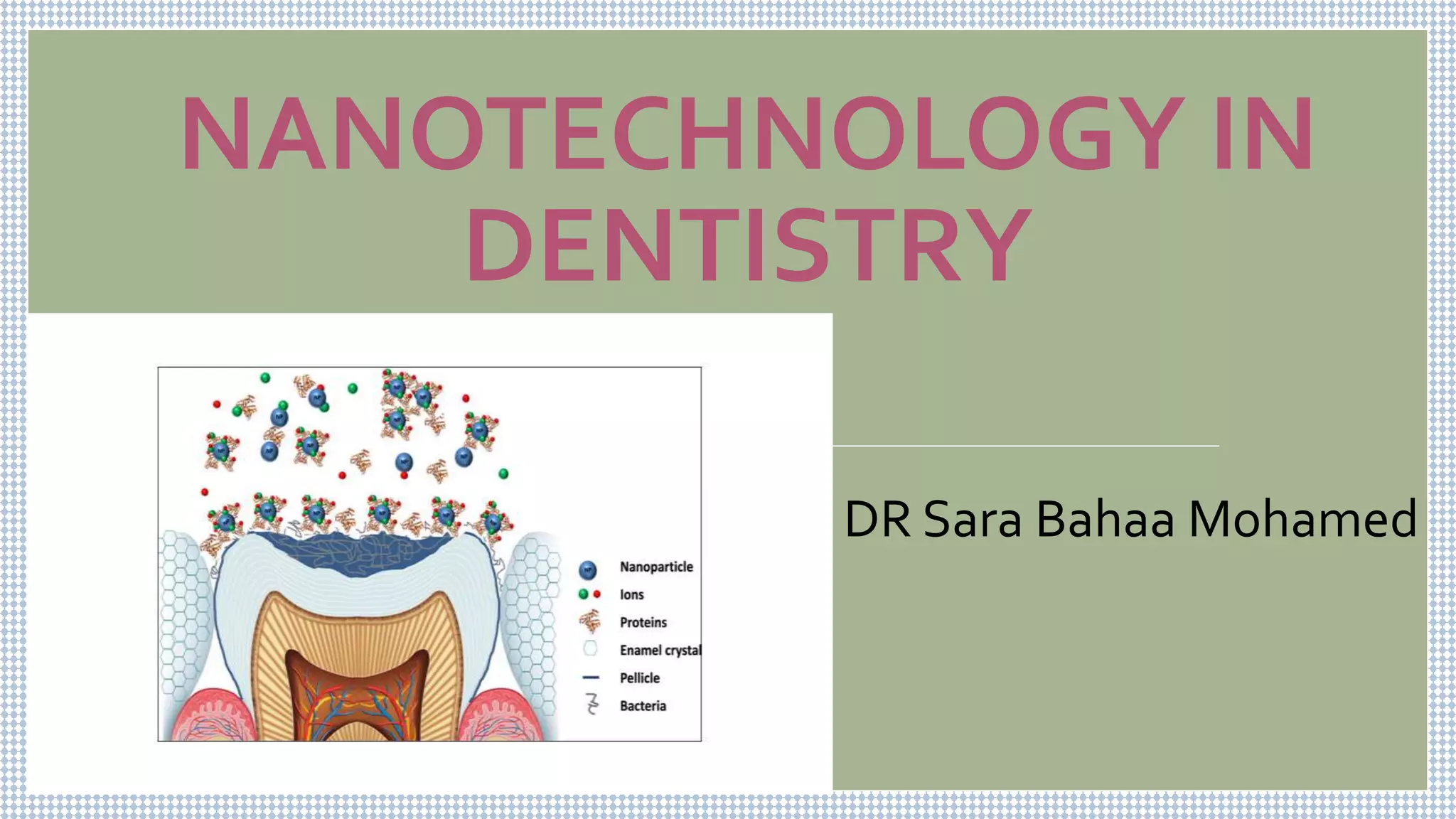
1. Prevention Dental Caries
2. Dental implants.
3. Impression materials
4. Orthodontic Treatment.
5. Nanocomposite.
6. Dentin hypersensitivity cure.
7. Prosthetic Dentistry.
8. Endodontics.
PREVENTION DENTAL CARIES
1-Using toothpaste containing nano sized calcium carbonate
remineralization of early enamel lesions.
2- Silver, zinc oxide and gold nanoparticles have an
antimicrobial effect on streptococcus mutans
3-Silver nano particles can be used in lowest concentration which
make them the least toxic.
IMPLANTS
Nano technologies used for surface modifications of dental of
implants.
Surfaces properties such as: chemistry and roughness play a role in
achieving their long term stability Ex: Nano diamonds.
IMPLANTS
Nanostructured hydroxyapatite coatings on the implants have also
been shown to enhance osteointegration of the implants.
Biocompatibility studies showed that hydroxyapatite has very high
binding ability to bone. It can be used to increase osteointegration of
titanium implants to the alveolar bone due to their chemical bond
forming properties. In addition, such implants have been shown to
increase osteoblast adhesion, proliferation and mineralization.
IMPLANTS
Nanosized carbon fibers have also been shown to cause a significant increase
in osteoblast adhesion required for successful orthopedic/dental implant
applications because of their high surface area, In addition, modification of
the implant surface with mechanical nano-properties.
IMPRESSION MATERIALS;
Nano fillers are integrated in producing a unique
impression material. The material has: Better flow,
Improved hydrophilic properties and Enhanced detail
precision.
ORTHODONTIC TREATMENT
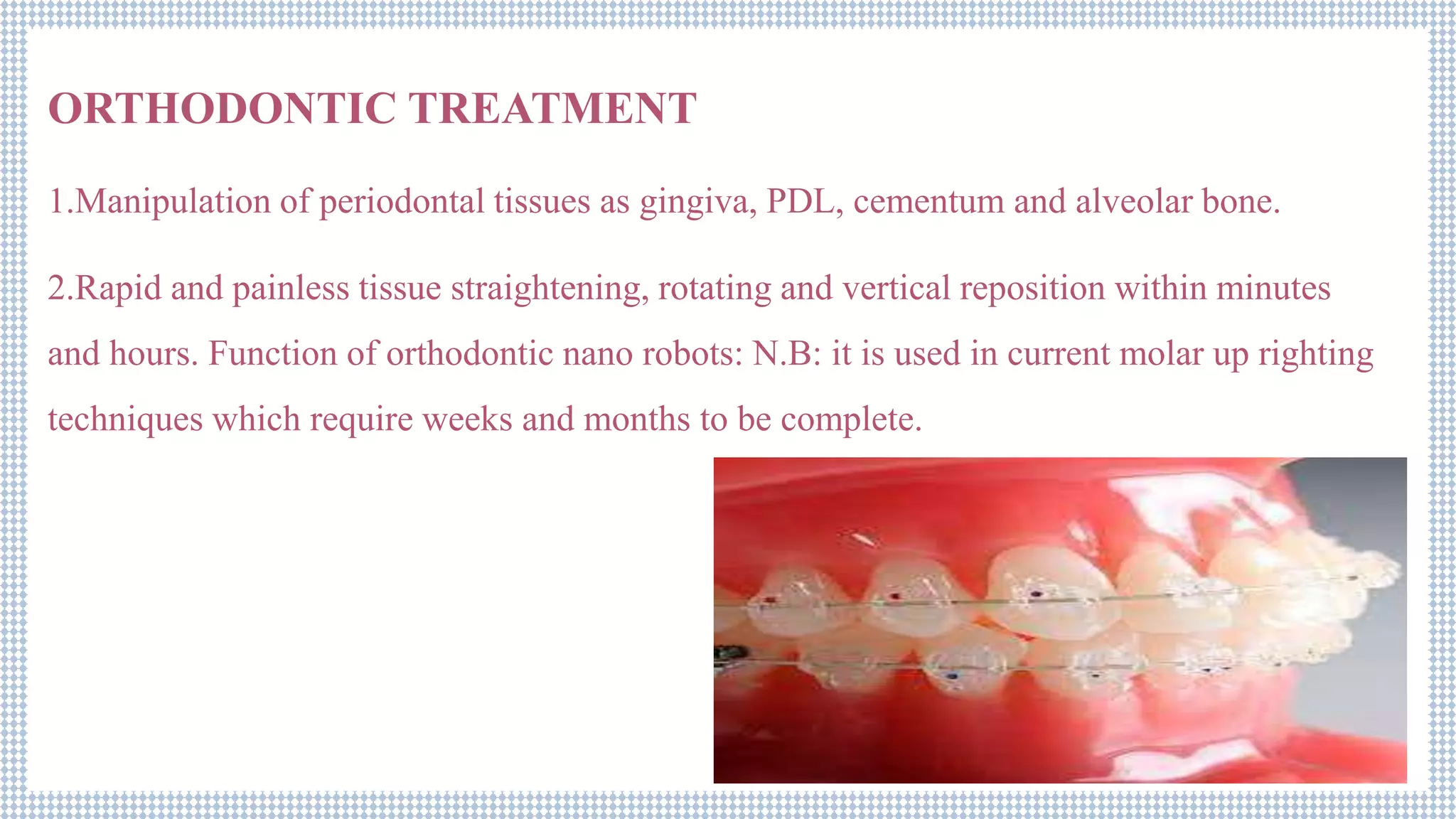
1.Manipulation of periodontal tissues as gingiva, PDL, cementum and alveolar bone.
2.Rapid and painless tissue straightening, rotating and vertical reposition within minutes
and hours. Function of orthodontic nano robots: N.B: it is used in current molar up righting
techniques which require weeks and months to be complete.
NANO COMPOSITES
Dental resin nano composites are comprised of a mixture of the
resin matrix, nano fillers, photo initiator, etc., Nano-fillers are silica
nanoparticles. They differentiate from hybrid composites by their
particle size.
NANO COMPOSITES
Advantages:
1-Super Hardness.
2-High strength, modulus of elasticity and translucency.
3-Reduced filling shrinkage.
4-Excellent handling properties.
5-Better polish-ability handling characteristics.
DENTIN HYPERSENSITIVITY
Dentin hypersensitivity is pathologic phenomenon that causes movement of fluid within the
dentin tubules.
A permanent solution could be done using gold nanoparticles (5 nm in diameter) to occlude
the selected sub-micron sized dentinal tubules. sintering of highly concentrated gold
nanoparticles brushed into the exposed open ends of dentinal tubules. Laser irradiation also
induced the photo fusion of gold nanoparticles via photothermal conversion.
Prosthetic Dentistry
Nanomaterials can be used for various applications in prosthetic dentistry.
One of these applications is to develop better impression materials.
Another application is to develop better materials for prosthetic tooth
production.
Prosthetic cements constitute another application area for nanomaterials in
prosthetic dentistry.
Endodontics
The addition of bio-ceramic nanoparticles such as bioglass, zirconia, and
glass ceramics into the endodontic sealers has been shown to result in
improvement in material characteristics, such as faster curing time, lower
dissolution in body fluids, and better adaptation to dental tissue
compared to traditional endodontic sealers
ADVANTAGES OF NANO DENTISTRY:
1. Superior hardness, High strength, modulus of elasticity and durability of
nano dental materials.
2. Faster and accurate diagnosis of oral diseases.
3. Reduced span of treatment procedures with faster healing properties.
4. Better aesthetics.
5. Reduced frequent visits to dental clinics, so more economic.
6. Better outcome of treatment procedures.
DISADVANTAGES OF NANO DENTISTRY:
1. Numerous ethical issues
2. It can lead to loss of genetic information which could be used
for better prospects.
3. Nano particles can sometimes be toxic which makes it harmful.
Nanotechnology in Dentistry .pptx

Nanotechnology in Dentistry .pptx

  • 1.
  • 2.
    •Nanotechnology is basedon the concept of creating functional structures by controlling atoms and molecules size. •It deals with the physical, chemical, and biological properties of structures. •It promotes bio-integration.
  • 3.
    •Why Need Nanomaterialsin Dentistry? nanotechnology is important to manufacture synthetic nanomaterials closely matching in morphology and have properties similar to natural dental tissues.
  • 4.
    Classification of Nanotechnology A)Top Down Approach -Nanomaterials are synthesized by breaking down of bulk solids into nanosizes. Top-down processing has been and will be the dominant process in semiconductor manufacturing. B) Bottom-up Approach -Nanomaterials are assembling the atoms/molecules together. Instead of taking material away to make structures, the bottom up approach selectively adds atoms to create structures.
  • 5.
    APPLICATIONS IN DENTISTRY: 1.Prevention Dental Caries 2. Dental implants. 3. Impression materials 4. Orthodontic Treatment. 5. Nanocomposite. 6. Dentin hypersensitivity cure. 7. Prosthetic Dentistry. 8. Endodontics.
  • 6.
    PREVENTION DENTAL CARIES 1-Usingtoothpaste containing nano sized calcium carbonate remineralization of early enamel lesions. 2- Silver, zinc oxide and gold nanoparticles have an antimicrobial effect on streptococcus mutans 3-Silver nano particles can be used in lowest concentration which make them the least toxic.
  • 7.
    IMPLANTS Nano technologies usedfor surface modifications of dental of implants. Surfaces properties such as: chemistry and roughness play a role in achieving their long term stability Ex: Nano diamonds.
  • 8.
    IMPLANTS Nanostructured hydroxyapatite coatingson the implants have also been shown to enhance osteointegration of the implants. Biocompatibility studies showed that hydroxyapatite has very high binding ability to bone. It can be used to increase osteointegration of titanium implants to the alveolar bone due to their chemical bond forming properties. In addition, such implants have been shown to increase osteoblast adhesion, proliferation and mineralization.
  • 9.
    IMPLANTS Nanosized carbon fibershave also been shown to cause a significant increase in osteoblast adhesion required for successful orthopedic/dental implant applications because of their high surface area, In addition, modification of the implant surface with mechanical nano-properties.
  • 10.
    IMPRESSION MATERIALS; Nano fillersare integrated in producing a unique impression material. The material has: Better flow, Improved hydrophilic properties and Enhanced detail precision.
  • 11.
    ORTHODONTIC TREATMENT 1.Manipulation ofperiodontal tissues as gingiva, PDL, cementum and alveolar bone. 2.Rapid and painless tissue straightening, rotating and vertical reposition within minutes and hours. Function of orthodontic nano robots: N.B: it is used in current molar up righting techniques which require weeks and months to be complete.
  • 12.
    NANO COMPOSITES Dental resinnano composites are comprised of a mixture of the resin matrix, nano fillers, photo initiator, etc., Nano-fillers are silica nanoparticles. They differentiate from hybrid composites by their particle size.
  • 13.
    NANO COMPOSITES Advantages: 1-Super Hardness. 2-Highstrength, modulus of elasticity and translucency. 3-Reduced filling shrinkage. 4-Excellent handling properties. 5-Better polish-ability handling characteristics.
  • 14.
    DENTIN HYPERSENSITIVITY Dentin hypersensitivityis pathologic phenomenon that causes movement of fluid within the dentin tubules. A permanent solution could be done using gold nanoparticles (5 nm in diameter) to occlude the selected sub-micron sized dentinal tubules. sintering of highly concentrated gold nanoparticles brushed into the exposed open ends of dentinal tubules. Laser irradiation also induced the photo fusion of gold nanoparticles via photothermal conversion.
  • 15.
    Prosthetic Dentistry Nanomaterials canbe used for various applications in prosthetic dentistry. One of these applications is to develop better impression materials. Another application is to develop better materials for prosthetic tooth production. Prosthetic cements constitute another application area for nanomaterials in prosthetic dentistry.
  • 16.
    Endodontics The addition ofbio-ceramic nanoparticles such as bioglass, zirconia, and glass ceramics into the endodontic sealers has been shown to result in improvement in material characteristics, such as faster curing time, lower dissolution in body fluids, and better adaptation to dental tissue compared to traditional endodontic sealers
  • 17.
    ADVANTAGES OF NANODENTISTRY: 1. Superior hardness, High strength, modulus of elasticity and durability of nano dental materials. 2. Faster and accurate diagnosis of oral diseases. 3. Reduced span of treatment procedures with faster healing properties. 4. Better aesthetics. 5. Reduced frequent visits to dental clinics, so more economic. 6. Better outcome of treatment procedures.
  • 18.
    DISADVANTAGES OF NANODENTISTRY: 1. Numerous ethical issues 2. It can lead to loss of genetic information which could be used for better prospects. 3. Nano particles can sometimes be toxic which makes it harmful.