Nanocomputing
Introduction Broad overview of nanotechnology and specifically nanocomputing will be presented. Special attention given to a certain important area in nanocomputing. After the presentation you should have a good general knowledge of nanotechnology, and nanocomputing.
Flow of Discussion Overview of nanotechnology and applications Associated risks and ethical considerations Introduction to nanocomputers Focus on quantum dots and cellular automata Nanotech at the University of Central Florida
Nanotechnology Can be defined as the development and use of technology on an extremely small scale. Specifically, any technological creation ranging in size from 0.1 to 100 nm. One nanometer is a millionth of a millimeter (a billionth of a meter). Involves the use and manipulation of molecules and atoms themselves. Size places nanotechnology between the worlds of classical and quantum mechanics.
Applications of Nanotechnology Nanotech can be viewed as being part of an interdisciplinary area. Due to it’s nature, nanotech involves the work of scientists in chemistry, physics, engineering, biology, computer science, and numerous related fields. Hard to say what nanotechnology is and/or will be a part of;  too numerous to mention. Areas ranging from computing and medicine, to stain resistant textiles and suntan lotions.
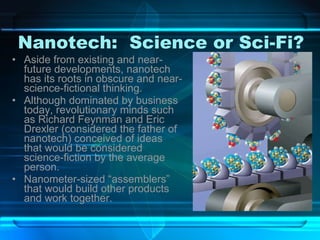
Nanotech:  Science or Sci-Fi? Aside from existing and near-future developments, nanotech has its roots in obscure and near-science-fictional thinking. Although dominated by business today, revolutionary minds such as Richard Feynman and Eric Drexler (considered the father of nanotech) conceived of ideas that would be considered science-fiction by the average person. Nanometer-sized “assemblers” that would build other products and work together.
Nanotech:  Science or Sci-Fi? Self-replicating machines that would take in feedstock and produce self-replicas, among other purposes. Created the notion of “grey goo” Idea that run-away self-replication or mutation could cause an enormous disaster. Also the possibility of nanobugs or nanobots used as weapons.
Risks of Nanotechnology As further advancements are made, numerous risks can and likely will arise alongside its benefits. Far-off possibility of previously-mentioned grey goo catastrophe. Use of assemblers and similar nanobots in constructing both conventional and super-weapons. Possibility of previously-inconceivable and undetectable spying. Other invasive uses that individuals or the public aren’t aware of.
Ethical Considerations Nanotechnology raises some very important issues. In the future, as more and more nano-based technologies increase, scientists working on them will likely encounter issues that will require sound ethical deliberation and decision-making. The nanocomputing subfield is no different.
Example Say hypothetically that you are assigned to work on a project for some government or private business. Your specific job is to help construct a highly-efficient nano-processor that will be integrated into a system used to collect and store massive amounts of personal data of unknowing citizens. What would you do? Ideally – be a whistleblower. Selfishly – don’t risk your job, proceed. Luckily, enough professionals in this relatively new field are ethically-aware enough to have some guidelines down (e.g.-self-replicating machines).
Nanocomputers Simply defined as computers whose components are small enough to be measured in nanometers, and which are integrated in a highly-dense manner on this same scale. Seems likely to be part of the natural progression of computers (transistors, etc.). Transistor expected to reach a minimum size in the future, therefore new techniques or structures will be needed to continue advancements in both speed and storage-size of computers (e.g.-Moore’s Law). The field which will bring about quantum and molecular computing. Quantum computing: Solving a 64-bit encryption key today, about 2 64  operations (292.5 years) versus 64-qbit quantum computer taking one operation.
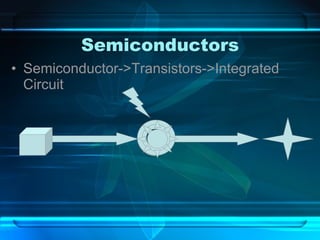
Semiconductors Semiconductor->Transistors->Integrated Circuit
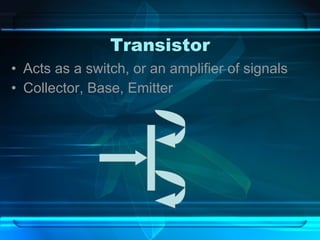
Transistor Acts as a switch, or an amplifier of signals Collector, Base, Emitter
Quantum Dots Highly promising outlook in nanocomputing. “ Artificial atom,” allows an electron to be contained inside. Operates on “wireless” principle, versus other directions taken in nanocomputing. Uses electrical fields, or the natural repulsion of electrons to transmit signals. Component making up...
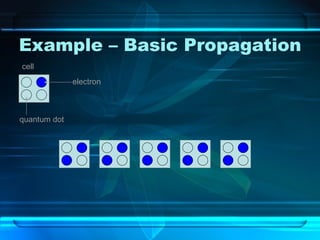
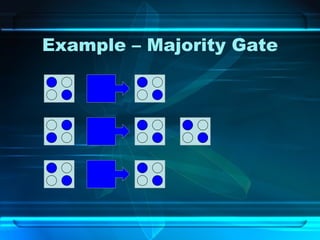
Quantum Cellular Automata Cells composed of quantum dots, arranged next to each other on a semiconductor material. A cell receives two electrons (that can’t escape) when created. A signal is propagated down the line by a cell influencing its neighbor (or neighbors). Beneficial, as it works on an extremely small scale (allowing dense components), and uses very little power.
Example – Basic Propagation quantum dot electron cell
Example – Majority Gate
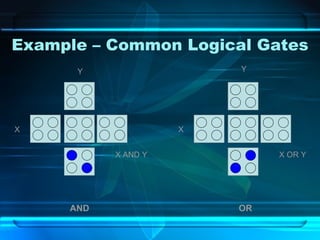
Example – Common Logical Gates AND OR X Y X Y X AND Y X OR Y
Nanotech at UCF Nanoscience Technology Center Located at Research Pavillion Millions of dollars in funding Working with numerous organizations and industries Aerospace, Physics, Biomolecular Science, Electrical and Computer Engineering
Summary Nanotechnology is a relatively new field tying together numerous disciplines. Has some sci-fi aspects that need to be explained to the general public, to gain more acceptance as time progresses. Nanocomputing is a promising field and is the likely direction computers will be headed. Nanotech is popping up in academic institutions all around the world.
References McCarthy, Wil.  Hacking Matter .  New York:  Basic Books, 2003. Montemerlo, Michael S., J. Christopher Love, and James C. Ellenbogen.  Overview of Electronic Nanocomputers .  MITRE Nanosystems Group.  17 Feb. 2005.  <http://www.mitre.org/tech/nanotech/nano_elect_ovw.html>. Murch, Richard.  Nanocomputing: When Will It Happen?  InformIT.com.  10 Dec. 2004.  17 Feb. 2005.  <http://www.informit.com/articles/article.asp?p=354352>. Phoenix, Chris, and Eric Drexler.  Safe exponential manufacturing .  Nanotechnology, 15(8): 869-872, 2004. Shukla, Sandeep K., and R. Iris Bahar(edited).  Nano, Quantum and Molecular Computing .  Dordrecht:  Kluwer Academic Publishers, 2004. Walus, Konrad.  QCADesigner – Basic QCA Tutorial .  4 Apr. 2004.  18 Feb. 2005.  <http://www.qcadesigner.ca/tutorials/QCATutorial.html>.

Nanocomputing

  • 1.
  • 2.
    Introduction Broad overviewof nanotechnology and specifically nanocomputing will be presented. Special attention given to a certain important area in nanocomputing. After the presentation you should have a good general knowledge of nanotechnology, and nanocomputing.
  • 3.
    Flow of DiscussionOverview of nanotechnology and applications Associated risks and ethical considerations Introduction to nanocomputers Focus on quantum dots and cellular automata Nanotech at the University of Central Florida
  • 4.
    Nanotechnology Can bedefined as the development and use of technology on an extremely small scale. Specifically, any technological creation ranging in size from 0.1 to 100 nm. One nanometer is a millionth of a millimeter (a billionth of a meter). Involves the use and manipulation of molecules and atoms themselves. Size places nanotechnology between the worlds of classical and quantum mechanics.
  • 5.
    Applications of NanotechnologyNanotech can be viewed as being part of an interdisciplinary area. Due to it’s nature, nanotech involves the work of scientists in chemistry, physics, engineering, biology, computer science, and numerous related fields. Hard to say what nanotechnology is and/or will be a part of; too numerous to mention. Areas ranging from computing and medicine, to stain resistant textiles and suntan lotions.
  • 6.
    Nanotech: Scienceor Sci-Fi? Aside from existing and near-future developments, nanotech has its roots in obscure and near-science-fictional thinking. Although dominated by business today, revolutionary minds such as Richard Feynman and Eric Drexler (considered the father of nanotech) conceived of ideas that would be considered science-fiction by the average person. Nanometer-sized “assemblers” that would build other products and work together.
  • 7.
    Nanotech: Scienceor Sci-Fi? Self-replicating machines that would take in feedstock and produce self-replicas, among other purposes. Created the notion of “grey goo” Idea that run-away self-replication or mutation could cause an enormous disaster. Also the possibility of nanobugs or nanobots used as weapons.
  • 8.
    Risks of NanotechnologyAs further advancements are made, numerous risks can and likely will arise alongside its benefits. Far-off possibility of previously-mentioned grey goo catastrophe. Use of assemblers and similar nanobots in constructing both conventional and super-weapons. Possibility of previously-inconceivable and undetectable spying. Other invasive uses that individuals or the public aren’t aware of.
  • 9.
    Ethical Considerations Nanotechnologyraises some very important issues. In the future, as more and more nano-based technologies increase, scientists working on them will likely encounter issues that will require sound ethical deliberation and decision-making. The nanocomputing subfield is no different.
  • 10.
    Example Say hypotheticallythat you are assigned to work on a project for some government or private business. Your specific job is to help construct a highly-efficient nano-processor that will be integrated into a system used to collect and store massive amounts of personal data of unknowing citizens. What would you do? Ideally – be a whistleblower. Selfishly – don’t risk your job, proceed. Luckily, enough professionals in this relatively new field are ethically-aware enough to have some guidelines down (e.g.-self-replicating machines).
  • 11.
    Nanocomputers Simply definedas computers whose components are small enough to be measured in nanometers, and which are integrated in a highly-dense manner on this same scale. Seems likely to be part of the natural progression of computers (transistors, etc.). Transistor expected to reach a minimum size in the future, therefore new techniques or structures will be needed to continue advancements in both speed and storage-size of computers (e.g.-Moore’s Law). The field which will bring about quantum and molecular computing. Quantum computing: Solving a 64-bit encryption key today, about 2 64 operations (292.5 years) versus 64-qbit quantum computer taking one operation.
  • 12.
  • 13.
    Transistor Acts asa switch, or an amplifier of signals Collector, Base, Emitter
  • 14.
    Quantum Dots Highlypromising outlook in nanocomputing. “ Artificial atom,” allows an electron to be contained inside. Operates on “wireless” principle, versus other directions taken in nanocomputing. Uses electrical fields, or the natural repulsion of electrons to transmit signals. Component making up...
  • 15.
    Quantum Cellular AutomataCells composed of quantum dots, arranged next to each other on a semiconductor material. A cell receives two electrons (that can’t escape) when created. A signal is propagated down the line by a cell influencing its neighbor (or neighbors). Beneficial, as it works on an extremely small scale (allowing dense components), and uses very little power.
  • 16.
    Example – BasicPropagation quantum dot electron cell
  • 17.
  • 18.
    Example – CommonLogical Gates AND OR X Y X Y X AND Y X OR Y
  • 19.
    Nanotech at UCFNanoscience Technology Center Located at Research Pavillion Millions of dollars in funding Working with numerous organizations and industries Aerospace, Physics, Biomolecular Science, Electrical and Computer Engineering
  • 20.
    Summary Nanotechnology isa relatively new field tying together numerous disciplines. Has some sci-fi aspects that need to be explained to the general public, to gain more acceptance as time progresses. Nanocomputing is a promising field and is the likely direction computers will be headed. Nanotech is popping up in academic institutions all around the world.
  • 21.
    References McCarthy, Wil. Hacking Matter . New York: Basic Books, 2003. Montemerlo, Michael S., J. Christopher Love, and James C. Ellenbogen. Overview of Electronic Nanocomputers . MITRE Nanosystems Group. 17 Feb. 2005. <http://www.mitre.org/tech/nanotech/nano_elect_ovw.html>. Murch, Richard. Nanocomputing: When Will It Happen? InformIT.com. 10 Dec. 2004. 17 Feb. 2005. <http://www.informit.com/articles/article.asp?p=354352>. Phoenix, Chris, and Eric Drexler. Safe exponential manufacturing . Nanotechnology, 15(8): 869-872, 2004. Shukla, Sandeep K., and R. Iris Bahar(edited). Nano, Quantum and Molecular Computing . Dordrecht: Kluwer Academic Publishers, 2004. Walus, Konrad. QCADesigner – Basic QCA Tutorial . 4 Apr. 2004. 18 Feb. 2005. <http://www.qcadesigner.ca/tutorials/QCATutorial.html>.