Nanotechnology
Project report on


         Presented by:
                   Vimal Saxena
                   11 BME0171
Introduction
This is all very interesting and quite impressive,
but what use is it? Our lives have some meaning
on a scale of meters, but it's impossible to think
about ordinary, everyday existence on a scale
1000 times smaller than a fly's eye. We can't
really think about problems like AIDS, world
poverty, or global warming, because they lose all
meaning on the nanoscale. Yet the nanoscale—
the world where atoms, molecules (atoms joined
together), proteins, and cells rule the roost—is a
place where science and technology gain an
entirely new meaning.
Overview:
  How nanotechnology is
impacting our everyday lives

    Defining nanoscale science and
     engineering (“nanotechnology”)

    Why the excitement about
     nanotechnology? Examples of
     “nanotech” in current research
     … and everyday life
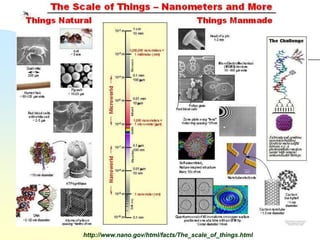
http://www.nano.gov/html/facts/The_scale_of_things.html
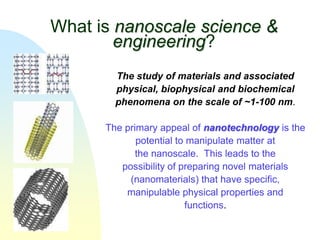
What is nanoscale science &
        engineering?
        The study of materials and associated
        physical, biophysical and biochemical
        phenomena on the scale of ~1-100 nm.

      The primary appeal of nanotechnology is the
             potential to manipulate matter at
             the nanoscale. This leads to the
         possibility of preparing novel materials
           (nanomaterials) that have specific,
          manipulable physical properties and
                         functions.
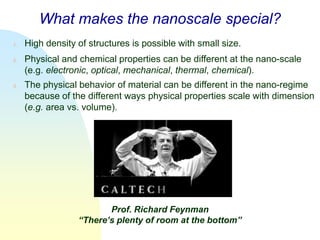
What makes the nanoscale special?
1.   High density of structures is possible with small size.
2.   Physical and chemical properties can be different at the nano-scale
     (e.g. electronic, optical, mechanical, thermal, chemical).
3.   The physical behavior of material can be different in the nano-regime
     because of the different ways physical properties scale with dimension
     (e.g. area vs. volume).


                         Prof. Richard Feynman
                  “There’s plenty of room at the bottom”
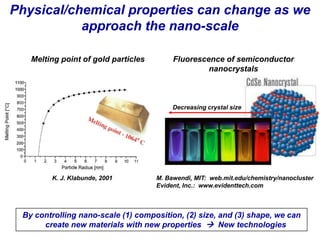
Physical/chemical properties can change as we
           approach the nano-scale

   Melting point of gold particles        Fluorescence of semiconductor
                                                   nanocrystals


                                          Decreasing crystal size


        K. J. Klabunde, 2001         M. Bawendi, MIT: web.mit.edu/chemistry/nanocluster
                                     Evident, Inc.: www.evidenttech.com


 By controlling nano-scale (1) composition, (2) size, and (3) shape, we can
      create new materials with new properties  New technologies
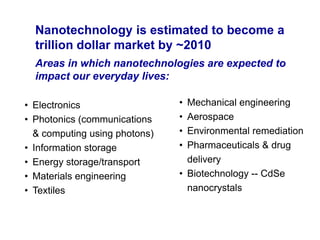
Nanotechnology is estimated to become a
  trillion dollar market by ~2010
  Areas in which nanotechnologies are expected to
  impact our everyday lives:

• Electronics                  • Mechanical engineering
• Photonics (communications    • Aerospace
  & computing using photons)   • Environmental remediation
• Information storage          • Pharmaceuticals & drug
• Energy storage/transport       delivery
• Materials engineering        • Biotechnology -- CdSe
• Textiles                       nanocrystals
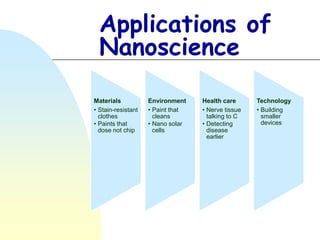
Applications of
  Nanoscience
Materials           Environment    Health care      Technology
• Stain-resistant   • Paint that   • Nerve tissue   • Building
  clothes             cleans         talking to C     smaller
• Paints that       • Nano solar   • Detecting        devices
  dose not chip       cells          disease
                                     earlier
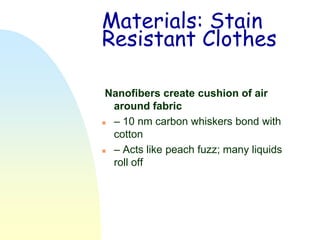
Materials: Stain
Resistant Clothes

 Nanofibers create cushion of air
  around fabric
 – 10 nm carbon whiskers bond with
  cotton
 – Acts like peach fuzz; many liquids
  roll off
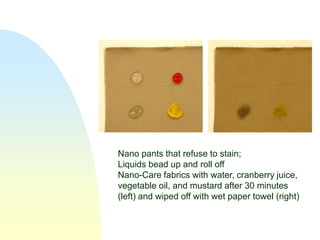
Nano pants that refuse to stain;
Liquids bead up and roll off
Nano-Care fabrics with water, cranberry juice,
vegetable oil, and mustard after 30 minutes
(left) and wiped off with wet paper towel (right)
Environment: Paint
That Cleans Air
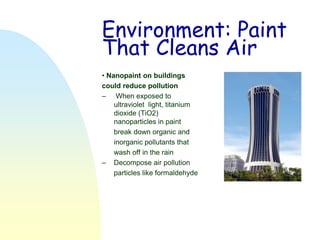
• Nanopaint on buildings
could reduce pollution
– When exposed to
    ultraviolet light, titanium
    dioxide (TiO2)
    nanoparticles in paint
    break down organic and
    inorganic pollutants that
    wash off in the rain
– Decompose air pollution
    particles like formaldehyde
Environment: Nano
Solar Cells
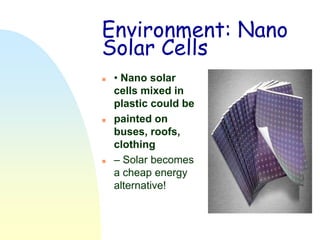
   • Nano solar
    cells mixed in
    plastic could be
   painted on
    buses, roofs,
    clothing
   – Solar becomes
    a cheap energy
    alternative!
Technology: Building
Smaller Devices
and Chips
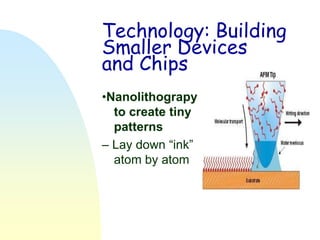
•Nanolithograpy
  to create tiny
  patterns
– Lay down ―ink‖
  atom by atom
Health Care:
Detecting Diseases
Earlier
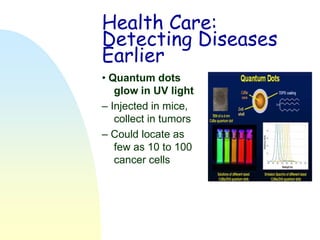
• Quantum dots
   glow in UV light
– Injected in mice,
   collect in tumors
– Could locate as
   few as 10 to 100
   cancer cells
Health Care: Nerve
   Tissue Talking to
   Computers
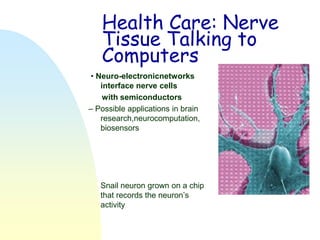
• Neuro-electronicnetworks
   interface nerve cells
    with semiconductors
– Possible applications in brain
   research,neurocomputation,
   biosensors


   Snail neuron grown on a chip
   that records the neuron’s
   activity
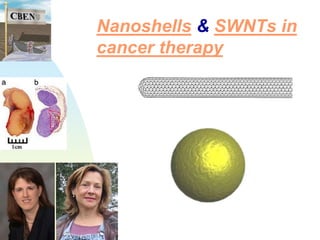
Nanoshells & SWNTs in
cancer therapy
Cancer Therapy
   Advances in nanotechnology are enabling many
    new diagnostic and therapeutic approaches in
    cancer. Nano particles are employed to induce
    localized heating within tumors . Approaches to
    nano particle-mediated thermal therapy include
    absorption of infrared light, radio frequency
    ablation, and magnetically-induced heating.
    These approaches have demonstrated high
    efficacy in animal models, and two are already in
    human clinical trials.
Other aspects of
Nano technology
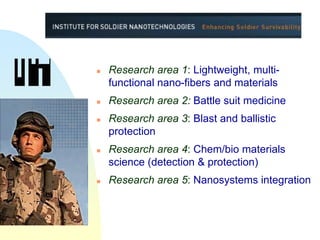
   Research area 1: Lightweight, multi-
    functional nano-fibers and materials
   Research area 2: Battle suit medicine
   Research area 3: Blast and ballistic
    protection
   Research area 4: Chem/bio materials
    science (detection & protection)
   Research area 5: Nanosystems integration
The
END

Vimal22

  • 1.
    Nanotechnology Project report on Presented by: Vimal Saxena 11 BME0171
  • 2.
    Introduction This is allvery interesting and quite impressive, but what use is it? Our lives have some meaning on a scale of meters, but it's impossible to think about ordinary, everyday existence on a scale 1000 times smaller than a fly's eye. We can't really think about problems like AIDS, world poverty, or global warming, because they lose all meaning on the nanoscale. Yet the nanoscale— the world where atoms, molecules (atoms joined together), proteins, and cells rule the roost—is a place where science and technology gain an entirely new meaning.
  • 3.
    Overview: Hownanotechnology is impacting our everyday lives  Defining nanoscale science and engineering (“nanotechnology”)  Why the excitement about nanotechnology? Examples of “nanotech” in current research … and everyday life
  • 5.
  • 6.
    What is nanoscalescience & engineering? The study of materials and associated physical, biophysical and biochemical phenomena on the scale of ~1-100 nm. The primary appeal of nanotechnology is the potential to manipulate matter at the nanoscale. This leads to the possibility of preparing novel materials (nanomaterials) that have specific, manipulable physical properties and functions.
  • 7.
    What makes thenanoscale special? 1. High density of structures is possible with small size. 2. Physical and chemical properties can be different at the nano-scale (e.g. electronic, optical, mechanical, thermal, chemical). 3. The physical behavior of material can be different in the nano-regime because of the different ways physical properties scale with dimension (e.g. area vs. volume). Prof. Richard Feynman “There’s plenty of room at the bottom”
  • 8.
    Physical/chemical properties canchange as we approach the nano-scale Melting point of gold particles Fluorescence of semiconductor nanocrystals Decreasing crystal size K. J. Klabunde, 2001 M. Bawendi, MIT: web.mit.edu/chemistry/nanocluster Evident, Inc.: www.evidenttech.com By controlling nano-scale (1) composition, (2) size, and (3) shape, we can create new materials with new properties  New technologies
  • 9.
    Nanotechnology is estimatedto become a trillion dollar market by ~2010 Areas in which nanotechnologies are expected to impact our everyday lives: • Electronics • Mechanical engineering • Photonics (communications • Aerospace & computing using photons) • Environmental remediation • Information storage • Pharmaceuticals & drug • Energy storage/transport delivery • Materials engineering • Biotechnology -- CdSe • Textiles nanocrystals
  • 10.
    Applications of Nanoscience Materials Environment Health care Technology • Stain-resistant • Paint that • Nerve tissue • Building clothes cleans talking to C smaller • Paints that • Nano solar • Detecting devices dose not chip cells disease earlier
  • 11.
    Materials: Stain Resistant Clothes Nanofibers create cushion of air around fabric  – 10 nm carbon whiskers bond with cotton  – Acts like peach fuzz; many liquids roll off
  • 12.
    Nano pants thatrefuse to stain; Liquids bead up and roll off Nano-Care fabrics with water, cranberry juice, vegetable oil, and mustard after 30 minutes (left) and wiped off with wet paper towel (right)
  • 13.
    Environment: Paint That CleansAir • Nanopaint on buildings could reduce pollution – When exposed to ultraviolet light, titanium dioxide (TiO2) nanoparticles in paint break down organic and inorganic pollutants that wash off in the rain – Decompose air pollution particles like formaldehyde
  • 14.
    Environment: Nano Solar Cells  • Nano solar cells mixed in plastic could be  painted on buses, roofs, clothing  – Solar becomes a cheap energy alternative!
  • 15.
    Technology: Building Smaller Devices andChips •Nanolithograpy to create tiny patterns – Lay down ―ink‖ atom by atom
  • 16.
    Health Care: Detecting Diseases Earlier •Quantum dots glow in UV light – Injected in mice, collect in tumors – Could locate as few as 10 to 100 cancer cells
  • 17.
    Health Care: Nerve Tissue Talking to Computers • Neuro-electronicnetworks interface nerve cells with semiconductors – Possible applications in brain research,neurocomputation, biosensors Snail neuron grown on a chip that records the neuron’s activity
  • 18.
    Nanoshells & SWNTsin cancer therapy
  • 19.
    Cancer Therapy  Advances in nanotechnology are enabling many new diagnostic and therapeutic approaches in cancer. Nano particles are employed to induce localized heating within tumors . Approaches to nano particle-mediated thermal therapy include absorption of infrared light, radio frequency ablation, and magnetically-induced heating. These approaches have demonstrated high efficacy in animal models, and two are already in human clinical trials.
  • 20.
  • 21.
    Research area 1: Lightweight, multi- functional nano-fibers and materials  Research area 2: Battle suit medicine  Research area 3: Blast and ballistic protection  Research area 4: Chem/bio materials science (detection & protection)  Research area 5: Nanosystems integration
  • 22.