• High technology, often abbreviated to high tech
(adjective forms high-technology, high-tech or hi-
tech) is technology that is at the cutting edge: the
most advanced technology available.
• Products currently considered high tech are often
those that incorporate advanced computer electronics.
However, there is no specific class of technology that
is high tech—the definition shifts and evolves over
time—so products hyped as high-tech in the past may
now be considered to have everyday or dated
technology.
• The opposite of high tech is low technology, referring
to simple, often traditional or mechanical, technology;
for example, a calculator is a low-tech calculating
device.
• Nanotechnology
• Nanotechnology ("nanotech") is manipulation of matter on an atomic, molecular, and
supramolecular scale. The earliest, widespread description of nanotechnology[1][2] referred to
the particular technological goal of precisely manipulating atoms and molecules for fabrication
of macroscale products, also now referred to as molecular nanotechnology. A more generalized
description of nanotechnology was subsequently established by the
National Nanotechnology Initiative, which defines nanotechnology as the manipulation of matter
with at least one dimension sized from 1 to 100 nanometers. This definition reflects the fact that
quantum mechanical effects are important at thisquantum-realm scale, and so the definition
shifted from a particular technological goal to a research category inclusive of all types of
research and technologies that deal with the special properties of matter that occur below the
given size threshold. It is therefore common to see the plural form "nanotechnologies" as well
as "nanoscale technologies" to refer to the broad range of research and applications whose
common trait is size. Because of the variety of potential applications (including industrial and
military), governments have invested billions of dollars in nanotechnology research. Until 2012,
through its National Nanotechnology Initiative, the USA has invested 3.7 billion dollars, the
European Union has invested 1.2 billion and Japan 750 million dollars.[3]
• Nanotechnology as defined by size is naturally very broad, including fields of science as diverse
as surface science,organic chemistry, molecular biology, semiconductor physics,
microfabrication, etc.[4] The associated research and applications are equally diverse, ranging
from extensions of conventional device physics to completely new approaches based upon
molecular self-assembly, from developing new materials with dimensions on the nanoscale to
direct control of matter on the atomic scale.
• Scientists currently debate the future implications of nanotechnology. Nanotechnology may be
able to create many new materials and devices with a vast range of applications, such as in
nanomedicine, nanoelectronics, biomaterials energy production, and consumer products. On
the other hand, nanotechnology raises many of the same issues as any new technology,
including concerns about the toxicity and environmental impact of nanomaterials,[5] and their
potential effects on global economics, as well as speculation about various doomsday scenarios
. These concerns have led to a debate among advocacy groups and governments on whether
special regulation of nanotechnology is warranted.
Telecommunication
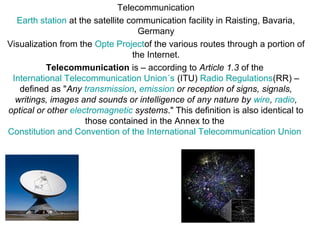
Earth station at the satellite communication facility in Raisting, Bavaria,
Germany
Visualization from the Opte Projectof the various routes through a portion of
the Internet.
Telecommunication is – according to Article 1.3 of the
International Telecommunication Union´s (ITU) Radio Regulations(RR) –
defined as "Any transmission, emission or reception of signs, signals,
writings, images and sounds or intelligence of any nature by wire, radio,
optical or other electromagnetic systems." This definition is also identical to
those contained in the Annex to the
Constitution and Convention of the International Telecommunication Union
• Computer science
• Computer science deals with the theoretical foundations of information and
computation, together with practical techniques for the implementation and
application of these foundations.
• Computer science is the scientific and practical approach to computation
and its applications. It is the systematic study of the feasibility, structure,
expression, and mechanization of the methodical procedures (oralgorithms)
that underlie the acquisition, representation, processing, storage,
communication of, and access toinformation. An alternate, more succinct
definition of computer science is the study of automating algorithmic
processes that scale. A computer scientist specializes in the theory of
computation and the design of computational systems.[1]
• Its fields can be divided into a variety of theoretical
and practical disciplines. Some fields, such as
computational complexity theory (which explores the
fundamental properties of computational and
intractable problems), are highly abstract, while fields
such as computer graphics emphasize real-world
visual applications. Still other fields focus on
challenges in implementing computation. For
example, programming language theory considers
various approaches to the description of computation,
while the study of computer programming itself
investigates various aspects of the use of
programming language and complex systems.
Human–computer interaction considers the challenges
in making computers and computations useful, usable,
and universally accessible to humans.
• Femtotechnology
• Theory
• Work in the femtometer range involves manipulation of excited energy
states within atomic nuclei, specifically nuclear isomers, to produce
metastable (or otherwise stabilized) states with unusual properties. In the
extreme case, excited states of the individual nucleons that make up the
atomic nucleus (protons and neutrons) are considered, ostensibly to tailor
the behavioral properties of these particles.
• The most advanced form of molecular nanotechnology is often imagined to
involve self-replicating molecular machines, and there have been some
speculations suggesting something similar might be possible with analogues
of molecules composed of nucleons rather than atoms. For example, the
astrophysicist Frank Drake once speculated about the possibility of self-
replicating organisms composed of such nuclear molecules living on the
surface of a neutron star, a suggestion taken up in the science fiction novel
Dragon's Egg by the physicist Robert Forward.[1] It is thought by physicists
that nuclear molecules may be possible,[2][3] but they would be very short-
lived, and whether they could actually be made to perform complex tasks
such as self-replication, or what type of technology could be used to
manipulate them, is unknown.
• Femtotechnology
• Theory
• Work in the femtometer range involves manipulation of excited energy
states within atomic nuclei, specifically nuclear isomers, to produce
metastable (or otherwise stabilized) states with unusual properties. In the
extreme case, excited states of the individual nucleons that make up the
atomic nucleus (protons and neutrons) are considered, ostensibly to tailor
the behavioral properties of these particles.
• The most advanced form of molecular nanotechnology is often imagined to
involve self-replicating molecular machines, and there have been some
speculations suggesting something similar might be possible with analogues
of molecules composed of nucleons rather than atoms. For example, the
astrophysicist Frank Drake once speculated about the possibility of self-
replicating organisms composed of such nuclear molecules living on the
surface of a neutron star, a suggestion taken up in the science fiction novel
Dragon's Egg by the physicist Robert Forward.[1] It is thought by physicists
that nuclear molecules may be possible,[2][3] but they would be very short-
lived, and whether they could actually be made to perform complex tasks
such as self-replication, or what type of technology could be used to
manipulate them, is unknown.

High technology

  • 1.
    • High technology,often abbreviated to high tech (adjective forms high-technology, high-tech or hi- tech) is technology that is at the cutting edge: the most advanced technology available. • Products currently considered high tech are often those that incorporate advanced computer electronics. However, there is no specific class of technology that is high tech—the definition shifts and evolves over time—so products hyped as high-tech in the past may now be considered to have everyday or dated technology. • The opposite of high tech is low technology, referring to simple, often traditional or mechanical, technology; for example, a calculator is a low-tech calculating device.
  • 2.
    • Nanotechnology • Nanotechnology("nanotech") is manipulation of matter on an atomic, molecular, and supramolecular scale. The earliest, widespread description of nanotechnology[1][2] referred to the particular technological goal of precisely manipulating atoms and molecules for fabrication of macroscale products, also now referred to as molecular nanotechnology. A more generalized description of nanotechnology was subsequently established by the National Nanotechnology Initiative, which defines nanotechnology as the manipulation of matter with at least one dimension sized from 1 to 100 nanometers. This definition reflects the fact that quantum mechanical effects are important at thisquantum-realm scale, and so the definition shifted from a particular technological goal to a research category inclusive of all types of research and technologies that deal with the special properties of matter that occur below the given size threshold. It is therefore common to see the plural form "nanotechnologies" as well as "nanoscale technologies" to refer to the broad range of research and applications whose common trait is size. Because of the variety of potential applications (including industrial and military), governments have invested billions of dollars in nanotechnology research. Until 2012, through its National Nanotechnology Initiative, the USA has invested 3.7 billion dollars, the European Union has invested 1.2 billion and Japan 750 million dollars.[3] • Nanotechnology as defined by size is naturally very broad, including fields of science as diverse as surface science,organic chemistry, molecular biology, semiconductor physics, microfabrication, etc.[4] The associated research and applications are equally diverse, ranging from extensions of conventional device physics to completely new approaches based upon molecular self-assembly, from developing new materials with dimensions on the nanoscale to direct control of matter on the atomic scale. • Scientists currently debate the future implications of nanotechnology. Nanotechnology may be able to create many new materials and devices with a vast range of applications, such as in nanomedicine, nanoelectronics, biomaterials energy production, and consumer products. On the other hand, nanotechnology raises many of the same issues as any new technology, including concerns about the toxicity and environmental impact of nanomaterials,[5] and their potential effects on global economics, as well as speculation about various doomsday scenarios . These concerns have led to a debate among advocacy groups and governments on whether special regulation of nanotechnology is warranted.
  • 3.
    Telecommunication Earth station atthe satellite communication facility in Raisting, Bavaria, Germany Visualization from the Opte Projectof the various routes through a portion of the Internet. Telecommunication is – according to Article 1.3 of the International Telecommunication Union´s (ITU) Radio Regulations(RR) – defined as "Any transmission, emission or reception of signs, signals, writings, images and sounds or intelligence of any nature by wire, radio, optical or other electromagnetic systems." This definition is also identical to those contained in the Annex to the Constitution and Convention of the International Telecommunication Union
  • 4.
    • Computer science •Computer science deals with the theoretical foundations of information and computation, together with practical techniques for the implementation and application of these foundations. • Computer science is the scientific and practical approach to computation and its applications. It is the systematic study of the feasibility, structure, expression, and mechanization of the methodical procedures (oralgorithms) that underlie the acquisition, representation, processing, storage, communication of, and access toinformation. An alternate, more succinct definition of computer science is the study of automating algorithmic processes that scale. A computer scientist specializes in the theory of computation and the design of computational systems.[1]
  • 5.
    • Its fieldscan be divided into a variety of theoretical and practical disciplines. Some fields, such as computational complexity theory (which explores the fundamental properties of computational and intractable problems), are highly abstract, while fields such as computer graphics emphasize real-world visual applications. Still other fields focus on challenges in implementing computation. For example, programming language theory considers various approaches to the description of computation, while the study of computer programming itself investigates various aspects of the use of programming language and complex systems. Human–computer interaction considers the challenges in making computers and computations useful, usable, and universally accessible to humans.
  • 6.
    • Femtotechnology • Theory •Work in the femtometer range involves manipulation of excited energy states within atomic nuclei, specifically nuclear isomers, to produce metastable (or otherwise stabilized) states with unusual properties. In the extreme case, excited states of the individual nucleons that make up the atomic nucleus (protons and neutrons) are considered, ostensibly to tailor the behavioral properties of these particles. • The most advanced form of molecular nanotechnology is often imagined to involve self-replicating molecular machines, and there have been some speculations suggesting something similar might be possible with analogues of molecules composed of nucleons rather than atoms. For example, the astrophysicist Frank Drake once speculated about the possibility of self- replicating organisms composed of such nuclear molecules living on the surface of a neutron star, a suggestion taken up in the science fiction novel Dragon's Egg by the physicist Robert Forward.[1] It is thought by physicists that nuclear molecules may be possible,[2][3] but they would be very short- lived, and whether they could actually be made to perform complex tasks such as self-replication, or what type of technology could be used to manipulate them, is unknown.
  • 7.
    • Femtotechnology • Theory •Work in the femtometer range involves manipulation of excited energy states within atomic nuclei, specifically nuclear isomers, to produce metastable (or otherwise stabilized) states with unusual properties. In the extreme case, excited states of the individual nucleons that make up the atomic nucleus (protons and neutrons) are considered, ostensibly to tailor the behavioral properties of these particles. • The most advanced form of molecular nanotechnology is often imagined to involve self-replicating molecular machines, and there have been some speculations suggesting something similar might be possible with analogues of molecules composed of nucleons rather than atoms. For example, the astrophysicist Frank Drake once speculated about the possibility of self- replicating organisms composed of such nuclear molecules living on the surface of a neutron star, a suggestion taken up in the science fiction novel Dragon's Egg by the physicist Robert Forward.[1] It is thought by physicists that nuclear molecules may be possible,[2][3] but they would be very short- lived, and whether they could actually be made to perform complex tasks such as self-replication, or what type of technology could be used to manipulate them, is unknown.