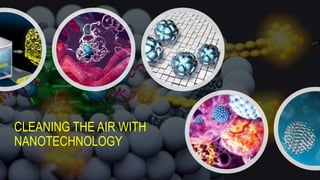
CLEANING THE AIR WITH
NANOTECHNOLOGY
Environmental application of nanotechnology
Global deterioration of water, soil, and atmosphere by the release of toxic
chemicals from the ongoing anthropogenic activities is becoming a serious
problem throughout the world.
This poses numerous issues relevant to ecosystem and human health that intensify
the application challenges of conventional treatment technologies.
The recent progresses in nanotechnology and its vital role to encompass the
imperative demand to monitor and treat the emerging hazardous wastes with lower
cost, less energy, as well as higher efficiency.
The treatment applications of some nanomaterials (e.g., carbon-based
nanoparticles, antibacterial nanoparticles, and metal oxide nanoparticles) in the
following environments:
(1) Air (treatment of greenhouse gases, volatile organic compounds, and
bioaerosols via adsorption, photocatalytic degradation, thermal decomposition, and
air filtration processes)
(2) Soil (application of nanomaterials as amendment agents for
phytoremediation processes and utilization of stabilizers to enhance their
performance)
(3) Water (removal of organic pollutants, heavy metals, pathogens through
adsorption, membrane processes, photocatalysis, and disinfection processes).
Nanotechnology offers many advantages to improve existing environmental
technologies and create new technology that is better than current technology.
Nanotechnology has three main capabilities that can be applied in the fields of
environment, including
1.The clean up (remediation) and purification,
2.The detection of contaminants (sensing and detection),
3.The pollution prevention.
Our environment is filled with various types of pollutants emitted from human
activities or industrial processes.
Examples of these pollutants are carbon monoxide (CO), chlorofluorocarbons
(CFCs), heavy metals (arsenic, chromium, lead, cadmium, mercury and zinc),
hydrocarbons, nitrogen oxides, organic compounds (volatile organic compounds
and dioxins), sulphur dioxide and particulates.
Human activities, such as oil, coal and gas combustion, have significant potential
to change emissions from natural sources.
Air remediation using Nano size semiconductor photocatalyst
Photocatalyst is a next generation of air purification technology, which can treat
air pollutions caused by more than 85% kinds of harmful gases such as car
exhausts NOx, formaldehyde, benzene, VOCs.
At the presence of light, photocatalyst produces hydroxyl radicals and holes (h+),
which react with organic materials and harmful gases to produce water and carbon
dioxide.
There is no extra pollution in the whole purification process.
Some materials such as titanium dioxide (TiO2), zinc oxide (ZnO), iron (III) oxide
(Fe2O3) and tungsten oxide (WO3) may serve as photocatalysts.
This photocatalyst has many uses, including as a white pigment which gives
colour to paper and paint, ultraviolet light-absorbing material on the sunscreen,
protective antimicrobials and automatic cleaners.
In relation to the environment and water remediation, photocatalysts are able to
oxidize organic pollutants into nontoxic materials.
In general, the use of TiO2 in advanced methods of photochemical oxidation for
the remediation of water is due to its low levels of toxicity, high
photoconductivity, high photostability, and that it is an easily available and
inexpensive material.
Using the principle of a semiconductor, organic molecules can be oxidized by
light.
 At a sufficient level of light, the charge transfer process will occur from the
valence band to the conduction band causing the surrounding substance to be
oxidized.
Through the development of nanotechnology, semiconductor photocatalysts are
modified in terms of reactivity and selectivity.
One semiconductor photocatalyst has been applied for water remediation.
The photocatalyst is able to remove contaminants from ground water containing
1,1-dichloroethane, cis-1,2-dischloroethane, 1,1,1-threechloroehtane, xylenes and
toluene.
 In a pilot scale, it was also found that TiO2 was capable of eliminating benzene,
toluene, ethylbenzene and xylene (BTEX) contents from groundwater.
In addition to the use of TiO2, which is already commonly used in industry, ZnO
photocatalysts are currently being developed as well.
As a concept, ZnO is expected to have two functions, namely to detect and
remediate contaminants. During laboratory experiments, a ZnO photocatalyst was
successfully used to detect and eliminate 4-chlorocatechol.
Features:
Purify most air pollution including NOx and VOCs
100% mineralize harmful gases to H2O and CO2
Environmentally friendly, no extra pollution
Organic pollutant decomposition
Catalytic action mode, long time performance
Odour control
Anti-bacterial
Removal of volatile organic compounds from air
Clearing volatile organic compounds (VOCs) from air: Researchers have
demonstrated a catalyst that breaks down VOCs at room temperature. The catalyst
is composed of porous manganese oxide in which gold nanoparticles have been
embedded.
In addition to nitrogen oxides and sulphur oxides, many chemicals are formed by
atmospheric reactions.
Heterogeneous reactions of HONO formation from NO2 and HNO3, polyaromatic
compounds .
 A density functional theory study of phenyl formation initiated by ethynyl radical
(C2H·) and ethyne (C2H2).
Aromatic formation from vinyl radical and acetylene.
Formation of PAHs and soot platelets: multiconfiguration theoretical study of the
key step in the ring closure-radical breeding polyene-based mechanism. and
volatile organic compounds (VOCs).
Clean air regulations have become increasingly stringent as those particles are
potentially damaging to human health.
Most modern air purification systems are based on photocatalysts, adsorbents such
as activated carbon or ozonolysis.
However, conventional systems are not very good at getting rid of organic
pollutants at room temperature.
 Japanese researchers have now developed a new material that is very effective for
removing VOCs, nitrogen and sulphur oxides from air at room temperature .
Novel mesoporous chromium oxide for VOCs elimination.
 It involves highly porous manganese oxide with gold nanoparticles that are grown
into it.
To prove the effectiveness of this catalyst, performed tests using three major
components of organic indoor air pollutants: acetaldehyde, toluene and hexane.
The results showed that all three pollutants in the air were very effectively
removed and degraded by this catalyst compared with the conventional catalyst
systems.
NANOTECHNOLOGIES FOR AIR QUALITY REMEDIATION
One of the most popular applications of nanotechnology is the use of nano
compounds, devices and tools for air remediation.
 Nanotechnology is being incorporated and improvised in in situ conditions for
detecting air contaminants, as well as cleaning, maintaining and enhancing air
quality.
Air filtration techniques are similar to water purification methods and find
applications in buildings to purify indoor air volumes.
Nano filters could be applied to automobile tailpipes and factory smokestacks to
separate out contaminants and prevent them from entering the atmosphere.
 In addition, Nano sensors have been developed to sense toxic gas leaks at
extremely low concentrations.
AIR PURIFICATION
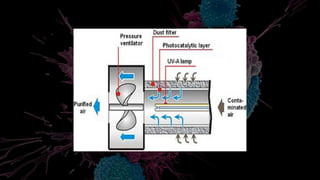
The project’s air purifying systems use photocatalytic filters that reduce airborne
organic contaminants to water and carbon dioxide.
By passing air through porous material with a titanium dioxide nanocrystal
photocatalyzer, these units destroy toxic organic substances and pathogenic
microorganisms.
Photocatalytic air purification can be employed to prevent the spread of viral
infections in medical facilities and in gathering places.
Project executives intend to manufacture several types of air cleaning systems for
installation in homes, offices, and industrial buildings.
They will also produce antibacterial, antismoke, and specialized medical units.
The photocatalytic elements in all these systems possess practically unlimited
resources. They work in a broad range of temperatures and use little energy.
Air purification using nanocrystal photocatalytic materials is one of the most
effective means of cleaning air.
 These systems are capable of removing such harmful contaminants as nitrogen
oxide, formaldehyde, and pathogenic microorganisms (bacteria and viruses),
something other methods of air cleaning cannot accomplish.
Their virtually unlimited resources contrast sharply with other air cleaning
systems that, in the absence of watchful filter replacement, themselves become
sources of toxic air pollutants.
The AIRLIFE systems do not have these problems because dangerous substances
are fully oxidized on the surface of the nanostructured photocatalyzer.
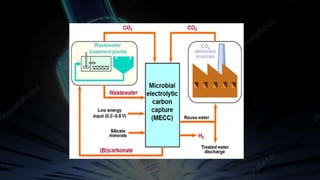
Treatment of greenhouse gases
Many practical design and operating decisions on wastewater treatment plants can
have significant impacts on the overall environmental performance, in particular
the greenhouse gas (GHG) emissions.
 The main factor in this regard is the use of aerobic or anaerobic treatment
technology.
The GHG production of a number of case studies with aerobic or anaerobic main
and sludge treatment of domestic wastewater and also looks at the energy balances
and economics.
This comparison demonstrates that major advantages can be gained by using
primarily anaerobic processes as it is possible to largely eliminate any net energy
input to the process, and therefore the production of GHG from fossil fuels.
 This is achieved by converting the energy of the incoming wastewater pollutants
to methane which is then used to generate electricity.
This is sufficient to power the aerobic processes as well as the mixing of the
anaerobic stages.
All of the CO2 produced in the anaerobic processes comes from the wastewater
pollutants and is therefore greenhouse gas neutral, whereas up to 1.4 kg CO2/kg
COD(removed) originates from power generation for the fully aerobic process.
This means that considerably more CO2 is produced in power generation than in
the actual treatment process, and all of this is typically from fossil fuels, whereas
the energy from the wastewater pollutants comes primarily from renewable energy
sources, namely agricultural products.
Even a change from anaerobic to aerobic sludge treatment processes (for the same
aerobic main process) has a massive impact on the CO2 production from fossil
fuels.
Air Pollution: Nanotechnology Applications under
Development
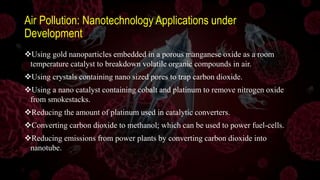
Using gold nanoparticles embedded in a porous manganese oxide as a room
temperature catalyst to breakdown volatile organic compounds in air.
Using crystals containing nano sized pores to trap carbon dioxide.
Using a nano catalyst containing cobalt and platinum to remove nitrogen oxide
from smokestacks.
Reducing the amount of platinum used in catalytic converters.
Converting carbon dioxide to methanol; which can be used to power fuel-cells.
Reducing emissions from power plants by converting carbon dioxide into
nanotube.
Removal of carbon
dioxide from industrial
smoke stacks using:
Carbon nanotube-based
membranes
Nanostructured
membranes
Genetically engineered
enzymes
Generating less pollution during the manufacture of materials
Example the use of silver nanoclusters as catalysts can significantly reduce the
polluting by products generated in the process used to manufacture propylene
oxide.
Propylene oxide is used to produce common materials such as plastics, paint,
detergents and brake fluid.
REFERENCES
• https://www.understandingnano.com/air.html
• http://en.rusnano.com/press-centre/news/88561
• http://blog.bccresearch.com/clearing-the-air-global-
nanotechnology-in-environmental-applications-
market
• http://www.greenearthnanoscience.com/air-
purification.php
• http://www.macrothink.org/journal/index.php/emsd/
article/viewFile/12047/9541
• https://www.tandfonline.com/doi/full/10.1080/2162
2515.2012.733966
Nano in Air

Nano in Air

  • 1.
    CLEANING THE AIRWITH NANOTECHNOLOGY
  • 2.
    Environmental application ofnanotechnology Global deterioration of water, soil, and atmosphere by the release of toxic chemicals from the ongoing anthropogenic activities is becoming a serious problem throughout the world. This poses numerous issues relevant to ecosystem and human health that intensify the application challenges of conventional treatment technologies. The recent progresses in nanotechnology and its vital role to encompass the imperative demand to monitor and treat the emerging hazardous wastes with lower cost, less energy, as well as higher efficiency.
  • 3.
    The treatment applicationsof some nanomaterials (e.g., carbon-based nanoparticles, antibacterial nanoparticles, and metal oxide nanoparticles) in the following environments: (1) Air (treatment of greenhouse gases, volatile organic compounds, and bioaerosols via adsorption, photocatalytic degradation, thermal decomposition, and air filtration processes) (2) Soil (application of nanomaterials as amendment agents for phytoremediation processes and utilization of stabilizers to enhance their performance) (3) Water (removal of organic pollutants, heavy metals, pathogens through adsorption, membrane processes, photocatalysis, and disinfection processes). Nanotechnology offers many advantages to improve existing environmental technologies and create new technology that is better than current technology.
  • 4.
    Nanotechnology has threemain capabilities that can be applied in the fields of environment, including 1.The clean up (remediation) and purification, 2.The detection of contaminants (sensing and detection), 3.The pollution prevention. Our environment is filled with various types of pollutants emitted from human activities or industrial processes. Examples of these pollutants are carbon monoxide (CO), chlorofluorocarbons (CFCs), heavy metals (arsenic, chromium, lead, cadmium, mercury and zinc), hydrocarbons, nitrogen oxides, organic compounds (volatile organic compounds and dioxins), sulphur dioxide and particulates. Human activities, such as oil, coal and gas combustion, have significant potential to change emissions from natural sources.
  • 5.
    Air remediation usingNano size semiconductor photocatalyst Photocatalyst is a next generation of air purification technology, which can treat air pollutions caused by more than 85% kinds of harmful gases such as car exhausts NOx, formaldehyde, benzene, VOCs. At the presence of light, photocatalyst produces hydroxyl radicals and holes (h+), which react with organic materials and harmful gases to produce water and carbon dioxide. There is no extra pollution in the whole purification process. Some materials such as titanium dioxide (TiO2), zinc oxide (ZnO), iron (III) oxide (Fe2O3) and tungsten oxide (WO3) may serve as photocatalysts. This photocatalyst has many uses, including as a white pigment which gives colour to paper and paint, ultraviolet light-absorbing material on the sunscreen, protective antimicrobials and automatic cleaners.
  • 6.
    In relation tothe environment and water remediation, photocatalysts are able to oxidize organic pollutants into nontoxic materials. In general, the use of TiO2 in advanced methods of photochemical oxidation for the remediation of water is due to its low levels of toxicity, high photoconductivity, high photostability, and that it is an easily available and inexpensive material. Using the principle of a semiconductor, organic molecules can be oxidized by light.  At a sufficient level of light, the charge transfer process will occur from the valence band to the conduction band causing the surrounding substance to be oxidized. Through the development of nanotechnology, semiconductor photocatalysts are modified in terms of reactivity and selectivity. One semiconductor photocatalyst has been applied for water remediation.
  • 7.
    The photocatalyst isable to remove contaminants from ground water containing 1,1-dichloroethane, cis-1,2-dischloroethane, 1,1,1-threechloroehtane, xylenes and toluene.  In a pilot scale, it was also found that TiO2 was capable of eliminating benzene, toluene, ethylbenzene and xylene (BTEX) contents from groundwater. In addition to the use of TiO2, which is already commonly used in industry, ZnO photocatalysts are currently being developed as well. As a concept, ZnO is expected to have two functions, namely to detect and remediate contaminants. During laboratory experiments, a ZnO photocatalyst was successfully used to detect and eliminate 4-chlorocatechol.
  • 8.
    Features: Purify most airpollution including NOx and VOCs 100% mineralize harmful gases to H2O and CO2 Environmentally friendly, no extra pollution Organic pollutant decomposition Catalytic action mode, long time performance Odour control Anti-bacterial
  • 9.
    Removal of volatileorganic compounds from air Clearing volatile organic compounds (VOCs) from air: Researchers have demonstrated a catalyst that breaks down VOCs at room temperature. The catalyst is composed of porous manganese oxide in which gold nanoparticles have been embedded. In addition to nitrogen oxides and sulphur oxides, many chemicals are formed by atmospheric reactions. Heterogeneous reactions of HONO formation from NO2 and HNO3, polyaromatic compounds .  A density functional theory study of phenyl formation initiated by ethynyl radical (C2H·) and ethyne (C2H2). Aromatic formation from vinyl radical and acetylene.
  • 10.
    Formation of PAHsand soot platelets: multiconfiguration theoretical study of the key step in the ring closure-radical breeding polyene-based mechanism. and volatile organic compounds (VOCs). Clean air regulations have become increasingly stringent as those particles are potentially damaging to human health. Most modern air purification systems are based on photocatalysts, adsorbents such as activated carbon or ozonolysis. However, conventional systems are not very good at getting rid of organic pollutants at room temperature.  Japanese researchers have now developed a new material that is very effective for removing VOCs, nitrogen and sulphur oxides from air at room temperature .
  • 11.
    Novel mesoporous chromiumoxide for VOCs elimination.  It involves highly porous manganese oxide with gold nanoparticles that are grown into it. To prove the effectiveness of this catalyst, performed tests using three major components of organic indoor air pollutants: acetaldehyde, toluene and hexane. The results showed that all three pollutants in the air were very effectively removed and degraded by this catalyst compared with the conventional catalyst systems.
  • 12.
    NANOTECHNOLOGIES FOR AIRQUALITY REMEDIATION One of the most popular applications of nanotechnology is the use of nano compounds, devices and tools for air remediation.  Nanotechnology is being incorporated and improvised in in situ conditions for detecting air contaminants, as well as cleaning, maintaining and enhancing air quality. Air filtration techniques are similar to water purification methods and find applications in buildings to purify indoor air volumes. Nano filters could be applied to automobile tailpipes and factory smokestacks to separate out contaminants and prevent them from entering the atmosphere.  In addition, Nano sensors have been developed to sense toxic gas leaks at extremely low concentrations.
  • 13.
    AIR PURIFICATION The project’sair purifying systems use photocatalytic filters that reduce airborne organic contaminants to water and carbon dioxide. By passing air through porous material with a titanium dioxide nanocrystal photocatalyzer, these units destroy toxic organic substances and pathogenic microorganisms. Photocatalytic air purification can be employed to prevent the spread of viral infections in medical facilities and in gathering places. Project executives intend to manufacture several types of air cleaning systems for installation in homes, offices, and industrial buildings. They will also produce antibacterial, antismoke, and specialized medical units. The photocatalytic elements in all these systems possess practically unlimited resources. They work in a broad range of temperatures and use little energy.
  • 14.
    Air purification usingnanocrystal photocatalytic materials is one of the most effective means of cleaning air.  These systems are capable of removing such harmful contaminants as nitrogen oxide, formaldehyde, and pathogenic microorganisms (bacteria and viruses), something other methods of air cleaning cannot accomplish. Their virtually unlimited resources contrast sharply with other air cleaning systems that, in the absence of watchful filter replacement, themselves become sources of toxic air pollutants. The AIRLIFE systems do not have these problems because dangerous substances are fully oxidized on the surface of the nanostructured photocatalyzer.
  • 16.
    Treatment of greenhousegases Many practical design and operating decisions on wastewater treatment plants can have significant impacts on the overall environmental performance, in particular the greenhouse gas (GHG) emissions.  The main factor in this regard is the use of aerobic or anaerobic treatment technology. The GHG production of a number of case studies with aerobic or anaerobic main and sludge treatment of domestic wastewater and also looks at the energy balances and economics. This comparison demonstrates that major advantages can be gained by using primarily anaerobic processes as it is possible to largely eliminate any net energy input to the process, and therefore the production of GHG from fossil fuels.
  • 17.
     This isachieved by converting the energy of the incoming wastewater pollutants to methane which is then used to generate electricity. This is sufficient to power the aerobic processes as well as the mixing of the anaerobic stages. All of the CO2 produced in the anaerobic processes comes from the wastewater pollutants and is therefore greenhouse gas neutral, whereas up to 1.4 kg CO2/kg COD(removed) originates from power generation for the fully aerobic process. This means that considerably more CO2 is produced in power generation than in the actual treatment process, and all of this is typically from fossil fuels, whereas the energy from the wastewater pollutants comes primarily from renewable energy sources, namely agricultural products. Even a change from anaerobic to aerobic sludge treatment processes (for the same aerobic main process) has a massive impact on the CO2 production from fossil fuels.
  • 19.
    Air Pollution: NanotechnologyApplications under Development Using gold nanoparticles embedded in a porous manganese oxide as a room temperature catalyst to breakdown volatile organic compounds in air. Using crystals containing nano sized pores to trap carbon dioxide. Using a nano catalyst containing cobalt and platinum to remove nitrogen oxide from smokestacks. Reducing the amount of platinum used in catalytic converters. Converting carbon dioxide to methanol; which can be used to power fuel-cells. Reducing emissions from power plants by converting carbon dioxide into nanotube.
  • 20.
    Removal of carbon dioxidefrom industrial smoke stacks using: Carbon nanotube-based membranes Nanostructured membranes Genetically engineered enzymes
  • 22.
    Generating less pollutionduring the manufacture of materials Example the use of silver nanoclusters as catalysts can significantly reduce the polluting by products generated in the process used to manufacture propylene oxide. Propylene oxide is used to produce common materials such as plastics, paint, detergents and brake fluid.
  • 23.
    REFERENCES • https://www.understandingnano.com/air.html • http://en.rusnano.com/press-centre/news/88561 •http://blog.bccresearch.com/clearing-the-air-global- nanotechnology-in-environmental-applications- market • http://www.greenearthnanoscience.com/air- purification.php • http://www.macrothink.org/journal/index.php/emsd/ article/viewFile/12047/9541 • https://www.tandfonline.com/doi/full/10.1080/2162 2515.2012.733966