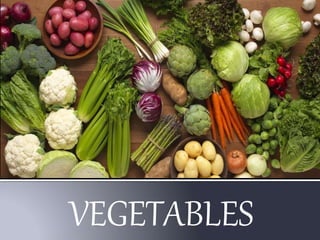
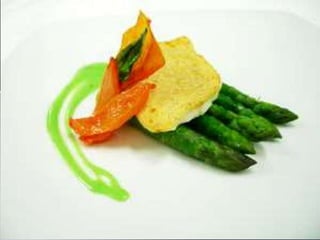
VEGETABLES
Classification of
Vegetables
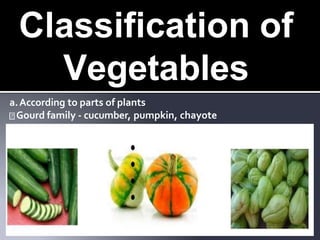
a.According to parts of plants
Gourd family - cucumber, pumpkin, chayote
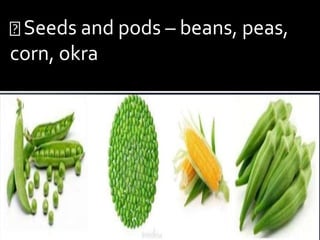
Seeds and pods – beans, peas,
corn, okra
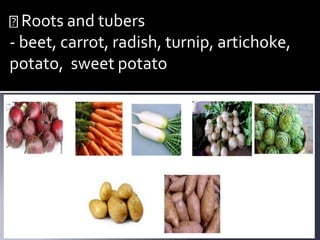
Roots and tubers
- beet, carrot, radish, turnip, artichoke,
potato, sweet potato
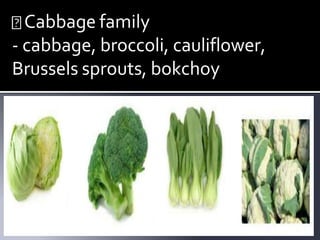
Cabbage family
- cabbage, broccoli, cauliflower,
Brussels sprouts, bokchoy
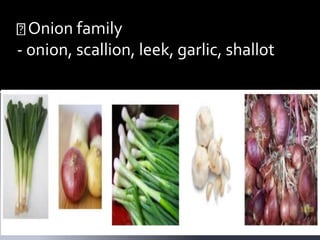
Onion family
- onion, scallion, leek, garlic, shallot
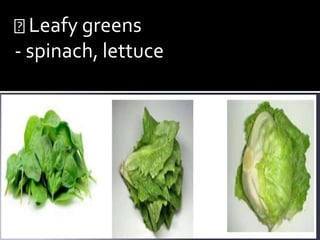
Leafy greens
- spinach, lettuce
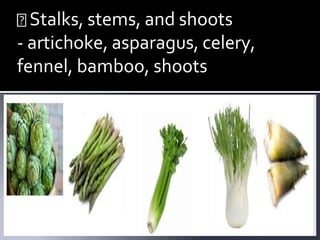
Stalks, stems, and shoots
- artichoke, asparagus, celery,
fennel, bamboo, shoots
Flavor Components of Vegetables
1.Sugar – Fructose – the natural sugar that provides the
sweetness in vegetables.
2.GlutamicAcid –This forms a product called monosodium
glutamate when combined with salt. It is found in large
amount from young and fresh vegetables.
3.Sulfur compounds –Give the characteristic strong flavor
and odor of some vegetables like onions, leeks, garlic,
chives, cabbage and broccoli.
Color Components
1. Chlorophyll – a fat soluble compound
responsible for the green color of plants. When
combined with acid, it forms pheophytin which
produces an olive green color. When combine
with alkali, it forms chlorophyllins which produces
a more intense green color. The addition of
baking soda when cooking that results to brighter
green color, is an example.
2.Carotenoids – the yellow, orange to
red soluble pigments found in plants.
1.- beta carotene from carrots and
squash 2.2 - lycopene, from tomatoes
3. Flavonoids 3.1 - Anthoxanthin –
responsible for the yellow pigments 3.2
-Anthocyanins – responsible for red
and blue to violet pigments (beets)
Tube, eggplants
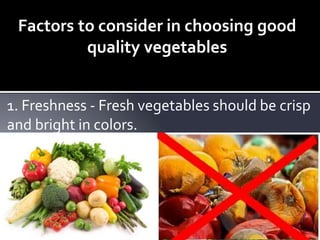
Factors to consider in choosing good
quality vegetables
1. Freshness - Fresh vegetables should be crisp
and bright in colors.
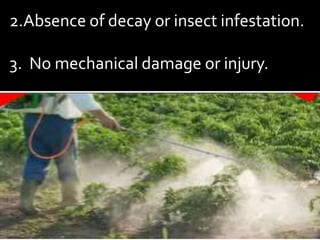
2.Absence of decay or insect infestation.
3. No mechanical damage or injury.
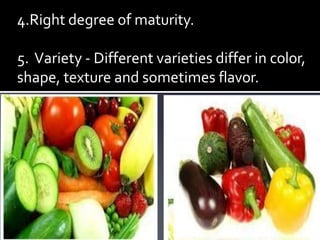
4.Right degree of maturity.
5. Variety - Different varieties differ in color,
shape, texture and sometimes flavor.
Vegetables are good sources of food
nutrients that are very important in
everyday meals.
Diets rich in potassium may help maintain
normal blood pressure.Vegetable sources of
potassium include sweet potatoes, white
potatoes, white beans, tomato products
(paste, sauce, and juice), beet greens,
soybeans, lima beans, spinach, lentils, and
kidney beans.
Dietary fiber from vegetables, as part of an
overall healthy diet, helps reduce blood
cholesterol levels and may lower risk of heart
disease. Fiber is important for proper bowel
function. It helps reduce constipation and
diverticulosis. Fiber-containing foods such as
vegetables help provide a feeling of fullness
with fewer calories.
 VitaminC helps heal cuts and wounds, and keeps teeth
and gums healthy.VitaminC aids in iron absorption.
 VitaminA keeps eyes and skin healthy and helps to
protect against infections.
 Folate (folic acid) helps the body form red blood cells.
Women of childbearing age who may become pregnant
should consume adequate folate from foods, and in
addition, 400 mcg of synthetic folic acid from fortified
foods or supplements.This reduces the risk of neural tube
defects, spinal bifida, and anencephaly during fetal
development.
NutritionalValue of
Vegetables
1.VitaminA -Green leafy vegetables are sources of
vitaminA.
Example: alugbati
ampalayaleaves
kalabasa leaves
malunggay
petchay
sili leaves
2.Vitamin C
Example: cabbage – type vegetables
bell peppers
lettuce
potatoes
dark green and yellow
vegetables
3.Vitamin B – complex Beans and
leafy greens are rich sources of
vitamin B – complex
Example: ampalaya tops
kulitis
pepper leaves
saluyot
dried beans
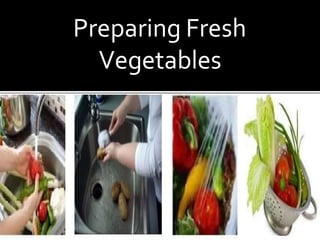
Preparing Fresh
Vegetables
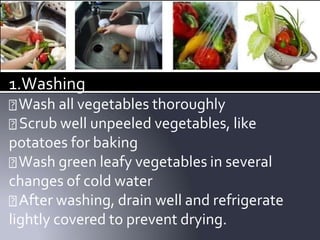
1.Washing
Wash all vegetables thoroughly
Scrub well unpeeled vegetables, like
potatoes for baking
Wash green leafy vegetables in several
changes of cold water
After washing, drain well and refrigerate
lightly covered to prevent drying.
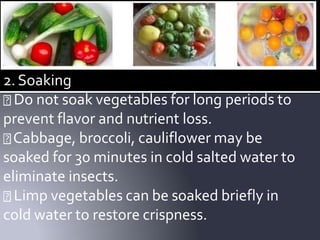
2.Soaking
Do not soak vegetables for long periods to
prevent flavor and nutrient loss.
Cabbage, broccoli, cauliflower may be
soaked for 30 minutes in cold salted water to
eliminate insects.
Limp vegetables can be soaked briefly in
cold water to restore crispness.
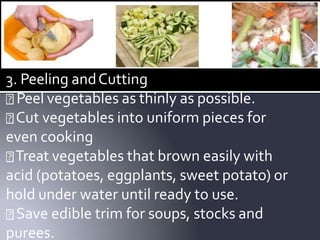
3. Peeling andCutting
Peel vegetables as thinly as possible.
Cut vegetables into uniform pieces for
even cooking
Treat vegetables that brown easily with
acid (potatoes, eggplants, sweet potato) or
hold under water until ready to use.
Save edible trim for soups, stocks and
purees.
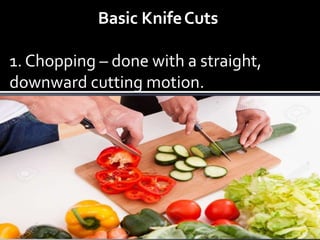
Basic KnifeCuts
1. Chopping – done with a straight,
downward cutting motion.
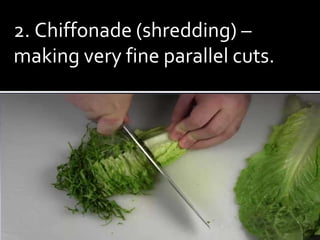
2. Chiffonade (shredding) –
making very fine parallel cuts.
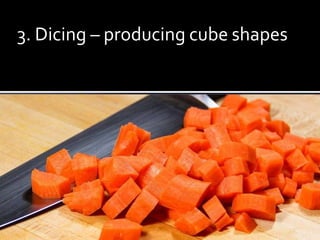
3. Dicing – producing cube shapes
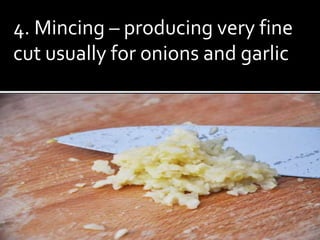
4. Mincing – producing very fine
cut usually for onions and garlic
5. Julienne and baton net –
making long rectangular
cut
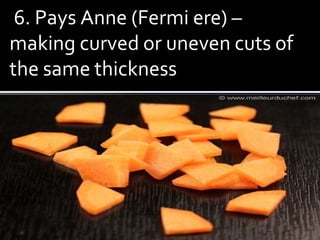
6. Pays Anne (Fermi ere) –
making curved or uneven cuts of
the same thickness
7. Rondelle – making
cylindrical cut
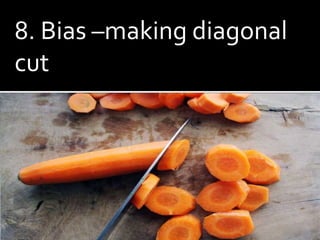
8. Bias –making diagonal
cut
Effects of Cooking
Vegetables
1.Changes in texture
2.Water is either lost or
absorbed.
3. Changes in color
4. Changes in nutrients
General Rules of
VegetableCookery
Don‘t overcook.
Prepare vegetable as close to service time as possible
and in small quantities.
If the vegetable must be cooked ahead, undercook
slightly and chill rapidly. Reheat at service time.
Cut vegetables uniformly for even cooking.
Cook green vegetables and strong – flavored vegetables
uncovered.
Standard Quality of
CookedVegetables
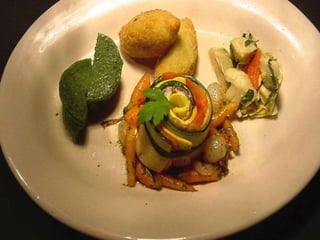
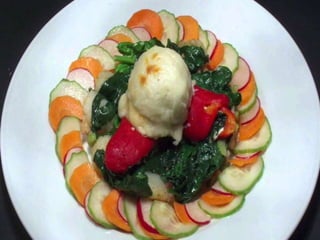
1. Color Bright, natural color
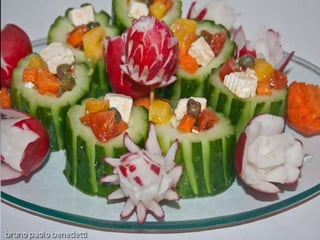
2.Appearance on plateCut neatly and uniformly
Attractively arranged with appropriate
combinations and garnishes.
3. Texture Cooked to the right degree of doneness Crisp –
tender, not overcooked and mushy Potatoes, squash,
sweet potatoes, tomatoes should be cooked through with
smooth texture
4.Flavor Natural flavor and sweetnessStrong –
flavored vegetables should be pleasantly mild, with no
off flavors or bitterness .
5.Seasonings Seasonings should not mask the natural
flavors
6.Sauces Do not use heavily. Vegetable should not be
greasy .
7.Vegetable combinationsVegetables should be cooked
separately for different cooking times, and then
combined Combine acid vegetables like tomatoes, to
green vegetables just before service to prevent
discoloration of greens.
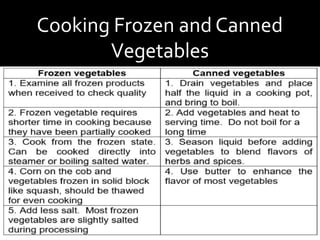
Cooking Frozen and Canned
Vegetables
prepare-vegetables.pptx

prepare-vegetables.pptx

  • 1.
  • 2.
    Classification of Vegetables a.According toparts of plants Gourd family - cucumber, pumpkin, chayote
  • 3.
    Seeds and pods– beans, peas, corn, okra
  • 4.
    Roots and tubers -beet, carrot, radish, turnip, artichoke, potato, sweet potato
  • 5.
    Cabbage family - cabbage,broccoli, cauliflower, Brussels sprouts, bokchoy
  • 6.
    Onion family - onion,scallion, leek, garlic, shallot
  • 7.
  • 8.
    Stalks, stems, andshoots - artichoke, asparagus, celery, fennel, bamboo, shoots
  • 9.
    Flavor Components ofVegetables 1.Sugar – Fructose – the natural sugar that provides the sweetness in vegetables. 2.GlutamicAcid –This forms a product called monosodium glutamate when combined with salt. It is found in large amount from young and fresh vegetables. 3.Sulfur compounds –Give the characteristic strong flavor and odor of some vegetables like onions, leeks, garlic, chives, cabbage and broccoli.
  • 10.
    Color Components 1. Chlorophyll– a fat soluble compound responsible for the green color of plants. When combined with acid, it forms pheophytin which produces an olive green color. When combine with alkali, it forms chlorophyllins which produces a more intense green color. The addition of baking soda when cooking that results to brighter green color, is an example.
  • 11.
    2.Carotenoids – theyellow, orange to red soluble pigments found in plants. 1.- beta carotene from carrots and squash 2.2 - lycopene, from tomatoes 3. Flavonoids 3.1 - Anthoxanthin – responsible for the yellow pigments 3.2 -Anthocyanins – responsible for red and blue to violet pigments (beets) Tube, eggplants
  • 12.
    Factors to considerin choosing good quality vegetables 1. Freshness - Fresh vegetables should be crisp and bright in colors.
  • 13.
    2.Absence of decayor insect infestation. 3. No mechanical damage or injury.
  • 14.
    4.Right degree ofmaturity. 5. Variety - Different varieties differ in color, shape, texture and sometimes flavor.
  • 15.
    Vegetables are goodsources of food nutrients that are very important in everyday meals. Diets rich in potassium may help maintain normal blood pressure.Vegetable sources of potassium include sweet potatoes, white potatoes, white beans, tomato products (paste, sauce, and juice), beet greens, soybeans, lima beans, spinach, lentils, and kidney beans.
  • 16.
    Dietary fiber fromvegetables, as part of an overall healthy diet, helps reduce blood cholesterol levels and may lower risk of heart disease. Fiber is important for proper bowel function. It helps reduce constipation and diverticulosis. Fiber-containing foods such as vegetables help provide a feeling of fullness with fewer calories.
  • 17.
     VitaminC helpsheal cuts and wounds, and keeps teeth and gums healthy.VitaminC aids in iron absorption.  VitaminA keeps eyes and skin healthy and helps to protect against infections.  Folate (folic acid) helps the body form red blood cells. Women of childbearing age who may become pregnant should consume adequate folate from foods, and in addition, 400 mcg of synthetic folic acid from fortified foods or supplements.This reduces the risk of neural tube defects, spinal bifida, and anencephaly during fetal development.
  • 18.
    NutritionalValue of Vegetables 1.VitaminA -Greenleafy vegetables are sources of vitaminA. Example: alugbati ampalayaleaves kalabasa leaves malunggay petchay sili leaves
  • 19.
    2.Vitamin C Example: cabbage– type vegetables bell peppers lettuce potatoes dark green and yellow vegetables
  • 20.
    3.Vitamin B –complex Beans and leafy greens are rich sources of vitamin B – complex Example: ampalaya tops kulitis pepper leaves saluyot dried beans
  • 21.
  • 22.
    1.Washing Wash all vegetablesthoroughly Scrub well unpeeled vegetables, like potatoes for baking Wash green leafy vegetables in several changes of cold water After washing, drain well and refrigerate lightly covered to prevent drying.
  • 23.
    2.Soaking Do not soakvegetables for long periods to prevent flavor and nutrient loss. Cabbage, broccoli, cauliflower may be soaked for 30 minutes in cold salted water to eliminate insects. Limp vegetables can be soaked briefly in cold water to restore crispness.
  • 24.
    3. Peeling andCutting Peelvegetables as thinly as possible. Cut vegetables into uniform pieces for even cooking Treat vegetables that brown easily with acid (potatoes, eggplants, sweet potato) or hold under water until ready to use. Save edible trim for soups, stocks and purees.
  • 25.
    Basic KnifeCuts 1. Chopping– done with a straight, downward cutting motion.
  • 26.
    2. Chiffonade (shredding)– making very fine parallel cuts.
  • 27.
    3. Dicing –producing cube shapes
  • 28.
    4. Mincing –producing very fine cut usually for onions and garlic
  • 29.
    5. Julienne andbaton net – making long rectangular cut
  • 30.
    6. Pays Anne(Fermi ere) – making curved or uneven cuts of the same thickness
  • 31.
    7. Rondelle –making cylindrical cut
  • 32.
    8. Bias –makingdiagonal cut
  • 33.
    Effects of Cooking Vegetables 1.Changesin texture 2.Water is either lost or absorbed. 3. Changes in color 4. Changes in nutrients
  • 34.
    General Rules of VegetableCookery Don‘tovercook. Prepare vegetable as close to service time as possible and in small quantities. If the vegetable must be cooked ahead, undercook slightly and chill rapidly. Reheat at service time. Cut vegetables uniformly for even cooking. Cook green vegetables and strong – flavored vegetables uncovered.
  • 35.
    Standard Quality of CookedVegetables 1.Color Bright, natural color 2.Appearance on plateCut neatly and uniformly Attractively arranged with appropriate combinations and garnishes.
  • 36.
    3. Texture Cookedto the right degree of doneness Crisp – tender, not overcooked and mushy Potatoes, squash, sweet potatoes, tomatoes should be cooked through with smooth texture 4.Flavor Natural flavor and sweetnessStrong – flavored vegetables should be pleasantly mild, with no off flavors or bitterness . 5.Seasonings Seasonings should not mask the natural flavors 6.Sauces Do not use heavily. Vegetable should not be greasy .
  • 37.
    7.Vegetable combinationsVegetables shouldbe cooked separately for different cooking times, and then combined Combine acid vegetables like tomatoes, to green vegetables just before service to prevent discoloration of greens.
  • 38.
    Cooking Frozen andCanned Vegetables