WASTE MANAGEMEN OF
INDORE
Presented By:-
Sachin Chalisgaonkar
SWATCH BHARAT MISSION (CLEAN INDIA
MISSION)
 On 2nd October 2014, the birth day of father of the
nation, Mahatma Gandhi, the ‘Swatch Bharat
Mission’ (SBM) was launched by Govt. of India.
This was given the shape of mass movement with
Prime Minister, Mr. Narendra Modi leading the
mission. The mission was split into two parts –
urban and rural. In urban areas, the focus was on
building open defecation free (ODF) towns by
constructing individual, community and public
toilets, and scientific solid waste management
CLEANEST CITY OF INDIA- INDORE
 Indore has yet again made it as India's cleanest city
in the nationwide annual cleanliness survey. Indore
was declared India's cleanest city for the fifth time
in a row by the central government on Saturday.
 Indore today generates over 1,115 MT of garbage a
day and all of it is collected from the source
whether it is a household or commercial
establishment. The door-to-door service was
started in January 2016 as a pilot projects in two of
the 84 wards in the city. It took almost a year to
achieve 100% door-to-door garbage collection.
Indore through its commendable collaborative
efforts has achieved segregation of waste at source
at 100% of its household’s and commercial units.
DOOR TO DOOR COLLECTION
 Indore has been divided into 19 zones and 85
wards. Each ward has on an average 6,000
households and 600 commercial establishments
(part of 88 notified commercial areas). In Indore,
waste is generated from various sources including
households, commercial areas and other
institutions like RWAs, hospitals, hotels among
others. The households or residential complexes
are covered by the door to door collection system
while the semi bulk and bulk generators are
covered by the bulk collection system. Indore
ensures the 100% coverage of wards through its
door to door collection system.
IMPLEMENTATION OF D2D COLLECTION
SYSTEM
In order to implementation successful door to door collection system, an
identification study had to be carried out which helped to figure out the
amount of waste generated at each ward and the population of each
ward. On that basis, a detailed route plan was prepared to cover all
wards. Based on the route plan, a detailed vehicle and staff deployment
plan was implemented in order to meet the waste collection demand of
each ward.
 The wet waste from the domestic generators is collected
through the Door to Door Collection System. The door to
door collection system has been deployed by IMC to
collect the waste from domestic generators and
commercial areas in Indore. The waste is collected
through partitioned vehicles known as ‘Tippers’ and
transported to the Garbage Transfer Stations for
secondary collection.
 The wet waste from semi bulk generators generating 25
to 100 kg of waste is collected through the Bulk
Collection System. The bulk collection vehicles consist
of a dumper which is used to collect wet waste and a
compactor which is used to collect dry waste. These
vehicles move in pairs as per a predefined deployment
plan. These vehicles on completing their collection route
transport the waste straight to the central processing
plant.
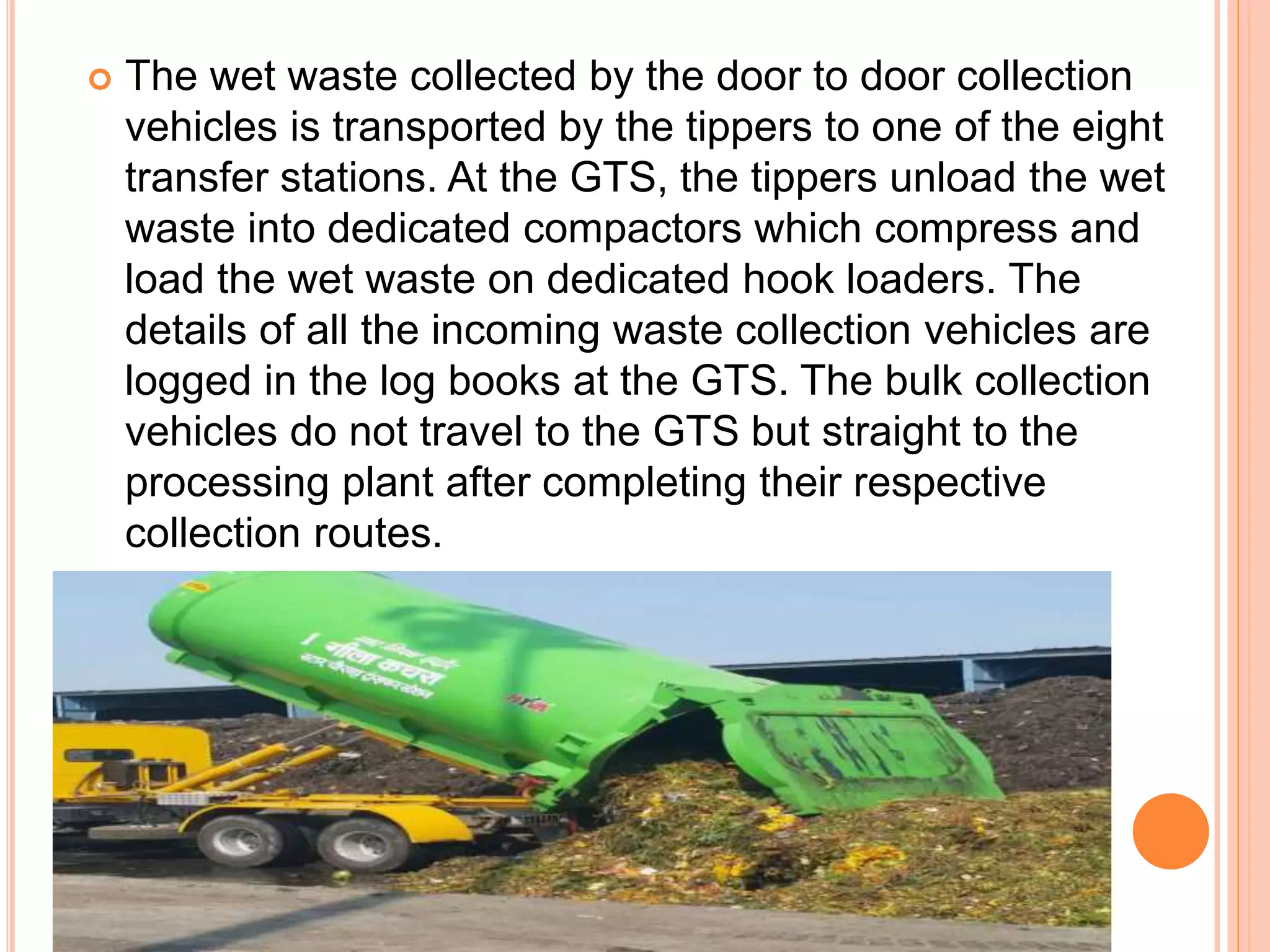
 The wet waste collected by the door to door collection
vehicles is transported by the tippers to one of the eight
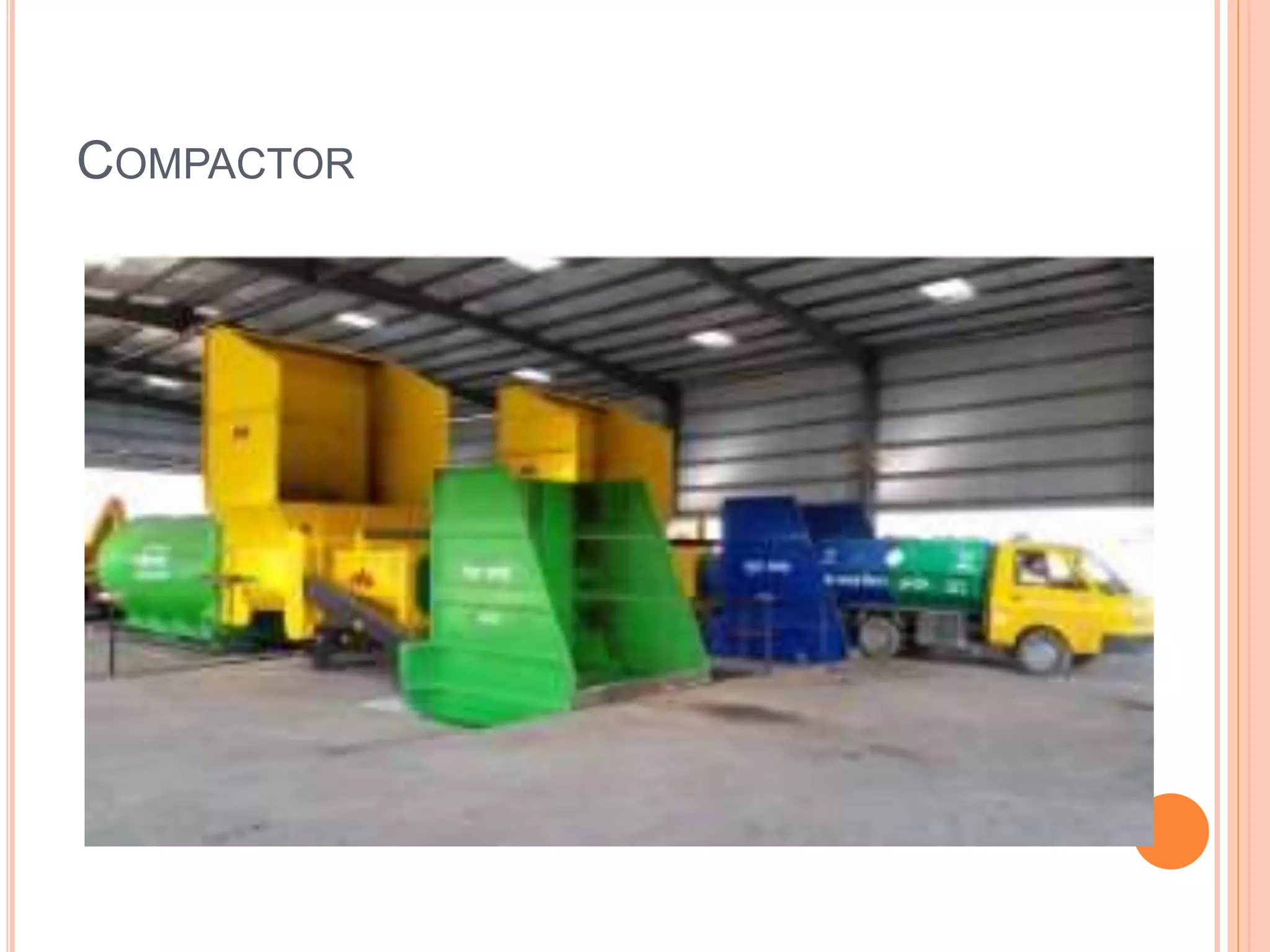
transfer stations. At the GTS, the tippers unload the wet
waste into dedicated compactors which compress and
load the wet waste on dedicated hook loaders. The
details of all the incoming waste collection vehicles are
logged in the log books at the GTS. The bulk collection
vehicles do not travel to the GTS but straight to the
processing plant after completing their respective
collection routes.
GARBAGE TRANSFER STATION
 The collected waste is transported by the Tri-
partioned garbage tippers deployed in all 85 wards
to the designated Garbage transfer station (GTS).
 To strengthen and reduce the cost of the Secondary
Collection and Transportation System, IMC has
constructed eight ultra-modern transfer stations of
three types of models such as Ramp based static
GTS, portable Compactors based GTS and semi
portable Compactors based GTS installed by Hyva
and TPS at different locations within the city.
COMPACTOR
OPEN DEFECATION FREE CITY
 Open defecation is due to lack of toilets and habits of
people. Besides construction of toilets education was an
important part of the mission ODF. In October 2016
NGOs were appointed by the IMC based on the strict
criteria of turnover and urban planning experience. The
main task of NGOs was to identify key ODF spots in and
around the city.
 The cleaning staff identified 72 critical ODF spots in the
city. NGOs played a very significant role in terms of
identifying ODF spots and informing about them to the
authorities. The major success for ODF came through
these NGOs who did a great job in identifying critical
ODF spots and bringing out behavioral change among
general public.
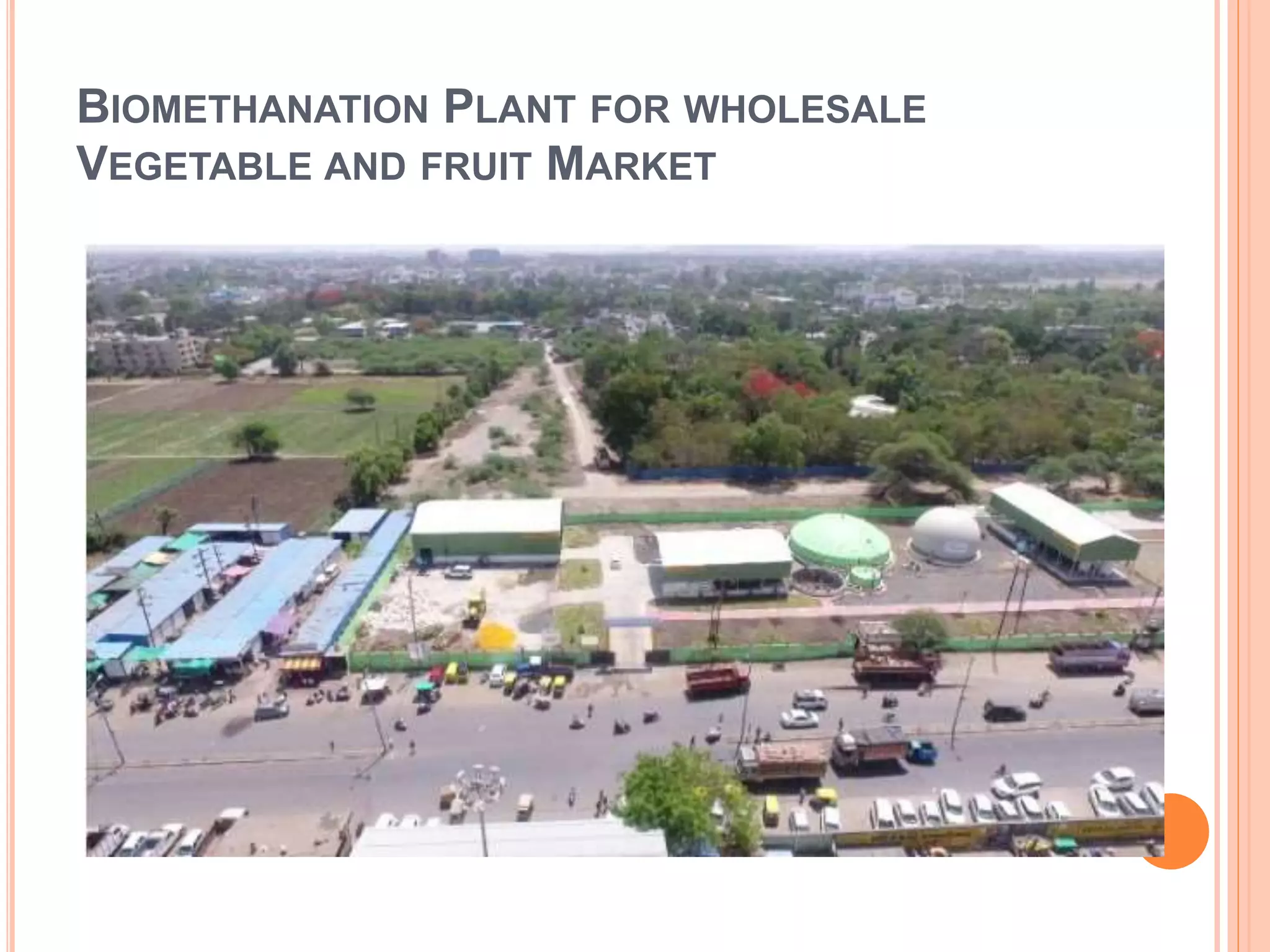
BIOMETHANATION PLANT FOR WHOLESALE
VEGETABLE AND FRUIT MARKET
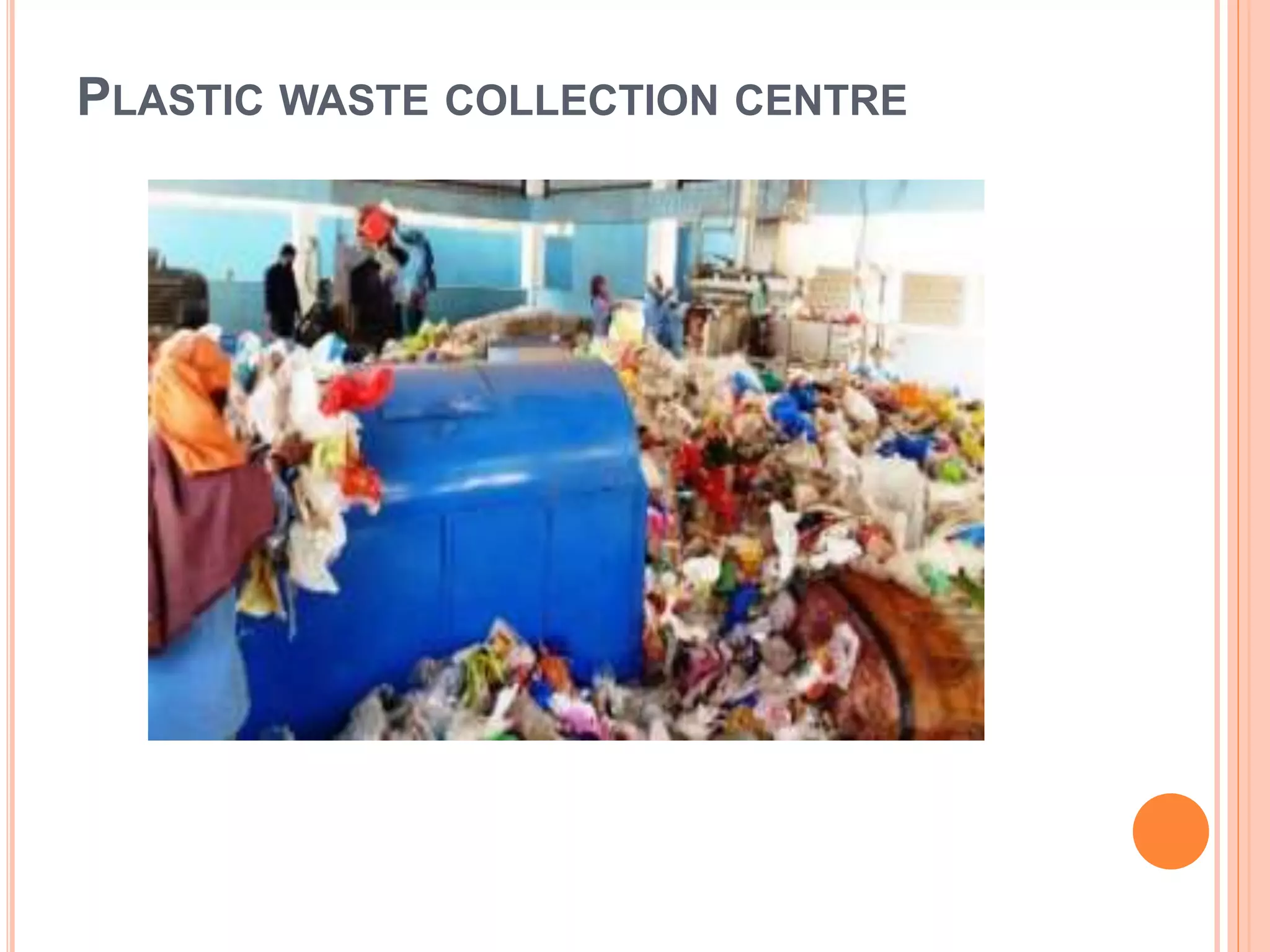
PLASTIC WASTE COLLECTION CENTRE
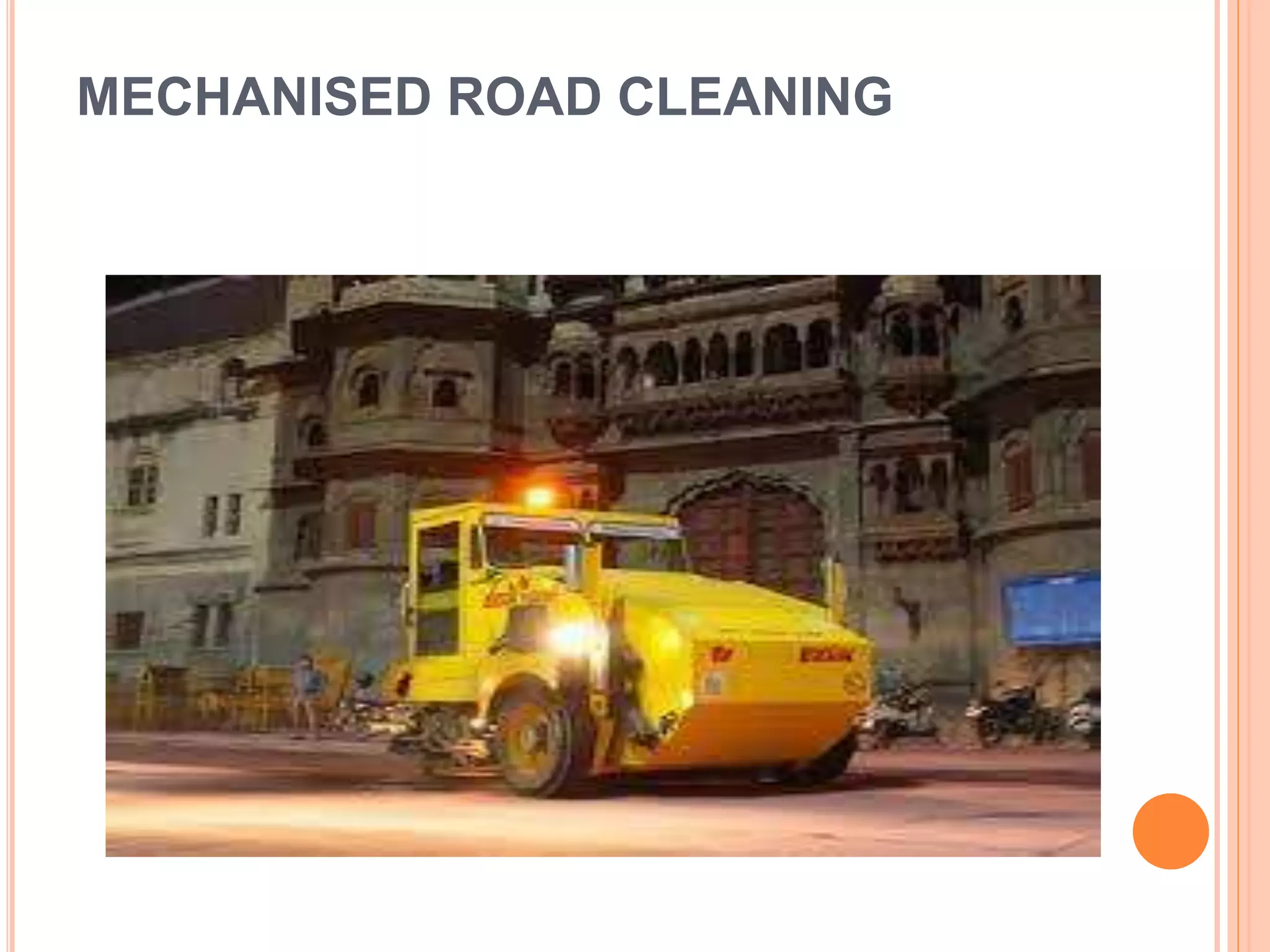
MECHANISED ROAD CLEANING
AWARENESS CAMPAIGN
 From IEC to Behavioral Change – The Secret of
Indore’s Transformation
 Information, Education and Communication (IEC) is
the key to behavior change which lies at the
foundation of making a success of Swachh Bharat
Mission.
THANK YOU

Indore waste management

  • 1.
    WASTE MANAGEMEN OF INDORE PresentedBy:- Sachin Chalisgaonkar
  • 2.
    SWATCH BHARAT MISSION(CLEAN INDIA MISSION)  On 2nd October 2014, the birth day of father of the nation, Mahatma Gandhi, the ‘Swatch Bharat Mission’ (SBM) was launched by Govt. of India. This was given the shape of mass movement with Prime Minister, Mr. Narendra Modi leading the mission. The mission was split into two parts – urban and rural. In urban areas, the focus was on building open defecation free (ODF) towns by constructing individual, community and public toilets, and scientific solid waste management
  • 3.
    CLEANEST CITY OFINDIA- INDORE  Indore has yet again made it as India's cleanest city in the nationwide annual cleanliness survey. Indore was declared India's cleanest city for the fifth time in a row by the central government on Saturday.
  • 4.
     Indore todaygenerates over 1,115 MT of garbage a day and all of it is collected from the source whether it is a household or commercial establishment. The door-to-door service was started in January 2016 as a pilot projects in two of the 84 wards in the city. It took almost a year to achieve 100% door-to-door garbage collection. Indore through its commendable collaborative efforts has achieved segregation of waste at source at 100% of its household’s and commercial units.
  • 5.
    DOOR TO DOORCOLLECTION  Indore has been divided into 19 zones and 85 wards. Each ward has on an average 6,000 households and 600 commercial establishments (part of 88 notified commercial areas). In Indore, waste is generated from various sources including households, commercial areas and other institutions like RWAs, hospitals, hotels among others. The households or residential complexes are covered by the door to door collection system while the semi bulk and bulk generators are covered by the bulk collection system. Indore ensures the 100% coverage of wards through its door to door collection system.
  • 6.
    IMPLEMENTATION OF D2DCOLLECTION SYSTEM In order to implementation successful door to door collection system, an identification study had to be carried out which helped to figure out the amount of waste generated at each ward and the population of each ward. On that basis, a detailed route plan was prepared to cover all wards. Based on the route plan, a detailed vehicle and staff deployment plan was implemented in order to meet the waste collection demand of each ward.
  • 7.
     The wetwaste from the domestic generators is collected through the Door to Door Collection System. The door to door collection system has been deployed by IMC to collect the waste from domestic generators and commercial areas in Indore. The waste is collected through partitioned vehicles known as ‘Tippers’ and transported to the Garbage Transfer Stations for secondary collection.  The wet waste from semi bulk generators generating 25 to 100 kg of waste is collected through the Bulk Collection System. The bulk collection vehicles consist of a dumper which is used to collect wet waste and a compactor which is used to collect dry waste. These vehicles move in pairs as per a predefined deployment plan. These vehicles on completing their collection route transport the waste straight to the central processing plant.
  • 8.
     The wetwaste collected by the door to door collection vehicles is transported by the tippers to one of the eight transfer stations. At the GTS, the tippers unload the wet waste into dedicated compactors which compress and load the wet waste on dedicated hook loaders. The details of all the incoming waste collection vehicles are logged in the log books at the GTS. The bulk collection vehicles do not travel to the GTS but straight to the processing plant after completing their respective collection routes.
  • 9.
    GARBAGE TRANSFER STATION The collected waste is transported by the Tri- partioned garbage tippers deployed in all 85 wards to the designated Garbage transfer station (GTS).  To strengthen and reduce the cost of the Secondary Collection and Transportation System, IMC has constructed eight ultra-modern transfer stations of three types of models such as Ramp based static GTS, portable Compactors based GTS and semi portable Compactors based GTS installed by Hyva and TPS at different locations within the city.
  • 10.
  • 11.
    OPEN DEFECATION FREECITY  Open defecation is due to lack of toilets and habits of people. Besides construction of toilets education was an important part of the mission ODF. In October 2016 NGOs were appointed by the IMC based on the strict criteria of turnover and urban planning experience. The main task of NGOs was to identify key ODF spots in and around the city.  The cleaning staff identified 72 critical ODF spots in the city. NGOs played a very significant role in terms of identifying ODF spots and informing about them to the authorities. The major success for ODF came through these NGOs who did a great job in identifying critical ODF spots and bringing out behavioral change among general public.
  • 12.
    BIOMETHANATION PLANT FORWHOLESALE VEGETABLE AND FRUIT MARKET
  • 13.
  • 14.
  • 15.
    AWARENESS CAMPAIGN  FromIEC to Behavioral Change – The Secret of Indore’s Transformation  Information, Education and Communication (IEC) is the key to behavior change which lies at the foundation of making a success of Swachh Bharat Mission.
  • 16.