MYIASIS AND MAGGOT
THERAPY
PRESENTED BY GROUP 3
Myiasis
Definition:
 The invasion of organs and tissues of humans or
other vertebrate animals with larvae of dipterous
flies, which for a period, feed upon the living or
dead tissue.
 So, Myiasis is a medical term for infestation with
the larvae (maggots) of a dipterous fly
Types of myiasis:
•Accidental
Egg or larvae reach human food or drink accidentally
• Insects in the family Muscidae
•Facultative
Necrobiots but can feed on living tissue
• Maggot therapy
• Maggots free-living, attack carcasses, may attack living host.
•Obligatory
• Maggots live on a live host for part of their life.(obligatory sarcobiots)
The main flies that cause myiasis in humans and
livestock belong to three main families:
- Calliphoridae (blowflies)
- Sarcophagidae (fleshflies)
- Oestridae (botflies)
Common Causes of Myiasis
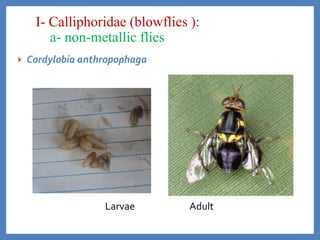
I- Calliphoridae (blowflies ):
a- non-metallic flies
 Cordylobia anthropophaga
Larvae Adult
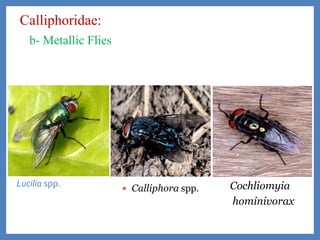
Calliphoridae:
b- Metallic Flies
Lucilia spp. Cochliomyia
hominivorax
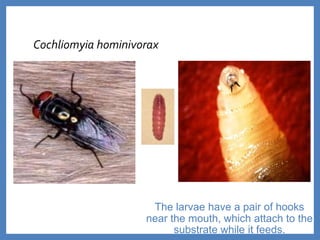
Cochliomyia hominivorax
The larvae have a pair of hooks
near the mouth, which attach to the
substrate while it feeds.
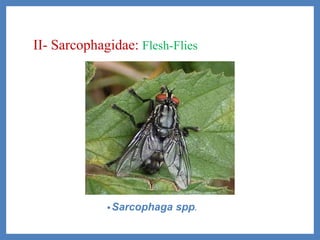
II- Sarcophagidae: Flesh-Flies
•Sarcophaga spp.
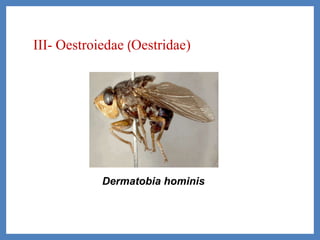
III- Oestroiedae (Oestridae)
Dermatobia hominis
Medical importance:
 Myiasis often results in considerable damage and
disfigurement, especially if face is attacked.
 When maggots invade nose, mouth, eyes they can
cause severe pain. They may eat their way through
the palate.
 Offensive discharges and ulcerations.
 Treatment should be immediate!
CLASSIFICATION OF MYIASIS
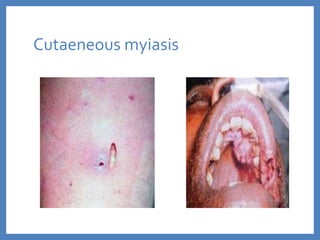
1. Cutaeneous
2. Intestinal
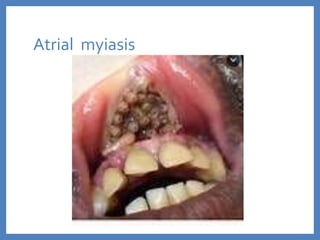
3. Atrial
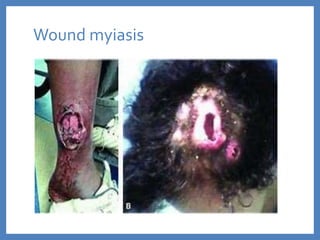
4. Wound
Cutaeneous myiasis
Intestinal myiasis
Atrial myiasis
Wound myiasis
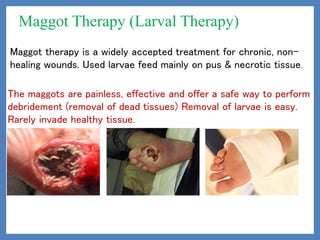
Maggot Therapy (Larval Therapy)
The maggots are painless, effective and offer a safe way to perform
debridement (removal of dead tissues) Removal of larvae is easy.
Rarely invade healthy tissue.
Maggot therapy is a widely accepted treatment for chronic, non-
healing wounds. Used larvae feed mainly on pus & necrotic tissue.
Mechanism of Action
•The larvae feed on dead tissue and cellular debris found in
necrotic wounds, secrete proteolytic enzymes that liquefy the
necrotic tissue, which, in turn, the larvae absorb and ingest.
• The maggots also assist in killing bacteria through a number of
mechanisms including bacteriocidal byproducts of the larval gut,
and chemical secretions that change the pH of the wound bed. .
So, useful in the treatment of severely infected wounds, for
extremely debilitated or severely diabetic patients or who may
not be candidates for surgical debridement procedures.
• Some suggested that myiasis directly stimulates granulation
tissue through physical stimulation or chemical mediators.
THANK YOU

MYIASIS AND MAGGOT THERAPY.ppt

  • 1.
  • 2.
    Myiasis Definition:  The invasionof organs and tissues of humans or other vertebrate animals with larvae of dipterous flies, which for a period, feed upon the living or dead tissue.  So, Myiasis is a medical term for infestation with the larvae (maggots) of a dipterous fly
  • 3.
    Types of myiasis: •Accidental Eggor larvae reach human food or drink accidentally • Insects in the family Muscidae •Facultative Necrobiots but can feed on living tissue • Maggot therapy • Maggots free-living, attack carcasses, may attack living host. •Obligatory • Maggots live on a live host for part of their life.(obligatory sarcobiots)
  • 4.
    The main fliesthat cause myiasis in humans and livestock belong to three main families: - Calliphoridae (blowflies) - Sarcophagidae (fleshflies) - Oestridae (botflies) Common Causes of Myiasis
  • 5.
    I- Calliphoridae (blowflies): a- non-metallic flies  Cordylobia anthropophaga Larvae Adult
  • 6.
    Calliphoridae: b- Metallic Flies Luciliaspp. Cochliomyia hominivorax
  • 7.
    Cochliomyia hominivorax The larvaehave a pair of hooks near the mouth, which attach to the substrate while it feeds.
  • 8.
  • 9.
  • 10.
    Medical importance:  Myiasisoften results in considerable damage and disfigurement, especially if face is attacked.  When maggots invade nose, mouth, eyes they can cause severe pain. They may eat their way through the palate.  Offensive discharges and ulcerations.  Treatment should be immediate!
  • 12.
    CLASSIFICATION OF MYIASIS 1.Cutaeneous 2. Intestinal 3. Atrial 4. Wound
  • 13.
  • 14.
  • 15.
  • 16.
  • 17.
    Maggot Therapy (LarvalTherapy) The maggots are painless, effective and offer a safe way to perform debridement (removal of dead tissues) Removal of larvae is easy. Rarely invade healthy tissue. Maggot therapy is a widely accepted treatment for chronic, non- healing wounds. Used larvae feed mainly on pus & necrotic tissue.
  • 18.
    Mechanism of Action •Thelarvae feed on dead tissue and cellular debris found in necrotic wounds, secrete proteolytic enzymes that liquefy the necrotic tissue, which, in turn, the larvae absorb and ingest. • The maggots also assist in killing bacteria through a number of mechanisms including bacteriocidal byproducts of the larval gut, and chemical secretions that change the pH of the wound bed. . So, useful in the treatment of severely infected wounds, for extremely debilitated or severely diabetic patients or who may not be candidates for surgical debridement procedures. • Some suggested that myiasis directly stimulates granulation tissue through physical stimulation or chemical mediators.
  • 19.