BY: - DR. MUSADDIKA SHAIKH
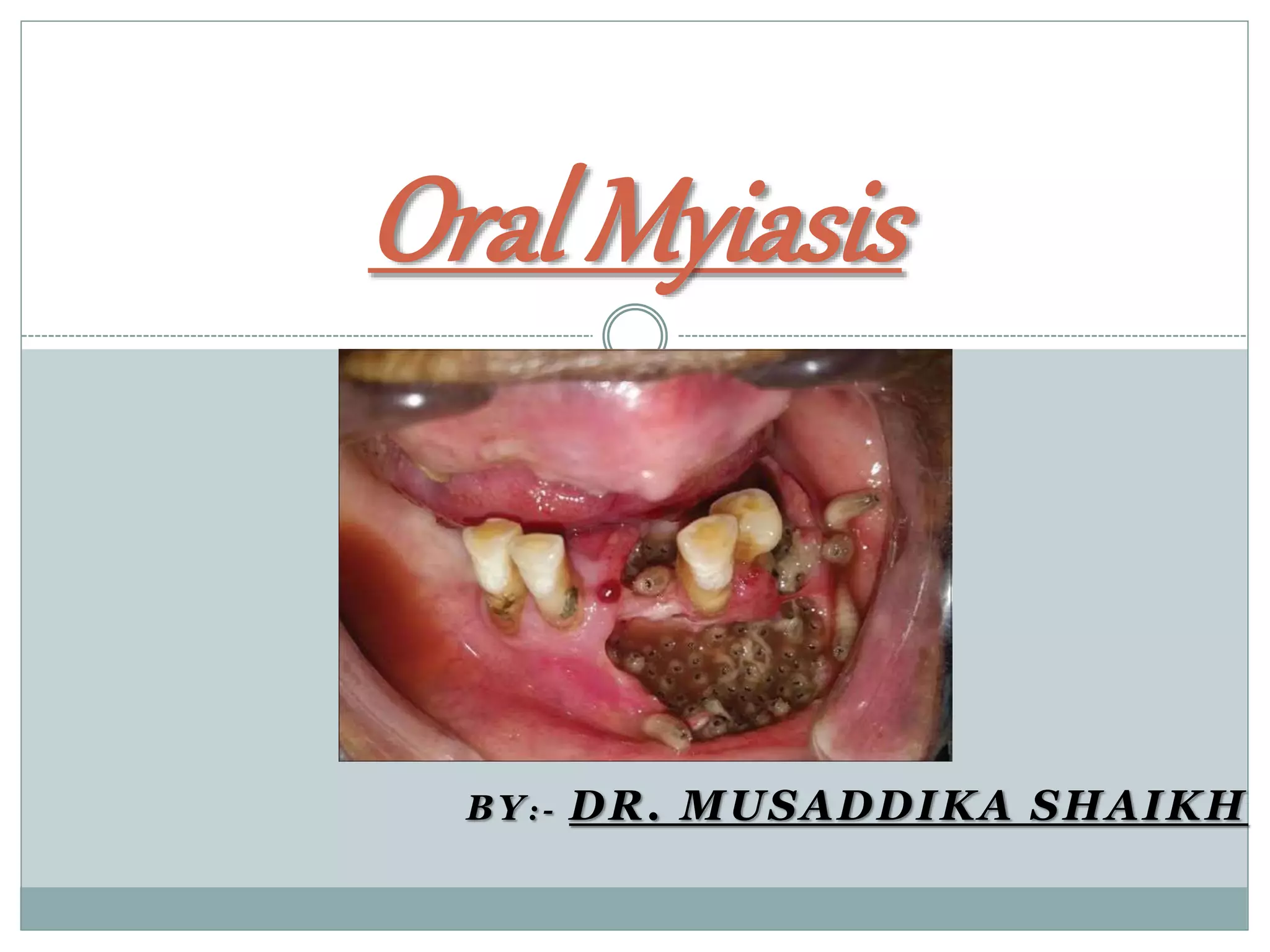
Oral Myiasis
Topics
Introduction
What is Myaisis
Classification of Myiasis
Etiology
Sign and symptoms
Diagnosis
Prevention
Treatment
INTRODUCTION
Oral Myiasis is rare pathology
associated with poor oral hygiene,
alcoholism, senility, suppurating
lession and severe halitosis
It arises from invasion of body
tissues or cavities of maggots or
larve of flies
What is myiasis?
Myiasis is parasictic infectation by fly larve which is
also known as maggots
Myiasis is greek word “Myia” meaning invasion of
vital tissues of body
They grow inside host while feeding on it’s on tissue
Although flies are attracted to open wound, urine,
feaces, but some species like myiatic fliescan create
infestation in broken skin
Most common myiatic flies are botfly, blowfly,
screwfly
Classification of Myiasis
A] Clinical classification:-
i) Primary Myiasis – when larvae feed on living tissue
ii) Secondary Myiasis – when larvae feed on dead tissue
B] Depending on condition of invoved tissue:-
i)Accidental Myiasis – when larve get ingested along with food
ii)Semi-specific Myiasis – when larvae are laid on necrotic tissue of wound
iii)Obligatory – required living tissue for larvae development
iv)Facultative – required necrotic tissue for flies to lay eggs and incubate them
C]Based on Anatomic sites:-
i)Cutaneous Myiasis
ii)Myaisis of External Orifies
iii)Myaisis of Iternal Organs
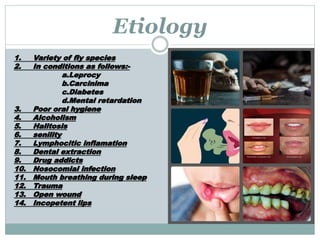
Etiology
1. Variety of fly species
2. In conditions as follows:-
a.Leprocy
b.Carcinima
c.Diabetes
d.Mental retardation
3. Poor oral hygiene
4. Alcoholism
5. Halitosis
6. senility
7. Lymphocitic inflamation
8. Dental extraction
9. Drug addicts
10. Nosocomial infection
11. Mouth breathing during sleep
12. Trauma
13. Open wound
14. Incopetent lips
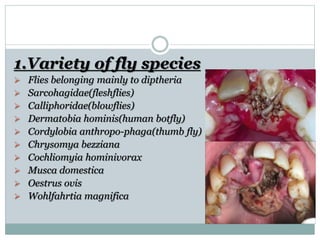
1.Variety of fly species
 Flies belonging mainly to diptheria
 Sarcohagidae(fleshflies)
 Calliphoridae(blowflies)
 Dermatobia hominis(human botfly)
 Cordylobia anthropo-phaga(thumb fly)
 Chrysomya bezziana
 Cochliomyia hominivorax
 Musca domestica
 Oestrus ovis
 Wohlfahrtia magnifica
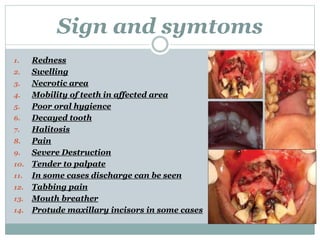
Sign and symtoms
1. Redness
2. Swelling
3. Necrotic area
4. Mobility of teeth in affected area
5. Poor oral hygience
6. Decayed tooth
7. Halitosis
8. Pain
9. Severe Destruction
10. Tender to palpate
11. In some cases discharge can be seen
12. Tabbing pain
13. Mouth breather
14. Protude maxillary incisors in some cases
Diagnosis
A] Clinical Examination :-
1. Poor oral hygiene
2. Redness
3. Swelling
4. Tissue destruction
5. Maggots in affected area
6. Trauma
7. Open lips
8. Difficulty in breathing
9. Tender to palpate
B]Radiographic Investigation :-
1. Orthopantamogram (OPG)
2. Tomography scan
3. Water’s Veiw
4. Intraoral Periapical
C] Haematological Investigation :-
1. Total White Blood Cells(WBC) Count
2. Total Red Blood Cells(RBC) Count
3. Platelet Count
4. Haemoglobin Concentration(HB)
D] Entomological Investigation :-
It is process of collecting evidence based on insect
It is done after removal of Maggots from oral cavity
Prevention
1. Good Sanitation
2. Personal Hygiene and Cleanliness
3. Environmental Hygiene Cleanliness
4. Proper Brushing of teeth and tongue twice a day
5. Proper flossing of teeth
6. Use of Mouth-wash
7. Avoid Alcohol
8. Avoid use of Drugs
9. Treatment of incompetent lips (Myofuctional
Thearapy)
10. Special appliance for mouth breathing habit
11. Proper treatment of Open Wounds,Trauma
Treatment
A] Procedure for removing Maggots :-
B] Removal of necrotic tissue
C] Repair of tissues or any fracture
D] Medications
E] Instructions
A] Procedure of Removal of Maggots :-
 Patient is given General Anesthesia
 Cotton bud is dipped in Turpentine Oil and is
applied to Lacerated mucosa for 10-12 min
 Maggots are removed with help of blunt tweezer
and curved forceps
 Entomological Investigation is done
B] Removal of dead tissues :-
 Surgical Removal of Necrotic Tissues is done
 Then area is irrigated with saline,Hydrgen
peroxide, and betadine with metronidazole
 After debridement repair can be done
C] Repair of Tissues or any Fracture :-
 First Patient is planned for open reduction
 Then internal Fixation is done
 Repair is done
 Patient is on medication for 5 days
D] Medications :-
 Patient is put on the following tablets
1. Ivermectin 6mg OD for 5 days
2. Doxycycline(Antibiotic) 100mg BD for
5 days
3. Metronidazole 100 ml 8h given for 5
days
E] Instructions :-
 Patient is advised to maintain proper oral hygiene
 Rinse wound with 0.2% Chlorhexidine mouthwash 3-5
times a day
 Patients is also advised to do oral prophalaxis
 Patientgetdischargedon4th day
 Followupappointmentis given
 Extrasuturesareremoved
 Patientis recalledperiodically
 On14th daywoundgetscompletelycleaned
Thankyou
This was info about Oral Myaisis. If you want more
information related to Dental or Medical
Then you can follow us on
Instagram – smile_angel48
Wordpress - thesmileangel48.wordpress.com

Oral Myiasis

  • 1.
    BY: - DR.MUSADDIKA SHAIKH Oral Myiasis
  • 2.
    Topics Introduction What is Myaisis Classificationof Myiasis Etiology Sign and symptoms Diagnosis Prevention Treatment
  • 3.
    INTRODUCTION Oral Myiasis israre pathology associated with poor oral hygiene, alcoholism, senility, suppurating lession and severe halitosis It arises from invasion of body tissues or cavities of maggots or larve of flies
  • 4.
    What is myiasis? Myiasisis parasictic infectation by fly larve which is also known as maggots Myiasis is greek word “Myia” meaning invasion of vital tissues of body They grow inside host while feeding on it’s on tissue Although flies are attracted to open wound, urine, feaces, but some species like myiatic fliescan create infestation in broken skin Most common myiatic flies are botfly, blowfly, screwfly
  • 5.
    Classification of Myiasis A]Clinical classification:- i) Primary Myiasis – when larvae feed on living tissue ii) Secondary Myiasis – when larvae feed on dead tissue B] Depending on condition of invoved tissue:- i)Accidental Myiasis – when larve get ingested along with food ii)Semi-specific Myiasis – when larvae are laid on necrotic tissue of wound iii)Obligatory – required living tissue for larvae development iv)Facultative – required necrotic tissue for flies to lay eggs and incubate them C]Based on Anatomic sites:- i)Cutaneous Myiasis ii)Myaisis of External Orifies iii)Myaisis of Iternal Organs
  • 6.
    Etiology 1. Variety offly species 2. In conditions as follows:- a.Leprocy b.Carcinima c.Diabetes d.Mental retardation 3. Poor oral hygiene 4. Alcoholism 5. Halitosis 6. senility 7. Lymphocitic inflamation 8. Dental extraction 9. Drug addicts 10. Nosocomial infection 11. Mouth breathing during sleep 12. Trauma 13. Open wound 14. Incopetent lips
  • 7.
    1.Variety of flyspecies  Flies belonging mainly to diptheria  Sarcohagidae(fleshflies)  Calliphoridae(blowflies)  Dermatobia hominis(human botfly)  Cordylobia anthropo-phaga(thumb fly)  Chrysomya bezziana  Cochliomyia hominivorax  Musca domestica  Oestrus ovis  Wohlfahrtia magnifica
  • 8.
    Sign and symtoms 1.Redness 2. Swelling 3. Necrotic area 4. Mobility of teeth in affected area 5. Poor oral hygience 6. Decayed tooth 7. Halitosis 8. Pain 9. Severe Destruction 10. Tender to palpate 11. In some cases discharge can be seen 12. Tabbing pain 13. Mouth breather 14. Protude maxillary incisors in some cases
  • 9.
    Diagnosis A] Clinical Examination:- 1. Poor oral hygiene 2. Redness 3. Swelling 4. Tissue destruction 5. Maggots in affected area 6. Trauma 7. Open lips 8. Difficulty in breathing 9. Tender to palpate
  • 10.
    B]Radiographic Investigation :- 1.Orthopantamogram (OPG) 2. Tomography scan 3. Water’s Veiw 4. Intraoral Periapical
  • 11.
    C] Haematological Investigation:- 1. Total White Blood Cells(WBC) Count 2. Total Red Blood Cells(RBC) Count 3. Platelet Count 4. Haemoglobin Concentration(HB) D] Entomological Investigation :- It is process of collecting evidence based on insect It is done after removal of Maggots from oral cavity
  • 12.
    Prevention 1. Good Sanitation 2.Personal Hygiene and Cleanliness 3. Environmental Hygiene Cleanliness 4. Proper Brushing of teeth and tongue twice a day 5. Proper flossing of teeth 6. Use of Mouth-wash 7. Avoid Alcohol 8. Avoid use of Drugs 9. Treatment of incompetent lips (Myofuctional Thearapy) 10. Special appliance for mouth breathing habit 11. Proper treatment of Open Wounds,Trauma
  • 13.
    Treatment A] Procedure forremoving Maggots :- B] Removal of necrotic tissue C] Repair of tissues or any fracture D] Medications E] Instructions
  • 14.
    A] Procedure ofRemoval of Maggots :-  Patient is given General Anesthesia  Cotton bud is dipped in Turpentine Oil and is applied to Lacerated mucosa for 10-12 min  Maggots are removed with help of blunt tweezer and curved forceps  Entomological Investigation is done
  • 15.
    B] Removal ofdead tissues :-  Surgical Removal of Necrotic Tissues is done  Then area is irrigated with saline,Hydrgen peroxide, and betadine with metronidazole  After debridement repair can be done
  • 16.
    C] Repair ofTissues or any Fracture :-  First Patient is planned for open reduction  Then internal Fixation is done  Repair is done  Patient is on medication for 5 days
  • 17.
    D] Medications :- Patient is put on the following tablets 1. Ivermectin 6mg OD for 5 days 2. Doxycycline(Antibiotic) 100mg BD for 5 days 3. Metronidazole 100 ml 8h given for 5 days
  • 18.
    E] Instructions :- Patient is advised to maintain proper oral hygiene  Rinse wound with 0.2% Chlorhexidine mouthwash 3-5 times a day  Patients is also advised to do oral prophalaxis  Patientgetdischargedon4th day  Followupappointmentis given  Extrasuturesareremoved  Patientis recalledperiodically  On14th daywoundgetscompletelycleaned
  • 19.
    Thankyou This was infoabout Oral Myaisis. If you want more information related to Dental or Medical Then you can follow us on Instagram – smile_angel48 Wordpress - thesmileangel48.wordpress.com