Smut of Barley
Content
• Pathogen
• Systematic position Distribution
• Distribution
• Symptoms
• The pathogen
• Disease cycle
• Control measures
Pathogen
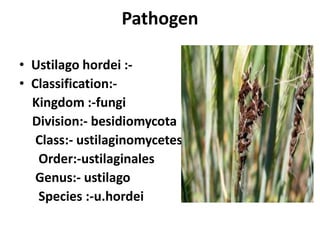
• Ustilago hordei :-
• Classification:-
Kingdom :-fungi
Division:- besidiomycota
Class:- ustilaginomycetes
Order:-ustilaginales
Genus:- ustilago
Species :-u.hordei
Symptoms
uInfected plant do not demonstrate symptoms
until heading .
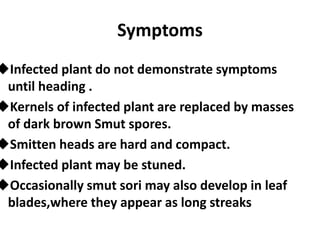
uKernels of infected plant are replaced by masses
of dark brown Smut spores.
uSmitten heads are hard and compact.
uInfected plant may be stuned.
uOccasionally smut sori may also develop in leaf
blades,where they appear as long streaks
The pathogen
lThe covered smut barley is caused by
ustilago hordei langerheim
lThe smut spores are rounded to ellipsodial
brown,smooth and upto 9 u in diameter.
lIn mass,the spores appear black, but actually
they are brown in colour
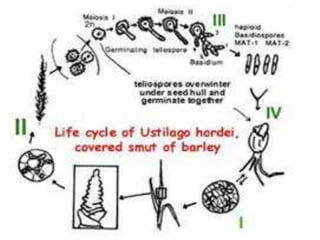
lEvery smut spore produces a promycelium or
besidium
lThe diploid nucleus of smut spore divides
meiotically forming four haploid nuclei
lThe besidium becomes septate and besidio
spores or sporidia are produced on the four
cells of besidium in chains.
lFrom two cells of the besidium ,the besidio
spores of + strain ,and from other two cells
,the basediospores of - strain develop.
lEvery sporedium ordes is uninucleate and
single called,which produces secondary
sporidia by means of budding.
lThe two sporodia of opposide strains fuse
together,and a dikeryotic hypha is resulted.
lNow dikeryotic hypha enters the coleoptile
,and develops upwards in the seedling.
l The mycellium develops first in the stem and
on emergnce of ears,it becomes most active in
floral parts.
l The mycellium within the floral parts
becomes closely septate and thus the smut
spores are formed.
Disease cycle
• This is an externally seed- borne and
systematic disease.
• Every year the recurrence of disease takes
place by the contaminated seeds.
• The mycellium develops from the very
beginning ,along with the coleoptile and
ultimately reaches the ear.
• During threshing the smut spores are
released and they make seeds contaminated
again.
Control measures
• Rogueing :- The infected plants may be
uprooted and burnt
• Seed selection :-seed must be taken from
healthy crop
• Seed treatment :- the infected seeds may be
treated with organomercuric compound
such. as agrosan GN,and ceresan.
• About five KG. Of seeds may be treated with
10 gms .of seed disinfectant for about fifteen
minutes.
• Resistant verieties :- the resistant verieties
should be grown.
• Some resistant verieties have been evovaled.
• They are k-12,C.N.294,C 84

smut of barley

  • 1.
  • 2.
    Content • Pathogen • Systematicposition Distribution • Distribution • Symptoms • The pathogen • Disease cycle • Control measures
  • 3.
    Pathogen • Ustilago hordei:- • Classification:- Kingdom :-fungi Division:- besidiomycota Class:- ustilaginomycetes Order:-ustilaginales Genus:- ustilago Species :-u.hordei
  • 4.
    Symptoms uInfected plant donot demonstrate symptoms until heading . uKernels of infected plant are replaced by masses of dark brown Smut spores. uSmitten heads are hard and compact. uInfected plant may be stuned. uOccasionally smut sori may also develop in leaf blades,where they appear as long streaks
  • 5.
    The pathogen lThe coveredsmut barley is caused by ustilago hordei langerheim lThe smut spores are rounded to ellipsodial brown,smooth and upto 9 u in diameter. lIn mass,the spores appear black, but actually they are brown in colour lEvery smut spore produces a promycelium or besidium lThe diploid nucleus of smut spore divides meiotically forming four haploid nuclei
  • 6.
    lThe besidium becomesseptate and besidio spores or sporidia are produced on the four cells of besidium in chains. lFrom two cells of the besidium ,the besidio spores of + strain ,and from other two cells ,the basediospores of - strain develop. lEvery sporedium ordes is uninucleate and single called,which produces secondary sporidia by means of budding. lThe two sporodia of opposide strains fuse together,and a dikeryotic hypha is resulted.
  • 7.
    lNow dikeryotic hyphaenters the coleoptile ,and develops upwards in the seedling. l The mycellium develops first in the stem and on emergnce of ears,it becomes most active in floral parts. l The mycellium within the floral parts becomes closely septate and thus the smut spores are formed.
  • 9.
    Disease cycle • Thisis an externally seed- borne and systematic disease. • Every year the recurrence of disease takes place by the contaminated seeds. • The mycellium develops from the very beginning ,along with the coleoptile and ultimately reaches the ear. • During threshing the smut spores are released and they make seeds contaminated again.
  • 10.
    Control measures • Rogueing:- The infected plants may be uprooted and burnt • Seed selection :-seed must be taken from healthy crop • Seed treatment :- the infected seeds may be treated with organomercuric compound such. as agrosan GN,and ceresan. • About five KG. Of seeds may be treated with 10 gms .of seed disinfectant for about fifteen minutes.
  • 11.
    • Resistant verieties:- the resistant verieties should be grown. • Some resistant verieties have been evovaled. • They are k-12,C.N.294,C 84