DHANUKA AGRI ACADEMY
AN INSITITUTE FOR
AGRICULTURE EXAM
PREPARATIOMaintenance Breeding: Frequently
Asked Questions | Branches | Plant
Breeding
Presentation
BY-Dhanendra dhanuka
Q.1. What is maintenance breeding?
2ADD A FOOTER
Ans. A branch/area of plant breeding which deals with principles and
methods of breeder seed production is referred to as maintenance
breeding. In other words, it deals with ways and means of maintaining
genetic and physical purity-of released and notified varieties and
parents of hybrid. It is also referred to as varietal maintenance
technology.
Q.2. What are main
features of
maintenance
breeding?
Ans. Thus main points related to
maintenance breeding are listed
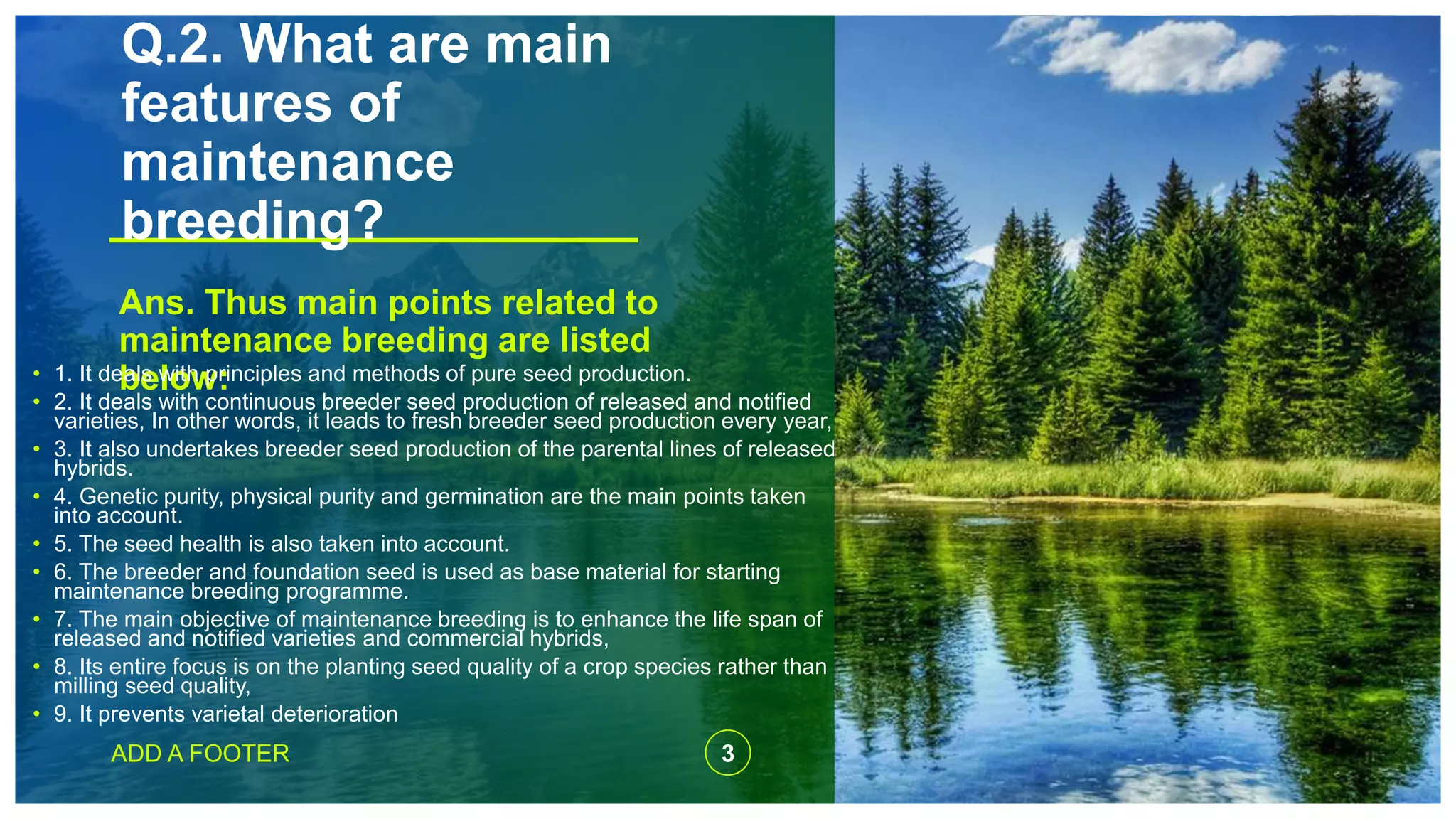
below:• 1. It deals with principles and methods of pure seed production.
• 2. It deals with continuous breeder seed production of released and notified
varieties, In other words, it leads to fresh breeder seed production every year,
• 3. It also undertakes breeder seed production of the parental lines of released
hybrids.
• 4. Genetic purity, physical purity and germination are the main points taken
into account.
• 5. The seed health is also taken into account.
• 6. The breeder and foundation seed is used as base material for starting
maintenance breeding programme.
• 7. The main objective of maintenance breeding is to enhance the life span of
released and notified varieties and commercial hybrids,
• 8. Its entire focus is on the planting seed quality of a crop species rather than
milling seed quality,
• 9. It prevents varietal deterioration
ADD A FOOTER 3
Q.3. What are genetic causes
of varietal deterioration?
(i) Cross pollination,
(ii) Mutations,
(iii) Residual variability, and
(iv) Adaptive changes.
• These are briefly discussed below:
• (i) Natural cross pollination or outcrossing with other
genotypes leads to genetic deterioration of a variety
in subsequent cycles of seed multiplication.
• (ii) Spontaneous mutations after crossing with the
original variety lead to its deterioration in subsequent
years.
• (iii) Sometimes residual variability remains in a
variety at the time of its release. Such variability
leads to deterioration of a variety in few years,
ADD A FOOTER 4
Q.4. What are non-
genetic causes of
varietal deterioration?
5ADD A FOOTER
Ans. Non-genetic causes of varietal
deterioration include:
•(i) Mechanical mixture,
•ii) Disease infestation,
and
•(iii) Adverse agroclimatic
conditions.
These are briefly
discussed below:
6ADD A FOOTER
i) Mixing of different varieties may take place during thrashing,
ginning, sowing with seed drills. Planting of such mixed seed
leads to varietal deterioration due to multiplication and natural
outcrossing.
(ii) Development of new virulent races of a pathogen may lead to
deterioration of a variety. The variety may become susceptible to
such races and deteriorate.
(iii) Adverse agro-climatic conditions such as flood, drought, soil
salinity etc. may lead to deterioration of a variety.
Q.5. What are
important
activities of plant
breeding?
7ADD A FOOTER
Ans. Plant breeding has three important activities, viz.:
(i) Varietal development,
(ii) Seed multiplication, and
(iii) Varietal maintenance.
8ADD A FOOTER
These are defined below:
(i) Varietal Development:
It makes use of various plant breeding methods
(selection, hybridization, mutation and genetic
engineering) to develop new plant varieties.
(ii) Seed Multiplication:
It deals with multiplication/production of successive
generations of various categories of seeds such as
nucleus seed, breeder seed, foundation seed,
registered seed and certified seed. The seed
multiplication/increase is regulated by seed
certification agencies and breeders.
(iii) Varietal Maintenance:
It deals with continuous fresh supply (annually) of
breeder seed which used to start another cycle of
seed multiplication. It makes use of various
selection/maintenance procedures.
Q.6. What are
types of
maintenance
procedures?
9ADD A FOOTER
Ans. Maintenance procedures are of
two types, viz.:
(i) Selection procedures and
(ii) Non-selection procedure.
The second approach deals with
maintenance of breeder seed in cold
storage.
Merits and
demerits of these
methods are given
below:
10ADD A FOOTER
1. Selection Procedures:
(i) It involves continuous extensive field testing.
(ii) The material is exposed to outcrossing, spontaneous
mutations and change in gene frequencies.
2. Storage Methods:
(i) Field testing is not required.
(ii) The seed material is not exposed to outcrossing, mutations,
diseases, insects, mechanical mixtures, change in gene frequency
caused due to
natural selection and selection exerted by breeders.
11ADD A FOOTER
Merits and demerits of these methods
are given below:
Section 1 Title
• Lorem ipsum dolor sit amet, consectetuer adipiscing elit. Maecenas porttitor congue massa. Fusce posuere, magna
sed pulvinar ultricies, purus lectus malesuada libero
• Nunc viverra imperdiet enim. Fusce est. Vivamus a tellus.
• Pellentesque habitant morbi tristique senectus et netus et malesuada fames ac turpis egestas. Proin pharetra
nonummy pede. Mauris et orci.
ADD A FOOTER 12
CHART SLIDE
Lorem ipsum dolor sit amet,
consectetuer adipiscing elit.
Maecenas porttitor congue
massa. Fusce posuere
$0
$10,000
$20,000
$30,000
$40,000
$50,000
20XX 20XX 20XX 20XX 20XX
ADD A FOOTER 13
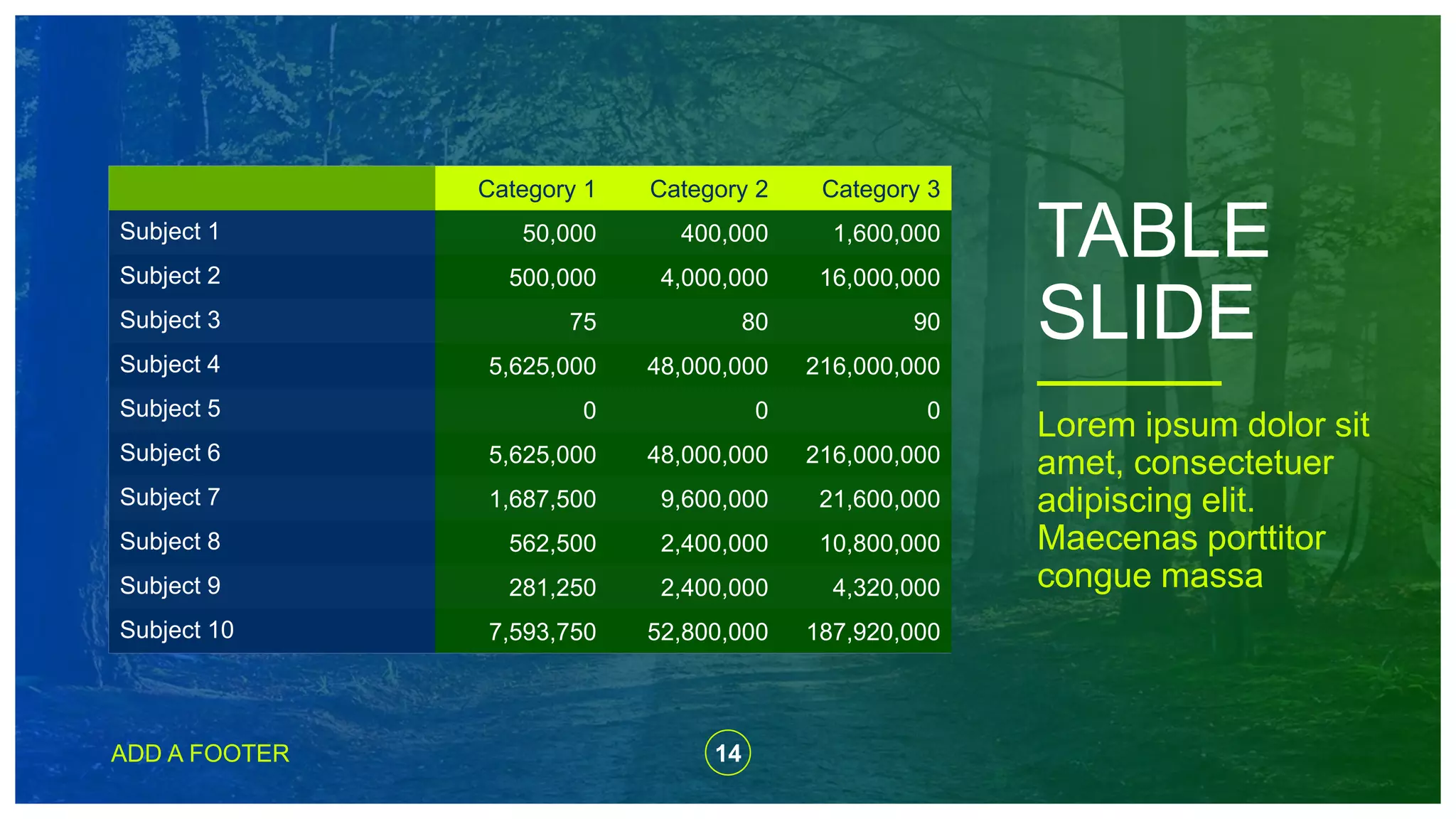
Category 1 Category 2 Category 3
Subject 1 50,000 400,000 1,600,000
Subject 2 500,000 4,000,000 16,000,000
Subject 3 75 80 90
Subject 4 5,625,000 48,000,000 216,000,000
Subject 5 0 0 0
Subject 6 5,625,000 48,000,000 216,000,000
Subject 7 1,687,500 9,600,000 21,600,000
Subject 8 562,500 2,400,000 10,800,000
Subject 9 281,250 2,400,000 4,320,000
Subject 10 7,593,750 52,800,000 187,920,000
TABLE
SLIDE
Lorem ipsum dolor sit
amet, consectetuer
adipiscing elit.
Maecenas porttitor
congue massa
ADD A FOOTER 14
BIG IMAGE SLIDE
Lorem ipsum dolor sit amet, consectetuer adipiscing elit
ADD A FOOTER 15
VIDEO SLIDE
ADD A FOOTER 16
THANK YOU!
Alexander Martensson
Phone
678-555-0143
Email
martensson@example.com
Customize this Template
Template Editing
Instructions and
Feedback
ADD A FOOTER 18

Mentannace breeding by Dhanendra Dhanuka

  • 1.
    DHANUKA AGRI ACADEMY ANINSITITUTE FOR AGRICULTURE EXAM PREPARATIOMaintenance Breeding: Frequently Asked Questions | Branches | Plant Breeding Presentation BY-Dhanendra dhanuka
  • 2.
    Q.1. What ismaintenance breeding? 2ADD A FOOTER Ans. A branch/area of plant breeding which deals with principles and methods of breeder seed production is referred to as maintenance breeding. In other words, it deals with ways and means of maintaining genetic and physical purity-of released and notified varieties and parents of hybrid. It is also referred to as varietal maintenance technology.
  • 3.
    Q.2. What aremain features of maintenance breeding? Ans. Thus main points related to maintenance breeding are listed below:• 1. It deals with principles and methods of pure seed production. • 2. It deals with continuous breeder seed production of released and notified varieties, In other words, it leads to fresh breeder seed production every year, • 3. It also undertakes breeder seed production of the parental lines of released hybrids. • 4. Genetic purity, physical purity and germination are the main points taken into account. • 5. The seed health is also taken into account. • 6. The breeder and foundation seed is used as base material for starting maintenance breeding programme. • 7. The main objective of maintenance breeding is to enhance the life span of released and notified varieties and commercial hybrids, • 8. Its entire focus is on the planting seed quality of a crop species rather than milling seed quality, • 9. It prevents varietal deterioration ADD A FOOTER 3
  • 4.
    Q.3. What aregenetic causes of varietal deterioration? (i) Cross pollination, (ii) Mutations, (iii) Residual variability, and (iv) Adaptive changes. • These are briefly discussed below: • (i) Natural cross pollination or outcrossing with other genotypes leads to genetic deterioration of a variety in subsequent cycles of seed multiplication. • (ii) Spontaneous mutations after crossing with the original variety lead to its deterioration in subsequent years. • (iii) Sometimes residual variability remains in a variety at the time of its release. Such variability leads to deterioration of a variety in few years, ADD A FOOTER 4
  • 5.
    Q.4. What arenon- genetic causes of varietal deterioration? 5ADD A FOOTER Ans. Non-genetic causes of varietal deterioration include: •(i) Mechanical mixture, •ii) Disease infestation, and •(iii) Adverse agroclimatic conditions.
  • 6.
    These are briefly discussedbelow: 6ADD A FOOTER i) Mixing of different varieties may take place during thrashing, ginning, sowing with seed drills. Planting of such mixed seed leads to varietal deterioration due to multiplication and natural outcrossing. (ii) Development of new virulent races of a pathogen may lead to deterioration of a variety. The variety may become susceptible to such races and deteriorate. (iii) Adverse agro-climatic conditions such as flood, drought, soil salinity etc. may lead to deterioration of a variety.
  • 7.
    Q.5. What are important activitiesof plant breeding? 7ADD A FOOTER Ans. Plant breeding has three important activities, viz.: (i) Varietal development, (ii) Seed multiplication, and (iii) Varietal maintenance.
  • 8.
    8ADD A FOOTER Theseare defined below: (i) Varietal Development: It makes use of various plant breeding methods (selection, hybridization, mutation and genetic engineering) to develop new plant varieties. (ii) Seed Multiplication: It deals with multiplication/production of successive generations of various categories of seeds such as nucleus seed, breeder seed, foundation seed, registered seed and certified seed. The seed multiplication/increase is regulated by seed certification agencies and breeders. (iii) Varietal Maintenance: It deals with continuous fresh supply (annually) of breeder seed which used to start another cycle of seed multiplication. It makes use of various selection/maintenance procedures.
  • 9.
    Q.6. What are typesof maintenance procedures? 9ADD A FOOTER Ans. Maintenance procedures are of two types, viz.: (i) Selection procedures and (ii) Non-selection procedure. The second approach deals with maintenance of breeder seed in cold storage.
  • 10.
    Merits and demerits ofthese methods are given below: 10ADD A FOOTER 1. Selection Procedures: (i) It involves continuous extensive field testing. (ii) The material is exposed to outcrossing, spontaneous mutations and change in gene frequencies. 2. Storage Methods: (i) Field testing is not required. (ii) The seed material is not exposed to outcrossing, mutations, diseases, insects, mechanical mixtures, change in gene frequency caused due to natural selection and selection exerted by breeders.
  • 11.
  • 12.
    Merits and demeritsof these methods are given below: Section 1 Title • Lorem ipsum dolor sit amet, consectetuer adipiscing elit. Maecenas porttitor congue massa. Fusce posuere, magna sed pulvinar ultricies, purus lectus malesuada libero • Nunc viverra imperdiet enim. Fusce est. Vivamus a tellus. • Pellentesque habitant morbi tristique senectus et netus et malesuada fames ac turpis egestas. Proin pharetra nonummy pede. Mauris et orci. ADD A FOOTER 12
  • 13.
    CHART SLIDE Lorem ipsumdolor sit amet, consectetuer adipiscing elit. Maecenas porttitor congue massa. Fusce posuere $0 $10,000 $20,000 $30,000 $40,000 $50,000 20XX 20XX 20XX 20XX 20XX ADD A FOOTER 13
  • 14.
    Category 1 Category2 Category 3 Subject 1 50,000 400,000 1,600,000 Subject 2 500,000 4,000,000 16,000,000 Subject 3 75 80 90 Subject 4 5,625,000 48,000,000 216,000,000 Subject 5 0 0 0 Subject 6 5,625,000 48,000,000 216,000,000 Subject 7 1,687,500 9,600,000 21,600,000 Subject 8 562,500 2,400,000 10,800,000 Subject 9 281,250 2,400,000 4,320,000 Subject 10 7,593,750 52,800,000 187,920,000 TABLE SLIDE Lorem ipsum dolor sit amet, consectetuer adipiscing elit. Maecenas porttitor congue massa ADD A FOOTER 14
  • 15.
    BIG IMAGE SLIDE Loremipsum dolor sit amet, consectetuer adipiscing elit ADD A FOOTER 15
  • 16.
  • 17.
  • 18.
    Customize this Template TemplateEditing Instructions and Feedback ADD A FOOTER 18