DESIGN THINKING
Prepared By
Mrs. C. Ranganayaki, MBA, SLET, MPhil
Assistant Professor,
Sri Ramakrishna College of Arts & Science
Nava India, Coimbatore
DESIGN THINKING
The process of:
Redefining problems,
Understanding the challenges faced by users &
Coming up with an innovative solution
- is known as DESIGN THINKING
Leading global brands have implemented design thinking
into their processes
- it has helped them in achieving greater success
DESIGN THINKING
Companies such as Apple, Adidas, Airbnb & PepsiCo
have outperformed, all thanks to design thinking
Through the design thinking process, a business
problem is broken down into smaller aspects
Then start thinking from the base level to come up
with various solutions
Solutions are compared with each other
Depending on the situation, the most suitable solution
is selected
Design thinking thus involves understanding the
target users in an empathetic manner
Stages in DESIGN THINKING
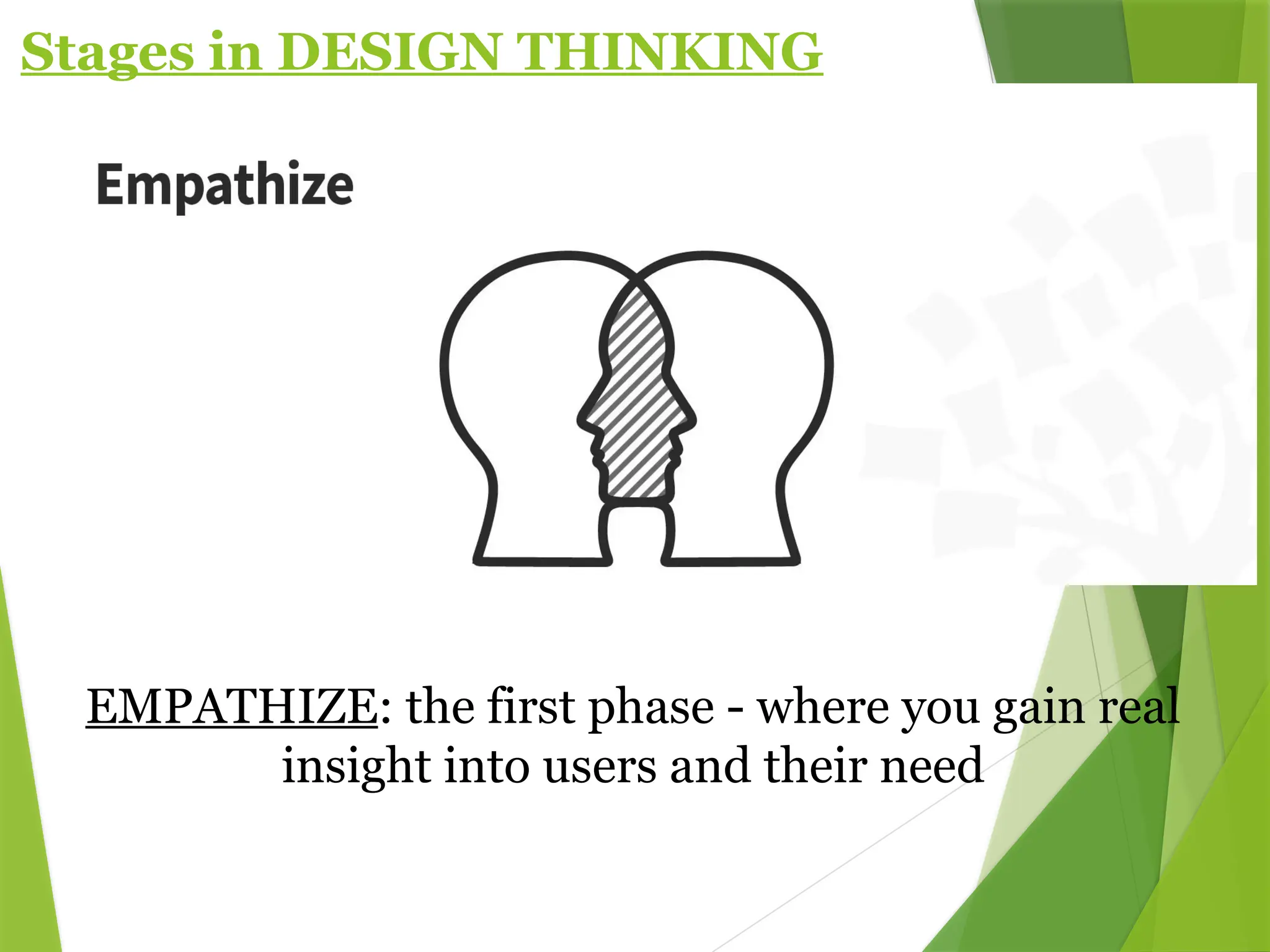
EMPATHIZE: the first phase - where you gain real
insight into users and their need
Stages in DESIGN THINKING
DEFINE: the second phase – where you define the
problem statement in a human-centered manner
Stages in DESIGN THINKING
IDEATE: the third phase – where you identify
innovative solutions to the problem statement that have
been created
Stages in DESIGN THINKING
PROTOTYPE: the fourth phase - where you identify the
best possible solution
Stages in DESIGN THINKING
TEST: the fifth and final phase - where you test
solutions to derive a deep understanding of the product
and its users
DESIGN THINKING Process
“Design is not just what it looks like and feels like.
Design is how it works” – Steve Jobs
DESIGN THINKING Methodology
Why Entrepreneurs need
- DESIGN THINKING?
Long-term strategy planning
Allows divergent thinking
Incorporate a process model
Be curious and observe
In the words of IDEO’s Founder, David Kelley, “The
main tenet of design thinking is empathy for the people
you’re trying to design for. Leadership is the same
thing — building empathy for the people that you’re
entrusted to help.”
These words are enough to describe how many people
who understand design thinking will turn into great
leaders and be able to create brilliant products
Key Principles of - DESIGN THINKING
USER CENTRICITY
COLLABORATION
IDEATION
EXPERIMENTATION
IMPLEMENTATION
Examples of - DESIGN THINKING
Airbnb
Overview: Airbnb is a multi-billion dollar online platform right now. But
went close to bankruptcy in its early days. Like many startups, they were
barely noticed by anyone at their launch. A small change in the design
thinking principle made it a multi-billion dollar business.
Challenge: Diverse listings in different categories and cities brought traffic to
their site. The company still wasn't making any revenue.
Realization: They found that there was a repeated pattern in the pictures of
their advertisements. The pictures weren't very appealing, as the owners took
them with smart phones. Moreover, not all the rooms were shown. They didn't
get many bookings because people weren't sure what they would be paying
for.
Solution: Airbnb associates traveled to New York to meet the hosts and help
them take high-quality pictures. This non-scalable and non-technical solution
doubled their revenue within a week. Airbnb continues to test ideas and
understand the needs of the people who use their platform.
Examples of - DESIGN THINKING
Uber Eats
Overview: To understand the different markets and how their products fit
into the physical conditions of various cities, UberEats constantly research the
places where their customers live, work, and eat. This is one of the best design
thinking examples that led to success.
Challenge: The problem was how to connect people to restaurants in
different cities.
Realization: UberEats realized that to serve its customers, it needed to
immerse and learn about the experiences of restaurant workers, delivery
partners, and customers. And the food culture and ecosystem of each city.
Solution: While developing UberEats, the designers constantly traveled to
different markets to interview users. From following delivery drivers to paying
a visit to local restaurant owners, they did it all. The team, based on the
insights, then ran experiments and built prototypes. They created features like
the "Most Popular Items'' category. Through research and iteration, it has
continued to transform the experience of food delivery.
Examples of - DESIGN THINKING
Oral B Electric Toothbrush
Overview: The electric toothbrush was modified to cater better to the
customers' needs. This is one of the design thinking examples that can teach
designers a lot about the process.
Challenge: The designers originally wanted to make a high-tech device that
provided in-depth data on their customer's brushing performance.
Realization: researching and interviewing the users allowed them to
discover that people were already nervous about not brushing. Therefore,
providing detailed data on their hygiene habits would increase anxiety. The
key insight was found. People were looking to make brushing less stressful.
Solution: The design team decided to make brushing simple by adding
features such as chargeable batteries and brush head replacements. This is
one of the classic design thinking examples.
Examples of - DESIGN THINKING
Netflix
Overview: Netflix is one of the prime design thinking examples. It used the
approach to determine what its customers wanted and needed and later
changed its business model to meet those needs.
Challenge: Customers were looking for more interesting content. It was
faced with competition as movies and sitcoms were easily available on other
platforms as well.
Realization: Netflix used the design thinking approach to develop new ideas.
It kept testing and experimenting. Netflix knew they needed more to lure
customers.
Solution: Netflix started giving DVD subscriptions. It was tested and
experimented on for ten years. People were made comfortable with streaming
videos. It took over the market as broadband and internet services began to
grow.
Examples of - DESIGN THINKING
Nike
Overview: Nike combined sports and design when it launched the first
sneaker with technology in it.
Challenge: The challenge NIKE faced most was how to avoid going out of
trend. Even though it had loyal customers, it knew it had to offer something
unique.
Realization: Nike kept looking for partners to gain insights from their
customers. This, in turn, inspired the company's designers. Thus Nike focuses
on the need and better service to its loyal customers.
Solution: Nike is one of the best design thinking process examples. The
designers redesigned the shoes with a transparent panel. This allowed the
wearer to show the socks they chose to wear underneath. It also developed
pressurized air technology to help athletes perform their best. Apart from
that, it quickly became a fashion statement

Design Thinking for new business Starters.pptx

  • 1.
    DESIGN THINKING Prepared By Mrs.C. Ranganayaki, MBA, SLET, MPhil Assistant Professor, Sri Ramakrishna College of Arts & Science Nava India, Coimbatore
  • 2.
    DESIGN THINKING The processof: Redefining problems, Understanding the challenges faced by users & Coming up with an innovative solution - is known as DESIGN THINKING Leading global brands have implemented design thinking into their processes - it has helped them in achieving greater success
  • 3.
    DESIGN THINKING Companies suchas Apple, Adidas, Airbnb & PepsiCo have outperformed, all thanks to design thinking Through the design thinking process, a business problem is broken down into smaller aspects Then start thinking from the base level to come up with various solutions Solutions are compared with each other Depending on the situation, the most suitable solution is selected Design thinking thus involves understanding the target users in an empathetic manner
  • 4.
    Stages in DESIGNTHINKING EMPATHIZE: the first phase - where you gain real insight into users and their need
  • 5.
    Stages in DESIGNTHINKING DEFINE: the second phase – where you define the problem statement in a human-centered manner
  • 6.
    Stages in DESIGNTHINKING IDEATE: the third phase – where you identify innovative solutions to the problem statement that have been created
  • 7.
    Stages in DESIGNTHINKING PROTOTYPE: the fourth phase - where you identify the best possible solution
  • 8.
    Stages in DESIGNTHINKING TEST: the fifth and final phase - where you test solutions to derive a deep understanding of the product and its users
  • 9.
    DESIGN THINKING Process “Designis not just what it looks like and feels like. Design is how it works” – Steve Jobs
  • 10.
  • 11.
    Why Entrepreneurs need -DESIGN THINKING? Long-term strategy planning Allows divergent thinking Incorporate a process model Be curious and observe In the words of IDEO’s Founder, David Kelley, “The main tenet of design thinking is empathy for the people you’re trying to design for. Leadership is the same thing — building empathy for the people that you’re entrusted to help.” These words are enough to describe how many people who understand design thinking will turn into great leaders and be able to create brilliant products
  • 12.
    Key Principles of- DESIGN THINKING USER CENTRICITY COLLABORATION IDEATION EXPERIMENTATION IMPLEMENTATION
  • 13.
    Examples of -DESIGN THINKING Airbnb Overview: Airbnb is a multi-billion dollar online platform right now. But went close to bankruptcy in its early days. Like many startups, they were barely noticed by anyone at their launch. A small change in the design thinking principle made it a multi-billion dollar business. Challenge: Diverse listings in different categories and cities brought traffic to their site. The company still wasn't making any revenue. Realization: They found that there was a repeated pattern in the pictures of their advertisements. The pictures weren't very appealing, as the owners took them with smart phones. Moreover, not all the rooms were shown. They didn't get many bookings because people weren't sure what they would be paying for. Solution: Airbnb associates traveled to New York to meet the hosts and help them take high-quality pictures. This non-scalable and non-technical solution doubled their revenue within a week. Airbnb continues to test ideas and understand the needs of the people who use their platform.
  • 14.
    Examples of -DESIGN THINKING Uber Eats Overview: To understand the different markets and how their products fit into the physical conditions of various cities, UberEats constantly research the places where their customers live, work, and eat. This is one of the best design thinking examples that led to success. Challenge: The problem was how to connect people to restaurants in different cities. Realization: UberEats realized that to serve its customers, it needed to immerse and learn about the experiences of restaurant workers, delivery partners, and customers. And the food culture and ecosystem of each city. Solution: While developing UberEats, the designers constantly traveled to different markets to interview users. From following delivery drivers to paying a visit to local restaurant owners, they did it all. The team, based on the insights, then ran experiments and built prototypes. They created features like the "Most Popular Items'' category. Through research and iteration, it has continued to transform the experience of food delivery.
  • 15.
    Examples of -DESIGN THINKING Oral B Electric Toothbrush Overview: The electric toothbrush was modified to cater better to the customers' needs. This is one of the design thinking examples that can teach designers a lot about the process. Challenge: The designers originally wanted to make a high-tech device that provided in-depth data on their customer's brushing performance. Realization: researching and interviewing the users allowed them to discover that people were already nervous about not brushing. Therefore, providing detailed data on their hygiene habits would increase anxiety. The key insight was found. People were looking to make brushing less stressful. Solution: The design team decided to make brushing simple by adding features such as chargeable batteries and brush head replacements. This is one of the classic design thinking examples.
  • 16.
    Examples of -DESIGN THINKING Netflix Overview: Netflix is one of the prime design thinking examples. It used the approach to determine what its customers wanted and needed and later changed its business model to meet those needs. Challenge: Customers were looking for more interesting content. It was faced with competition as movies and sitcoms were easily available on other platforms as well. Realization: Netflix used the design thinking approach to develop new ideas. It kept testing and experimenting. Netflix knew they needed more to lure customers. Solution: Netflix started giving DVD subscriptions. It was tested and experimented on for ten years. People were made comfortable with streaming videos. It took over the market as broadband and internet services began to grow.
  • 17.
    Examples of -DESIGN THINKING Nike Overview: Nike combined sports and design when it launched the first sneaker with technology in it. Challenge: The challenge NIKE faced most was how to avoid going out of trend. Even though it had loyal customers, it knew it had to offer something unique. Realization: Nike kept looking for partners to gain insights from their customers. This, in turn, inspired the company's designers. Thus Nike focuses on the need and better service to its loyal customers. Solution: Nike is one of the best design thinking process examples. The designers redesigned the shoes with a transparent panel. This allowed the wearer to show the socks they chose to wear underneath. It also developed pressurized air technology to help athletes perform their best. Apart from that, it quickly became a fashion statement