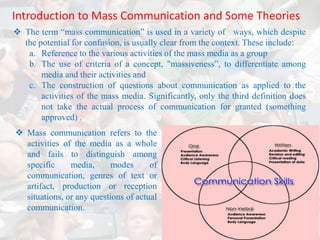
Introduction to Mass Communication and Some Theories The term “mass communication” is used in a variety of   ways, which despite the potential for confusion, is usually clear from the context. These include: Reference to the various activities of the mass media as a groupThe use of criteria of a concept, "massiveness”, to differentiate among media and their activities andThe construction of questions about communication as applied to the activities of the mass media. Significantly, only the third definition does not take the actual process of communication for granted(something approved) . Mass communication refers to the activities of the media as a whole and fails to distinguish among specific media, modes of communication, genres of text or artifact, production or reception situations, or any questions of actual communication.Theories of Mass CommunicationA theory is some form of explanation of a class of observed phenomena. Karl Popper described theory as, “the net, which we throw out in order to catch the world, to rationalize, explain and dominate it”.
The idea of a theory lies at the heart of any scholarly process, and while those in the social sciences tend to adopt the tests of a good theory from natural sciences, many who study communication adhere to an idea of theory that is akin to that found in other academic fields.
There are 6 yardsticks to evaluating theory;Theoretical scope:Appropriateness:Heuristic value:Validity:Parsimony:Openness:
In the context of social sciences, we may find different theories which may each explain a  Phenomenon in useful ways.
There is value in being able to use theories as “lenses” through which one can understand the world together with other scholars.
There are several theories Related to mass communication such as:Agenda setting theory:Cultivation theory:Cultural imperialism theory: Diffusion of innovation theory:Media dependency theory:Media equation theory:Spiral of silence theory:Technological determinism theory:Functional approach to mass communication theory:Human action theory:
Effects of Mass Media Most media scholars today believe the effects of the mass media generally are cumulative over time.
Individuals choose some mass media over others for the satisfactions they anticipate.

My second homework for communication class

  • 1.
    Introduction to MassCommunication and Some Theories The term “mass communication” is used in a variety of ways, which despite the potential for confusion, is usually clear from the context. These include: Reference to the various activities of the mass media as a groupThe use of criteria of a concept, "massiveness”, to differentiate among media and their activities andThe construction of questions about communication as applied to the activities of the mass media. Significantly, only the third definition does not take the actual process of communication for granted(something approved) . Mass communication refers to the activities of the media as a whole and fails to distinguish among specific media, modes of communication, genres of text or artifact, production or reception situations, or any questions of actual communication.Theories of Mass CommunicationA theory is some form of explanation of a class of observed phenomena. Karl Popper described theory as, “the net, which we throw out in order to catch the world, to rationalize, explain and dominate it”.
  • 2.
    The idea ofa theory lies at the heart of any scholarly process, and while those in the social sciences tend to adopt the tests of a good theory from natural sciences, many who study communication adhere to an idea of theory that is akin to that found in other academic fields.
  • 3.
    There are 6yardsticks to evaluating theory;Theoretical scope:Appropriateness:Heuristic value:Validity:Parsimony:Openness:
  • 4.
    In the contextof social sciences, we may find different theories which may each explain a Phenomenon in useful ways.
  • 5.
    There is valuein being able to use theories as “lenses” through which one can understand the world together with other scholars.
  • 6.
    There are severaltheories Related to mass communication such as:Agenda setting theory:Cultivation theory:Cultural imperialism theory: Diffusion of innovation theory:Media dependency theory:Media equation theory:Spiral of silence theory:Technological determinism theory:Functional approach to mass communication theory:Human action theory:
  • 7.
    Effects of MassMedia Most media scholars today believe the effects of the mass media generally are cumulative over time.
  • 8.
    Individuals choose somemass media over others for the satisfactions they anticipate.

Editor's Notes

  • #2 Introduction to Mass Communication and Some Theories
  • #3 Theories of Mass Communication
  • #4 Theories of Mass Communication
  • #5 Effects of Mass Media
  • #6 SNS and Mass Communication
  • #7 Own Opinion and Suggestion
  • #8 References