Channel Expansion Theory
SHEENA WILLIAMS
COM 820
Overview
 Introduction to Channel Expansion Theory (CET)
 Discussion of articles which have used CET
 Evaluation of CET
Channel Expansion Theory
Carlson & Zmud (1994)
 Media richness depends on users perception of the

medium
 Focus on how individuals develop perceptions
 Based on experiential factors



Through knowledge-building experience
Also, socially constructed
CET
 In other words, how do individuals expand their

perception of a given channel? How does the
richness of a medium change?
 What is media richness?
 How does perceived richness develop?
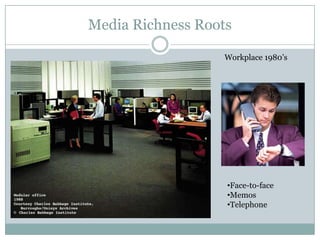
Media Richness Roots
Workplace 1980’s

•Face-to-face
•Memos
•Telephone
Media Richness Roots
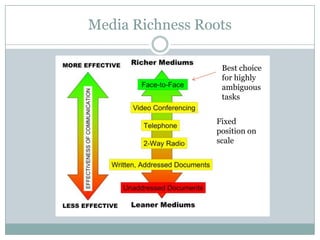
 Media Richness Theory (Daft & Lengel, 1984)

 Developed in order to explain and evaluate the

effectiveness of media used in organizations
 Addresses communication challenges



Conflicting interpretations
Unclear messages
What is media richness?
 Richness = productive and fruitfulness
 Based on ability of medium to:
 allow multiple information cues simultaneously



aid in speedy responses




How quickly do you receive feedback?

establish a personal focus




The more verbal and non-verbal cues the richer the media.

Is the message addressed to a specific person?

make use of natural language

 Media richness is important in creating a shared understanding in

communication


Ability to encode and decode


Avoid misunderstandings/unclear messages

"The more learning that can be pumped through a medium, the richer
the medium.“ - Daft & Lengel (1984)
Media Richness Roots
Best choice
for highly
ambiguous
tasks
Fixed
position on
scale
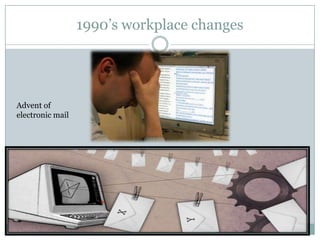
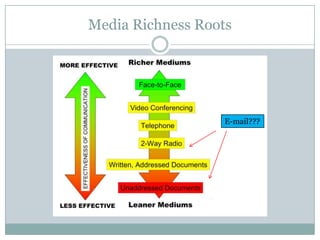
1990’s workplace changes

Advent of
electronic mail
Media Richness Roots

E-mail???
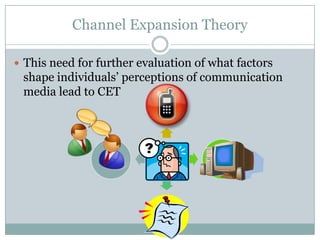
Channel Expansion Theory
 This need for further evaluation of what factors

shape individuals’ perceptions of communication
media lead to CET
What affects perceived richness?
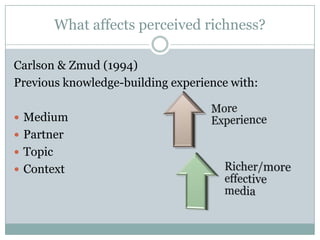
Carlson & Zmud (1994)
Previous knowledge-building experience with:
 Medium
 Partner
 Topic
 Context
What affects perceived richness?
Also,
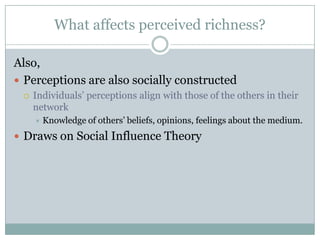
 Perceptions are also socially constructed


Individuals’ perceptions align with those of the others in their
network


Knowledge of others’ beliefs, opinions, feelings about the medium.

 Draws on Social Influence Theory
CET vs. MRT
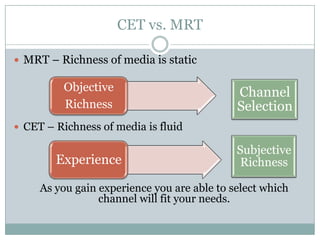
 MRT – Richness of media is static

Objective
Richness

Channel
Selection

 CET – Richness of media is fluid

Experience

Subjective
Richness

As you gain experience you are able to select which
channel will fit your needs.
Channel Expansion Theory
 CET can be thought of as linear and developing

across time.


What seemed as less efficient and lean can become more
efficient and richer with experience

 Goal is to use the medium to create a shared

understanding in communication


Avoid misunderstandings and unclear messages
D’Urso & Rains, 2008
 Put CET through the test
 Organizational situation
 Examine traditional vs. new communication media
 face-to-face
 telephone
 e-mail
 instant-messaging
 First time IMing applied to CET
 Only looked at experience with topic, partner, and

media and social influence
D’Urso & Rains, 2008
 Hypothesis 1: When controlling for the effects of perceived social influence and

structural differences in the media, (a) channel experience, (b) experience with
one’s communication partner, and (c) experience with the communication topic are
positively related to perceptions of richness of the four communication channels.

 Hypothesis 2: Channel type will interact with the experiential factors and

perceived social influence in predicting richness perceptions: (a) Channel
experience, (b) experience with one’s communication partner, (c) experience with
the communication topic, and (d) perceived social influence will more strongly
predict richness perceptions with newer communication technologies (e-mail and
IM) than with traditional technologies (face-to-face interaction and telephone).


Because FtF and phone are norms and should not be influenced by experiential factors and social
influence

 Research question: What relationships exist among the key types of experience, the

perceived social influence, and the four components of richness (multiple
channels, language variety, immediacy of feedback and personalness)?
D’Urso & Rains, 2008
Methods
 Students solicitation of participants
 over the age of 18
 employed at least part-time
 not employed by the university
 Participants asked which channels (i.e., e-mail, IM, FtF, telephone) they had regular

access at their job
 Participants randomly assigned to an online questionnaire related to one of the four
channels they had experience with


269 participants





69 e-mail
57 IM
71 phone
72 FtF

 Asked to think about a recent interaction at work using the medium addressed in

the questionnaire and to complete measures of




perceived social influence
media richness
three types of experience (partner, topic, medium)
D’Urso & Rains, 2008
Questionnaire Measures
 Media Richness
 Mediums ability to allow simultaneous multiple cues
 immediacy of feedback
 language variety




Ability to use symbols to communicate and express ideas through
nonword sounds and utterances

Personalness


medium is warm, sociable, and sensitive

 Perceived Social Influence
 Respondents rated the degree to which key others in their
organization (coworkers, supervisors, subordinates) use the medium
and perceive it to be useful.
 Channel, topic, and partner experience
D’Urso & Rains, 2008
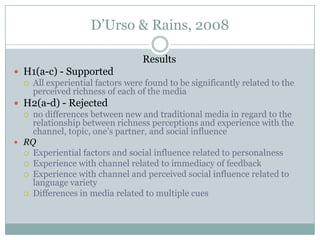
Results
 H1(a-c) - Supported
 All experiential factors were found to be significantly related to the
perceived richness of each of the media
 H2(a-d) - Rejected
 no differences between new and traditional media in regard to the
relationship between richness perceptions and experience with the
channel, topic, one’s partner, and social influence
 RQ
 Experiential factors and social influence related to personalness
 Experience with channel related to immediacy of feedback
 Experience with channel and perceived social influence related to
language variety
 Differences in media related to multiple cues
D’Urso & Rains, 2008
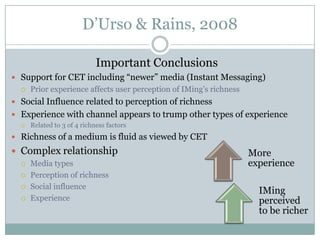
Important Conclusions
 Support for CET including “newer” media (Instant Messaging)


Prior experience affects user perception of IMing’s richness

 Social Influence related to perception of richness
 Experience with channel appears to trump other types of experience


Related to 3 of 4 richness factors

 Richness of a medium is fluid as viewed by CET

 Complex relationship





Media types
Perception of richness
Social influence
Experience

More
experience
IMing
perceived
to be richer
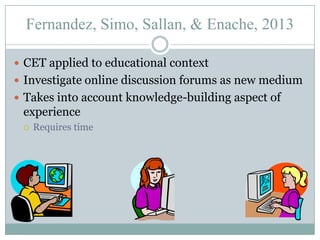
Fernandez, Simo, Sallan, & Enache, 2013
 CET applied to educational context
 Investigate online discussion forums as new medium
 Takes into account knowledge-building aspect of

experience


Requires time
Fernandez, et al., 2013
RQ: How does the perception of richness in a
communication media evolve over time, and how are
existing relations between the knowledge-building
experiences and the perception of media richness
affected?
Fernandez, et al., 2013
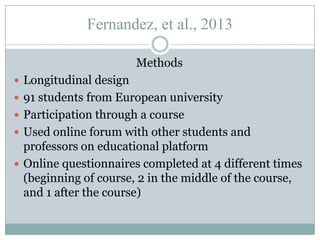
Methods
 Longitudinal design
 91 students from European university
 Participation through a course
 Used online forum with other students and

professors on educational platform
 Online questionnaires completed at 4 different times
(beginning of course, 2 in the middle of the course,
and 1 after the course)
Fernandez, et al., 2013
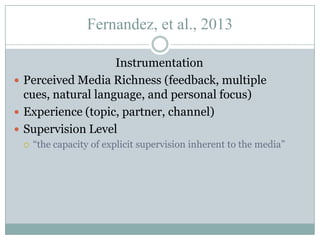
Instrumentation
 Perceived Media Richness (feedback, multiple
cues, natural language, and personal focus)
 Experience (topic, partner, channel)
 Supervision Level


“the capacity of explicit supervision inherent to the media”
Fernandez, et al., 2013








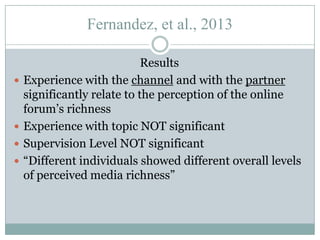
Results
Experience with the channel and with the partner
significantly relate to the perception of the online
forum’s richness
Experience with topic NOT significant
Supervision Level NOT significant
“Different individuals showed different overall levels
of perceived media richness”
Fernandez, et al., 2013
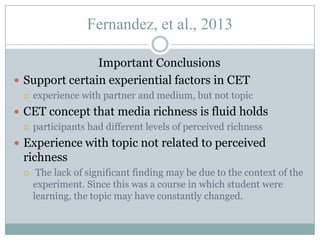
Important Conclusions
 Support certain experiential factors in CET


experience with partner and medium, but not topic

 CET concept that media richness is fluid holds
 participants had different levels of perceived richness

 Experience with topic not related to perceived

richness


The lack of significant finding may be due to the context of the
experiment. Since this was a course in which student were
learning, the topic may have constantly changed.
Evaluating CET
 From course text book (Miller, 2005):
 Accurate
 Consistent
 Broad Scope
 Parsimonious
 Fruitful
Accurate
 CET appears accurate, but too new and not enough

research to support this claim


Since CET does not state that all experiential factors are
simultaneously required. Thus, findings such as topic not
being a significant predictor of media richness (Fernandez, et
al., 2013) does not completely disagree with the theory’s
prediction AND cannot discredit CET.

 Easily testable and allow for evaluation of the social

world


As seen in empirical research examples
Consistent
 Internal
 Constructs do not seem to contradict themselves
 External
 CET is contradicts MRT in that richness of media is
fluid/subjective vs. static/objective richness
 CET also clashes with social influence theory
Scope
 CET appears to have an exceptionally broad scope
 With media types:
Videoconferencing
 Telephone
 E-mail
 Instant Messaging
 Online forums
 And more




Context
Various organizational settings
 Education
 Any situation where individuals communicate through a medium

Parsimonious
 CET is basically simple and clear
 Constructs easy to understand
 Relationship between experience and perceived richness

is easily understood (temporal order)
 Yet, it can be a bit complex with social influence aspect
and experience as leading to perception.
i.e. investigating 3 of 4 experiential factors
 Leaving out social influence
 Complex relationship (from D’Urso & Rains, 2008)







Media types
Perception of richness
Social influence
Experience
Fruitfulness
 CET has a heuristic value
 Although not as common as MRT, CET generate

numerous research questions and hypothesis
 CET has created a roadmap for future applications of
the theory in regards to new technologies and
situations
Overall Evaluation
 CET appears to be a simple, broad, accurate, fruitful,

& consistent theory!
 BUT, since it’s still in it’s teens, more research is

needed in order to accurately evaluate CET using
criteria.
References
Banner design email [Image]. Creative Jar, 2013. Retrieved from http://creative-jar.com/insights/labs/programming/html-email/html-emails-coding-like-its-the1990s-2/
Carlson, J. R., & Zmud, R. W. (1999). Channel expansion theory and the experiential nature of media richness perceptions. Academy of Management
Journal, 42(2), 153-170. doi:10.2307/257090
Charles Babbage Institute (1988). Modular office [Photograph]. Retrieved from http://www.smithsonianeducation.org/scitech/carbons/start.html
Daft, R. L., & Lengel, R. H. (1984). Information richness: A new approach to managerial behavior and organizational design. Research in Organizational
Behavior, 6, 191-233.
D’Urso, S. C., & Rains, S. A. (2008). Examining the scope of channel expansion: A test of channel expansion theory with new and traditional communication
media. Management Communication Quarterly, 21(4), 486-507. doi:10.1177/0893318907313712
Email 640 [Photograph]. Retrieved from http://www.theguardian.com/technology/2008/aug/28/email.addiction
Fernandez, V., Simo, P., Sallan, J. M., & Enache, M. (2013). Evolution of online discussion forum richness according to channel expansion theory: A longitudinal
panel data analysis. Computers & Education, 62, 32-40. doi:http://dx.doi.org/10.1016/j.compedu.2012.10.020
Miller, K. (2005). Communication theories: Perspectives, processes, and contexts. (2nd ed.). Boston: McGraw-Hill

Tntdj (2007). Media richness theory [Diagram]. Retrieved from http://en.wikipedia.org/wiki/File:Media_Richness_Theory_Diagram_PNG.png
1980s phone [Photograph]. Retrieved from http://www.australiansuper.com/tools-and-resources/blog/2013/07/having-a-stockbroker-is-so-80s.aspx

Channel Expansion Theory

  • 1.
  • 2.
    Overview  Introduction toChannel Expansion Theory (CET)  Discussion of articles which have used CET  Evaluation of CET
  • 3.
    Channel Expansion Theory Carlson& Zmud (1994)  Media richness depends on users perception of the medium  Focus on how individuals develop perceptions  Based on experiential factors   Through knowledge-building experience Also, socially constructed
  • 4.
    CET  In otherwords, how do individuals expand their perception of a given channel? How does the richness of a medium change?  What is media richness?  How does perceived richness develop?
  • 5.
    Media Richness Roots Workplace1980’s •Face-to-face •Memos •Telephone
  • 6.
    Media Richness Roots Media Richness Theory (Daft & Lengel, 1984)  Developed in order to explain and evaluate the effectiveness of media used in organizations  Addresses communication challenges   Conflicting interpretations Unclear messages
  • 7.
    What is mediarichness?  Richness = productive and fruitfulness  Based on ability of medium to:  allow multiple information cues simultaneously   aid in speedy responses   How quickly do you receive feedback? establish a personal focus   The more verbal and non-verbal cues the richer the media. Is the message addressed to a specific person? make use of natural language  Media richness is important in creating a shared understanding in communication  Ability to encode and decode  Avoid misunderstandings/unclear messages "The more learning that can be pumped through a medium, the richer the medium.“ - Daft & Lengel (1984)
  • 8.
    Media Richness Roots Bestchoice for highly ambiguous tasks Fixed position on scale
  • 9.
  • 10.
  • 11.
    Channel Expansion Theory This need for further evaluation of what factors shape individuals’ perceptions of communication media lead to CET
  • 12.
    What affects perceivedrichness? Carlson & Zmud (1994) Previous knowledge-building experience with:  Medium  Partner  Topic  Context
  • 13.
    What affects perceivedrichness? Also,  Perceptions are also socially constructed  Individuals’ perceptions align with those of the others in their network  Knowledge of others’ beliefs, opinions, feelings about the medium.  Draws on Social Influence Theory
  • 14.
    CET vs. MRT MRT – Richness of media is static Objective Richness Channel Selection  CET – Richness of media is fluid Experience Subjective Richness As you gain experience you are able to select which channel will fit your needs.
  • 15.
    Channel Expansion Theory CET can be thought of as linear and developing across time.  What seemed as less efficient and lean can become more efficient and richer with experience  Goal is to use the medium to create a shared understanding in communication  Avoid misunderstandings and unclear messages
  • 16.
    D’Urso & Rains,2008  Put CET through the test  Organizational situation  Examine traditional vs. new communication media  face-to-face  telephone  e-mail  instant-messaging  First time IMing applied to CET  Only looked at experience with topic, partner, and media and social influence
  • 17.
    D’Urso & Rains,2008  Hypothesis 1: When controlling for the effects of perceived social influence and structural differences in the media, (a) channel experience, (b) experience with one’s communication partner, and (c) experience with the communication topic are positively related to perceptions of richness of the four communication channels.  Hypothesis 2: Channel type will interact with the experiential factors and perceived social influence in predicting richness perceptions: (a) Channel experience, (b) experience with one’s communication partner, (c) experience with the communication topic, and (d) perceived social influence will more strongly predict richness perceptions with newer communication technologies (e-mail and IM) than with traditional technologies (face-to-face interaction and telephone).  Because FtF and phone are norms and should not be influenced by experiential factors and social influence  Research question: What relationships exist among the key types of experience, the perceived social influence, and the four components of richness (multiple channels, language variety, immediacy of feedback and personalness)?
  • 18.
    D’Urso & Rains,2008 Methods  Students solicitation of participants  over the age of 18  employed at least part-time  not employed by the university  Participants asked which channels (i.e., e-mail, IM, FtF, telephone) they had regular access at their job  Participants randomly assigned to an online questionnaire related to one of the four channels they had experience with  269 participants     69 e-mail 57 IM 71 phone 72 FtF  Asked to think about a recent interaction at work using the medium addressed in the questionnaire and to complete measures of    perceived social influence media richness three types of experience (partner, topic, medium)
  • 19.
    D’Urso & Rains,2008 Questionnaire Measures  Media Richness  Mediums ability to allow simultaneous multiple cues  immediacy of feedback  language variety   Ability to use symbols to communicate and express ideas through nonword sounds and utterances Personalness  medium is warm, sociable, and sensitive  Perceived Social Influence  Respondents rated the degree to which key others in their organization (coworkers, supervisors, subordinates) use the medium and perceive it to be useful.  Channel, topic, and partner experience
  • 20.
    D’Urso & Rains,2008 Results  H1(a-c) - Supported  All experiential factors were found to be significantly related to the perceived richness of each of the media  H2(a-d) - Rejected  no differences between new and traditional media in regard to the relationship between richness perceptions and experience with the channel, topic, one’s partner, and social influence  RQ  Experiential factors and social influence related to personalness  Experience with channel related to immediacy of feedback  Experience with channel and perceived social influence related to language variety  Differences in media related to multiple cues
  • 21.
    D’Urso & Rains,2008 Important Conclusions  Support for CET including “newer” media (Instant Messaging)  Prior experience affects user perception of IMing’s richness  Social Influence related to perception of richness  Experience with channel appears to trump other types of experience  Related to 3 of 4 richness factors  Richness of a medium is fluid as viewed by CET  Complex relationship     Media types Perception of richness Social influence Experience More experience IMing perceived to be richer
  • 22.
    Fernandez, Simo, Sallan,& Enache, 2013  CET applied to educational context  Investigate online discussion forums as new medium  Takes into account knowledge-building aspect of experience  Requires time
  • 23.
    Fernandez, et al.,2013 RQ: How does the perception of richness in a communication media evolve over time, and how are existing relations between the knowledge-building experiences and the perception of media richness affected?
  • 24.
    Fernandez, et al.,2013 Methods  Longitudinal design  91 students from European university  Participation through a course  Used online forum with other students and professors on educational platform  Online questionnaires completed at 4 different times (beginning of course, 2 in the middle of the course, and 1 after the course)
  • 25.
    Fernandez, et al.,2013 Instrumentation  Perceived Media Richness (feedback, multiple cues, natural language, and personal focus)  Experience (topic, partner, channel)  Supervision Level  “the capacity of explicit supervision inherent to the media”
  • 26.
    Fernandez, et al.,2013     Results Experience with the channel and with the partner significantly relate to the perception of the online forum’s richness Experience with topic NOT significant Supervision Level NOT significant “Different individuals showed different overall levels of perceived media richness”
  • 27.
    Fernandez, et al.,2013 Important Conclusions  Support certain experiential factors in CET  experience with partner and medium, but not topic  CET concept that media richness is fluid holds  participants had different levels of perceived richness  Experience with topic not related to perceived richness  The lack of significant finding may be due to the context of the experiment. Since this was a course in which student were learning, the topic may have constantly changed.
  • 28.
    Evaluating CET  Fromcourse text book (Miller, 2005):  Accurate  Consistent  Broad Scope  Parsimonious  Fruitful
  • 29.
    Accurate  CET appearsaccurate, but too new and not enough research to support this claim  Since CET does not state that all experiential factors are simultaneously required. Thus, findings such as topic not being a significant predictor of media richness (Fernandez, et al., 2013) does not completely disagree with the theory’s prediction AND cannot discredit CET.  Easily testable and allow for evaluation of the social world  As seen in empirical research examples
  • 30.
    Consistent  Internal  Constructsdo not seem to contradict themselves  External  CET is contradicts MRT in that richness of media is fluid/subjective vs. static/objective richness  CET also clashes with social influence theory
  • 31.
    Scope  CET appearsto have an exceptionally broad scope  With media types: Videoconferencing  Telephone  E-mail  Instant Messaging  Online forums  And more   Context Various organizational settings  Education  Any situation where individuals communicate through a medium 
  • 32.
    Parsimonious  CET isbasically simple and clear  Constructs easy to understand  Relationship between experience and perceived richness is easily understood (temporal order)  Yet, it can be a bit complex with social influence aspect and experience as leading to perception. i.e. investigating 3 of 4 experiential factors  Leaving out social influence  Complex relationship (from D’Urso & Rains, 2008)      Media types Perception of richness Social influence Experience
  • 33.
    Fruitfulness  CET hasa heuristic value  Although not as common as MRT, CET generate numerous research questions and hypothesis  CET has created a roadmap for future applications of the theory in regards to new technologies and situations
  • 34.
    Overall Evaluation  CETappears to be a simple, broad, accurate, fruitful, & consistent theory!  BUT, since it’s still in it’s teens, more research is needed in order to accurately evaluate CET using criteria.
  • 35.
    References Banner design email[Image]. Creative Jar, 2013. Retrieved from http://creative-jar.com/insights/labs/programming/html-email/html-emails-coding-like-its-the1990s-2/ Carlson, J. R., & Zmud, R. W. (1999). Channel expansion theory and the experiential nature of media richness perceptions. Academy of Management Journal, 42(2), 153-170. doi:10.2307/257090 Charles Babbage Institute (1988). Modular office [Photograph]. Retrieved from http://www.smithsonianeducation.org/scitech/carbons/start.html Daft, R. L., & Lengel, R. H. (1984). Information richness: A new approach to managerial behavior and organizational design. Research in Organizational Behavior, 6, 191-233. D’Urso, S. C., & Rains, S. A. (2008). Examining the scope of channel expansion: A test of channel expansion theory with new and traditional communication media. Management Communication Quarterly, 21(4), 486-507. doi:10.1177/0893318907313712 Email 640 [Photograph]. Retrieved from http://www.theguardian.com/technology/2008/aug/28/email.addiction Fernandez, V., Simo, P., Sallan, J. M., & Enache, M. (2013). Evolution of online discussion forum richness according to channel expansion theory: A longitudinal panel data analysis. Computers & Education, 62, 32-40. doi:http://dx.doi.org/10.1016/j.compedu.2012.10.020 Miller, K. (2005). Communication theories: Perspectives, processes, and contexts. (2nd ed.). Boston: McGraw-Hill Tntdj (2007). Media richness theory [Diagram]. Retrieved from http://en.wikipedia.org/wiki/File:Media_Richness_Theory_Diagram_PNG.png 1980s phone [Photograph]. Retrieved from http://www.australiansuper.com/tools-and-resources/blog/2013/07/having-a-stockbroker-is-so-80s.aspx