Dependency Theory
And
Social Cognitive Theory
By: Elena DeLuccia, Kelly Myers, Rukayat Oloko and Bridget Whitfield
Abstract
We evaluated the Media Dependency Theory (1976) and the Social Cognitive
Theory (2002) to determine if they were relevant to social media today,
because they were proposed far before the boom of modern social media
(including mobile applications). After researching and understanding each
theory in a modern construct, and with a new perspective on the each theory’s
proposed constructs and suggested effects, we have determined that they do
have a direct relation to the social media spectrum in today’s society.
Be honest:
What is the first thing you check in the morning?
Be honest:
If there is a crisis, where do you go to get your
information?
Be honest:
Why do you use social media?
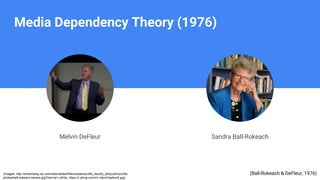
Media Dependency Theory (1976)
Melvin DeFleur Sandra Ball-Rokeach
(Ball-Rokeach & DeFleur, 1976)(Images: http://annenberg.usc.edu/sites/default/files/styles/profile_faculty_std/public/profile
photos/bell-rokeach-sandra.jpg?itok=tp1-uKQs; https://i.ytimg.com/vi/-v4jmUIqwkw/0.jpg)
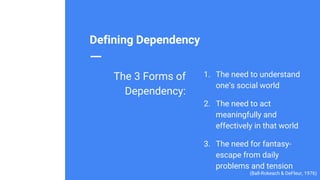
Defining Dependency
1. The need to understand
one’s social world
2. The need to act
meaningfully and
effectively in that world
3. The need for fantasy-
escape from daily
problems and tension
The 3 Forms of
Dependency:
(Ball-Rokeach & DeFleur, 1976)
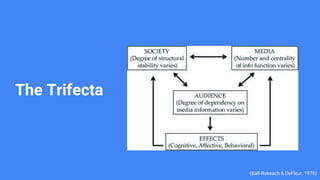
The Trifecta
(Ball-Rokeach & DeFleur, 1976)
Factor 1:
Individual
Media needs to meet the
needs of the consumer
Dependency increases if
media meets your
individual needs
(University of Twente, n.d.)
Be honest:
What is the first thing you check in the morning?
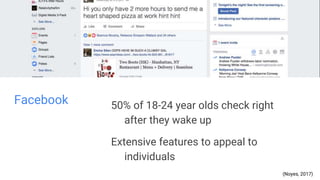
Facebook 50% of 18-24 year olds check right
after they wake up
Extensive features to appeal to
individuals
(Noyes, 2017)
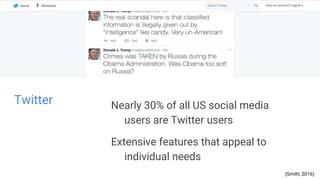
Twitter Nearly 30% of all US social media
users are Twitter users
Extensive features that appeal to
individual needs
(Smith, 2016)
Factor 2:
Social Stability
As social change
happens, established
institutions, beliefs and
practices are
challenged
Reevaluation and new
choices
Reliance increases
(University of Twente, n.d.)
Be honest:
If there is a crisis, where do you go to get your
information?
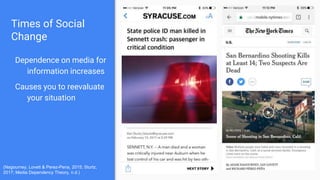
Times of Social
Change
Dependence on media for
information increases
Causes you to reevaluate
your situation
(Nagourney, Lovett & Perez-Pena, 2015; Sturtz,
2017; Media Dependency Theory, n.d.)
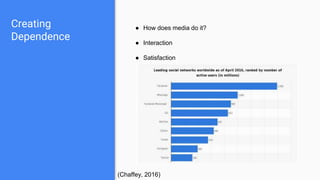
Creating
Dependence
● How does media do it?
● Interaction
● Satisfaction
(Chaffey, 2016)
Would You Rather...
Watch an Elite Daily video
on Facebook about what
it’s like to date in 2017,
Receive an email from Elite
Daily that explains it all in
plain text?
OR
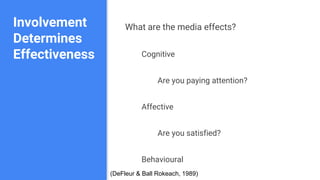
Involvement
Determines
Effectiveness
What are the media effects?
Cognitive
Are you paying attention?
Affective
Are you satisfied?
Behavioural
(DeFleur & Ball Rokeach, 1989)
BREAKING NEWS
Syracuse University always posts a live video on their Facebook
page when a major storm occurs (ok pretend)
● South Campus is flooded
● You’re in class watching it live
● The last live video saved you from a hassle
How effective is this dependency?
Let’s Kahoot it!
TOK
https://play.kahoot.it/#/k/6edf7f89-8096-4f5f-9707-
8bf99a983889
Social Cognitive Theory
The social cognitive theory explains how people acquire and maintain certain
behavioral patterns, while also providing the basis for intervention strategies
(Bandura, 1997).
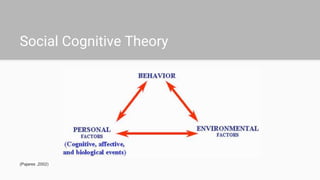
Social Cognitive Theory
(Pajares ,2002)
Social Cognitive Theory
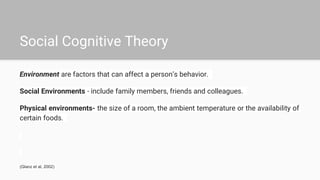
Environment are factors that can affect a person’s behavior.
Social Environments - include family members, friends and colleagues.
Physical environments- the size of a room, the ambient temperature or the availability of
certain foods.
(Glanz et al, 2002)
Social Cognitive Theory
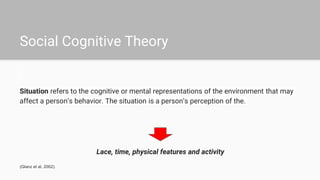
Situation refers to the cognitive or mental representations of the environment that may
affect a person’s behavior. The situation is a person’s perception of the.
Lace, time, physical features and activity
(Glanz et al, 2002).
Social Cognitive Theory
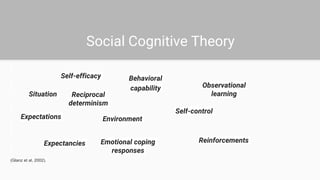
(Glanz et al, 2002).
Environment
Situation
Behavioral
capability
Expectations
Expectancies
Self-control
Observational
learning
Reinforcements
Self-efficacy
Emotional coping
responses
Reciprocal
determinism
Relation to Modern
Social Media
Analytics
Relation to Modern
Social Media
framework for
designing,
implementing
evaluating
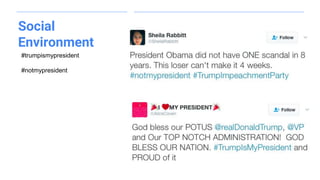
Social
Environment
#trumpismypresident
#notmypresident
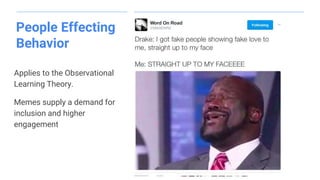
People Effecting
Behavior
Applies to the Observational
Learning Theory.
Memes supply a demand for
inclusion and higher
engagement
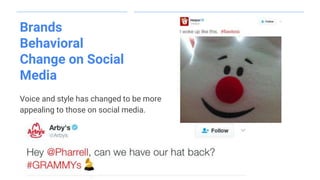
Brands
Behavioral
Change on Social
Media
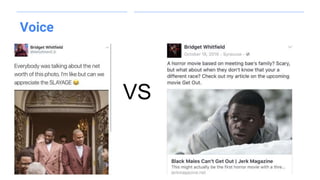
Voice and style has changed to be more
appealing to those on social media.
Social Circles
Certain social circles on the effect
on your personal voice and
content
Voice
VS
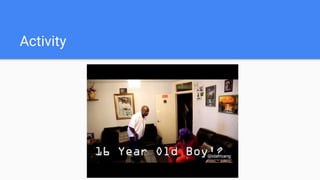
Activity
References
Ball-Rokeach, S. J., & DeFleur, M.L. (1976). A dependency model of mass media effects.Communication Research, 3, 3-21.
Chaffey, D. (2016). Global social media research summary 2016. Retrieved from http://www.smartinsights.com/social-media-marketing/social-media-strategy/new-global-social-
media-research/
DeFleur, M. L. & Ball-Rokeach, S. (1989). Theories of mass communication (5th ed.). White Plains, NY: Longman.
Media Dependency Theory. (n.d.). Retrieved from http://communicationtheory.org/media-dependency-theory/
Nagourney, A., Lovett, I., & Pérez-Peña, R. (2015). San Bernardino Shooting Kills at Least 14; Two Suspects Are Dead. Retrieved from
https://mobile.nytimes.com/2015/12/03/us/san-bernardino-shooting.html
Noyes, D. (2017). Top 20 Facebook Statistics. Retrieved from https://zephoria.com/top-15-valuable-facebook-statistics/
Smith, K. (2016). 44 Astonishing Twitter Stats and Facts for 2016. Retrieved from https://www.brandwatch.com/blog/44-twitter-stats-2016/
Sturtz, K. (2017). State police ID man killed in Sennett crash; passenger in critical condition. Retrieved from
http://www.syracuse.com/crime/index.ssf/2017/02/police_id_man_killed_in_cayuga_county_crash_passenger_in_critical_condition.html
University of Twente. (n.d.). Dependency Theory. Retrieved from https://www.utwente.nl/cw/theorieenoverzicht/Theory%20Clusters/Mass%20Media/Dependency%20Theory/
Zuckerberg, M. (2014). Safety Check on Facebook. Retrieved February 15, 2017, from https://www.facebook.com/zuck/posts/10101699265809491
References
Glanz, K., Rimer, B.K. & Lewis, F.M. (2002). Health Behavior and Health Education. Theory, Research and Practice. San Fransisco: Wiley & Sons.
Bandura, A. (1997). Self-efficacy: The exercise of control. New York: Freeman.
Pajares, F., & Schunk, D. H. (2001). Self-beliefs and school success: Self-efficacy, self-concept, and school achievement. In R. Riding & S. Rayner
(Eds.), Self-perception (pp. 239-266).

Social media presentation

  • 1.
    Dependency Theory And Social CognitiveTheory By: Elena DeLuccia, Kelly Myers, Rukayat Oloko and Bridget Whitfield
  • 2.
    Abstract We evaluated theMedia Dependency Theory (1976) and the Social Cognitive Theory (2002) to determine if they were relevant to social media today, because they were proposed far before the boom of modern social media (including mobile applications). After researching and understanding each theory in a modern construct, and with a new perspective on the each theory’s proposed constructs and suggested effects, we have determined that they do have a direct relation to the social media spectrum in today’s society.
  • 3.
    Be honest: What isthe first thing you check in the morning?
  • 4.
    Be honest: If thereis a crisis, where do you go to get your information?
  • 5.
    Be honest: Why doyou use social media?
  • 6.
    Media Dependency Theory(1976) Melvin DeFleur Sandra Ball-Rokeach (Ball-Rokeach & DeFleur, 1976)(Images: http://annenberg.usc.edu/sites/default/files/styles/profile_faculty_std/public/profile photos/bell-rokeach-sandra.jpg?itok=tp1-uKQs; https://i.ytimg.com/vi/-v4jmUIqwkw/0.jpg)
  • 7.
    Defining Dependency 1. Theneed to understand one’s social world 2. The need to act meaningfully and effectively in that world 3. The need for fantasy- escape from daily problems and tension The 3 Forms of Dependency: (Ball-Rokeach & DeFleur, 1976)
  • 8.
  • 9.
    Factor 1: Individual Media needsto meet the needs of the consumer Dependency increases if media meets your individual needs (University of Twente, n.d.)
  • 10.
    Be honest: What isthe first thing you check in the morning?
  • 11.
    Facebook 50% of18-24 year olds check right after they wake up Extensive features to appeal to individuals (Noyes, 2017)
  • 12.
    Twitter Nearly 30%of all US social media users are Twitter users Extensive features that appeal to individual needs (Smith, 2016)
  • 13.
    Factor 2: Social Stability Associal change happens, established institutions, beliefs and practices are challenged Reevaluation and new choices Reliance increases (University of Twente, n.d.)
  • 14.
    Be honest: If thereis a crisis, where do you go to get your information?
  • 15.
    Times of Social Change Dependenceon media for information increases Causes you to reevaluate your situation (Nagourney, Lovett & Perez-Pena, 2015; Sturtz, 2017; Media Dependency Theory, n.d.)
  • 16.
    Creating Dependence ● How doesmedia do it? ● Interaction ● Satisfaction (Chaffey, 2016)
  • 17.
    Would You Rather... Watchan Elite Daily video on Facebook about what it’s like to date in 2017, Receive an email from Elite Daily that explains it all in plain text? OR
  • 18.
    Involvement Determines Effectiveness What are themedia effects? Cognitive Are you paying attention? Affective Are you satisfied? Behavioural (DeFleur & Ball Rokeach, 1989)
  • 19.
    BREAKING NEWS Syracuse Universityalways posts a live video on their Facebook page when a major storm occurs (ok pretend) ● South Campus is flooded ● You’re in class watching it live ● The last live video saved you from a hassle How effective is this dependency?
  • 20.
  • 21.
    Social Cognitive Theory Thesocial cognitive theory explains how people acquire and maintain certain behavioral patterns, while also providing the basis for intervention strategies (Bandura, 1997).
  • 22.
  • 23.
    Social Cognitive Theory Environmentare factors that can affect a person’s behavior. Social Environments - include family members, friends and colleagues. Physical environments- the size of a room, the ambient temperature or the availability of certain foods. (Glanz et al, 2002)
  • 24.
    Social Cognitive Theory Situationrefers to the cognitive or mental representations of the environment that may affect a person’s behavior. The situation is a person’s perception of the. Lace, time, physical features and activity (Glanz et al, 2002).
  • 25.
    Social Cognitive Theory (Glanzet al, 2002). Environment Situation Behavioral capability Expectations Expectancies Self-control Observational learning Reinforcements Self-efficacy Emotional coping responses Reciprocal determinism
  • 26.
  • 27.
    Relation to Modern SocialMedia framework for designing, implementing evaluating
  • 28.
  • 29.
    People Effecting Behavior Applies tothe Observational Learning Theory. Memes supply a demand for inclusion and higher engagement
  • 30.
    Brands Behavioral Change on Social Media Voiceand style has changed to be more appealing to those on social media.
  • 31.
    Social Circles Certain socialcircles on the effect on your personal voice and content
  • 32.
  • 33.
  • 34.
    References Ball-Rokeach, S. J.,& DeFleur, M.L. (1976). A dependency model of mass media effects.Communication Research, 3, 3-21. Chaffey, D. (2016). Global social media research summary 2016. Retrieved from http://www.smartinsights.com/social-media-marketing/social-media-strategy/new-global-social- media-research/ DeFleur, M. L. & Ball-Rokeach, S. (1989). Theories of mass communication (5th ed.). White Plains, NY: Longman. Media Dependency Theory. (n.d.). Retrieved from http://communicationtheory.org/media-dependency-theory/ Nagourney, A., Lovett, I., & Pérez-Peña, R. (2015). San Bernardino Shooting Kills at Least 14; Two Suspects Are Dead. Retrieved from https://mobile.nytimes.com/2015/12/03/us/san-bernardino-shooting.html Noyes, D. (2017). Top 20 Facebook Statistics. Retrieved from https://zephoria.com/top-15-valuable-facebook-statistics/ Smith, K. (2016). 44 Astonishing Twitter Stats and Facts for 2016. Retrieved from https://www.brandwatch.com/blog/44-twitter-stats-2016/ Sturtz, K. (2017). State police ID man killed in Sennett crash; passenger in critical condition. Retrieved from http://www.syracuse.com/crime/index.ssf/2017/02/police_id_man_killed_in_cayuga_county_crash_passenger_in_critical_condition.html University of Twente. (n.d.). Dependency Theory. Retrieved from https://www.utwente.nl/cw/theorieenoverzicht/Theory%20Clusters/Mass%20Media/Dependency%20Theory/ Zuckerberg, M. (2014). Safety Check on Facebook. Retrieved February 15, 2017, from https://www.facebook.com/zuck/posts/10101699265809491
  • 35.
    References Glanz, K., Rimer,B.K. & Lewis, F.M. (2002). Health Behavior and Health Education. Theory, Research and Practice. San Fransisco: Wiley & Sons. Bandura, A. (1997). Self-efficacy: The exercise of control. New York: Freeman. Pajares, F., & Schunk, D. H. (2001). Self-beliefs and school success: Self-efficacy, self-concept, and school achievement. In R. Riding & S. Rayner (Eds.), Self-perception (pp. 239-266).