My Portfolio in Educational
Technology II
Alyssa Mae D. de Ocampo
BSE Mathematics 3-1
OUTLINE
• The Student
• Educational Technology in a Nutshell
• Learning through Educational Technology
• The student after Educational Technology
The Student
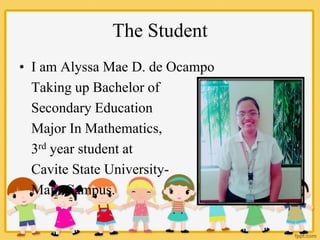
• I am Alyssa Mae D. de Ocampo
Taking up Bachelor of
Secondary Education
Major In Mathematics,
3rd year student at
Cavite State University-
Main Campus.
The Student
This portfolio as the Final
Requirement of the student in
Educational Technology II
summarizes her track of
development through the subject.
The learning of the student after
the subject will really help her in
the future as an Educator.
Educational Technology in a Nut
Shell
The word technology comes from two
Greek words, transliterated techne and logos.
Techne means art, skill, craft, or the way,
manner, or means by which a thing is gained.
Logos means word, the utterance by
which inward thought is expressed, a saying, or
an expression.
So, literally, technology means words or
discourse about the way things are gained.
Educational Technology in a Nut
Shell
Educational technology is the
effective use of technological tools in
learning. As a concept, it concerns an
array of tools, such as media,
machines and networking hardware,
as well as considering underlying
theoretical perspectives for their
effective application.
Educational Technology II
“Integrating Technology into Teaching and
Learning.”
This course aims to infuse
technology in the student-
teachers training, helping them
to adapt and meet rapid and
continuing technological
changes particularly in the
thriving global information and
communication technology
(ICT) environment.
Educational Technology in the Asia
Pacific Region
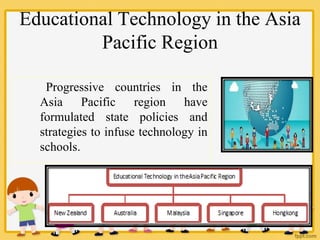
Progressive countries in the
Asia Pacific region have
formulated state policies and
strategies to infuse technology in
schools.
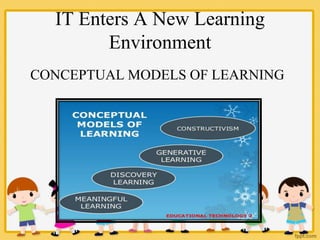
IT Enters A New Learning
Environment
CONCEPTUAL MODELS OF LEARNING
Conceptual Models of Learning
1. Meaningful learning- gives focus to new
experience departs from that is related to what
the learners already knows.
2. Discovery learning- is differentiated from
reception learning in which ideas are
presented directly to student in a well-
organized way
Conceptual Models of Learning
3. Generative learning- we have active learners
who attend to learning events and generate
meaning from this experience and draw
inferences thereby creating a personal model
or explanation to the new experience in the
context of existing knowledge.
Conceptual Models of Learning
4. Constructivism- the learner builds a personal
understanding through appropriate learning
activities and a good learning environment.
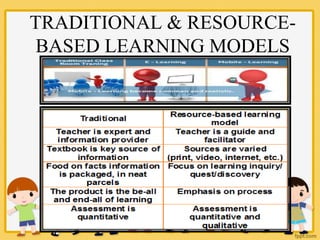
TRADITIONAL & RESOURCE-
BASED LEARNING MODELS
The Computer as a Tutor
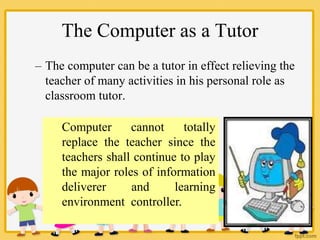
– The computer can be a tutor in effect relieving the
teacher of many activities in his personal role as
classroom tutor.
Computer cannot totally
replace the teacher since the
teachers shall continue to play
the major roles of information
deliverer and learning
environment controller.
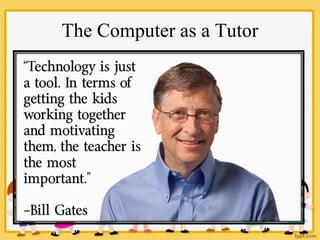
The Computer as a Tutor
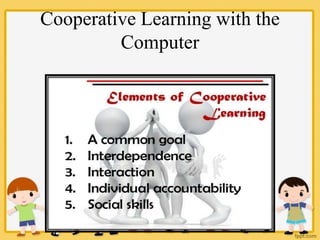
Cooperative Learning with the
Computer
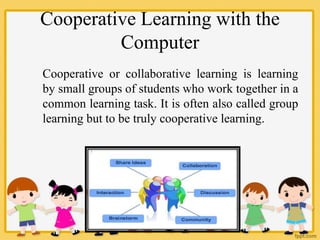
Cooperative or collaborative learning is learning
by small groups of students who work together in a
common learning task. It is often also called group
learning but to be truly cooperative learning.
Cooperative Learning with the
Computer
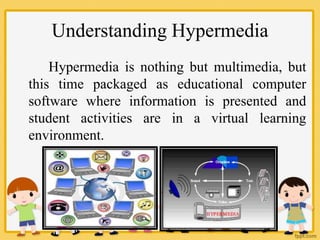
Understanding Hypermedia
Hypermedia is nothing but multimedia, but
this time packaged as educational computer
software where information is presented and
student activities are in a virtual learning
environment.
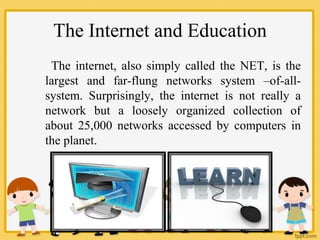
The Internet and Education
The internet, also simply called the NET, is the
largest and far-flung networks system –of-all-
system. Surprisingly, the internet is not really a
network but a loosely organized collection of
about 25,000 networks accessed by computers in
the planet.
The Internet and Education
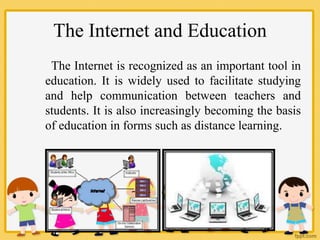
The Internet is recognized as an important tool in
education. It is widely used to facilitate studying
and help communication between teachers and
students. It is also increasingly becoming the basis
of education in forms such as distance learning.
Learning Through Educational
Technology
The course Educational Technology involves
using Technology in the classroom to enhance the
teaching learning process especially in the 21st
Century classroom. Technology undeniably plays a
central role in modern life. We are also exposed to
different materials highlighting the importance of
integrating technology in the classroom.
Learning Through Educational
Technology
The wide variety of technology that can
easily and effectively be incorporated into a
classroom offers every teacher a venue into the
technological world. The 21st Century Learners
learns differently from those before. As a future
educator this course helps me to be competent
enough so as to be able to meet the changing needs
and demands of my future students.
Learning Through Educational
Technology
This course really helped me to get
an understanding of what digital literacy
really is and adjustments that teachers will
have to make an effective learning and
teaching process.
Learning Through Educational
Technology
The course has lend me to
understand that the technological
advancement of the 21st century learner
has a positive implication for the teaching
and learning process while the changes in
behavior has resulted in strict policies
being implemented to limit the behavior of
the students.
The student after educational
technology
This portfolio summarizes my work,
learning and efforts in Educational
Technology II. It shows that
technology is really now part of the
education. As a future educator this
subject helps me on how to cope
on the changing world, how to
utilize the technology appropriately,
and most important is how to be an
effective teacher on the future.
The student after educational
technology
Educational Technology challenges
the students and the teacher to
prepare their selves in the new
teaching-learning process in the 21st
century. The Filipinos teacher shall
be empowered to meet the
technology challenges of the 21st
century digital age.
My Portfolio in Educational Technology II

My Portfolio in Educational Technology II

  • 1.
    My Portfolio inEducational Technology II Alyssa Mae D. de Ocampo BSE Mathematics 3-1
  • 2.
    OUTLINE • The Student •Educational Technology in a Nutshell • Learning through Educational Technology • The student after Educational Technology
  • 3.
    The Student • Iam Alyssa Mae D. de Ocampo Taking up Bachelor of Secondary Education Major In Mathematics, 3rd year student at Cavite State University- Main Campus.
  • 4.
    The Student This portfolioas the Final Requirement of the student in Educational Technology II summarizes her track of development through the subject. The learning of the student after the subject will really help her in the future as an Educator.
  • 5.
    Educational Technology ina Nut Shell The word technology comes from two Greek words, transliterated techne and logos. Techne means art, skill, craft, or the way, manner, or means by which a thing is gained. Logos means word, the utterance by which inward thought is expressed, a saying, or an expression. So, literally, technology means words or discourse about the way things are gained.
  • 6.
    Educational Technology ina Nut Shell Educational technology is the effective use of technological tools in learning. As a concept, it concerns an array of tools, such as media, machines and networking hardware, as well as considering underlying theoretical perspectives for their effective application.
  • 7.
    Educational Technology II “IntegratingTechnology into Teaching and Learning.” This course aims to infuse technology in the student- teachers training, helping them to adapt and meet rapid and continuing technological changes particularly in the thriving global information and communication technology (ICT) environment.
  • 8.
    Educational Technology inthe Asia Pacific Region Progressive countries in the Asia Pacific region have formulated state policies and strategies to infuse technology in schools.
  • 9.
    IT Enters ANew Learning Environment CONCEPTUAL MODELS OF LEARNING
  • 10.
    Conceptual Models ofLearning 1. Meaningful learning- gives focus to new experience departs from that is related to what the learners already knows. 2. Discovery learning- is differentiated from reception learning in which ideas are presented directly to student in a well- organized way
  • 11.
    Conceptual Models ofLearning 3. Generative learning- we have active learners who attend to learning events and generate meaning from this experience and draw inferences thereby creating a personal model or explanation to the new experience in the context of existing knowledge.
  • 12.
    Conceptual Models ofLearning 4. Constructivism- the learner builds a personal understanding through appropriate learning activities and a good learning environment.
  • 13.
  • 14.
    The Computer asa Tutor – The computer can be a tutor in effect relieving the teacher of many activities in his personal role as classroom tutor. Computer cannot totally replace the teacher since the teachers shall continue to play the major roles of information deliverer and learning environment controller.
  • 15.
  • 16.
    Cooperative Learning withthe Computer Cooperative or collaborative learning is learning by small groups of students who work together in a common learning task. It is often also called group learning but to be truly cooperative learning.
  • 17.
  • 18.
    Understanding Hypermedia Hypermedia isnothing but multimedia, but this time packaged as educational computer software where information is presented and student activities are in a virtual learning environment.
  • 19.
    The Internet andEducation The internet, also simply called the NET, is the largest and far-flung networks system –of-all- system. Surprisingly, the internet is not really a network but a loosely organized collection of about 25,000 networks accessed by computers in the planet.
  • 20.
    The Internet andEducation The Internet is recognized as an important tool in education. It is widely used to facilitate studying and help communication between teachers and students. It is also increasingly becoming the basis of education in forms such as distance learning.
  • 21.
    Learning Through Educational Technology Thecourse Educational Technology involves using Technology in the classroom to enhance the teaching learning process especially in the 21st Century classroom. Technology undeniably plays a central role in modern life. We are also exposed to different materials highlighting the importance of integrating technology in the classroom.
  • 22.
    Learning Through Educational Technology Thewide variety of technology that can easily and effectively be incorporated into a classroom offers every teacher a venue into the technological world. The 21st Century Learners learns differently from those before. As a future educator this course helps me to be competent enough so as to be able to meet the changing needs and demands of my future students.
  • 23.
    Learning Through Educational Technology Thiscourse really helped me to get an understanding of what digital literacy really is and adjustments that teachers will have to make an effective learning and teaching process.
  • 24.
    Learning Through Educational Technology Thecourse has lend me to understand that the technological advancement of the 21st century learner has a positive implication for the teaching and learning process while the changes in behavior has resulted in strict policies being implemented to limit the behavior of the students.
  • 25.
    The student aftereducational technology This portfolio summarizes my work, learning and efforts in Educational Technology II. It shows that technology is really now part of the education. As a future educator this subject helps me on how to cope on the changing world, how to utilize the technology appropriately, and most important is how to be an effective teacher on the future.
  • 26.
    The student aftereducational technology Educational Technology challenges the students and the teacher to prepare their selves in the new teaching-learning process in the 21st century. The Filipinos teacher shall be empowered to meet the technology challenges of the 21st century digital age.