



CASE STUDY
Breast Cancer
Bailey Lervick
Initial Symptoms:
■ Sarah is a 45 year old female that presents for a regular check up. A
small lump is discovered on her left breast. Sarah informs you that her
breast has been tender to the touch but she did not find them out of the
ordinary.
■ An x-ray is performed on her chest and a small lump is confirmed to be
present.
What’s your initial diagnosis?
What is Breast Cancer?
■ Breast cancer is a form of cancer found in tissue of the breasts
and can occur in both men and women, but is most common
in women
■ 85-90% of breast cancer is caused by mutations that occur as
a result of aging.
■ Approximately 1 in 8 women will be diagnosed with breast
cancer.
Diagnosis
■ Mammograms are performed more in depth if it is suspected that a lump is cancerous
■ A breast ultrasound may also be performed to determine the composition of a lump-
fluid filled or solid?
■ A biopsy is the most definitive tool for breast cancer diagnosis. It can be used to
confirm the cancerous nature of cells, the type of cells, the grade of the cancer, and
the makeup of the cancerous cells.
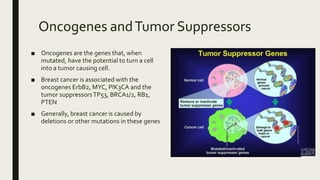
Oncogenes andTumor Suppressors
■ Oncogenes are the genes that, when
mutated, have the potential to turn a cell
into a tumor causing cell.
■ Breast cancer is associated with the
oncogenes ErbB2, MYC, PIK3CA and the
tumor suppressorsTP53, BRCA1/2, RB1,
PTEN
■ Generally, breast cancer is caused by
deletions or other mutations in these genes
Sarah’s biopsy results:
■ Sarah has a biopsy done on the solid mass found in her left breast and it is found to be:
– Malignant
– Stage III
– Containing no hormone receptors
What treatment options are available?
■ Treatment is dependent upon the cancer grade, cell type, and the invasiveness of the
tumor.
■ Radiation therapy uses high energy sources such as x-rays and protons to kill cancer
cells
■ Chemotherapy uses drugs to target and kill cancer cells
■ Hormone therapy is an option if the cancer cells contain hormone receptors
■ Surgical options include: a lumpectomy or mastectomy
– Lumpectomy’s are usually performed only on smaller tumors
These treatment options will often be used in varying combinations.
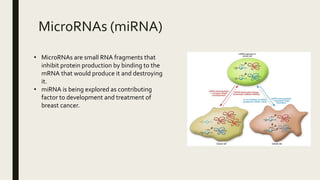
MicroRNAs (miRNA)
• MicroRNAs are small RNA fragments that
inhibit protein production by binding to the
mRNA that would produce it and destroying
it.
• miRNA is being explored as contributing
factor to development and treatment of
breast cancer.
What treatments would you recommend
for Sarah?
Sources
■ http://www.mayoclinic.org/diseases-conditions/breast-cancer
■ http://cshperspectives.cshlp.org/content/4/6/a013466.full#ref-11
■ http://www.sciencedirect.com/science/article/pii/S0012160606010967

Breast Cancer

  • 1.
  • 2.
    Initial Symptoms: ■ Sarahis a 45 year old female that presents for a regular check up. A small lump is discovered on her left breast. Sarah informs you that her breast has been tender to the touch but she did not find them out of the ordinary. ■ An x-ray is performed on her chest and a small lump is confirmed to be present.
  • 3.
  • 4.
    What is BreastCancer? ■ Breast cancer is a form of cancer found in tissue of the breasts and can occur in both men and women, but is most common in women ■ 85-90% of breast cancer is caused by mutations that occur as a result of aging. ■ Approximately 1 in 8 women will be diagnosed with breast cancer.
  • 6.
    Diagnosis ■ Mammograms areperformed more in depth if it is suspected that a lump is cancerous ■ A breast ultrasound may also be performed to determine the composition of a lump- fluid filled or solid? ■ A biopsy is the most definitive tool for breast cancer diagnosis. It can be used to confirm the cancerous nature of cells, the type of cells, the grade of the cancer, and the makeup of the cancerous cells.
  • 7.
    Oncogenes andTumor Suppressors ■Oncogenes are the genes that, when mutated, have the potential to turn a cell into a tumor causing cell. ■ Breast cancer is associated with the oncogenes ErbB2, MYC, PIK3CA and the tumor suppressorsTP53, BRCA1/2, RB1, PTEN ■ Generally, breast cancer is caused by deletions or other mutations in these genes
  • 8.
    Sarah’s biopsy results: ■Sarah has a biopsy done on the solid mass found in her left breast and it is found to be: – Malignant – Stage III – Containing no hormone receptors
  • 9.
    What treatment optionsare available? ■ Treatment is dependent upon the cancer grade, cell type, and the invasiveness of the tumor. ■ Radiation therapy uses high energy sources such as x-rays and protons to kill cancer cells ■ Chemotherapy uses drugs to target and kill cancer cells ■ Hormone therapy is an option if the cancer cells contain hormone receptors ■ Surgical options include: a lumpectomy or mastectomy – Lumpectomy’s are usually performed only on smaller tumors These treatment options will often be used in varying combinations.
  • 10.
    MicroRNAs (miRNA) • MicroRNAsare small RNA fragments that inhibit protein production by binding to the mRNA that would produce it and destroying it. • miRNA is being explored as contributing factor to development and treatment of breast cancer.
  • 11.
    What treatments wouldyou recommend for Sarah?
  • 12.