Life and its
manifestation
ABDULJALEEL K
ASSISTANT PROFESSOR
GOVERNMENT COLLEGE
KASARGOD
Science also refers to the body
of knowledge produced by
scientific investigation.
Pseudoscience
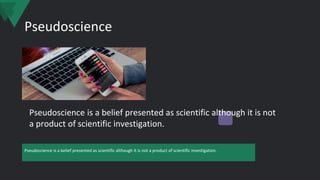
Pseudoscience is a belief presented as scientific although it is not a product of scientific investigation.
Pseudoscience is a belief presented as scientific although it is not
a product of scientific investigation.
BIOLOGY
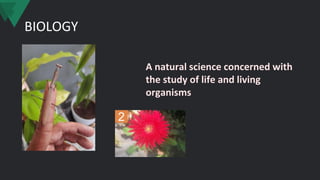
A natural science concerned with
the study of life and living
organisms
2
Living and life
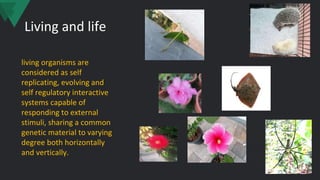
living organisms are
considered as self
replicating, evolving and
self regulatory interactive
systems capable of
responding to external
stimuli, sharing a common
genetic material to varying
degree both horizontally
and vertically.
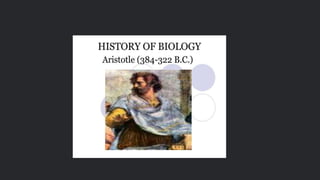
HISTORY OF BIOLOGY
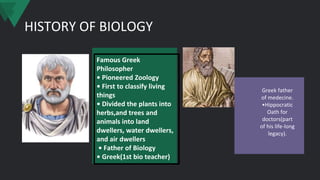
Famous Greek
Philosopher
• Pioneered Zoology
• First to classify living
things
• Divided the plants into
herbs,and trees and
animals into land
dwellers, water dwellers,
and air dwellers
• Father of Biology
• Greek(1st bio teacher)
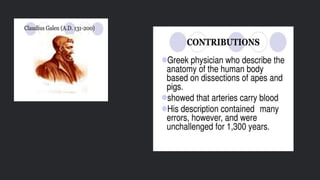
Greek father
of medecine.
•Hippocratic
Oath for
doctors(part
of his life-long
legacy).
Your Title Here
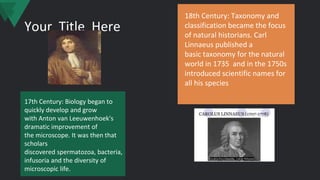
18th Century: Taxonomy and
classification became the focus
of natural historians. Carl
Linnaeus published a
basic taxonomy for the natural
world in 1735 and in the 1750s
introduced scientific names for
all his species
17th Century: Biology began to
quickly develop and grow
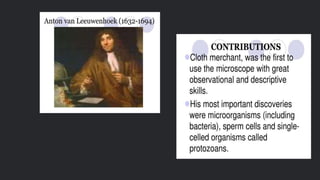
with Anton van Leeuwenhoek's
dramatic improvement of
the microscope. It was then that
scholars
discovered spermatozoa, bacteria,
infusoria and the diversity of
microscopic life.
Your Title Here
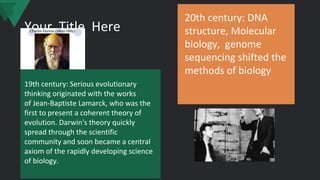
20th century: DNA
structure, Molecular
biology, genome
sequencing shifted the
methods of biology
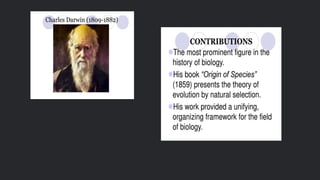
19th century: Serious evolutionary
thinking originated with the works
of Jean-Baptiste Lamarck, who was the
first to present a coherent theory of
evolution. Darwin's theory quickly
spread through the scientific
community and soon became a central
axiom of the rapidly developing science
of biology.
Manifestation of life
Living things are highly
organized, meaning they
contain specialized,
coordinated parts. All
living organisms are made
up of one or more cells,
which are considered the
fundamental units of life.
organisation
Life depends on an
enormous number of
interlocking chemical
reactions. The sum total
of the biochemical
reactions occurring in
an organism is called
its metabolism.
Metabolism
Living organisms regulate
their internal
environment to maintain
the relatively narrow
range of conditions
needed for cell function.
This maintenance of a
stable internal
environment, even in the
face of a changing
external environment, is
known as homeostasis
Homeostasis
Living organisms
undergo regulated
growth. Individual cells
become larger in size,
and multicellular
organisms accumulate
many cells through cell
division.
Growt
h
Life features
Reproduction
Evolution
Response
Living organisms can
reproduce themselves
to create new
organisms.
Reproduction can be
either asexual,
involving a single
parent organism,
or sexual, requiring
two parents
Living organisms
show “irritability,”
meaning that they
respond to stimuli
or changes in their
environment.
Populations of living organisms can
undergo evolution, meaning that the
genetic makeup of a population may
change over time. In some cases,
evolution involves natural selection,
in which a heritable trait, such as
darker fur color or narrower beak
shape, lets organisms survive and
reproduce better in a particular
environment.
Thanks
Add your text

'Life and its ma-WPS Office.pptx'.pptx

  • 1.
    Life and its manifestation ABDULJALEELK ASSISTANT PROFESSOR GOVERNMENT COLLEGE KASARGOD
  • 2.
    Science also refersto the body of knowledge produced by scientific investigation.
  • 3.
    Pseudoscience Pseudoscience is abelief presented as scientific although it is not a product of scientific investigation. Pseudoscience is a belief presented as scientific although it is not a product of scientific investigation.
  • 4.
    BIOLOGY A natural scienceconcerned with the study of life and living organisms 2
  • 5.
    Living and life livingorganisms are considered as self replicating, evolving and self regulatory interactive systems capable of responding to external stimuli, sharing a common genetic material to varying degree both horizontally and vertically.
  • 6.
    HISTORY OF BIOLOGY FamousGreek Philosopher • Pioneered Zoology • First to classify living things • Divided the plants into herbs,and trees and animals into land dwellers, water dwellers, and air dwellers • Father of Biology • Greek(1st bio teacher) Greek father of medecine. •Hippocratic Oath for doctors(part of his life-long legacy).
  • 7.
    Your Title Here 18thCentury: Taxonomy and classification became the focus of natural historians. Carl Linnaeus published a basic taxonomy for the natural world in 1735 and in the 1750s introduced scientific names for all his species 17th Century: Biology began to quickly develop and grow with Anton van Leeuwenhoek's dramatic improvement of the microscope. It was then that scholars discovered spermatozoa, bacteria, infusoria and the diversity of microscopic life.
  • 8.
    Your Title Here 20thcentury: DNA structure, Molecular biology, genome sequencing shifted the methods of biology 19th century: Serious evolutionary thinking originated with the works of Jean-Baptiste Lamarck, who was the first to present a coherent theory of evolution. Darwin's theory quickly spread through the scientific community and soon became a central axiom of the rapidly developing science of biology.
  • 19.
    Manifestation of life Livingthings are highly organized, meaning they contain specialized, coordinated parts. All living organisms are made up of one or more cells, which are considered the fundamental units of life. organisation Life depends on an enormous number of interlocking chemical reactions. The sum total of the biochemical reactions occurring in an organism is called its metabolism. Metabolism Living organisms regulate their internal environment to maintain the relatively narrow range of conditions needed for cell function. This maintenance of a stable internal environment, even in the face of a changing external environment, is known as homeostasis Homeostasis Living organisms undergo regulated growth. Individual cells become larger in size, and multicellular organisms accumulate many cells through cell division. Growt h
  • 20.
    Life features Reproduction Evolution Response Living organismscan reproduce themselves to create new organisms. Reproduction can be either asexual, involving a single parent organism, or sexual, requiring two parents Living organisms show “irritability,” meaning that they respond to stimuli or changes in their environment. Populations of living organisms can undergo evolution, meaning that the genetic makeup of a population may change over time. In some cases, evolution involves natural selection, in which a heritable trait, such as darker fur color or narrower beak shape, lets organisms survive and reproduce better in a particular environment.
  • 21.