DNA BARCODING
Dr. ABDULJALEEL K
Assistant Professor
Dept. of Zoology
Government College, Kasaragod
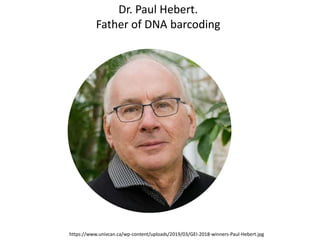
Dr. Paul Hebert.
Father of DNA barcoding
https://www.univcan.ca/wp-content/uploads/2019/03/GEI-2018-winners-Paul-Hebert.jpg
DNA barcoding
• A method of species identification using a
short section of DNA from a specific gene or
genes.
• The premise of DNA barcoding is that by
comparison with a reference library of such
DNA sequence, an individual sequence can
be used to uniquely identify an organism to
species,
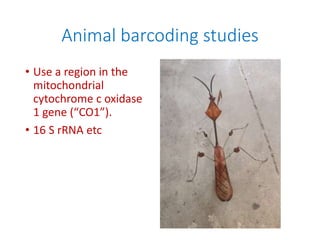
Animal barcoding studies
• Use a region in the
mitochondrial
cytochrome c oxidase
1 gene (“CO1”).
• 16 S rRNA etc
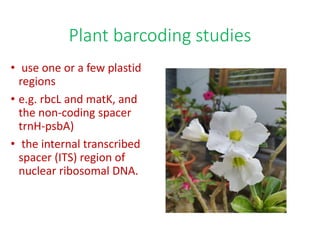
Plant barcoding studies
• use one or a few plastid
regions
• e.g. rbcL and matK, and
the non-coding spacer
trnH-psbA)
• the internal transcribed
spacer (ITS) region of
nuclear ribosomal DNA.
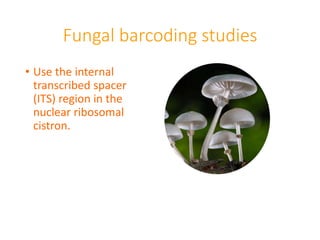
Fungal barcoding studies
• Use the internal
transcribed spacer
(ITS) region in the
nuclear ribosomal
cistron.
Steps
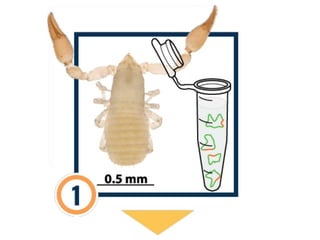
• 1: Isolate DNA from the sample
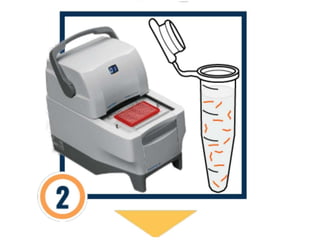
• 2: Amplify the target DNA barcode region using PCR
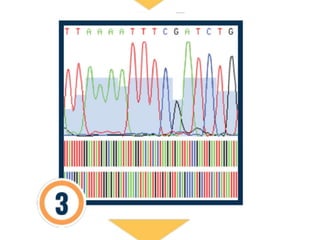
• 3: Sequence the PCR products
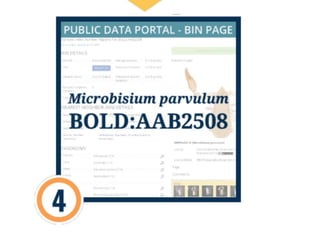
• 4: Compare the resulting sequences against reference
databases to find the matching species
Applications
• Taxonomy and species identification
• Pest and disease control
• Food production and safety
• Resource management
• Conservation
• Research
• Education
• Recreation.
References
• https://ibol.org/about/dna-barcoding/
• https://en.m.wikipedia.org/wiki/DNA_barcoding
• https://www.univcan.ca/wp-content/uploads/2019/03/GEI-2018-winners-
Paul-Hebert.jpg

DNA BARCODING INTRODUCTION

  • 1.
    DNA BARCODING Dr. ABDULJALEELK Assistant Professor Dept. of Zoology Government College, Kasaragod
  • 2.
    Dr. Paul Hebert. Fatherof DNA barcoding https://www.univcan.ca/wp-content/uploads/2019/03/GEI-2018-winners-Paul-Hebert.jpg
  • 3.
    DNA barcoding • Amethod of species identification using a short section of DNA from a specific gene or genes. • The premise of DNA barcoding is that by comparison with a reference library of such DNA sequence, an individual sequence can be used to uniquely identify an organism to species,
  • 4.
    Animal barcoding studies •Use a region in the mitochondrial cytochrome c oxidase 1 gene (“CO1”). • 16 S rRNA etc
  • 5.
    Plant barcoding studies •use one or a few plastid regions • e.g. rbcL and matK, and the non-coding spacer trnH-psbA) • the internal transcribed spacer (ITS) region of nuclear ribosomal DNA.
  • 6.
    Fungal barcoding studies •Use the internal transcribed spacer (ITS) region in the nuclear ribosomal cistron.
  • 7.
    Steps • 1: IsolateDNA from the sample • 2: Amplify the target DNA barcode region using PCR • 3: Sequence the PCR products • 4: Compare the resulting sequences against reference databases to find the matching species
  • 12.
    Applications • Taxonomy andspecies identification • Pest and disease control • Food production and safety • Resource management • Conservation • Research • Education • Recreation.
  • 13.
    References • https://ibol.org/about/dna-barcoding/ • https://en.m.wikipedia.org/wiki/DNA_barcoding •https://www.univcan.ca/wp-content/uploads/2019/03/GEI-2018-winners- Paul-Hebert.jpg