

This document discusses different factors that influence muscular hypertrophy, or muscle growth. It states that to maximize hypertrophy, training should target all muscle fiber types by incorporating a wide range of rep ranges and loads. Higher volume through increased sets, frequency, and density is more important for hypertrophy than other variables, though overtraining can occur with excessive volume increases. Training to muscular failure can further enhance hypertrophy when work is matched, but should not be done continually to avoid overtraining. Genetics and use of steroids also impact hypertrophy but cannot be controlled. Proper nutrition is essential to support training adaptations.
Focuses on muscle fiber types, motor unit recruitment, and importance of training types for hypertrophy.
Discusses mechanical tension, muscle damage, metabolic stress, and satellite cells affecting muscle growth.Describes function and activation of satellite cells in muscle repair and growth during hypertrophy.
Highlights variables impacting hypertrophy, including volume, failure, intensity, and training frequency.
Emphasizes the importance of volume in training, identifying multiple sets as more effective for growth.
Explains that training to failure can enhance hypertrophy but warns about overtraining risks.
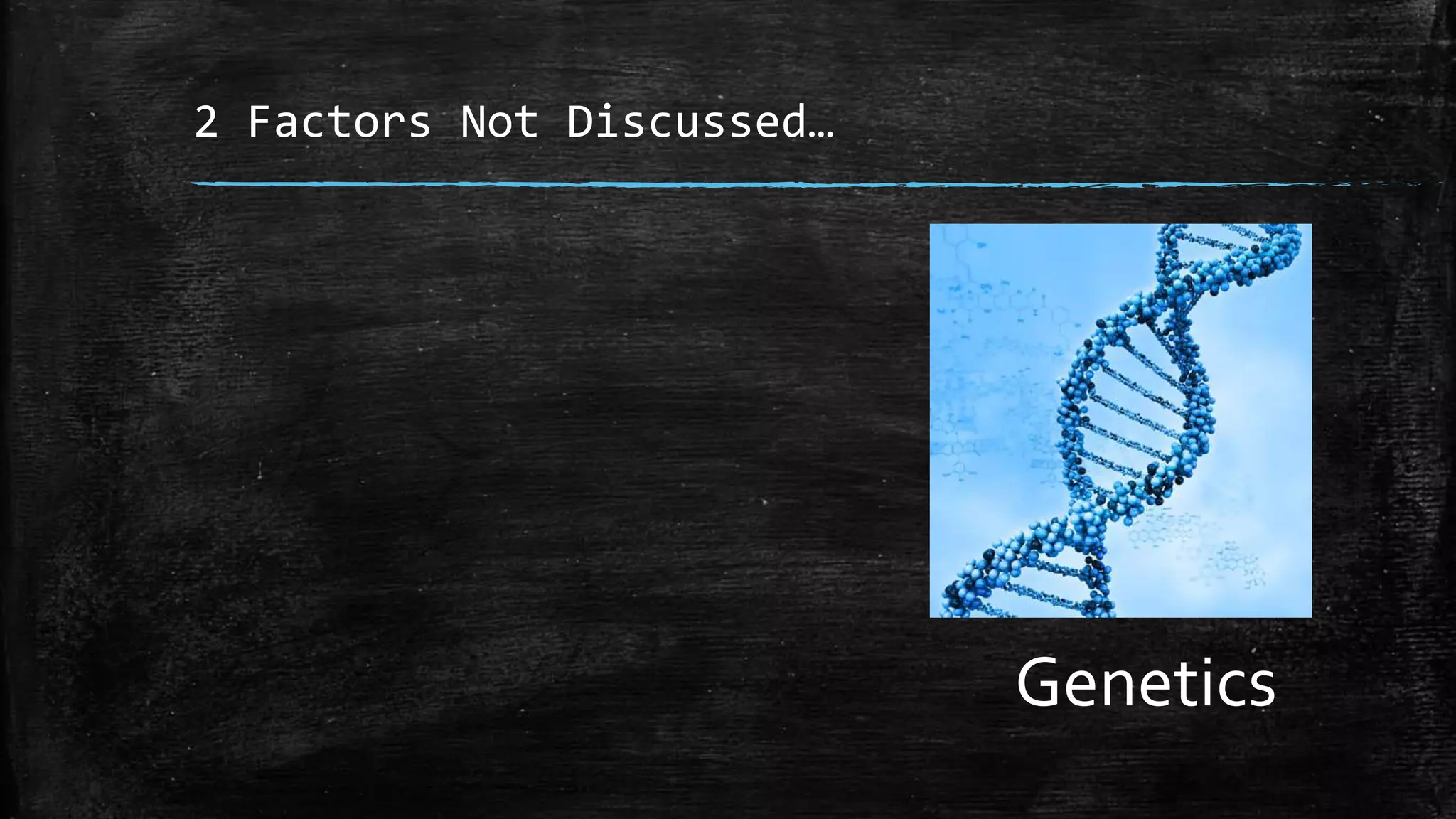
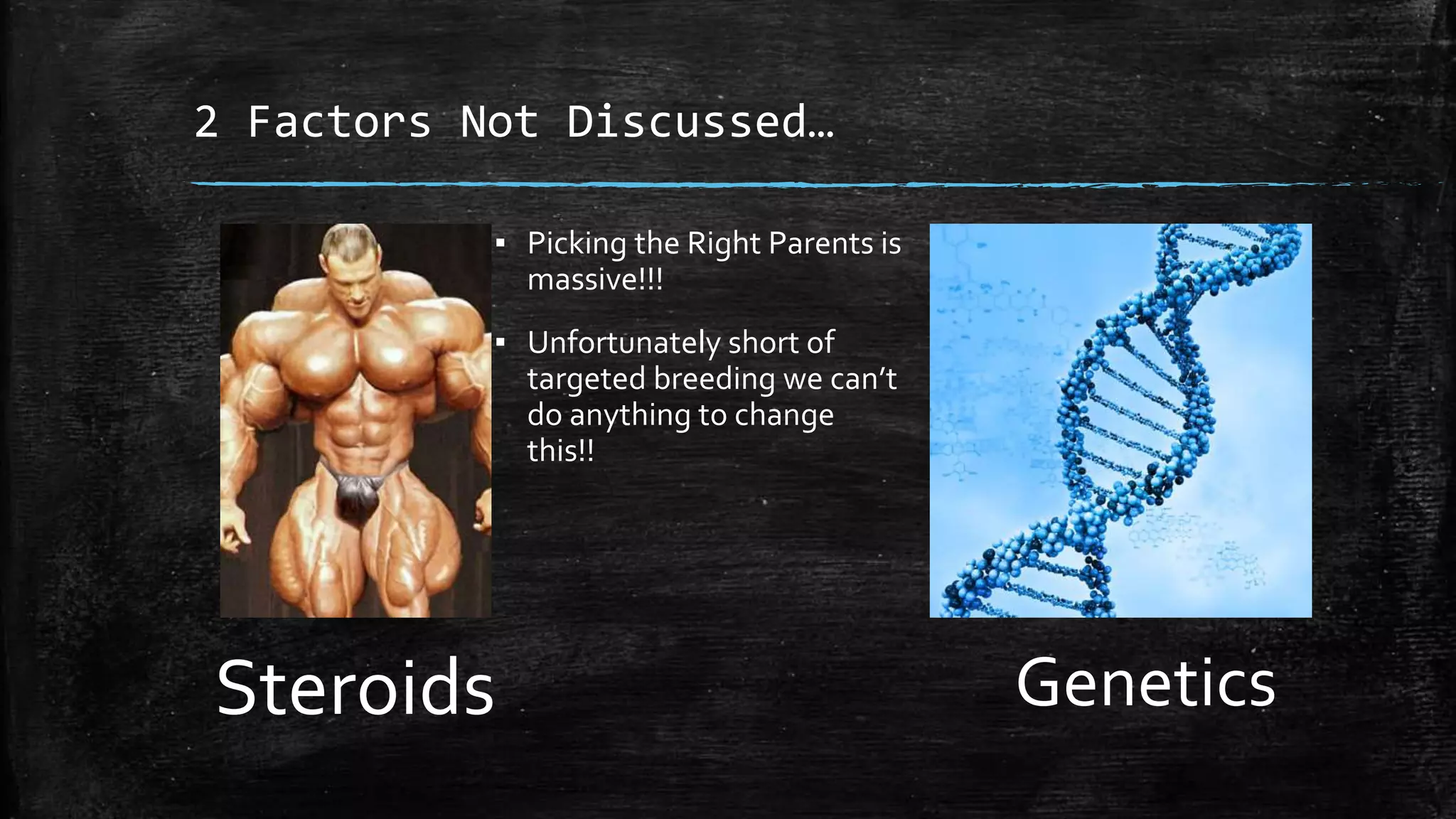
Discusses genetic factors and the impact of steroids on muscle growth, including an example of testosterone use.
Highlights the significant role of nutrition and diet in maximizing training gains; emphasizes protein intake.
Discusses the balance of hypertrophy with other training goals like strength, power, and conditioning.
Explains the individualization of training programs for hypertrophy, considering sport-specific needs.
Summarizes key takeaways on hypertrophy training strategies emphasizing recruitment, volume, and methods.
Muscle Fibre typehypertrophy
▪ The goal should be to maximally recruit the entire motor unit pool
(and therefore all muscle fibres)
4.
Muscle Fibre typehypertrophy
▪ The goal should be to maximally recruit the entire motor unit pool
(and therefore all muscle fibres)
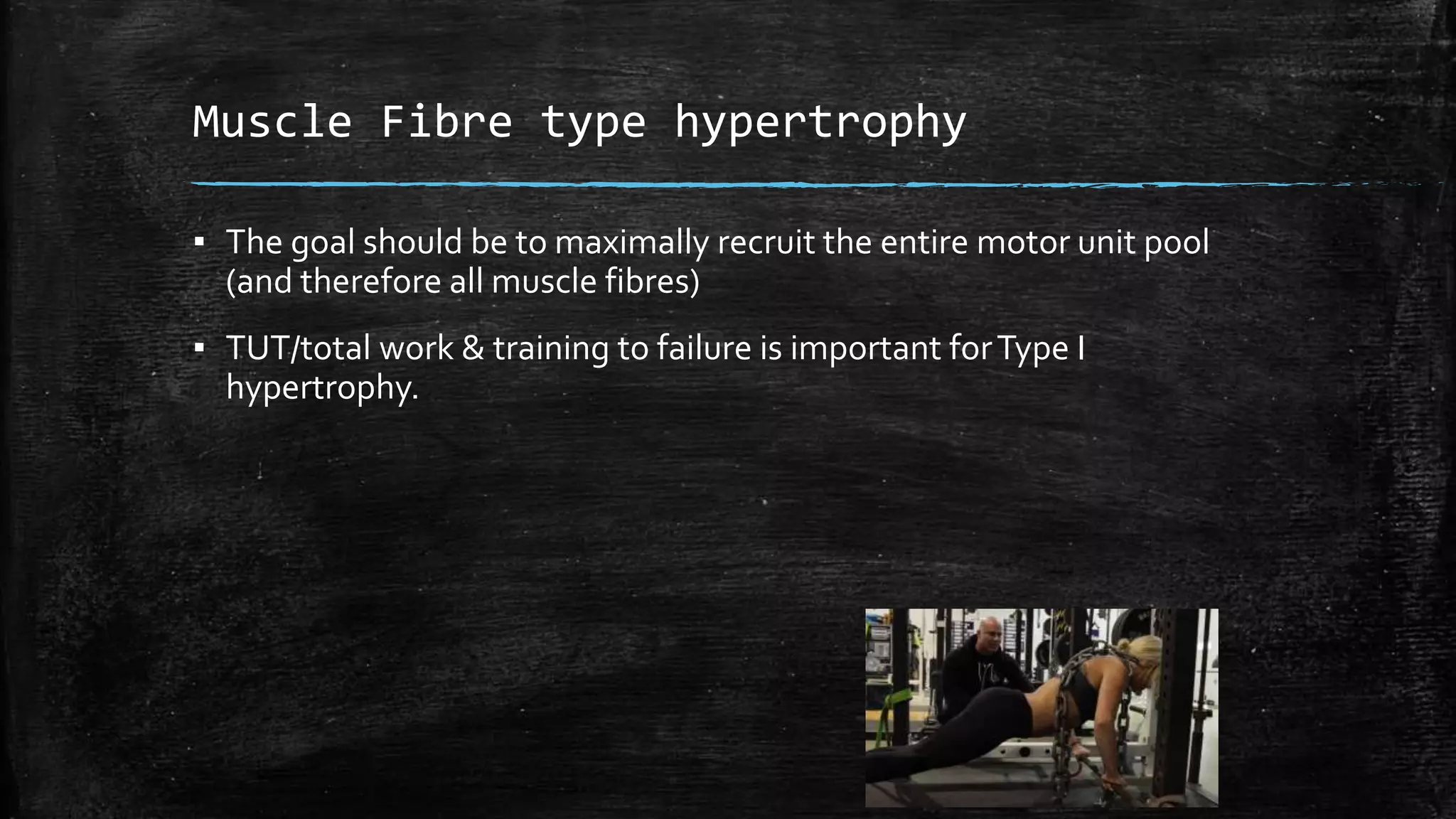
▪ TUT/total work & training to failure is important forType I
hypertrophy.
5.
Muscle Fibre typehypertrophy
▪ The goal should be to maximally recruit the entire motor unit pool
(and therefore all muscle fibres)
▪ TUT/total work & training to failure is important forType I
hypertrophy.
▪ Load & Movement velocity is important forType II hypertrophy.
6.
Muscle Fibre typehypertrophy
▪ The goal should be to maximally recruit the entire motor unit pool
(and therefore all muscle fibres)
▪ TUT/total work & training to failure is important forType I
hypertrophy.
▪ Load & Movement velocity is important forType II hypertrophy.
▪ This is why drop sets to failure may work when lifting at heavy loads,
as it provides the minimal effective dose forType I fibre hypertrophy
as well.
7.
Muscle Fibre typehypertrophy
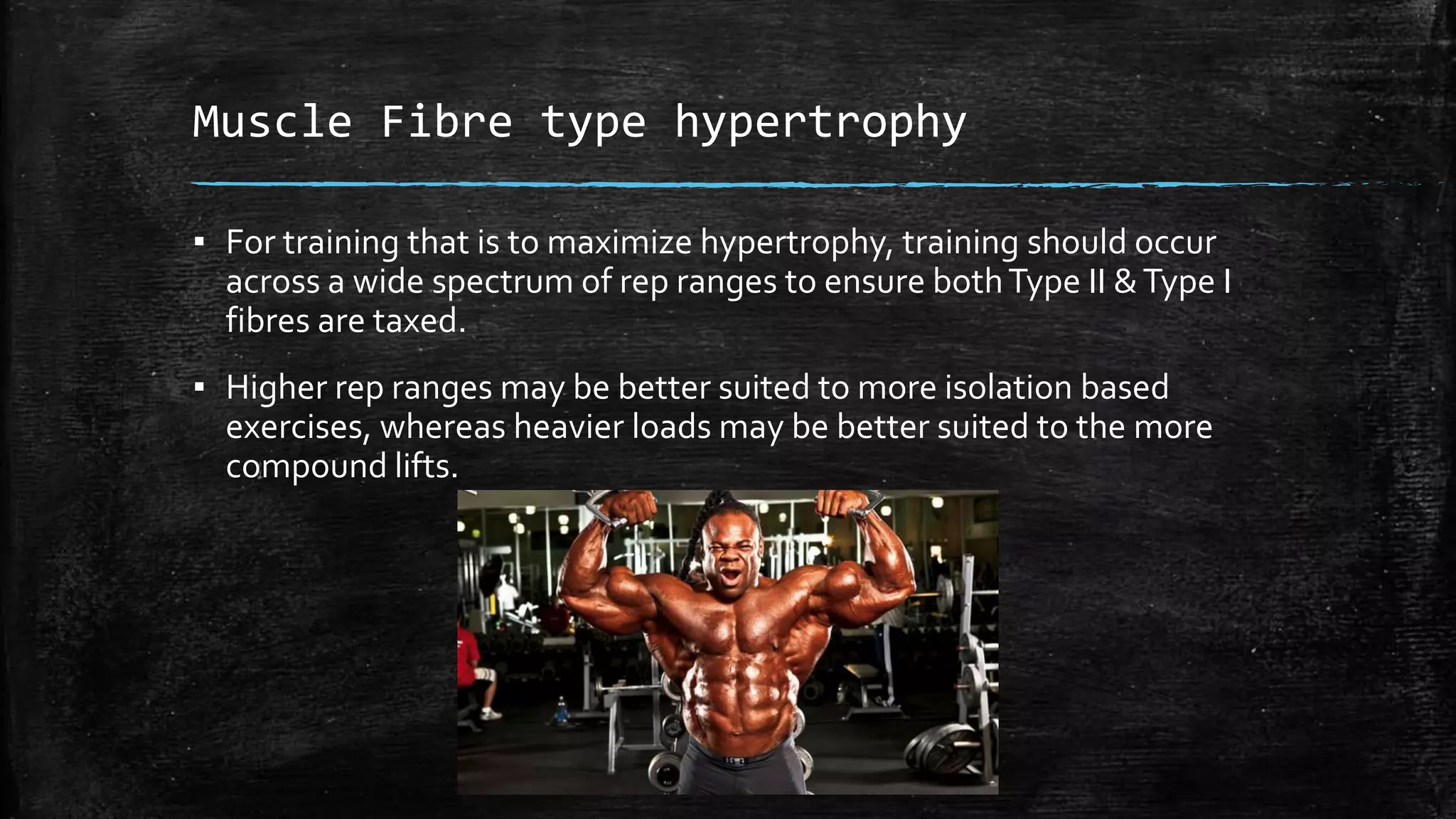
▪ For training that is to maximize hypertrophy, training should occur
across a wide spectrum of rep ranges to ensure bothType II &Type I
fibres are taxed.
8.
Muscle Fibre typehypertrophy
▪ For training that is to maximize hypertrophy, training should occur
across a wide spectrum of rep ranges to ensure bothType II &Type I
fibres are taxed.
▪ Higher rep ranges may be better suited to more isolation based
exercises, whereas heavier loads may be better suited to the more
compound lifts.
9.
How does HypertrophyOccur?
▪ 3 Factors that are massively important at a fibre level for your body
to adapt…
– MechanicalTension
– Muscle Damage
– Metabolic Stress
10.
How does HypertrophyOccur?
▪ 3 Factors that are massively important at a fibre level for your body
to adapt…
– MechanicalTension
– Muscle Damage
– Metabolic Stress
▪ All of these things will initiate myogenic signaling pathways such as
mTOR that it seems may be the master regulator for muscular
hypertrophy.
11.
How does HypertrophyOccur?
▪ 3 Factors that are massively important at a fibre level for your body
to adapt…
– MechanicalTension
– Muscle Damage
– Metabolic Stress
▪ All of these things will initiate myogenic signaling pathways such as
mTOR that it seems may be the master regulator for muscular
hypertrophy.
▪ Furthermore you will get increased satellite cell activation and
proliferation…
12.
Satellite Cells
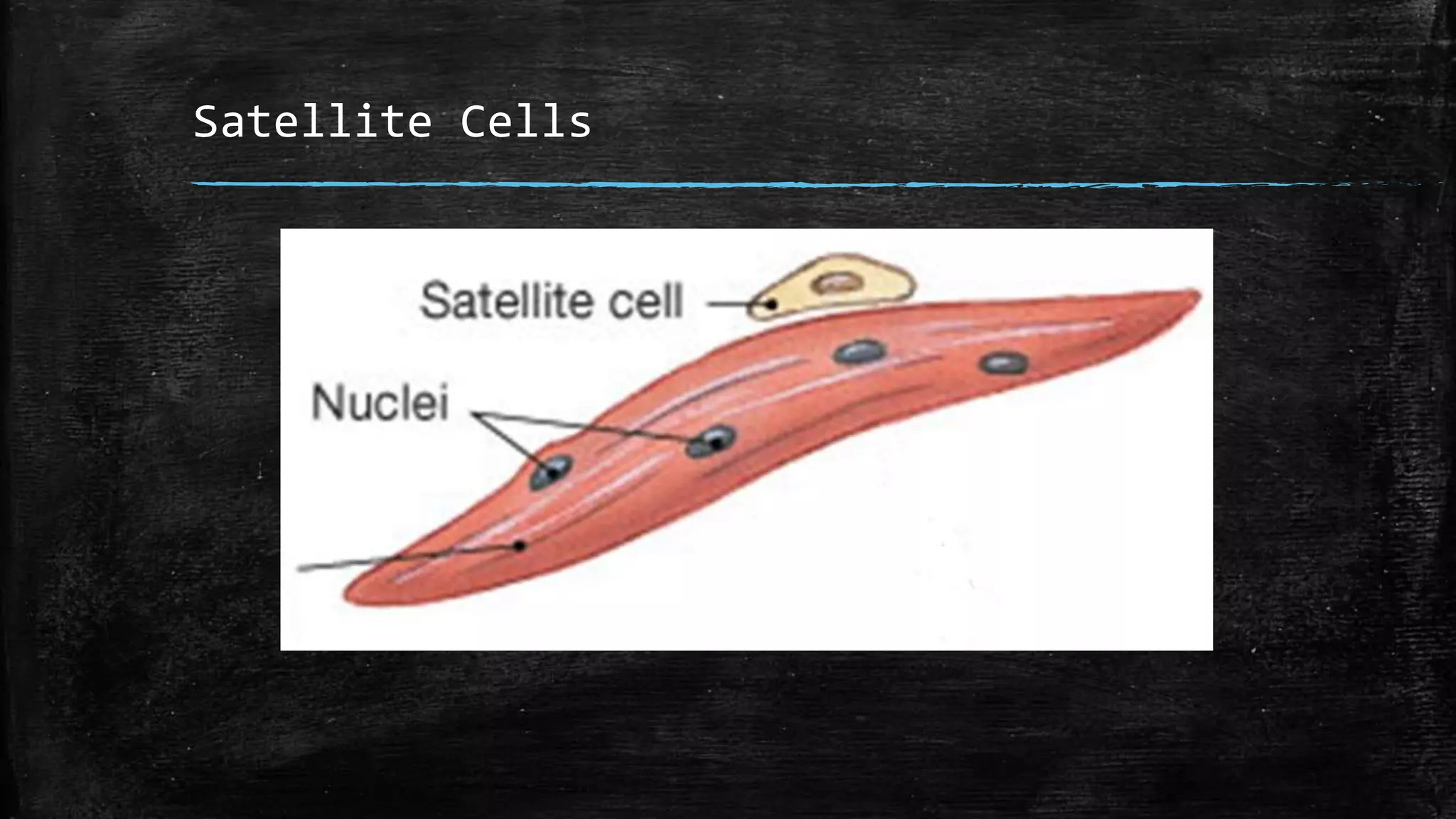
▪ SatelliteCells are stem cells that hover outside of muscle fibres and
when the muscle fibre is damaged – i.e. from weight training - swoop
in to patch up the muscle to build it bigger and better.
13.
Satellite Cells
▪ SatelliteCells are stem cells that hover outside of muscle fibres and
when the muscle fibre is damaged – i.e. from weight training - swoop
in to patch up the muscle to build it bigger and better.
▪ Muscle is controlled by myonuclei which are like the command
centres for a certain area of muscle.As a muscle fibre grows with
training so does the area that the myonuclei governs over. Until the
point when the muscle fibre gets big enough that the myonuclei
needs help, this is when the satellite cells provide backup and form
new command centres allowing your muscles to continue to grow.
14.
Satellite Cells
▪ SatelliteCells are stem cells that hover outside of muscle fibres and
when the muscle fibre is damaged – i.e. from weight training - swoop
in to patch up the muscle to build it bigger and better.
▪ Muscle is controlled by myonuclei which are like the command
centres for a certain area of muscle.As a muscle fibre grows with
training so does the area that the myonuclei governs over. Until the
point when the muscle fibre gets big enough that the myonuclei
needs help, this is when the satellite cells provide backup and form
new command centres allowing your muscles to continue to grow.
▪ Satellite cell activity is usually the difference between our ‘hard
gainers’ and our ‘genetic freaks’.
Factors That AffectHypertrophy
▪ Volume
▪ Muscular Failure
▪ Intensity (Relative Load)
▪ Range of Motion
21.
Factors That AffectHypertrophy
▪ Volume
▪ Muscular Failure
▪ Intensity (Relative Load)
▪ Range of Motion
▪ Rest Periods
22.
Factors That AffectHypertrophy
▪ Volume
▪ Muscular Failure
▪ Intensity (Relative Load)
▪ Range of Motion
▪ Rest Periods
▪ Rep Speed
23.
Factors That AffectHypertrophy
▪ Volume
▪ Muscular Failure
▪ Intensity (Relative Load)
▪ Range of Motion
▪ Rest Periods
▪ Rep Speed
▪ Frequency
24.
Factors That AffectHypertrophy
▪ Volume
▪ Muscular Failure
▪ Intensity (Relative Load)
▪ Range of Motion
▪ Rest Periods
▪ Rep Speed
▪ Frequency
▪ Muscle Action
25.
But Which VariablesMatter More?
Rep
Speed
Rest
Periods
Muscle Action
Frequency
Range of Motion
Intensity
Muscular Failure
Volume
26.
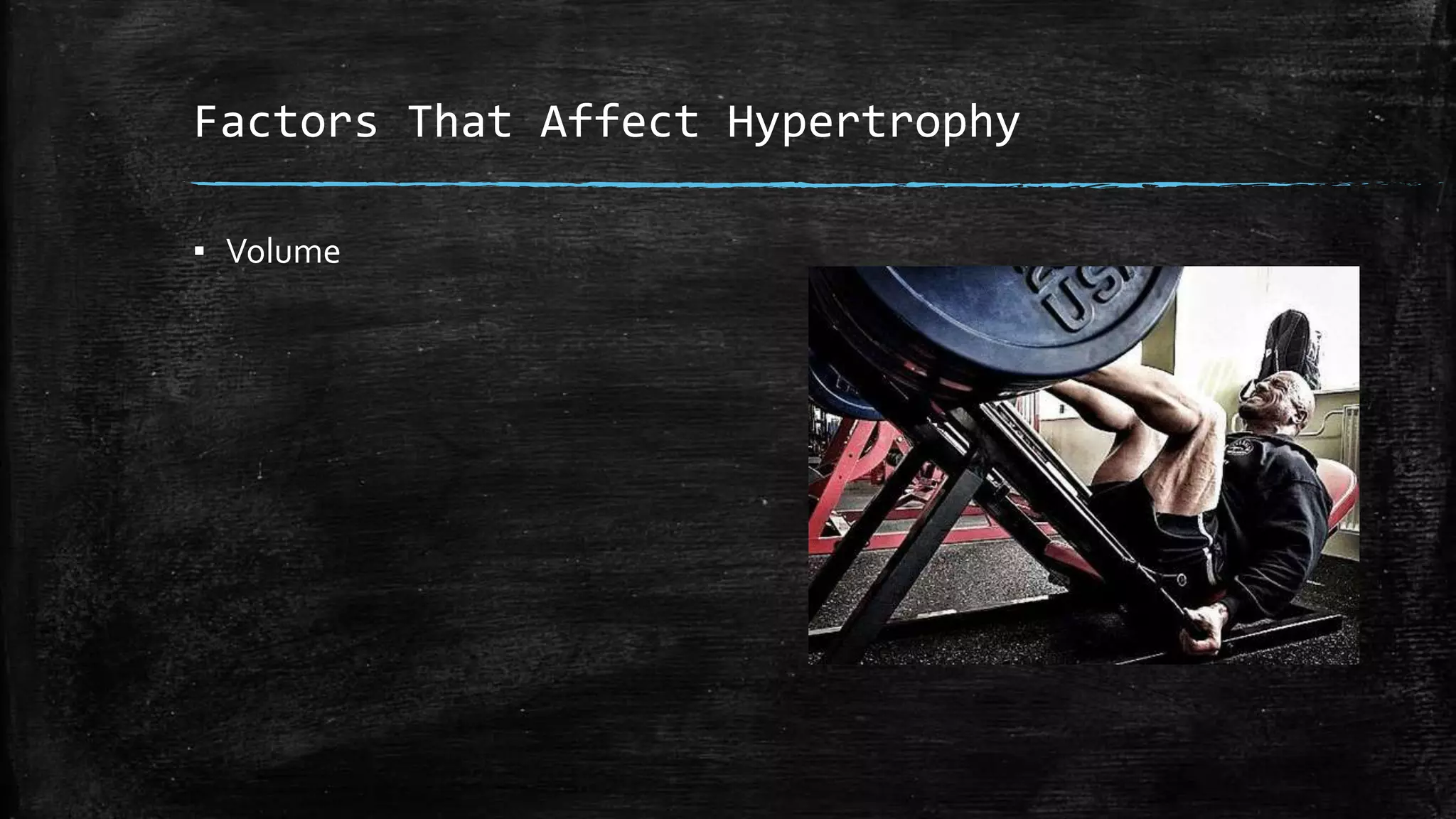
Volume
▪ Multiple setsare better than one. ‘Volume appears to be a more
important variable with respect to skeletal muscle hypertrophy’
(Loenneke, 2012)
27.
Volume
▪ Multiple setsare better than one. ‘Volume appears to be a more
important variable with respect to skeletal muscle hypertrophy’
(Loenneke, 2012)
▪ Can be achieved by increasing number of sets or by the frequency of
workouts to increase the ‘weekly volume’.This approach especially
seems to work for trained athletes. (McLester, 2000)
28.
Volume
▪ Multiple setsare better than one. ‘Volume appears to be a more
important variable with respect to skeletal muscle hypertrophy’
(Loenneke, 2012)
▪ Can be achieved by increasing number of sets or by the frequency of
workouts to increase the ‘weekly volume’.This approach especially
seems to work for trained athletes. (McLester, 2000)
▪ More lifts within the workout, increases the training density which in
turn increases volume.
29.
Volume
▪ Multiple setsare better than one. ‘Volume appears to be a more
important variable with respect to skeletal muscle hypertrophy’
(Loenneke, 2012)
▪ Can be achieved by increasing number of sets or by the frequency of
workouts to increase the ‘weekly volume’.This approach especially
seems to work for trained athletes. (McLester, 2000)
▪ More lifts within the workout, increases the training density which in
turn increases volume.
▪ There will be a point of diminishing returns.
30.
Volume
▪ Multiple setsare better than one. ‘Volume appears to be a more
important variable with respect to skeletal muscle hypertrophy’
(Loenneke, 2012)
▪ Can be achieved by increasing number of sets or by the frequency of
workouts to increase the ‘weekly volume’.This approach especially
seems to work for trained athletes. (McLester, 2000)
▪ More lifts within the workout, increases the training density which in
turn increases volume.
▪ There will be a point of diminishing returns.
▪ Overtraining is a major issue with continually accumulating more and
more volume.
31.
Muscular Failure
▪ Whenwork matched, training to failure seems to improve muscular
hypertrophy above what not training to failure can do.
32.
Muscular Failure
▪ Whenwork matched, training to failure seems to improve muscular
hypertrophy above what not training to failure can do.
▪ Overtraining is again an issue with ~7 weeks of continual lifting to
failure being associated with sustained CNS fatigue and overtraining.
(Stone, 1996)
33.
Muscular Failure
▪ Whenwork matched, training to failure seems to improve muscular
hypertrophy above what not training to failure can do.
▪ Overtraining is again an issue with ~7 weeks of continual lifting to
failure being associated with sustained CNS fatigue and overtraining.
(Stone, 1996)
▪ Makes programming easier, no matter the load selected you know
you’ll get what you want.
34.
Muscular Failure
▪ Whenwork matched, training to failure seems to improve muscular
hypertrophy above what not training to failure can do.
▪ Overtraining is again an issue with ~7 weeks of continual lifting to
failure being associated with sustained CNS fatigue and overtraining.
(Stone, 1996)
▪ Makes programming easier, no matter the load selected you know
you’ll get what you want.
▪ Comparable hypertrophy can occur at loads of 30% 1RM compared to
higher load lifting as long as the sets are taken to failure. (Burd, 2010)
2 Factors NotDiscussed…
Genetics
▪ Picking the Right Parents is
massive!!!
▪ Unfortunately short of
targeted breeding we can’t
do anything to change
this!!
39.
2 Factors NotDiscussed…
Steroids Genetics
▪ Picking the Right Parents is
massive!!!
▪ Unfortunately short of
targeted breeding we can’t
do anything to change
this!!
40.
2 Factors NotDiscussed…
Steroids Genetics
▪ Picking the Right Parents is
massive!!!
▪ Unfortunately short of
targeted breeding we can’t
do anything to change
this!!
▪ Steroids work. Of course
they do: but they aren’t an
option either.
▪ 600mg of weekly
Testosterone enanthate
over 12weeks = ~6kg of
lean mass gain (3-11kg
range) (Bhasin, 1996)
Is training theOnly Thing?
▪ Diet & Nutrition play a HUGE role in augmenting the training that
you are doing!!
▪ Feed the Machine!!!
43.
Is training theOnly Thing?
▪ Diet & Nutrition play a HUGE role in augmenting the training that
you are doing!!
▪ Feed the Machine!!!
▪ For them to fully realise their gains what they do away from us will be
if not more important.
44.
Is training theOnly Thing?
▪ Diet & Nutrition play a HUGE role in augmenting the training that
you are doing!!
▪ Feed the Machine!!!
▪ For them to fully realise their gains what they do away from us will be
if not more important.
▪ RECOMMENDATION – EAT!!!
45.
Is training theOnly Thing?
▪ Diet & Nutrition play a HUGE role in augmenting the training that
you are doing!!
▪ Feed the Machine!!!
▪ For them to fully realise their gains what they do away from us will be
if not more important.
▪ RECOMMENDATION – EAT!!!
▪ Get the protein in!!!
46.
How does HypertrophyProgramming Fit in
Our Environment???
▪ Despite Hypertrophy being important…It’s not the only thing our
guys need:
47.
How does HypertrophyProgramming Fit in
Our Environment???
▪ Despite Hypertrophy being important…It’s not the only thing our
guys need:
▪ Strength, Power, Conditioning, Mobility, Repeated Sprint Ability etc.
▪ All of these factors may not be best developed or be compatible with
strictly hypertrophy focused training.
48.
How does HypertrophyProgramming Fit in
Our Environment???
▪ Despite Hypertrophy being important…It’s not the only thing our
guys need:
▪ Strength, Power, Conditioning, Mobility, Repeated Sprint Ability etc.
▪ All of these factors may not be best developed or be compatible with
strictly hypertrophy focused training.
Strength-Power +
49.
How does HypertrophyProgramming Fit in
Our Environment???
▪ Despite Hypertrophy being important…It’s not the only thing our
guys need:
▪ Strength, Power, Conditioning, Mobility, Repeated Sprint Ability etc.
▪ All of these factors may not be best developed or be compatible with
strictly hypertrophy focused training.
Strength-Power + Hypertrophy +
50.
How does HypertrophyProgramming Fit in
Our Environment???
▪ Despite Hypertrophy being important…It’s not the only thing our
guys need:
▪ Strength, Power, Conditioning, Mobility, Repeated Sprint Ability etc.
▪ All of these factors may not be best developed or be compatible with
strictly hypertrophy focused training.
Strength-Power + Hypertrophy + Conditioning =
51.
How does HypertrophyProgramming Fit in
Our Environment???
▪ Despite Hypertrophy being important…It’s not the only thing our
guys need:
▪ Strength, Power, Conditioning, Mobility, Repeated Sprint Ability etc.
▪ All of these factors may not be best developed or be compatible with
strictly hypertrophy focused training.
Strength-Power + Hypertrophy + Conditioning = Results
So how shouldit be programmed??
▪ The answer as always is it depends!!
54.
So how shouldit be programmed??
▪ The answer as always is it depends!!
▪ Luckily there are many pathways to Rome, so it is going to be highly
individual and sport/environment/situation specific.
55.
So how shouldit be programmed??
▪ The answer as always is it depends!!
▪ Luckily there are many pathways to Rome, so it is going to be highly
individual and sport/environment/situation specific.
▪ Preseason periods will be massive to increase muscular hypertrophy,
as game volume and competing stimuli will be lower.
56.
So how shouldit be programmed??
▪ The answer as always is it depends!!
▪ Luckily there are many pathways to Rome, so it is going to be highly
individual and sport/environment/situation specific.
▪ Preseason periods will be massive to increase muscular hypertrophy,
as game volume and competing stimuli will be lower.
▪ Take advantage of periods where game & training volume are
reduced.
57.
So how shouldit be programmed??
▪ The answer as always is it depends!!
▪ Luckily there are many pathways to Rome, so it is going to be highly
individual and sport/environment/situation specific.
▪ Preseason periods will be massive to increase muscular hypertrophy,
as game volume and competing stimuli will be lower.
▪ Take advantage of periods where game & training volume are
reduced.
▪ For our environment STR is paramount so any HYP training strategy
that allows for STR development should be prioritized.
58.
Take Home Points…
▪Aim to get full motor unit recruitment (BothType II andType I fibres)
by activating as much of the muscle as possible.
59.
Take Home Points…
▪Aim to get full motor unit recruitment (BothType II andType I fibres)
by activating as much of the muscle as possible.
▪ mTOR & Satellite cell activity are the keys to send the signals to tell
your body to grow.
60.
Take Home Points…
▪Aim to get full motor unit recruitment (BothType II andType I fibres)
by activating as much of the muscle as possible.
▪ mTOR & Satellite cell activity are the keys to send the signals to tell
your body to grow.
▪ Volume, muscular failure & intensity are important if hypertrophy is
the goal.
61.
Take Home Points…
▪Aim to get full motor unit recruitment (BothType II andType I fibres)
by activating as much of the muscle as possible.
▪ mTOR & Satellite cell activity are the keys to send the signals to tell
your body to grow.
▪ Volume, muscular failure & intensity are important if hypertrophy is
the goal.
▪ There are many ways to achieve hypertrophy, so a variety of
methods, exercises & loads should be used.
62.
Take Home Points…
▪Aim to get full motor unit recruitment (BothType II andType I fibres)
by activating as much of the muscle as possible.
▪ mTOR & Satellite cell activity are the keys to send the signals to tell
your body to grow.
▪ Volume, muscular failure & intensity are important if hypertrophy is
the goal.
▪ There are many ways to achieve hypertrophy, so a variety of
methods, exercises & loads should be used.
▪ Be cognizant of the other needs of the program – i.e. strength,
conditioning etc. – and how they mesh with hypertrophy training.