










Absolutely, Positively Negative!
 
What is Hypertrophy? Sarcoplasmic Hypertrophy Applied Negatives Defined Putting the Two Together Exercise Examples Program Design Study Introduction
The Wonder of Hypertrophy! We’ve all heard about it Every “guru” chats about it Our athletes harass us about it Magical number of reps! Magical percent of 1RM! REALLY??
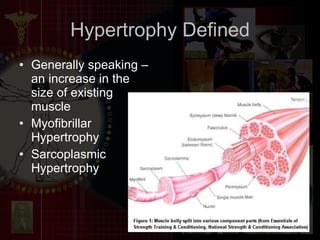
Hypertrophy Defined Generally speaking – an increase in the size of existing muscle Myofibrillar Hypertrophy Sarcoplasmic Hypertrophy
Sarcoplasmic and Myofibrillar cannot be separated completely Cannot train either one exclusively Can train one more than the other Hypertrophy Defined
Hypertrophy Defined Most athletes want/need some size We want them to be stronger/faster/etc. So, a little bit of size with an increase in strength is PRIME! Enter Myofibrillar Hypertrophy Addition of strength comes from distribution of force over a broader surface area
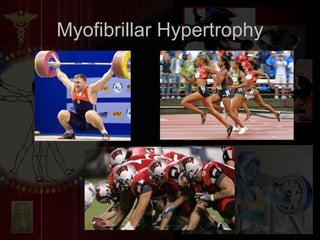
Myofibrillar Hypertrophy Primarily due to increase in size & number of actin and myosin filaments. Synthesis of actin & myosin proteins controlled by genes in cell nucleus. Strength exercise prompt genes to send chemical message to enzymes outside nucleus, stimulating actin/myosin construction.  Filaments added to periphery of myofibrils, enlarging existing myofibrils.  Though both fast & slow twitch fibers may increase in size, fast appear more responsive.
Myofibrillar Hypertrophy
Other Needs? But what about our “special” athletes? Want larger muscles, but don’t necessarily  need to be stronger? SAY IT ISN’T SO! In walks Sarcoplasmic Hypertrophy
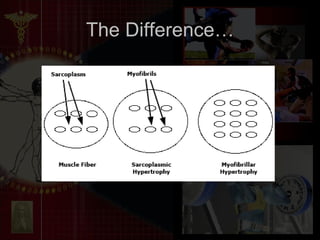
Sarcoplasmic Hypertrophy Muscle fibers stimulated to exert force that is uncommon to their normal function Muscles compelled to increase the storage of necessary nutrients in order to maintain these new required levels of force.   This alteration in these stored levels of substrates leads to an increase in fluids. This lends to the swelling in the size of the Sarcomere, without a corresponding enhancement in contractile proteins.
Sarcoplasmic Hypertrophy
The Difference…
But how can we do THAT? We know about concentric training (positives) We know about eccentric training (negatives) Sooooo……..
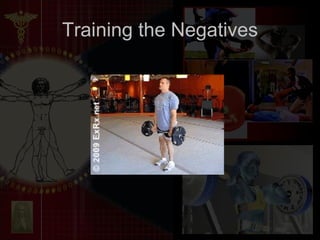
Training the Negatives When the same force is exerted during the concentric phase of the lift as in the eccentric phase, fewer muscle fibers are activated while the muscle lengthens. In other words: it’s “easier” to fight gravity than to go against gravity. Because of this, eccentric contractions allow greater overall force production in addition to less fiber recruitment, which means the fibers are stressed more.
Training the Negatives
However, there’s a concern Because of this difference in fiber activation and utilization, a typical pyramid loading method may not be the most effective in the development of muscle. In regards to typical resistance training, both types of contractions are involved, and, therefore, the concentric contraction limits the performance of the muscle; hence the amount of load that can be used is also limited.  Similarly, since the intensity of exercise is reliant on the magnitude of the load relative to maximum capabilities, it is logical to assume that the concentric phase is the variable that experiences the greater stress, and therefore the greater adaptation (Hortobagyi and Katch 1990).
This can lead to another issue Eccentric contractions are generally believed to induce greater gains by providing a greater training stimulus because there are greater forces associated with them.  This may lead to the belief that training eccentrically exclusively would be the best choice for the most hypertrophy.  This, however, is not the case.
Solution? The size of the force relative to the maximum is what determines training stimulus, not the absolute force.  Concentric-only and eccentric-only programs yield similar gains in strength and work capacity.
Programs that include both provide the greatest results, rather than programs that are exclusive of one or the other (Dudley, et al 1991; Colliander and Tesch 1990; Godard, et al 1998). In addition, some studies have shown that an increase in peak torque in a concentric/eccentric exercise is greater after secondary training with eccentric-only contractions (Higbie, et al 1996). Solution?
The How’s and the Why’s These characteristics of eccentric contractions can be attributed to the following characteristics:
1. Cross-Bridge Activity The high amount of stresses associate with eccentric training may actually lead to a mechanical disruption of the chemical actin/myosin bond in contrast to the systematic binding of ATP.  Because there are less total number of contractile proteins during eccentric movements, as well as the amount of overlapping among sarcomeres, the maximum force that each sarcomere can exert varies along the length of a muscle.  Therefore, each sarcomere is stretched and then popped as it reaches its stress limit during the lengthening of a muscle, that is, the eccentric motion (Morgan 1990; Morgan and Allen 1999).
2. Motor Unit Activity Synchronization among motor units is increased during eccentric movements The proportion of common input to pairs of motor units is greater as well (Semmler, et al 2000). This may also lead to increase in strength due to neurological adaption.
3. Maximality of Activation Muscle force is greater during a voluntary eccentric phase; however, EMG is substantially less than during concentric.  This implies that an individual is unable to maximally activate a muscle during an eccentric phase (Higbie, et al 1996; Nakazawa, et al 1993; Kellis and Baltzopoulos 1998; Pasquet, et al 2000; Tesch, et al 1990; Webber and Kriellaars 1997; Westing, et al 1991).
4. Hypertrophy Eccentric movements may be a more effective stimulus for hypertrophy, which might be mediated by a differential control (transcription verses translation) of protein synthesis (Booth and Baldwin 1996; Williams and Neufer 1996; Wong and Booth 1990).
So, what’s the training method?
Warnings! Athlete must have solid foundation in resistance training Two years minimum Traditional regimens: compound movements, strength/power, hypertrophy, conditioning, etc.
Warnings! Very intense training Serious injury can result if it is not done properly by an  experienced  lifter with a coach or a reliable training partner present.  Proper diet and nutrition is of vital importance to increase and maintain the levels of intracellular substrates, thereby increasing and maintaining the size of the sarcomeres.
First things first… Facilitate intracellular fluid depletion Total volume is more important than volume per set.  In a concentric / eccentric movement, the load should be about 80% 1RM, and 60-80  total reps  per body part.  Complete and total failure of the muscle tissue is not the goal.
First things first… It is then necessary to condition the body to increase the levels of intracellular fluid storage by increasing the demand of these substrates. This is done with an eccentric-only phase: the load for this segment should be about 100-140% 1RM, and reps should stay between 3-5 reps per set.
So, what is really meant by  “negatives?” Not only just a slow tempo on the eccentric phrase (i.e., a 4 count) BUT KEY : An actual overload of resistance (at least 100-140% 1RM)
Examples of Negative/Eccentric Training Assisted Negatives Forced Negatives Free weights  Rack Smith Plate-Loaded
Forced negatives with free weights
Assisted negatives on a rack
Assisted negatives on a Smith
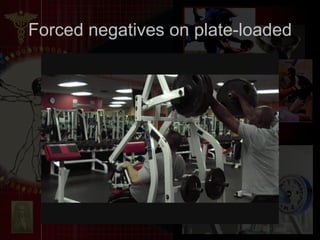
Forced negatives on plate-loaded
Exercise Examples Biceps Curl 8 reps of eccentric/concentric movement Immediately followed by 4 reps of forced negatives 3 sets total 3x8+4
Incline Bench Press 3 sets with 8 reps of concentric/eccentric movements Followed by 3 sets with 4 reps of assisted negatives-only 3x8, then 3x4 Exercise Examples
Study Male, 42 y/o, 179.07 cm Masters competitive physique athlete Currently off-season/pre-contest Experience: Six years consistent  Biospace InBody 320
Beginning Values Date: July 15 th , 2009 Body Weight: 248.2 lbs Lean Mass: 187.6 Body Fat: 24.4%
Ending Values Date: December 15 th , 2009 Body Weight: 270.7 lbs Lean Mass: 206.4 lbs Body Fat: 23.8%
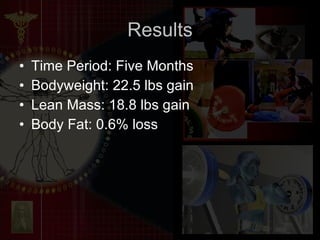
Results Time Period: Five Months Bodyweight: 22.5 lbs gain Lean Mass: 18.8 lbs gain Body Fat: 0.6% loss
Positive Side-Effects Increased Muscle Mass Improved Energy Expenditure Improved Neurological Function Decreased Training Time
Questions?
Michael S. Palmieri,  CSCS, USAW [email_address]

Positively negative!

  • 1.
  • 2.
  • 3.
    What is Hypertrophy?Sarcoplasmic Hypertrophy Applied Negatives Defined Putting the Two Together Exercise Examples Program Design Study Introduction
  • 4.
    The Wonder ofHypertrophy! We’ve all heard about it Every “guru” chats about it Our athletes harass us about it Magical number of reps! Magical percent of 1RM! REALLY??
  • 5.
    Hypertrophy Defined Generallyspeaking – an increase in the size of existing muscle Myofibrillar Hypertrophy Sarcoplasmic Hypertrophy
  • 6.
    Sarcoplasmic and Myofibrillarcannot be separated completely Cannot train either one exclusively Can train one more than the other Hypertrophy Defined
  • 7.
    Hypertrophy Defined Mostathletes want/need some size We want them to be stronger/faster/etc. So, a little bit of size with an increase in strength is PRIME! Enter Myofibrillar Hypertrophy Addition of strength comes from distribution of force over a broader surface area
  • 8.
    Myofibrillar Hypertrophy Primarilydue to increase in size & number of actin and myosin filaments. Synthesis of actin & myosin proteins controlled by genes in cell nucleus. Strength exercise prompt genes to send chemical message to enzymes outside nucleus, stimulating actin/myosin construction. Filaments added to periphery of myofibrils, enlarging existing myofibrils. Though both fast & slow twitch fibers may increase in size, fast appear more responsive.
  • 9.
  • 10.
    Other Needs? Butwhat about our “special” athletes? Want larger muscles, but don’t necessarily need to be stronger? SAY IT ISN’T SO! In walks Sarcoplasmic Hypertrophy
  • 11.
    Sarcoplasmic Hypertrophy Musclefibers stimulated to exert force that is uncommon to their normal function Muscles compelled to increase the storage of necessary nutrients in order to maintain these new required levels of force. This alteration in these stored levels of substrates leads to an increase in fluids. This lends to the swelling in the size of the Sarcomere, without a corresponding enhancement in contractile proteins.
  • 12.
  • 13.
  • 14.
    But how canwe do THAT? We know about concentric training (positives) We know about eccentric training (negatives) Sooooo……..
  • 15.
    Training the NegativesWhen the same force is exerted during the concentric phase of the lift as in the eccentric phase, fewer muscle fibers are activated while the muscle lengthens. In other words: it’s “easier” to fight gravity than to go against gravity. Because of this, eccentric contractions allow greater overall force production in addition to less fiber recruitment, which means the fibers are stressed more.
  • 16.
  • 17.
    However, there’s aconcern Because of this difference in fiber activation and utilization, a typical pyramid loading method may not be the most effective in the development of muscle. In regards to typical resistance training, both types of contractions are involved, and, therefore, the concentric contraction limits the performance of the muscle; hence the amount of load that can be used is also limited. Similarly, since the intensity of exercise is reliant on the magnitude of the load relative to maximum capabilities, it is logical to assume that the concentric phase is the variable that experiences the greater stress, and therefore the greater adaptation (Hortobagyi and Katch 1990).
  • 18.
    This can leadto another issue Eccentric contractions are generally believed to induce greater gains by providing a greater training stimulus because there are greater forces associated with them. This may lead to the belief that training eccentrically exclusively would be the best choice for the most hypertrophy. This, however, is not the case.
  • 19.
    Solution? The sizeof the force relative to the maximum is what determines training stimulus, not the absolute force. Concentric-only and eccentric-only programs yield similar gains in strength and work capacity.
  • 20.
    Programs that includeboth provide the greatest results, rather than programs that are exclusive of one or the other (Dudley, et al 1991; Colliander and Tesch 1990; Godard, et al 1998). In addition, some studies have shown that an increase in peak torque in a concentric/eccentric exercise is greater after secondary training with eccentric-only contractions (Higbie, et al 1996). Solution?
  • 21.
    The How’s andthe Why’s These characteristics of eccentric contractions can be attributed to the following characteristics:
  • 22.
    1. Cross-Bridge ActivityThe high amount of stresses associate with eccentric training may actually lead to a mechanical disruption of the chemical actin/myosin bond in contrast to the systematic binding of ATP. Because there are less total number of contractile proteins during eccentric movements, as well as the amount of overlapping among sarcomeres, the maximum force that each sarcomere can exert varies along the length of a muscle. Therefore, each sarcomere is stretched and then popped as it reaches its stress limit during the lengthening of a muscle, that is, the eccentric motion (Morgan 1990; Morgan and Allen 1999).
  • 23.
    2. Motor UnitActivity Synchronization among motor units is increased during eccentric movements The proportion of common input to pairs of motor units is greater as well (Semmler, et al 2000). This may also lead to increase in strength due to neurological adaption.
  • 24.
    3. Maximality ofActivation Muscle force is greater during a voluntary eccentric phase; however, EMG is substantially less than during concentric. This implies that an individual is unable to maximally activate a muscle during an eccentric phase (Higbie, et al 1996; Nakazawa, et al 1993; Kellis and Baltzopoulos 1998; Pasquet, et al 2000; Tesch, et al 1990; Webber and Kriellaars 1997; Westing, et al 1991).
  • 25.
    4. Hypertrophy Eccentricmovements may be a more effective stimulus for hypertrophy, which might be mediated by a differential control (transcription verses translation) of protein synthesis (Booth and Baldwin 1996; Williams and Neufer 1996; Wong and Booth 1990).
  • 26.
    So, what’s thetraining method?
  • 27.
    Warnings! Athlete musthave solid foundation in resistance training Two years minimum Traditional regimens: compound movements, strength/power, hypertrophy, conditioning, etc.
  • 28.
    Warnings! Very intensetraining Serious injury can result if it is not done properly by an experienced lifter with a coach or a reliable training partner present. Proper diet and nutrition is of vital importance to increase and maintain the levels of intracellular substrates, thereby increasing and maintaining the size of the sarcomeres.
  • 29.
    First things first…Facilitate intracellular fluid depletion Total volume is more important than volume per set. In a concentric / eccentric movement, the load should be about 80% 1RM, and 60-80 total reps per body part. Complete and total failure of the muscle tissue is not the goal.
  • 30.
    First things first…It is then necessary to condition the body to increase the levels of intracellular fluid storage by increasing the demand of these substrates. This is done with an eccentric-only phase: the load for this segment should be about 100-140% 1RM, and reps should stay between 3-5 reps per set.
  • 31.
    So, what isreally meant by “negatives?” Not only just a slow tempo on the eccentric phrase (i.e., a 4 count) BUT KEY : An actual overload of resistance (at least 100-140% 1RM)
  • 32.
    Examples of Negative/EccentricTraining Assisted Negatives Forced Negatives Free weights Rack Smith Plate-Loaded
  • 33.
  • 34.
  • 35.
  • 36.
    Forced negatives onplate-loaded
  • 37.
    Exercise Examples BicepsCurl 8 reps of eccentric/concentric movement Immediately followed by 4 reps of forced negatives 3 sets total 3x8+4
  • 38.
    Incline Bench Press3 sets with 8 reps of concentric/eccentric movements Followed by 3 sets with 4 reps of assisted negatives-only 3x8, then 3x4 Exercise Examples
  • 39.
    Study Male, 42y/o, 179.07 cm Masters competitive physique athlete Currently off-season/pre-contest Experience: Six years consistent Biospace InBody 320
  • 40.
    Beginning Values Date:July 15 th , 2009 Body Weight: 248.2 lbs Lean Mass: 187.6 Body Fat: 24.4%
  • 41.
    Ending Values Date:December 15 th , 2009 Body Weight: 270.7 lbs Lean Mass: 206.4 lbs Body Fat: 23.8%
  • 42.
    Results Time Period:Five Months Bodyweight: 22.5 lbs gain Lean Mass: 18.8 lbs gain Body Fat: 0.6% loss
  • 43.
    Positive Side-Effects IncreasedMuscle Mass Improved Energy Expenditure Improved Neurological Function Decreased Training Time
  • 44.
  • 45.
    Michael S. Palmieri, CSCS, USAW [email_address]