Agility & Change of Direction –
From Science to Practice
What is COD ?
What is COD (Change of Direction)?
‘Change of direction can
be defined as a rapid
change of velocity or
direction that is pre-
planned.’
What is Agility?
“A rapid whole-body movement with
change of velocity or direction in response
to a stimulus. This definition respects the
cognitive components of visual scanning
and decision making that contribute to
agility performance in sport.”
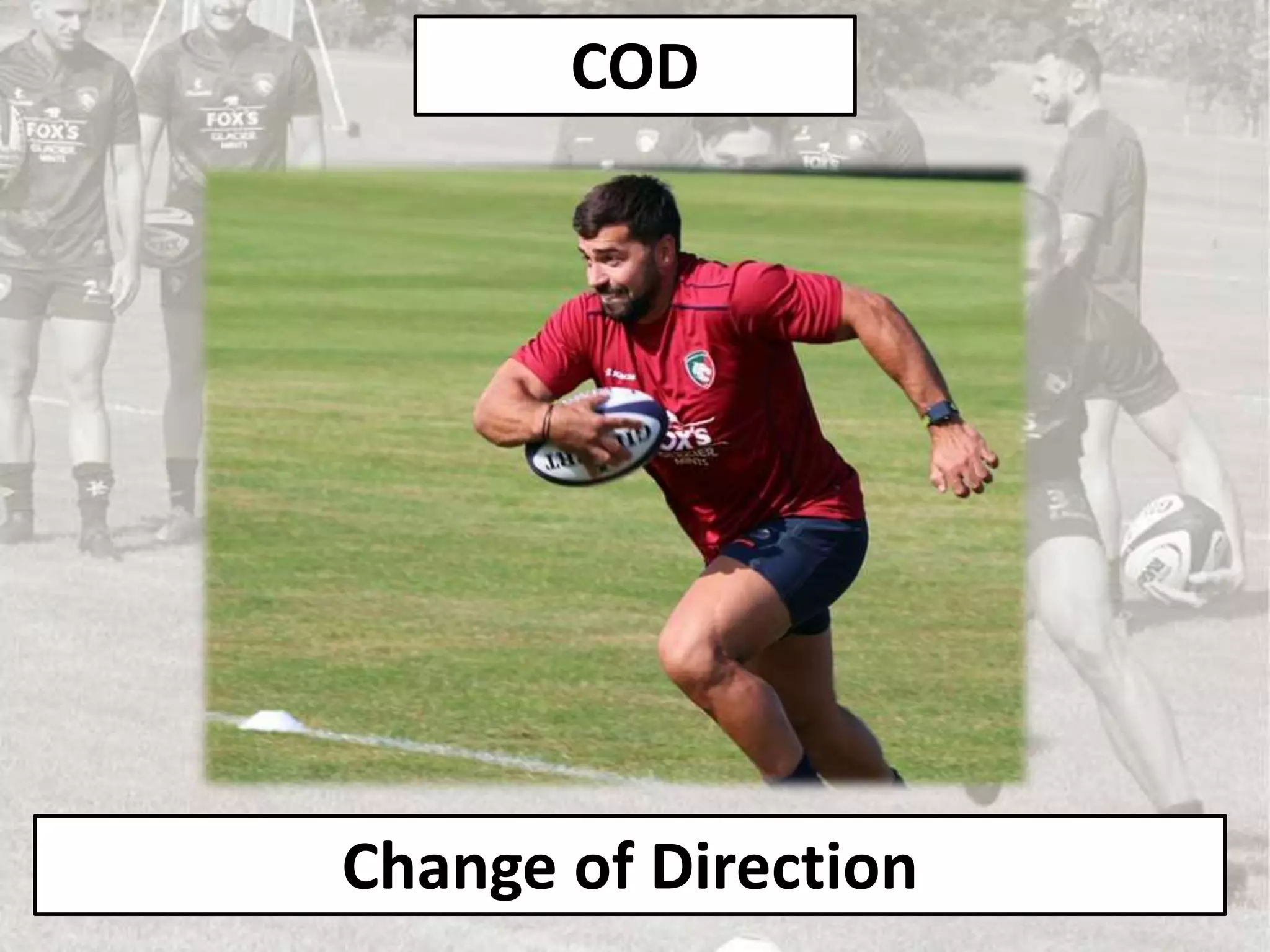
COD
Change of Direction
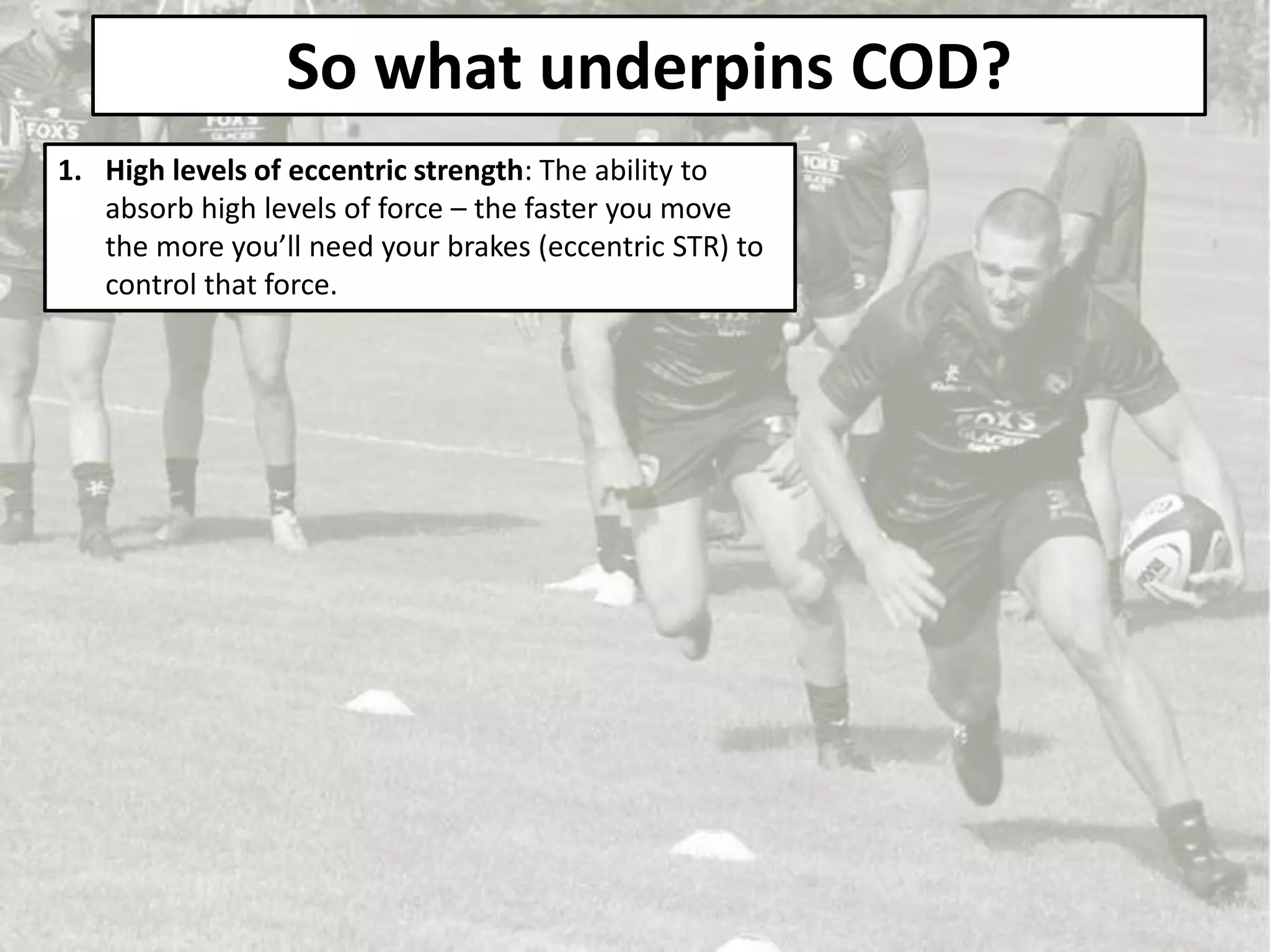
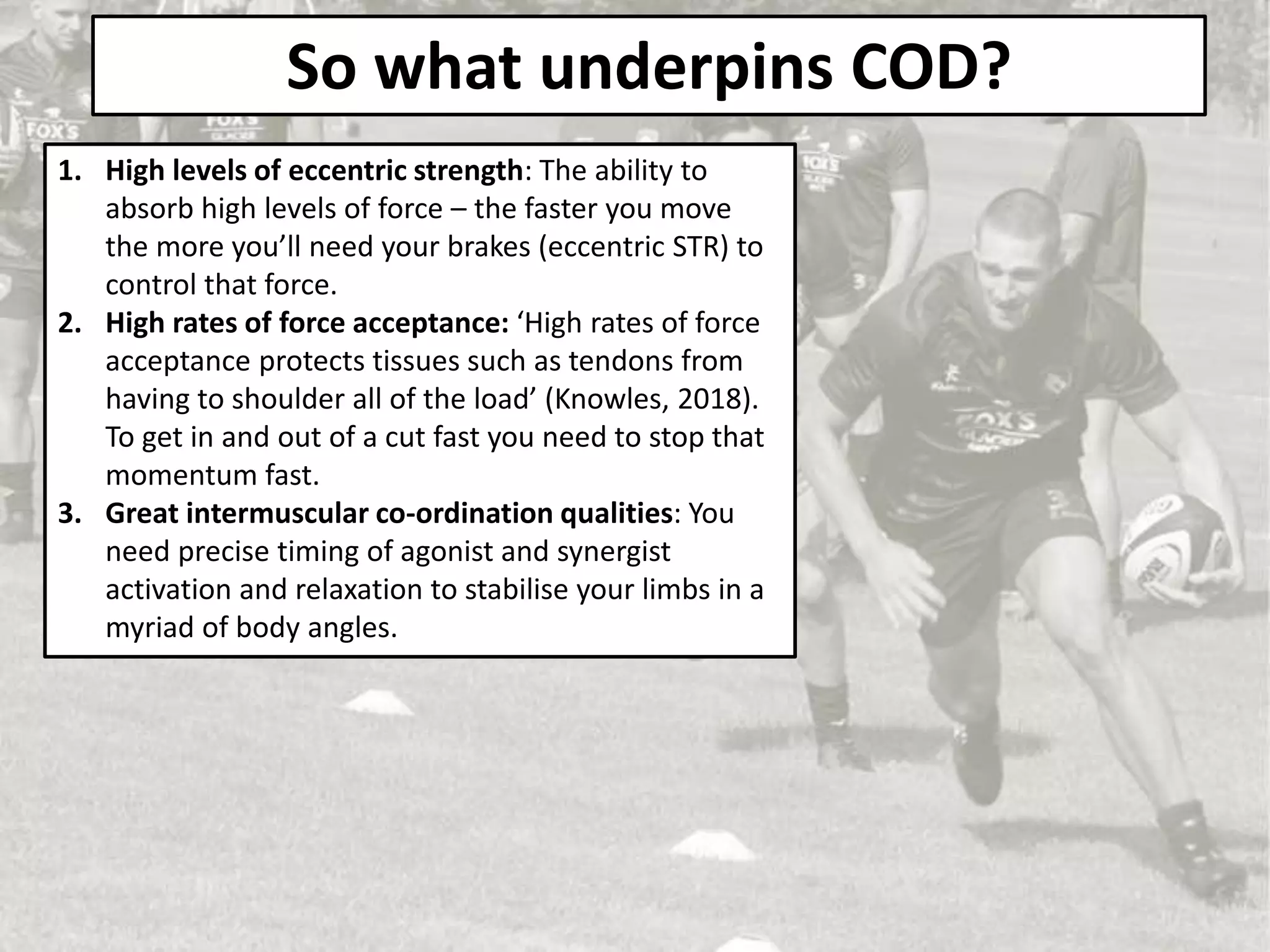
So what underpins COD?
1. High levels of eccentric strength: The ability to
absorb high levels of force – the faster you move
the more you’ll need your brakes (eccentric STR) to
control that force.
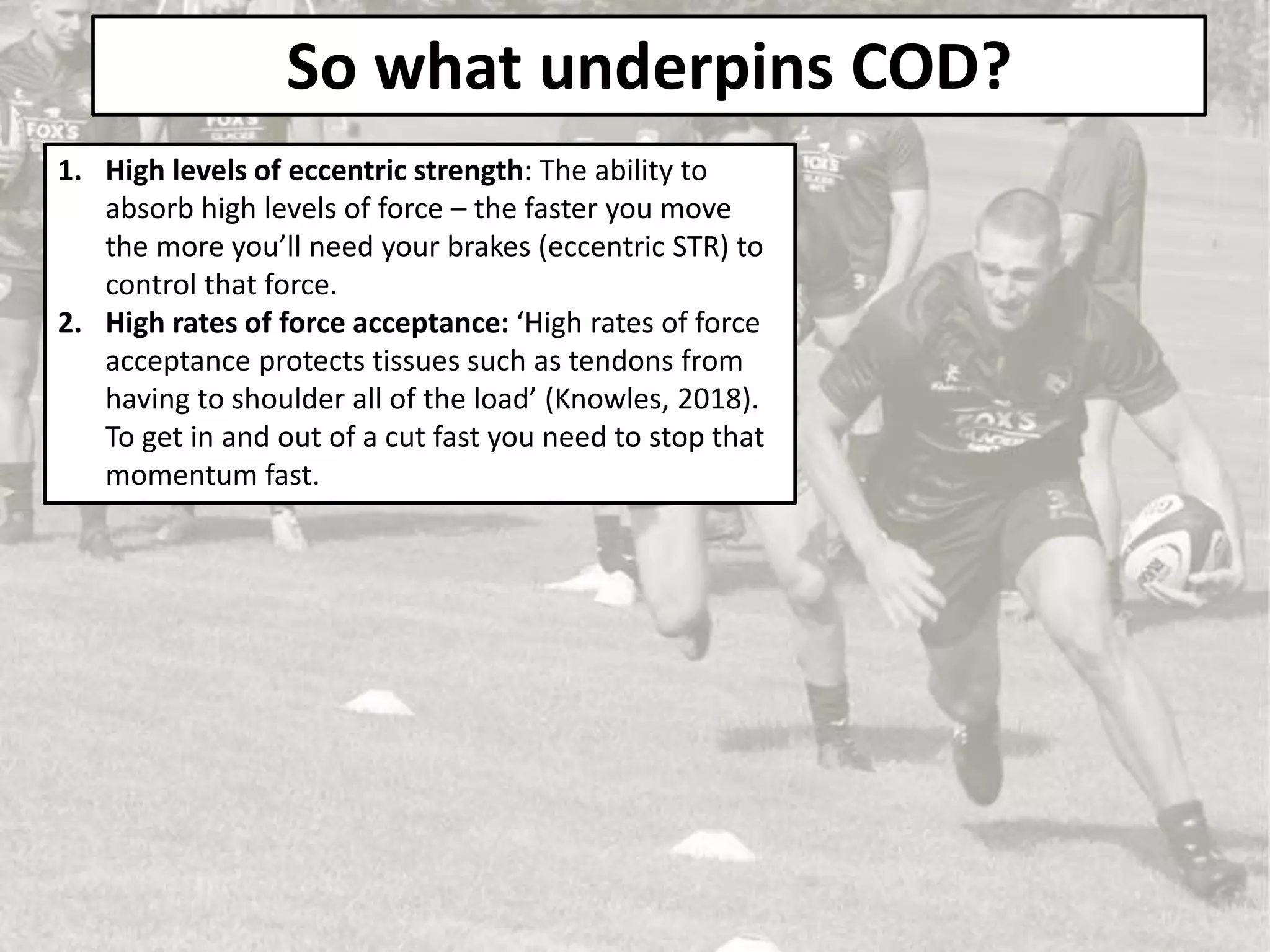
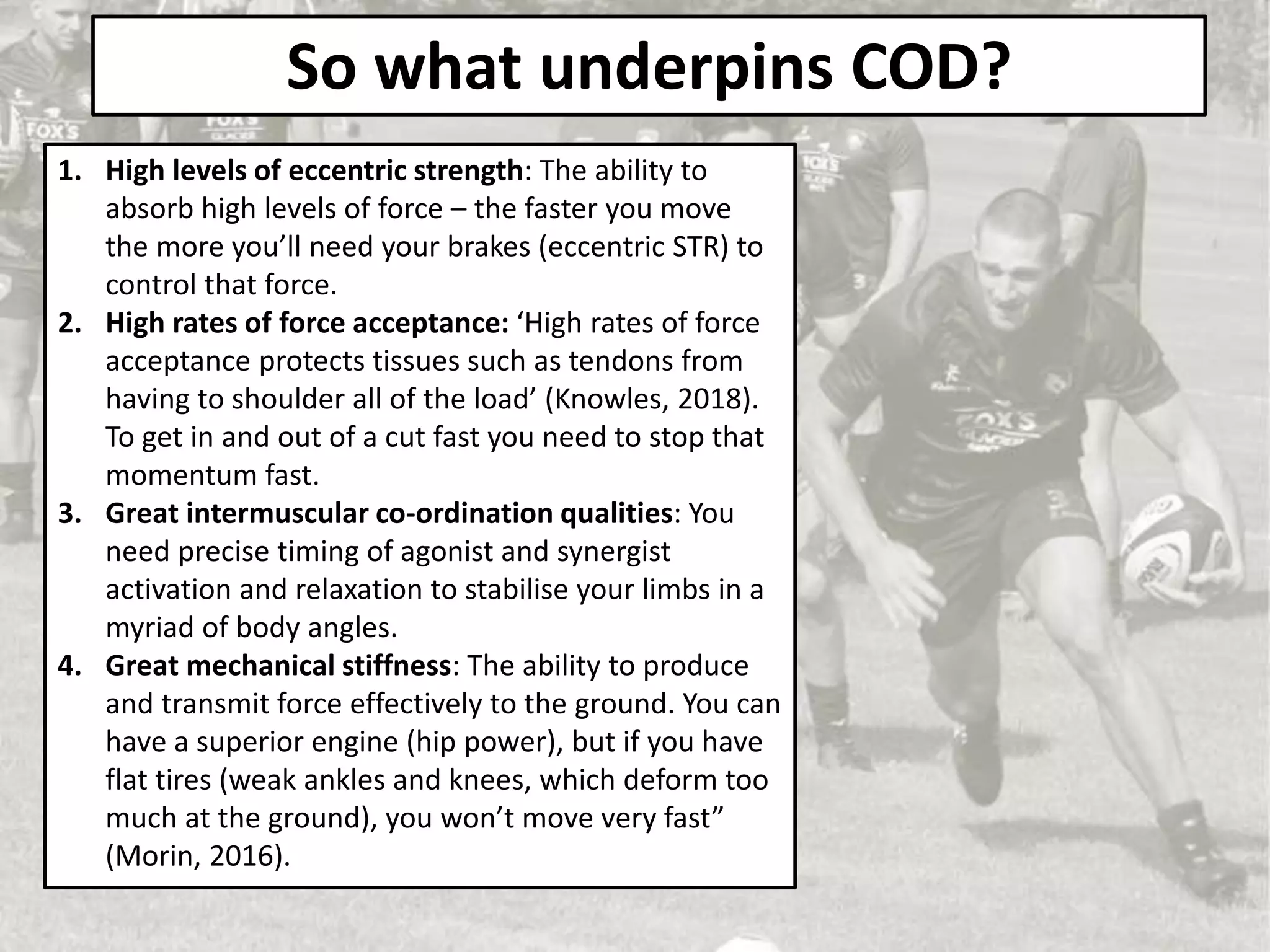
So what underpins COD?
1. High levels of eccentric strength: The ability to
absorb high levels of force – the faster you move
the more you’ll need your brakes (eccentric STR) to
control that force.
2. High rates of force acceptance: ‘High rates of force
acceptance protects tissues such as tendons from
having to shoulder all of the load’ (Knowles, 2018).
To get in and out of a cut fast you need to stop that
momentum fast.
So what underpins COD?
1. High levels of eccentric strength: The ability to
absorb high levels of force – the faster you move
the more you’ll need your brakes (eccentric STR) to
control that force.
2. High rates of force acceptance: ‘High rates of force
acceptance protects tissues such as tendons from
having to shoulder all of the load’ (Knowles, 2018).
To get in and out of a cut fast you need to stop that
momentum fast.
3. Great intermuscular co-ordination qualities: You
need precise timing of agonist and synergist
activation and relaxation to stabilise your limbs in a
myriad of body angles.
So what underpins COD?
1. High levels of eccentric strength: The ability to
absorb high levels of force – the faster you move
the more you’ll need your brakes (eccentric STR) to
control that force.
2. High rates of force acceptance: ‘High rates of force
acceptance protects tissues such as tendons from
having to shoulder all of the load’ (Knowles, 2018).
To get in and out of a cut fast you need to stop that
momentum fast.
3. Great intermuscular co-ordination qualities: You
need precise timing of agonist and synergist
activation and relaxation to stabilise your limbs in a
myriad of body angles.
4. Great mechanical stiffness: The ability to produce
and transmit force effectively to the ground. You can
have a superior engine (hip power), but if you have
flat tires (weak ankles and knees, which deform too
much at the ground), you won’t move very fast”
(Morin, 2016).
Improving it?
1. High levels of eccentric strength: The ability to
absorb high levels of force – the faster you move
the more you’ll need your brakes (eccentric STR) to
control that force.
2. High rates of force acceptance: ‘High rates of force
acceptance protects tissues such as tendons from
having to shoulder all of the load’ (Knowles, 2018).
To get in and out of a cut fast you need to stop that
momentum fast.
3. Great intermuscular co-ordination qualities: You
need precise timing of agonist and synergist
activation and relaxation to stabilise your limbs in a
myriad of body angles.
4. Great mechanical stiffness: The ability to produce
and transmit force effectively to the ground. You can
have a superior engine (hip power), but if you have
flat tires (weak ankles and knees, which deform too
much at the ground), you won’t move very fast”
(Morin, 2016).
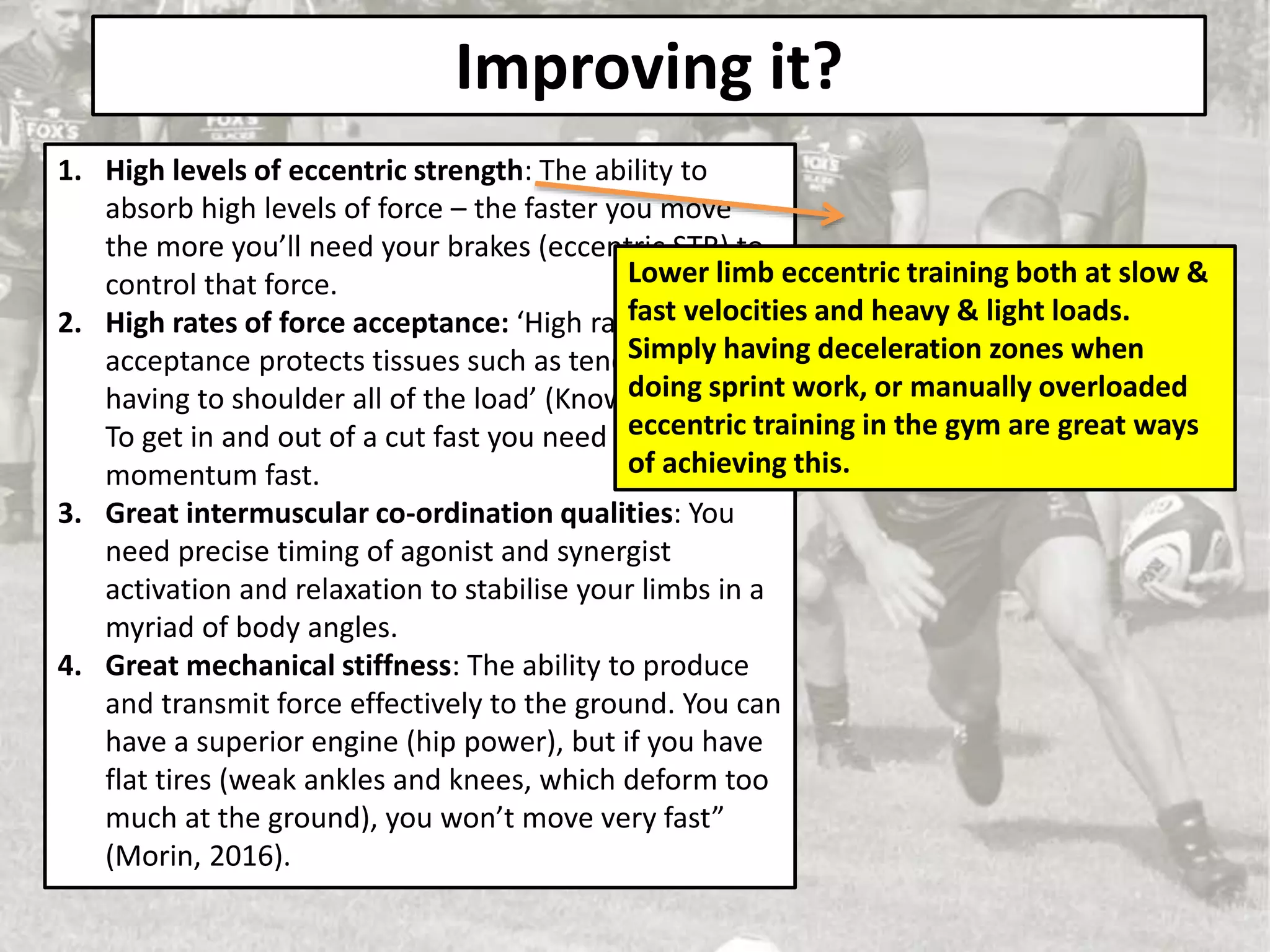
Lower limb eccentric training both at slow &
fast velocities and heavy & light loads.
Simply having deceleration zones when
doing sprint work, or manually overloaded
eccentric training in the gym are great ways
of achieving this.
Improving it?
1. High levels of eccentric strength: The ability to
absorb high levels of force – the faster you move
the more you’ll need your brakes (eccentric STR) to
control that force.
2. High rates of force acceptance: ‘High rates of force
acceptance protects tissues such as tendons from
having to shoulder all of the load’ (Knowles, 2018).
To get in and out of a cut fast you need to stop that
momentum fast.
3. Great intermuscular co-ordination qualities: You
need precise timing of agonist and synergist
activation and relaxation to stabilise your limbs in a
myriad of body angles.
4. Great mechanical stiffness: The ability to produce
and transmit force effectively to the ground. You can
have a superior engine (hip power), but if you have
flat tires (weak ankles and knees, which deform too
much at the ground), you won’t move very fast”
(Morin, 2016).
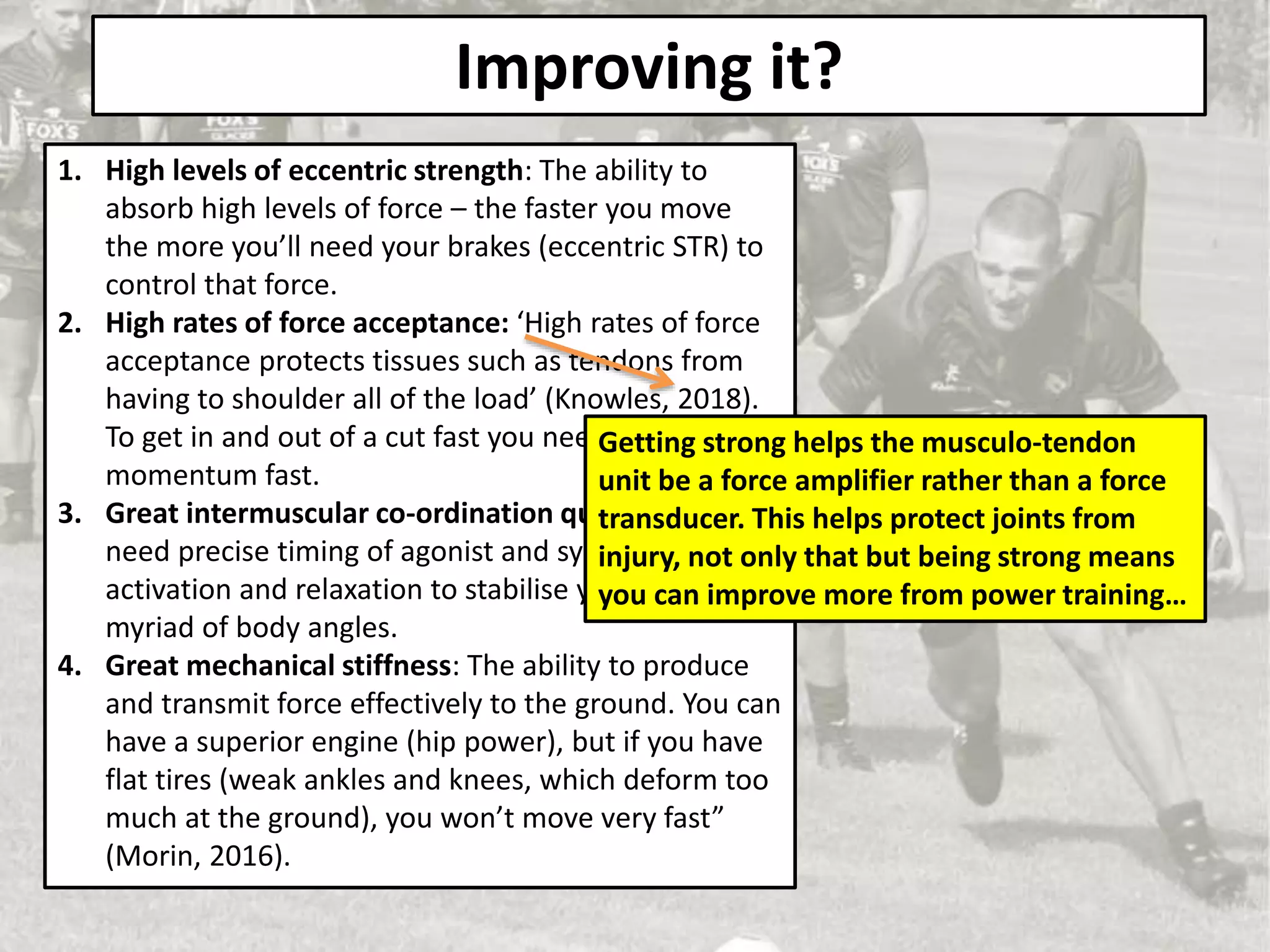
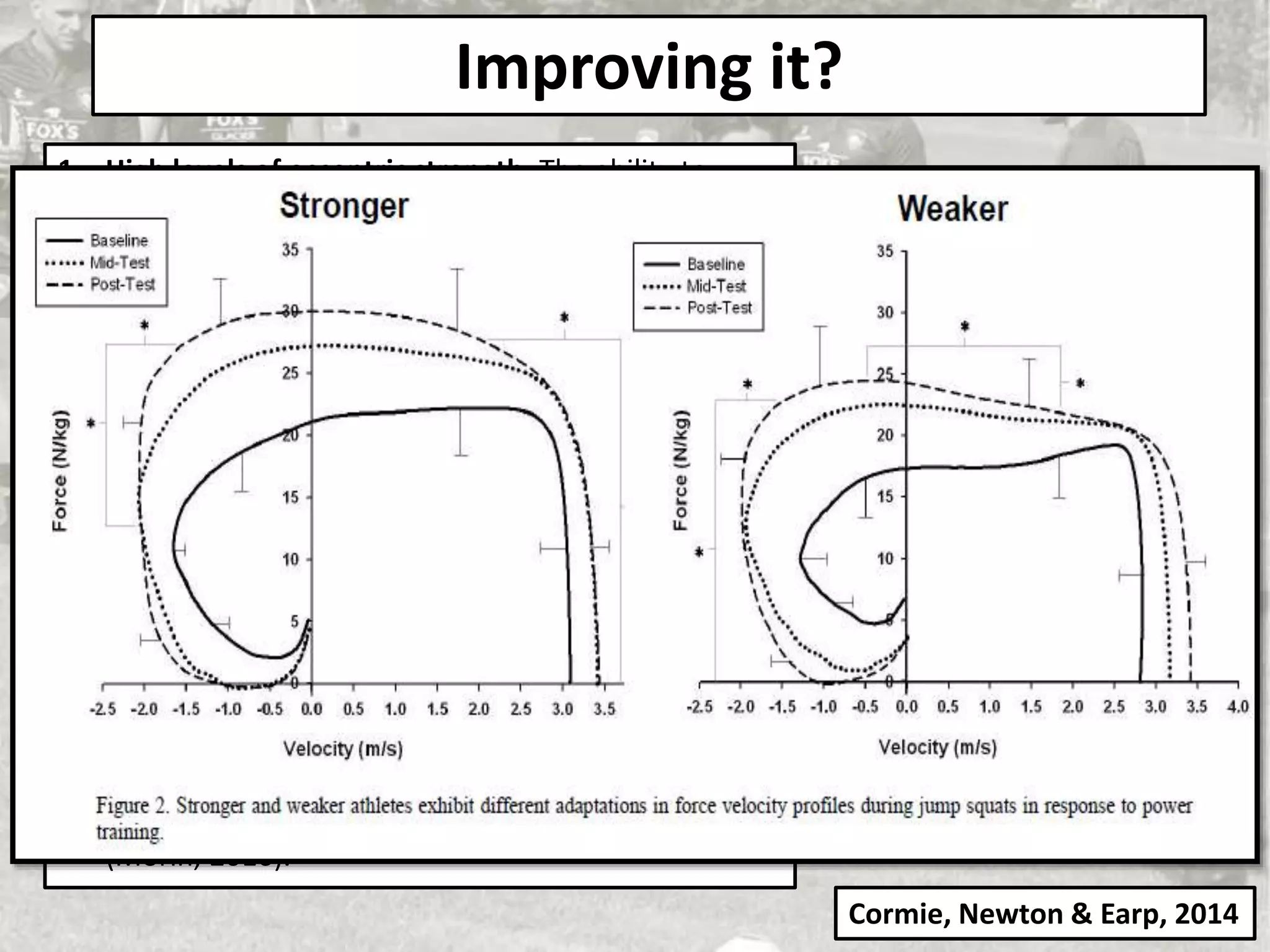
Getting strong helps the musculo-tendon
unit be a force amplifier rather than a force
transducer. This helps protect joints from
injury, not only that but being strong means
you can improve more from power training…
Improving it?
1. High levels of eccentric strength: The ability to
absorb high levels of force – the faster you move
the more you’ll need your brakes (eccentric STR) to
control that force.
2. High rates of force acceptance: ‘High rates of force
acceptance protects tissues such as tendons from
having to shoulder all of the load’ (Knowles, 2018).
To get in and out of a cut fast you need to stop that
momentum fast.
3. Great intermuscular co-ordination qualities: You
need precise timing of agonist and synergist
activation and relaxation to stabilise your limbs in a
myriad of body angles.
4. Great mechanical stiffness: The ability to produce
and transmit force effectively to the ground. You can
have a superior engine (hip power), but if you have
flat tires (weak ankles and knees, which deform too
much at the ground), you won’t move very fast”
(Morin, 2016).
Getting strong helps the musculo-tendon
unit be a force amplifier rather than a force
transducer which helps protect joints from
injury, not only that but being strong means
you can improve more from power training…
Cormie, Newton & Earp, 2014
Improving it?
1. High levels of eccentric strength: The ability to
absorb high levels of force – the faster you move
the more you’ll need your brakes (eccentric STR) to
control that force.
2. High rates of force acceptance: ‘High rates of force
acceptance protects tissues such as tendons from
having to shoulder all of the load’ (Knowles, 2018).
To get in and out of a cut fast you need to stop that
momentum fast.
3. Great intermuscular co-ordination qualities: You
need precise timing of agonist and synergist
activation and relaxation to stabilise your limbs in a
myriad of body angles.
4. Great mechanical stiffness: The ability to produce
and transmit force effectively to the ground. You can
have a superior engine (hip power), but if you have
flat tires (weak ankles and knees, which deform too
much at the ground), you won’t move very fast”
(Morin, 2016).
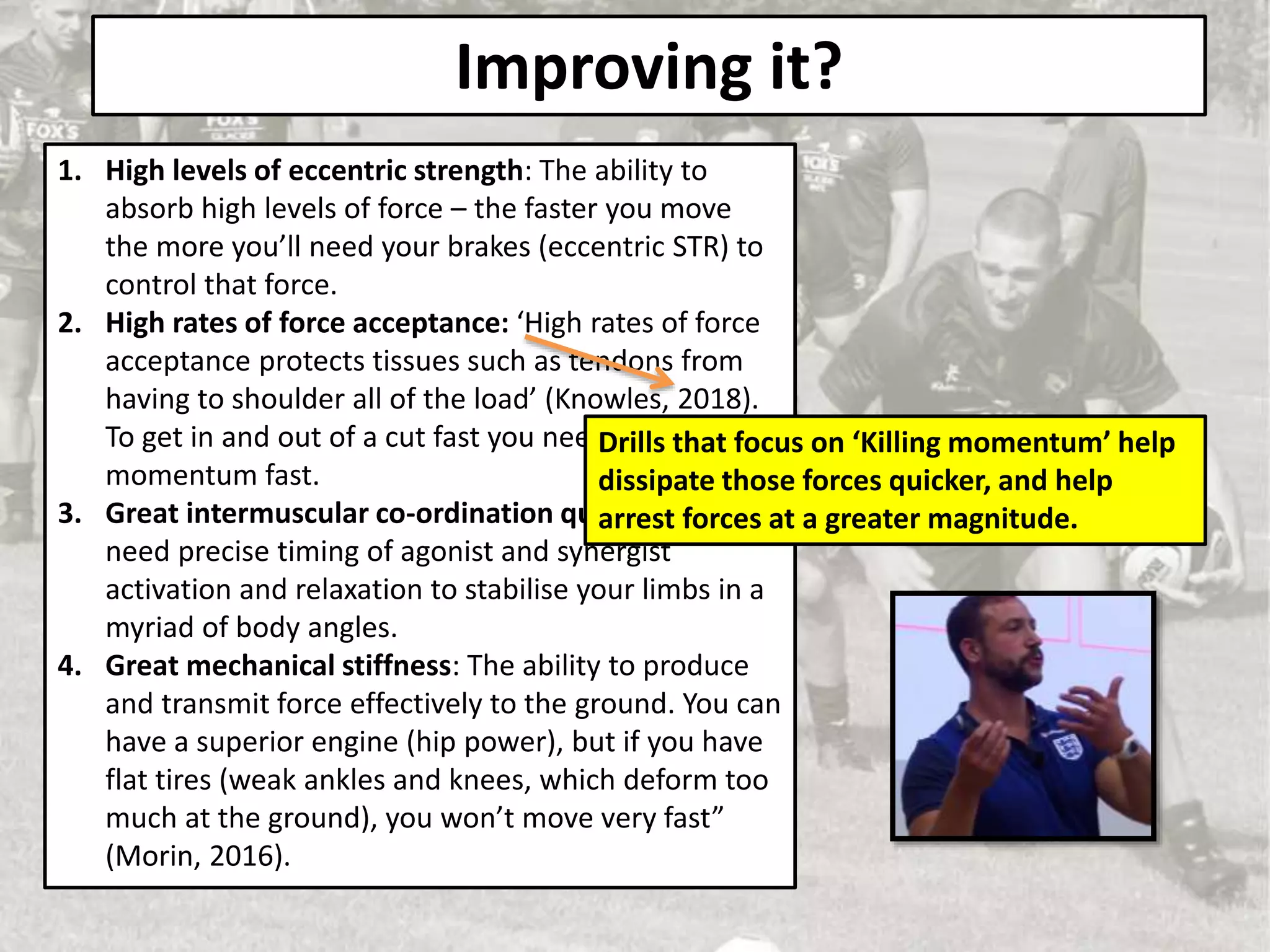
Drills that focus on ‘Killing momentum’ help
dissipate those forces quicker, and help
arrest forces at a greater magnitude.
Improving it?
1. High levels of eccentric strength: The ability to
absorb high levels of force – the faster you move
the more you’ll need your brakes (eccentric STR) to
control that force.
2. High rates of force acceptance: ‘High rates of force
acceptance protects tissues such as tendons from
having to shoulder all of the load’ (Knowles, 2018).
To get in and out of a cut fast you need to stop that
momentum fast.
3. Great intermuscular co-ordination qualities: You
need precise timing of agonist and synergist
activation and relaxation to stabilise your limbs in a
myriad of body angles.
4. Great mechanical stiffness: The ability to produce
and transmit force effectively to the ground. You can
have a superior engine (hip power), but if you have
flat tires (weak ankles and knees, which deform too
much at the ground), you won’t move very fast”
(Morin, 2016).
Plyometrics can help with this by reducing the
amortization phase of a movement, but where its
probably at is task specific force transfer work – so for
example if it’s the ability to go laterally you are after,
exercises that work the frontal plane are what you
need. If its accelerating out of a cut, then overloading
the velocity or contact time of an acceleration is maybe
where you want to go.
Improving it?
1. High levels of eccentric strength: The ability to
absorb high levels of force – the faster you move
the more you’ll need your brakes (eccentric STR) to
control that force.
2. High rates of force acceptance: ‘High rates of force
acceptance protects tissues such as tendons from
having to shoulder all of the load’ (Knowles, 2018).
To get in and out of a cut fast you need to stop that
momentum fast.
3. Great intermuscular co-ordination qualities: You
need precise timing of agonist and synergist
activation and relaxation to stabilise your limbs in a
myriad of body angles.
4. Great mechanical stiffness: The ability to produce
and transmit force effectively to the ground. You can
have a superior engine (hip power), but if you have
flat tires (weak ankles and knees, which deform too
much at the ground), you won’t move very fast”
(Morin, 2016).
Stiffness drills that work on the ‘suspension’ and
getting the body into efficient positions to take
advantage of SSC and the elastic components of the
muscle will lead to stiff, responsive, ‘bouncy, reactive’
contacts with the ground.
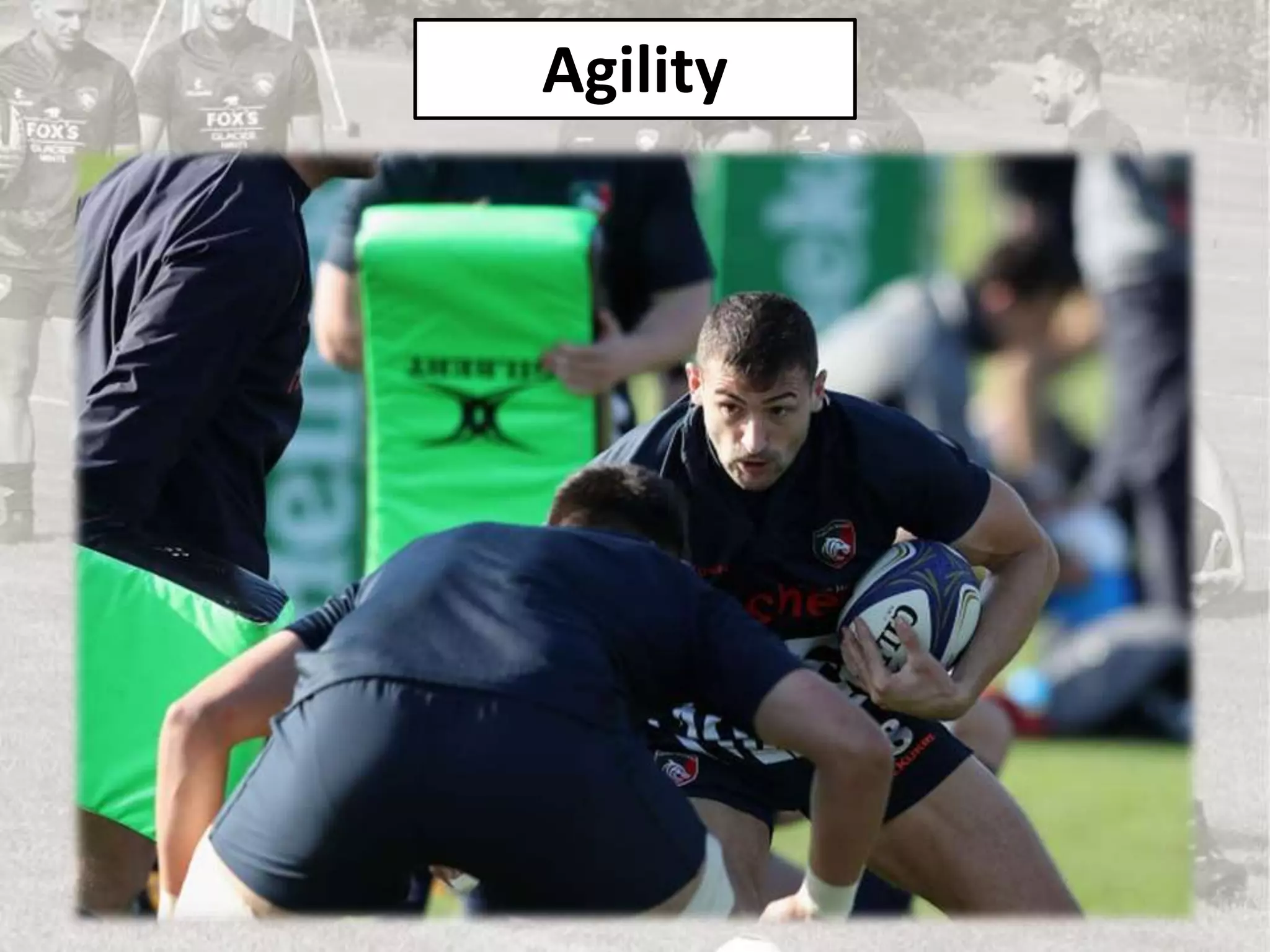
Agility
So what underpins agility?
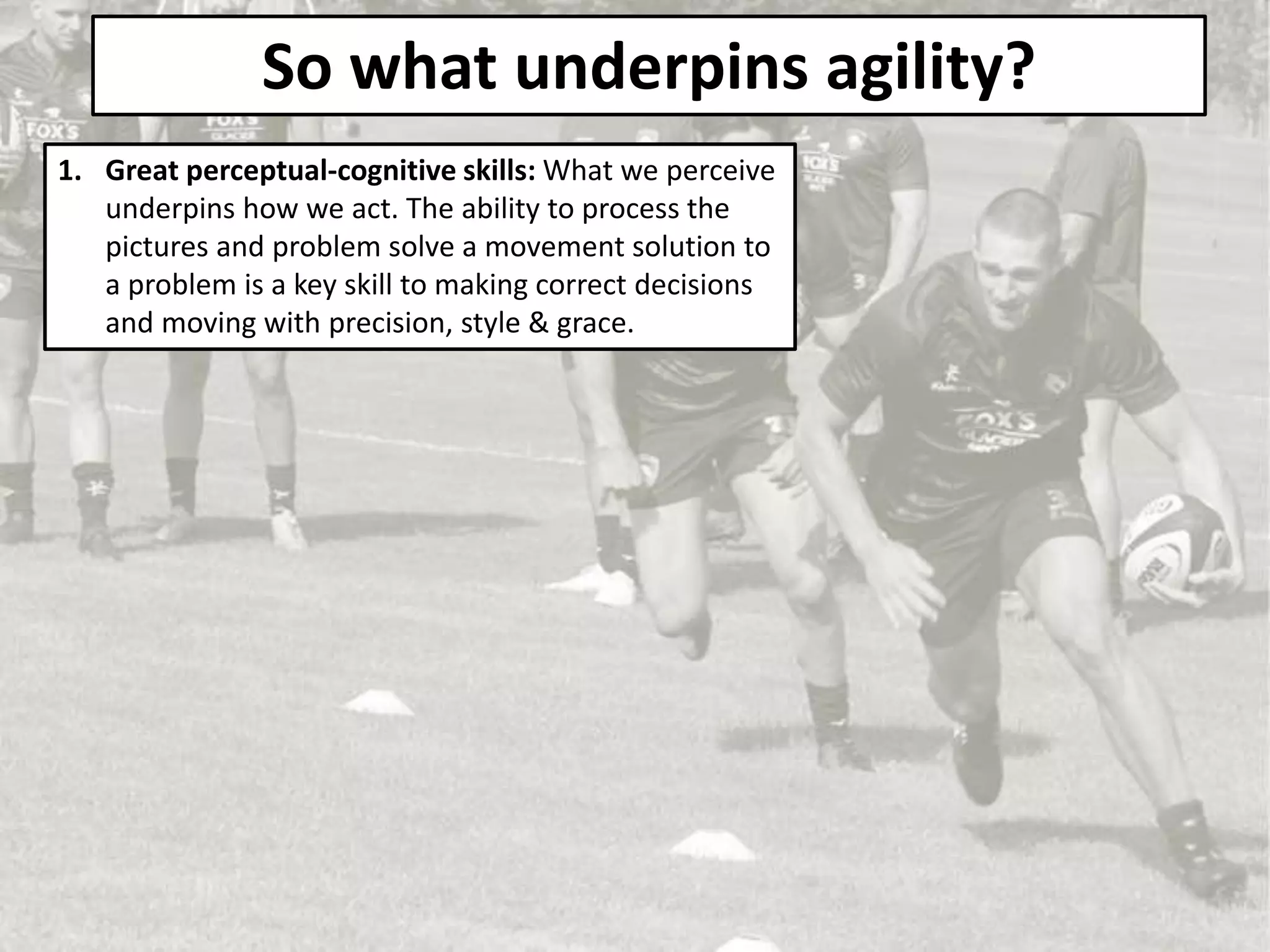
1. Great perceptual-cognitive skills: What we perceive
underpins how we act. The ability to process the
pictures and problem solve a movement solution to
a problem is a key skill to making correct decisions
and moving with precision, style & grace.
So what underpins agility?
1. Great perceptual-cognitive skills: What we perceive
underpins how we act. The ability to process the
pictures and problem solve a movement solution to
a problem is a key skill to making correct decisions
and moving with precision, style & grace.
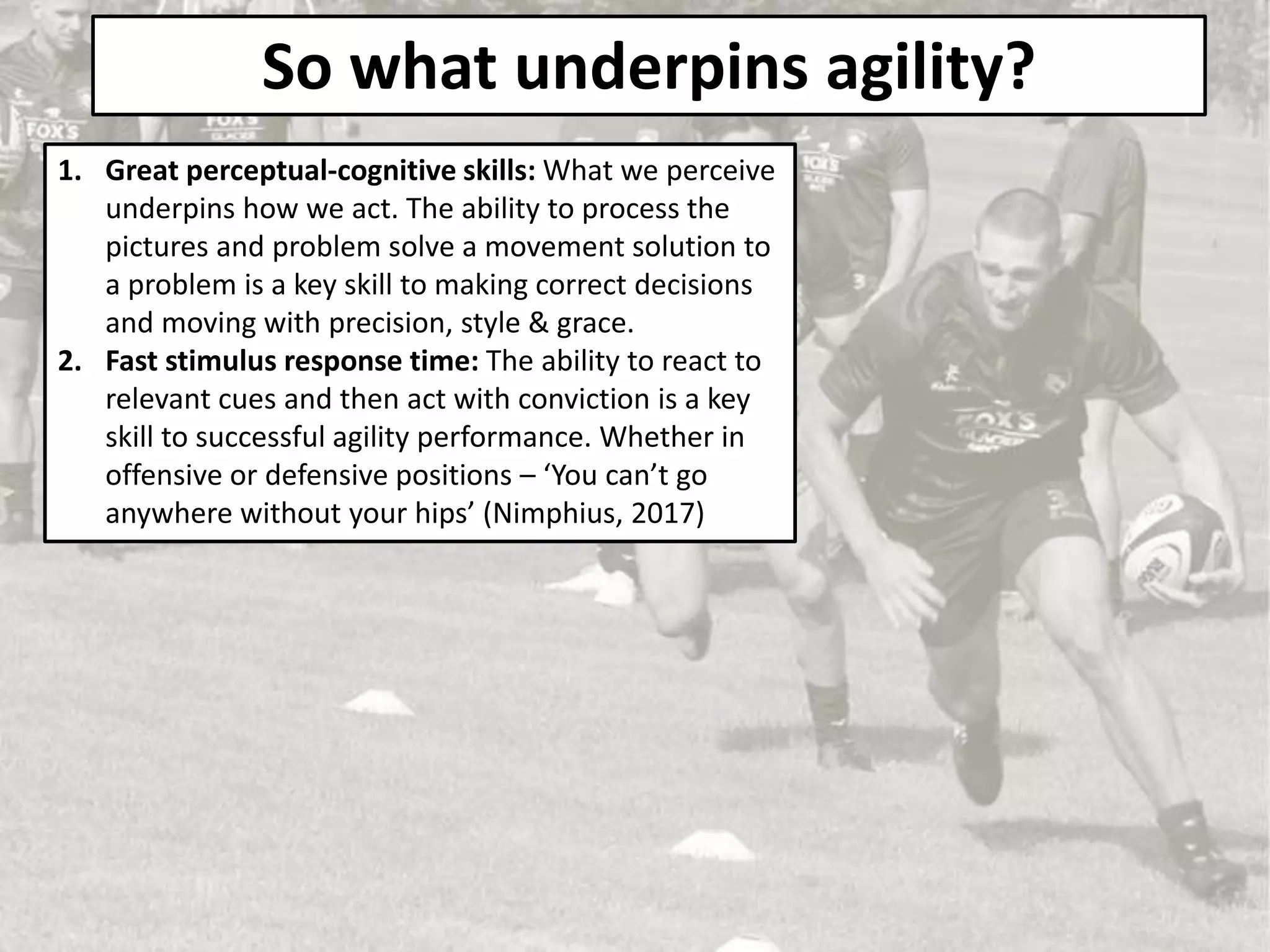
2. Fast stimulus response time: The ability to react to
relevant cues and then act with conviction is a key
skill to successful agility performance. Whether in
offensive or defensive positions – ‘You can’t go
anywhere without your hips’ (Nimphius, 2017)
So what underpins agility?
1. Great perceptual-cognitive skills: What we perceive
underpins how we act. The ability to process the
pictures and problem solve a movement solution to
a problem is a key skill to making correct decisions
and moving with precision, style & grace.
2. Fast stimulus response time: The ability to react to
relevant cues and then act with conviction is a key
skill to successful agility performance. Whether in
offensive or defensive positions – ‘You can’t go
anywhere without your hips’ (Nimphius, 2017)
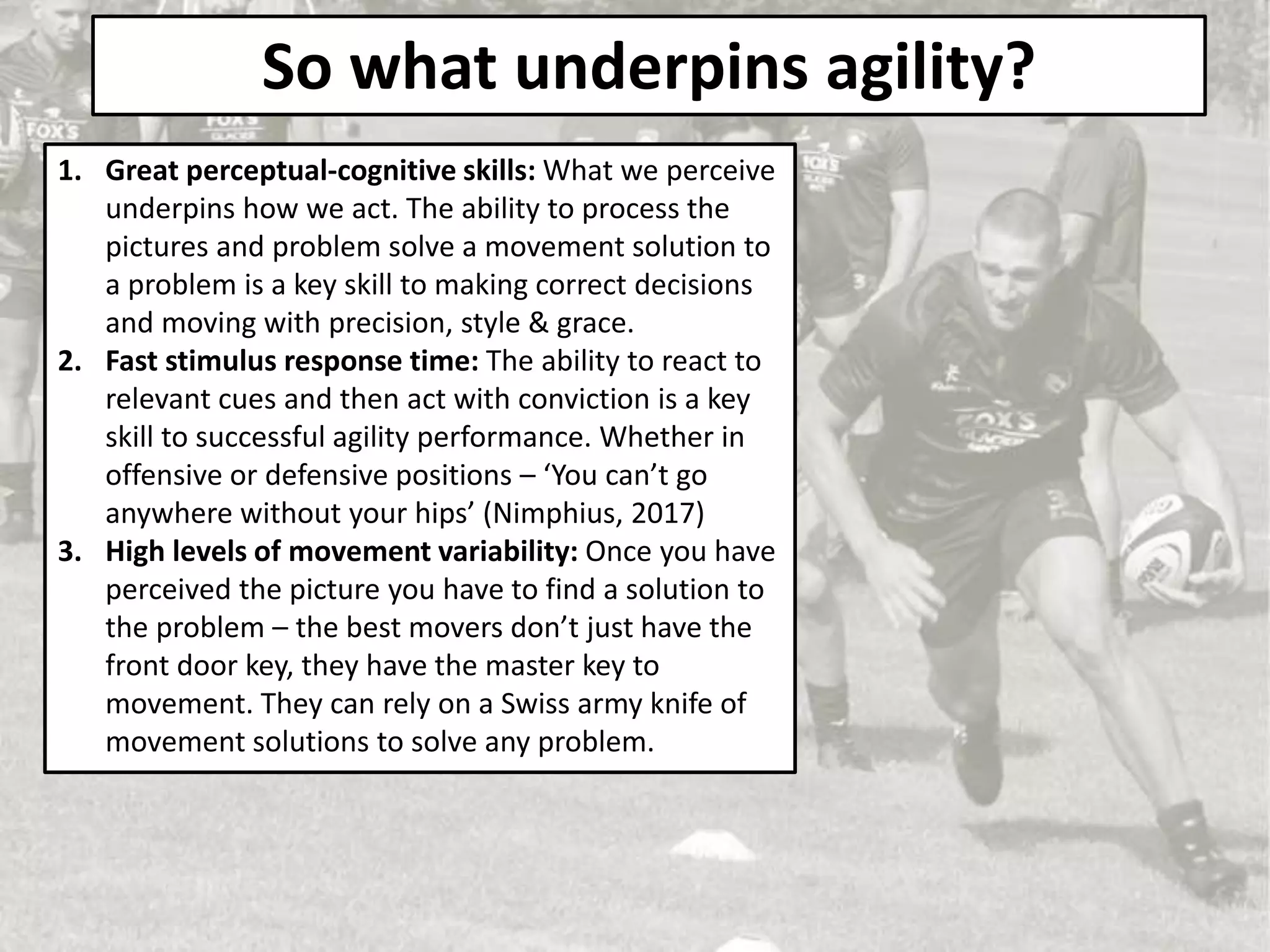
3. High levels of movement variability: Once you have
perceived the picture you have to find a solution to
the problem – the best movers don’t just have the
front door key, they have the master key to
movement. They can rely on a Swiss army knife of
movement solutions to solve any problem.
Improving it?
1. Great perceptual-cognitive skills: What we perceive
underpins how we act. The ability to process the
pictures and problem solve a movement solution to
a problem is a key skill to making correct decisions
and moving with precision, style & grace.
2. Fast stimulus response time: The ability to react to
relevant cues and then act with conviction is a key
skill to successful agility performance. Whether in
offensive or defensive positions – ‘You can’t go
anywhere without your hips’ (Nimphius, 2017)
3. High levels of movement variability: Once you have
perceived the picture you have to find a solution to
the problem – the best movers don’t just have the
front door key, they have the master key to
movement. They can rely on a Swiss army knife of
movement solutions to solve any problem.
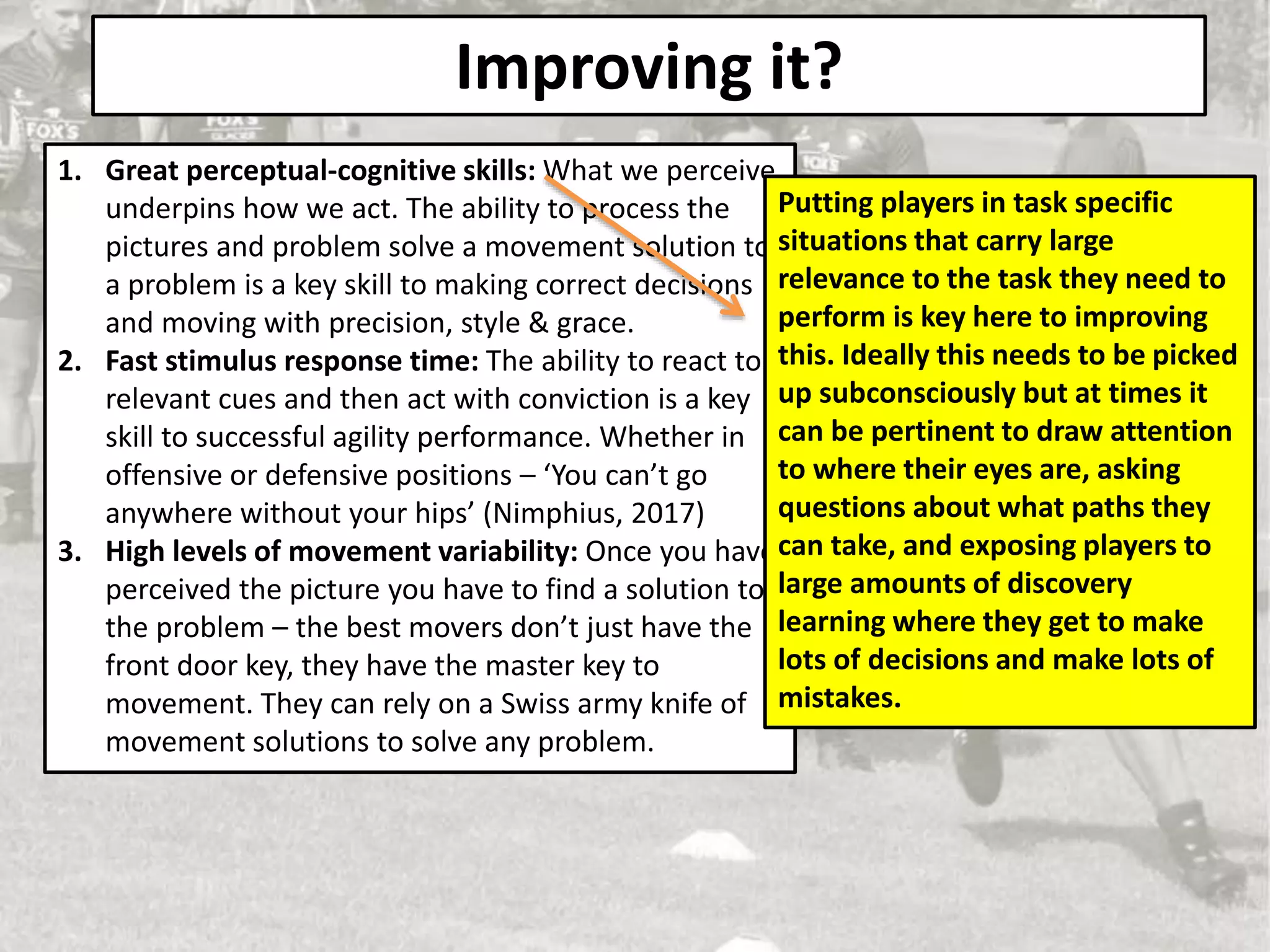
Putting players in task specific
situations that carry large
relevance to the task they need to
perform is key here to improving
this. Ideally this needs to be picked
up subconsciously but at times it
can be pertinent to draw attention
to where their eyes are, asking
questions about what paths they
can take, and exposing players to
large amounts of discovery
learning where they get to make
lots of decisions and make lots of
mistakes.
Improving it?
1. Great perceptual-cognitive skills: What we perceive
underpins how we act. The ability to process the
pictures and problem solve a movement solution to
a problem is a key skill to making correct decisions
and moving with precision, style & grace.
2. Fast stimulus response time: The ability to react to
relevant cues and then act with conviction is a key
skill to successful agility performance. Whether in
offensive or defensive positions – ‘You can’t go
anywhere without your hips’ (Nimphius, 2017)
3. High levels of movement variability: Once you have
perceived the picture you have to find a solution to
the problem – the best movers don’t just have the
front door key, they have the master key to
movement. They can rely on a Swiss army knife of
movement solutions to solve any problem.
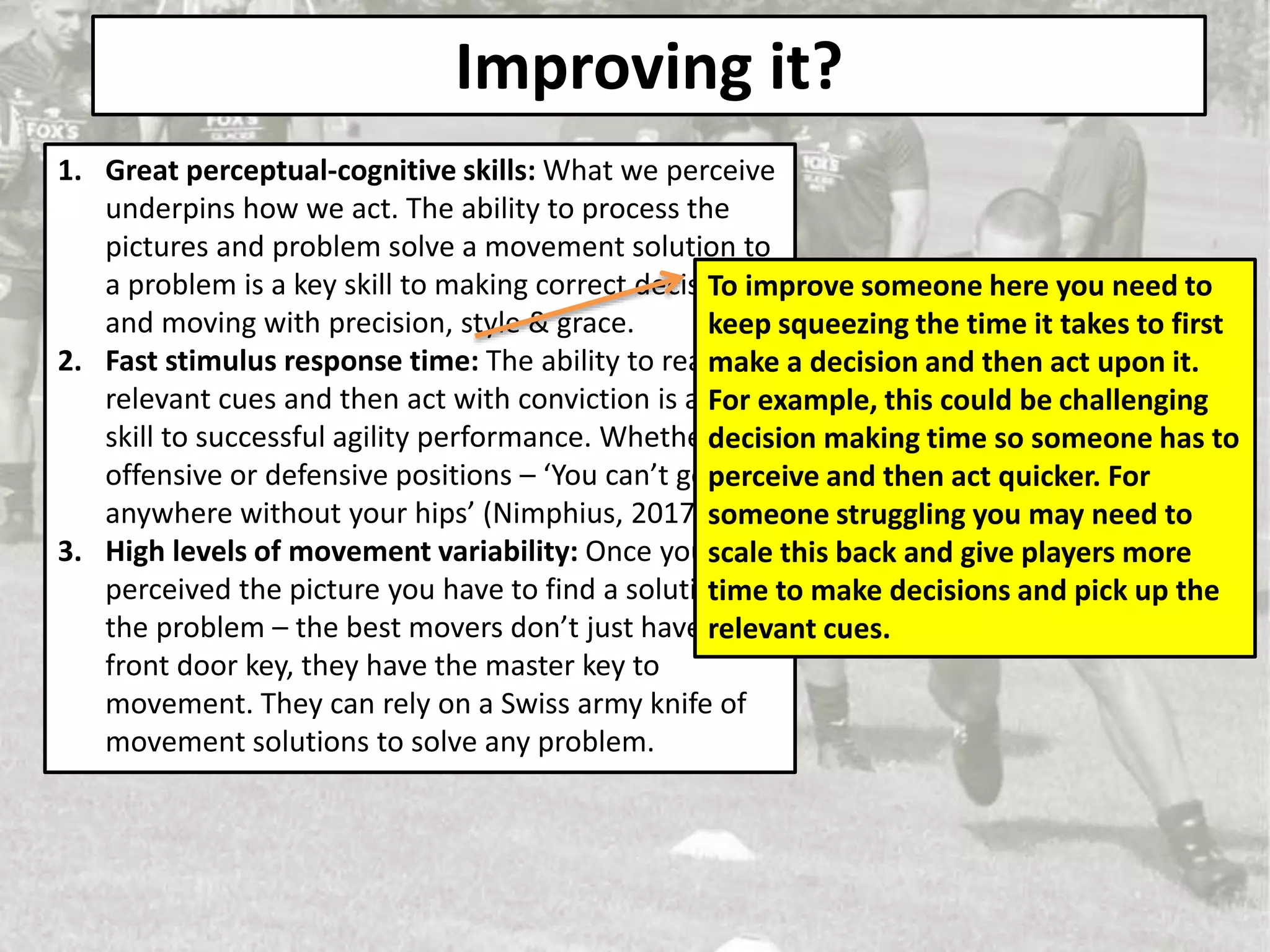
To improve someone here you need to
keep squeezing the time it takes to first
make a decision and then act upon it.
For example, this could be challenging
decision making time so someone has to
perceive and then act quicker. For
someone struggling you may need to
scale this back and give players more
time to make decisions and pick up the
relevant cues.
Improving it?
1. Great perceptual-cognitive skills: What we perceive
underpins how we act. The ability to process the
pictures and problem solve a movement solution to
a problem is a key skill to making correct decisions
and moving with precision, style & grace.
2. Fast stimulus response time: The ability to react to
relevant cues and then act with conviction is a key
skill to successful agility performance. Whether in
offensive or defensive positions – ‘You can’t go
anywhere without your hips’ (Nimphius, 2017)
3. High levels of movement variability: Once you have
perceived the picture you have to find a solution to
the problem – the best movers don’t just have the
front door key, they have the master key to
movement. They can rely on a Swiss army knife of
movement solutions to solve any problem.
Exposure to chaos. Repetition without
repetition. Everything is similar but
different. Most drills or games shouldn’t
look that neat and pretty, there will be
mistakes, there will be errors but this is
the uncomfortable zone for the player
where learning happens – this is where
you’re sharpening up that master key to
open up more doors. More variability in
the drills = more movement problems =
more movement solutions = more
movement variability.
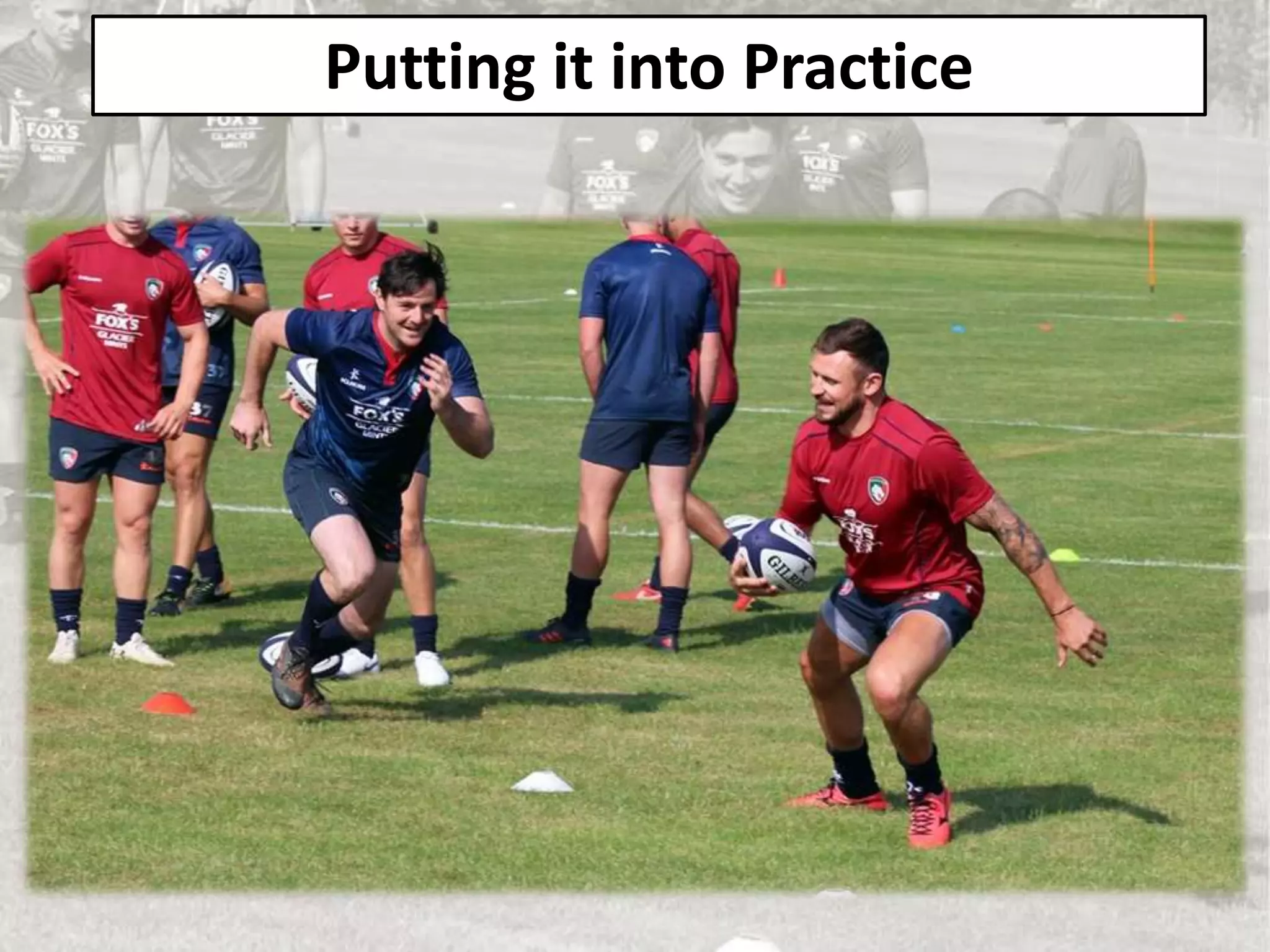
Putting it into Practice
What might it look like?
https://www.youtube.com/watch?v=B_CEbcg7dwE
https://www.youtube.com/watch?v=pXiQGgMy3Io
https://www.youtube.com/watch?v=vRyEjhCxixg
https://twitter.com/TopSpeedLLC/status/598493846243188737
https://youtu.be/chPHaKeNDZQ?t=155

Agility & Change of Direction - From Science to Practice

  • 1.
    Agility & Changeof Direction – From Science to Practice
  • 2.
  • 3.
    What is COD(Change of Direction)?
  • 4.
    What is COD(Change of Direction)? ‘Change of direction can be defined as a rapid change of velocity or direction that is pre- planned.’
  • 5.
    What is Agility? “Arapid whole-body movement with change of velocity or direction in response to a stimulus. This definition respects the cognitive components of visual scanning and decision making that contribute to agility performance in sport.”
  • 6.
  • 7.
    So what underpinsCOD? 1. High levels of eccentric strength: The ability to absorb high levels of force – the faster you move the more you’ll need your brakes (eccentric STR) to control that force.
  • 8.
    So what underpinsCOD? 1. High levels of eccentric strength: The ability to absorb high levels of force – the faster you move the more you’ll need your brakes (eccentric STR) to control that force. 2. High rates of force acceptance: ‘High rates of force acceptance protects tissues such as tendons from having to shoulder all of the load’ (Knowles, 2018). To get in and out of a cut fast you need to stop that momentum fast.
  • 9.
    So what underpinsCOD? 1. High levels of eccentric strength: The ability to absorb high levels of force – the faster you move the more you’ll need your brakes (eccentric STR) to control that force. 2. High rates of force acceptance: ‘High rates of force acceptance protects tissues such as tendons from having to shoulder all of the load’ (Knowles, 2018). To get in and out of a cut fast you need to stop that momentum fast. 3. Great intermuscular co-ordination qualities: You need precise timing of agonist and synergist activation and relaxation to stabilise your limbs in a myriad of body angles.
  • 10.
    So what underpinsCOD? 1. High levels of eccentric strength: The ability to absorb high levels of force – the faster you move the more you’ll need your brakes (eccentric STR) to control that force. 2. High rates of force acceptance: ‘High rates of force acceptance protects tissues such as tendons from having to shoulder all of the load’ (Knowles, 2018). To get in and out of a cut fast you need to stop that momentum fast. 3. Great intermuscular co-ordination qualities: You need precise timing of agonist and synergist activation and relaxation to stabilise your limbs in a myriad of body angles. 4. Great mechanical stiffness: The ability to produce and transmit force effectively to the ground. You can have a superior engine (hip power), but if you have flat tires (weak ankles and knees, which deform too much at the ground), you won’t move very fast” (Morin, 2016).
  • 11.
    Improving it? 1. Highlevels of eccentric strength: The ability to absorb high levels of force – the faster you move the more you’ll need your brakes (eccentric STR) to control that force. 2. High rates of force acceptance: ‘High rates of force acceptance protects tissues such as tendons from having to shoulder all of the load’ (Knowles, 2018). To get in and out of a cut fast you need to stop that momentum fast. 3. Great intermuscular co-ordination qualities: You need precise timing of agonist and synergist activation and relaxation to stabilise your limbs in a myriad of body angles. 4. Great mechanical stiffness: The ability to produce and transmit force effectively to the ground. You can have a superior engine (hip power), but if you have flat tires (weak ankles and knees, which deform too much at the ground), you won’t move very fast” (Morin, 2016). Lower limb eccentric training both at slow & fast velocities and heavy & light loads. Simply having deceleration zones when doing sprint work, or manually overloaded eccentric training in the gym are great ways of achieving this.
  • 12.
    Improving it? 1. Highlevels of eccentric strength: The ability to absorb high levels of force – the faster you move the more you’ll need your brakes (eccentric STR) to control that force. 2. High rates of force acceptance: ‘High rates of force acceptance protects tissues such as tendons from having to shoulder all of the load’ (Knowles, 2018). To get in and out of a cut fast you need to stop that momentum fast. 3. Great intermuscular co-ordination qualities: You need precise timing of agonist and synergist activation and relaxation to stabilise your limbs in a myriad of body angles. 4. Great mechanical stiffness: The ability to produce and transmit force effectively to the ground. You can have a superior engine (hip power), but if you have flat tires (weak ankles and knees, which deform too much at the ground), you won’t move very fast” (Morin, 2016). Getting strong helps the musculo-tendon unit be a force amplifier rather than a force transducer. This helps protect joints from injury, not only that but being strong means you can improve more from power training…
  • 13.
    Improving it? 1. Highlevels of eccentric strength: The ability to absorb high levels of force – the faster you move the more you’ll need your brakes (eccentric STR) to control that force. 2. High rates of force acceptance: ‘High rates of force acceptance protects tissues such as tendons from having to shoulder all of the load’ (Knowles, 2018). To get in and out of a cut fast you need to stop that momentum fast. 3. Great intermuscular co-ordination qualities: You need precise timing of agonist and synergist activation and relaxation to stabilise your limbs in a myriad of body angles. 4. Great mechanical stiffness: The ability to produce and transmit force effectively to the ground. You can have a superior engine (hip power), but if you have flat tires (weak ankles and knees, which deform too much at the ground), you won’t move very fast” (Morin, 2016). Getting strong helps the musculo-tendon unit be a force amplifier rather than a force transducer which helps protect joints from injury, not only that but being strong means you can improve more from power training… Cormie, Newton & Earp, 2014
  • 14.
    Improving it? 1. Highlevels of eccentric strength: The ability to absorb high levels of force – the faster you move the more you’ll need your brakes (eccentric STR) to control that force. 2. High rates of force acceptance: ‘High rates of force acceptance protects tissues such as tendons from having to shoulder all of the load’ (Knowles, 2018). To get in and out of a cut fast you need to stop that momentum fast. 3. Great intermuscular co-ordination qualities: You need precise timing of agonist and synergist activation and relaxation to stabilise your limbs in a myriad of body angles. 4. Great mechanical stiffness: The ability to produce and transmit force effectively to the ground. You can have a superior engine (hip power), but if you have flat tires (weak ankles and knees, which deform too much at the ground), you won’t move very fast” (Morin, 2016). Drills that focus on ‘Killing momentum’ help dissipate those forces quicker, and help arrest forces at a greater magnitude.
  • 15.
    Improving it? 1. Highlevels of eccentric strength: The ability to absorb high levels of force – the faster you move the more you’ll need your brakes (eccentric STR) to control that force. 2. High rates of force acceptance: ‘High rates of force acceptance protects tissues such as tendons from having to shoulder all of the load’ (Knowles, 2018). To get in and out of a cut fast you need to stop that momentum fast. 3. Great intermuscular co-ordination qualities: You need precise timing of agonist and synergist activation and relaxation to stabilise your limbs in a myriad of body angles. 4. Great mechanical stiffness: The ability to produce and transmit force effectively to the ground. You can have a superior engine (hip power), but if you have flat tires (weak ankles and knees, which deform too much at the ground), you won’t move very fast” (Morin, 2016). Plyometrics can help with this by reducing the amortization phase of a movement, but where its probably at is task specific force transfer work – so for example if it’s the ability to go laterally you are after, exercises that work the frontal plane are what you need. If its accelerating out of a cut, then overloading the velocity or contact time of an acceleration is maybe where you want to go.
  • 16.
    Improving it? 1. Highlevels of eccentric strength: The ability to absorb high levels of force – the faster you move the more you’ll need your brakes (eccentric STR) to control that force. 2. High rates of force acceptance: ‘High rates of force acceptance protects tissues such as tendons from having to shoulder all of the load’ (Knowles, 2018). To get in and out of a cut fast you need to stop that momentum fast. 3. Great intermuscular co-ordination qualities: You need precise timing of agonist and synergist activation and relaxation to stabilise your limbs in a myriad of body angles. 4. Great mechanical stiffness: The ability to produce and transmit force effectively to the ground. You can have a superior engine (hip power), but if you have flat tires (weak ankles and knees, which deform too much at the ground), you won’t move very fast” (Morin, 2016). Stiffness drills that work on the ‘suspension’ and getting the body into efficient positions to take advantage of SSC and the elastic components of the muscle will lead to stiff, responsive, ‘bouncy, reactive’ contacts with the ground.
  • 17.
  • 18.
    So what underpinsagility? 1. Great perceptual-cognitive skills: What we perceive underpins how we act. The ability to process the pictures and problem solve a movement solution to a problem is a key skill to making correct decisions and moving with precision, style & grace.
  • 19.
    So what underpinsagility? 1. Great perceptual-cognitive skills: What we perceive underpins how we act. The ability to process the pictures and problem solve a movement solution to a problem is a key skill to making correct decisions and moving with precision, style & grace. 2. Fast stimulus response time: The ability to react to relevant cues and then act with conviction is a key skill to successful agility performance. Whether in offensive or defensive positions – ‘You can’t go anywhere without your hips’ (Nimphius, 2017)
  • 20.
    So what underpinsagility? 1. Great perceptual-cognitive skills: What we perceive underpins how we act. The ability to process the pictures and problem solve a movement solution to a problem is a key skill to making correct decisions and moving with precision, style & grace. 2. Fast stimulus response time: The ability to react to relevant cues and then act with conviction is a key skill to successful agility performance. Whether in offensive or defensive positions – ‘You can’t go anywhere without your hips’ (Nimphius, 2017) 3. High levels of movement variability: Once you have perceived the picture you have to find a solution to the problem – the best movers don’t just have the front door key, they have the master key to movement. They can rely on a Swiss army knife of movement solutions to solve any problem.
  • 21.
    Improving it? 1. Greatperceptual-cognitive skills: What we perceive underpins how we act. The ability to process the pictures and problem solve a movement solution to a problem is a key skill to making correct decisions and moving with precision, style & grace. 2. Fast stimulus response time: The ability to react to relevant cues and then act with conviction is a key skill to successful agility performance. Whether in offensive or defensive positions – ‘You can’t go anywhere without your hips’ (Nimphius, 2017) 3. High levels of movement variability: Once you have perceived the picture you have to find a solution to the problem – the best movers don’t just have the front door key, they have the master key to movement. They can rely on a Swiss army knife of movement solutions to solve any problem. Putting players in task specific situations that carry large relevance to the task they need to perform is key here to improving this. Ideally this needs to be picked up subconsciously but at times it can be pertinent to draw attention to where their eyes are, asking questions about what paths they can take, and exposing players to large amounts of discovery learning where they get to make lots of decisions and make lots of mistakes.
  • 22.
    Improving it? 1. Greatperceptual-cognitive skills: What we perceive underpins how we act. The ability to process the pictures and problem solve a movement solution to a problem is a key skill to making correct decisions and moving with precision, style & grace. 2. Fast stimulus response time: The ability to react to relevant cues and then act with conviction is a key skill to successful agility performance. Whether in offensive or defensive positions – ‘You can’t go anywhere without your hips’ (Nimphius, 2017) 3. High levels of movement variability: Once you have perceived the picture you have to find a solution to the problem – the best movers don’t just have the front door key, they have the master key to movement. They can rely on a Swiss army knife of movement solutions to solve any problem. To improve someone here you need to keep squeezing the time it takes to first make a decision and then act upon it. For example, this could be challenging decision making time so someone has to perceive and then act quicker. For someone struggling you may need to scale this back and give players more time to make decisions and pick up the relevant cues.
  • 23.
    Improving it? 1. Greatperceptual-cognitive skills: What we perceive underpins how we act. The ability to process the pictures and problem solve a movement solution to a problem is a key skill to making correct decisions and moving with precision, style & grace. 2. Fast stimulus response time: The ability to react to relevant cues and then act with conviction is a key skill to successful agility performance. Whether in offensive or defensive positions – ‘You can’t go anywhere without your hips’ (Nimphius, 2017) 3. High levels of movement variability: Once you have perceived the picture you have to find a solution to the problem – the best movers don’t just have the front door key, they have the master key to movement. They can rely on a Swiss army knife of movement solutions to solve any problem. Exposure to chaos. Repetition without repetition. Everything is similar but different. Most drills or games shouldn’t look that neat and pretty, there will be mistakes, there will be errors but this is the uncomfortable zone for the player where learning happens – this is where you’re sharpening up that master key to open up more doors. More variability in the drills = more movement problems = more movement solutions = more movement variability.
  • 24.
  • 25.
    What might itlook like? https://www.youtube.com/watch?v=B_CEbcg7dwE https://www.youtube.com/watch?v=pXiQGgMy3Io https://www.youtube.com/watch?v=vRyEjhCxixg https://twitter.com/TopSpeedLLC/status/598493846243188737 https://youtu.be/chPHaKeNDZQ?t=155