Muscle fatigue
Definition
Muscle fatigue is the decline in ability of a muscle to generate force. It can be a result of
vigorous exercise but abnormal fatigue may be caused by barriers to or interference with the
different stages of muscle contraction
the inability to maintain a given exercise intensity resulting in a decrease in work or
performance capacity
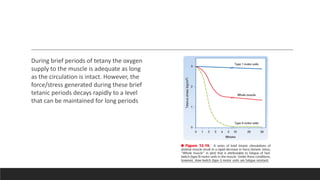
During brief periods of tetany the oxygen
supply to the muscle is adequate as long
as the circulation is intact. However, the
force/stress generated during these brief
tetanic periods decays rapidly to a level
that can be maintained for long periods
accumulation of Pi and lactic acid in the myoplasm accounts for muscle fatigue.
The accumulation of lactic acid, to levels as high as 15 to 26 mM, decreases myoplasmic pH
(from ≈7 to ≈6.2) and inhibits actin-myosin interactions.
decrease in pH reduces the sensitivity of the actinmyosin interaction to Ca++ by altering Ca++
binding to troponin C and by decreasing the maximum number of actin-myosin interactions.
Fast-twitch fi bers appear to be slightly more sensitive than slow-twitch muscle fi bers to the
effects of pH. Pi has also been implicated as an important factor in the development of fatigue
during intense exercise inasmuch as phosphate concentrations can increase from around 2 mM
at rest to nearly 40 mM in working muscle.
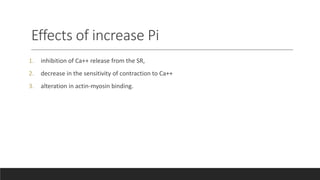
Effects of increase Pi
1. inhibition of Ca++ release from the SR,
2. decrease in the sensitivity of contraction to Ca++
3. alteration in actin-myosin binding.
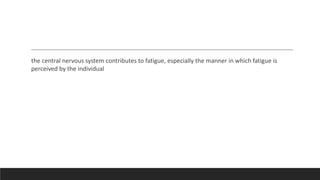
the central nervous system contributes to fatigue, especially the manner in which fatigue is
perceived by the individual
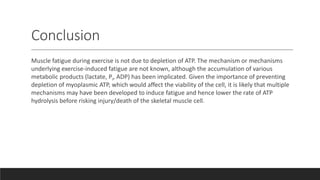
Conclusion
Muscle fatigue during exercise is not due to depletion of ATP. The mechanism or mechanisms
underlying exercise-induced fatigue are not known, although the accumulation of various
metabolic products (lactate, Pi, ADP) has been implicated. Given the importance of preventing
depletion of myoplasmic ATP, which would affect the viability of the cell, it is likely that multiple
mechanisms may have been developed to induce fatigue and hence lower the rate of ATP
hydrolysis before risking injury/death of the skeletal muscle cell.

Muscle fatigue physio.pptx

  • 1.
  • 2.
    Definition Muscle fatigue isthe decline in ability of a muscle to generate force. It can be a result of vigorous exercise but abnormal fatigue may be caused by barriers to or interference with the different stages of muscle contraction the inability to maintain a given exercise intensity resulting in a decrease in work or performance capacity
  • 3.
    During brief periodsof tetany the oxygen supply to the muscle is adequate as long as the circulation is intact. However, the force/stress generated during these brief tetanic periods decays rapidly to a level that can be maintained for long periods
  • 4.
    accumulation of Piand lactic acid in the myoplasm accounts for muscle fatigue. The accumulation of lactic acid, to levels as high as 15 to 26 mM, decreases myoplasmic pH (from ≈7 to ≈6.2) and inhibits actin-myosin interactions. decrease in pH reduces the sensitivity of the actinmyosin interaction to Ca++ by altering Ca++ binding to troponin C and by decreasing the maximum number of actin-myosin interactions.
  • 5.
    Fast-twitch fi bersappear to be slightly more sensitive than slow-twitch muscle fi bers to the effects of pH. Pi has also been implicated as an important factor in the development of fatigue during intense exercise inasmuch as phosphate concentrations can increase from around 2 mM at rest to nearly 40 mM in working muscle.
  • 6.
    Effects of increasePi 1. inhibition of Ca++ release from the SR, 2. decrease in the sensitivity of contraction to Ca++ 3. alteration in actin-myosin binding.
  • 9.
    the central nervoussystem contributes to fatigue, especially the manner in which fatigue is perceived by the individual
  • 10.
    Conclusion Muscle fatigue duringexercise is not due to depletion of ATP. The mechanism or mechanisms underlying exercise-induced fatigue are not known, although the accumulation of various metabolic products (lactate, Pi, ADP) has been implicated. Given the importance of preventing depletion of myoplasmic ATP, which would affect the viability of the cell, it is likely that multiple mechanisms may have been developed to induce fatigue and hence lower the rate of ATP hydrolysis before risking injury/death of the skeletal muscle cell.